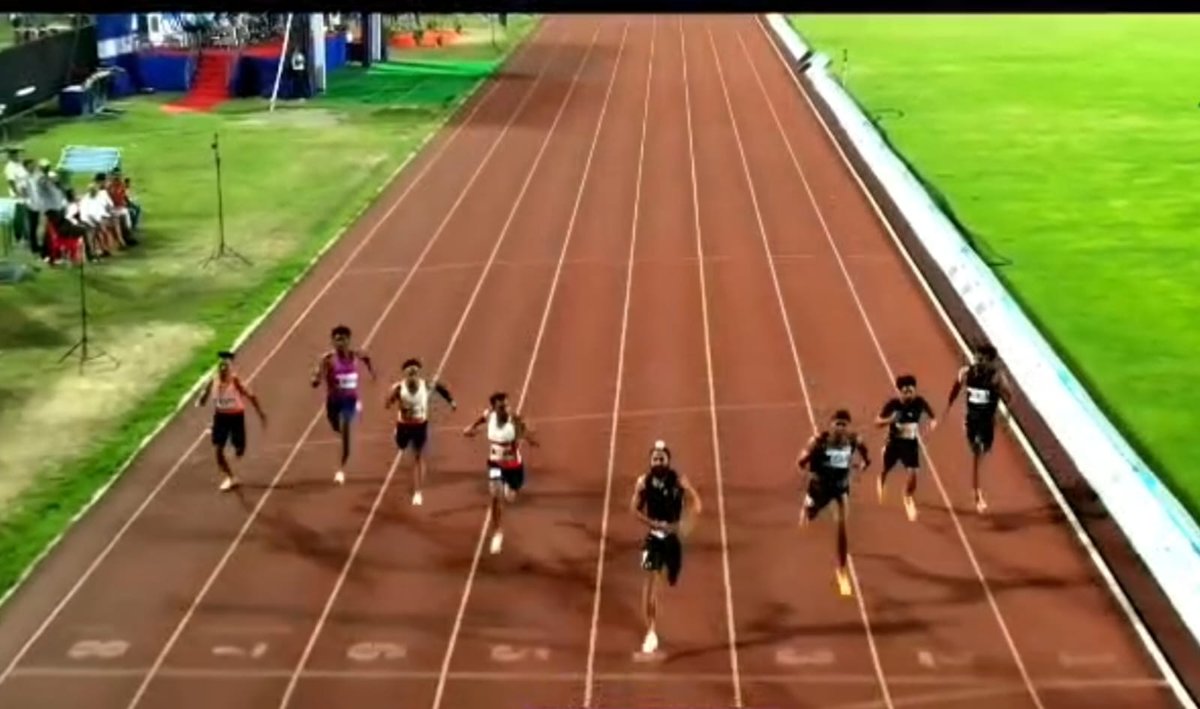
The idea of an all-new ‘Flying Sikh’ understandably captured headlines this past weekend.
And perhaps no event in athletics grips the world quite like the 100 metres sprint. The search for the world’s fastest human being.
As schoolchildren, we watched Jim Hines break the 10-second barrier at the 1968 Mexico Olympics. At the time, it was hard to imagine India ever entering that conversation.
Which is why the performances of Gurindervir Singh and Animesh Kujur feel so significant. They make us believe we do have what it takes to compete at the highest level.
India’s national record stood at 10.26 as recently as 2023. We have now moved to 10.09 in remarkably little time.
I checked on the net and found that Olympic finalists are typically in the 9.8–9.9 range.
World Championship semifinalists are often around 10.0–10.1.
And Asian/Commonwealth medal contention can happen around 10.0–10.15 depending on the field.
So Gurindervir is now operating at the edge of genuine international competitiveness.
(For perspective, let’s not forget that Su Bingtian of China ran 9.83 at the Tokyo Olympics semifinals in 2021.)
The final frontier, of course, is the mythical sub-10 barrier. One of sport’s rarest achievements.
A huge challenge still lies ahead.
But watching Gurindervir explode off the blocks and streak to the tape was exhilarating.
I’d like to start my week with that same momentum…🙂
#MondayMotivation
🚨📢 GURINDERVIR SINGH TAKES INDIAN SPRINTING BELOW 10.10s 🏃♂️🔥🔥🔥
Gurindervir Singh obliterated the 🇮🇳 100m National Record with a blazing 10.09s (+0.3 m/s) to shave a massive 0.06s off previous NR by Animesh Kujur and 0.08s off his own personal best!
Gurindervir seals the Commonwealth Games berth. Phenomenal performance and he's NOT DONE YET🔥
𝐓𝐇𝐄 𝐅𝐀𝐒𝐓𝐄𝐒𝐓 𝐌𝐀𝐍 𝐈𝐍 𝐈𝐍𝐃𝐈𝐀 𝐖𝐄𝐀𝐑𝐒 𝐖𝐇𝐈𝐓𝐄𝐒
Gurindervir Singh, Petty Officer of the #IndianNavy scripts history by setting a NEW NATIONAL RECORD in the 100m sprint with a sensational timing of 10.09 seconds at the ongoing 29th National Federation Cup Athletics Championships at Ranchi.
𝐖𝐢𝐭𝐡 𝐭𝐡𝐢𝐬 𝐫𝐞𝐦𝐚𝐫𝐤𝐚𝐛𝐥𝐞 𝐩𝐞𝐫𝐟𝐨𝐫𝐦𝐚𝐧𝐜𝐞, 𝐡𝐞 𝐡𝐚𝐬 𝐚𝐥𝐬𝐨 𝐪𝐮𝐚𝐥𝐢𝐟𝐢𝐞𝐝 𝐟𝐨𝐫 𝐭𝐡𝐞 #𝐀𝐬𝐢𝐚𝐧𝐆𝐚𝐦𝐞𝐬 𝐚𝐧𝐝 #𝐂𝐨𝐦𝐦𝐨𝐧𝐰𝐞𝐚𝐥𝐭𝐡𝐆𝐚𝐦𝐞𝐬 𝟐𝟎𝟐𝟔.
#IndianNavy salutes the spirit, speed and dedication of our champion sprinter.
Fair winds. Fast feet. 🇮🇳⚓️
#NationalRecord
#TeamIndia #AsianGames2026 #Glasgow2026
@afiindia@IndiaSports@SpokespersonMoD@YASMinistry
It’s interesting growing up and realizing that most adults are not very bright. I had my suspicions as a kid but I didn’t know that the situation was this serious.
Nvidia is worth $5 trillion, more than the entire economy of Japan. No company in history has ever been worth more. It was started in 1993 in a Denny's diner by three engineers who put $200 each on the table.
The CEO running it, Jensen Huang, grew up washing dishes at Denny's. He met two engineers at a booth in San Jose. Over cheap coffee, they started sketching out a company. Their plan was to build computer chips for video games, the kind that make 3D graphics look real on a screen.
That was the pond they thought they were swimming in. Video games. Still a small industry in 1993.
In 2006, Jensen made a decision that nearly killed the company. He started building software that turned his gaming chips into something more powerful. Scientists could now use them to do heavy math problems, the kind that used to require expensive supercomputers. Wall Street thought he was crazy. From 2006 to 2017, Nvidia spent close to $12 billion on this work while their revenue was only a few billion dollars a year. In 2014 alone, they put 30 cents of every dollar they made into research that was not paying off. Jensen later said it was the closest he ever came to killing his own company.
Six years later, in 2012, a team at the University of Toronto built a program called AlexNet that could look at a picture and tell you what was in it. They trained it in a grad student's bedroom using two of Jensen's gaming chips that cost $500 each. They entered a contest and beat every other team in the world. Almost no one noticed. But Jensen did. He started rebuilding the entire company around teaching computers to think, even though almost nobody wanted that yet.
Today, almost every AI in the world runs on Jensen's chips. In 2023, Larry Ellison, the founder of Oracle, said he and other tech CEOs had to spend an hour with Jensen at a sushi restaurant in Palo Alto, begging him for more chips.
Jensen on the early years: "I had no idea how to do it. None of us knew how to do anything."
The pond he thought he was swimming in was video games. The actual pond turned out to be every computer on the planet.
The Denny's booth where it all started has a plaque on it now. It reads: "The booth that launched a trillion-dollar company." That number is now five.
2004 was a good year, but your Gmail address doesn't need to be stuck in it.
To say goodbye to [email protected] or [email protected] (or whatever you were into at the time), go to your Google Account settings and choose any name available. You'll keep your old username and you can sign in with both.