Jennifer Doudna won the Nobel Prize for gene editing and went on Bloomberg to say the chatbots everyone is betting on cannot innovate at all. Every promise Silicon Valley is making about AI curing disease just hit the one person qualified to check it.
She has spent her whole career inside the actual frontier of curing disease.
So when she talks about what AI can and cannot do in biology, she is not guessing. She is reporting from inside the lab.
Her words were blunt. She is not seeing chatbots innovate. They summarize data. They write reports. They do not come up with a brand new idea nobody has ever had.
Then the interviewer pushed. So you're saying AI can't innovate?
Doudna did not flinch. She does not know if it can't. She just does not see it doing it right now.
This lands harder when you remember who is making the opposite case. Sam Altman says AI will eliminate disease within five years. Larry Ellison says AI will cure cancer in a 48 hour window.
An OpenAI executive even floated that the company should get a cut of sales on any drug discovered through ChatGPT. Doudna answered that in two words. Good luck.
Even the cancer specialists Altman is selling to keep warning that cancer is not one disease but hundreds, each needing its own cure, and that compute does not skip the years of lab work.
Her reason is simpler. Biology is hard. You cannot simulate your way to an understanding of the human body.
The people promising cures are the ones selling the tool.
The person who actually won a Nobel building them is telling you it has not happened yet.
Source: Bloomberg Originals
Watch the full video on their official channel.
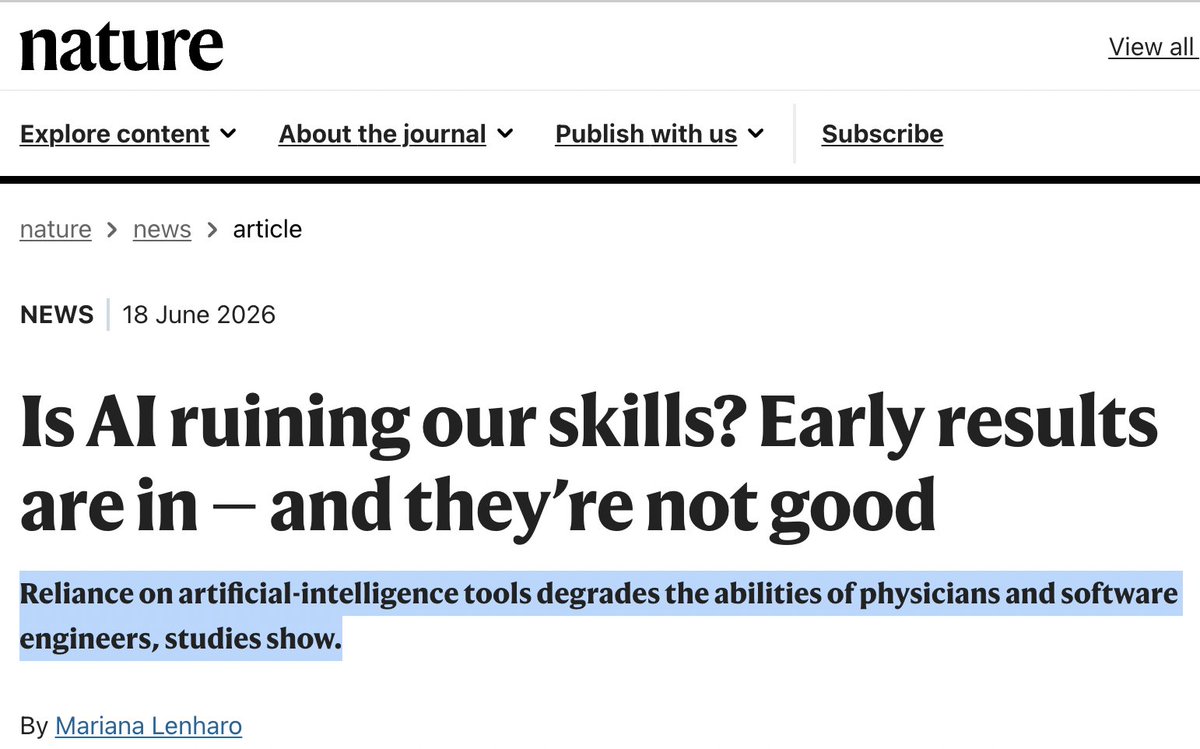
Studies suggests that reliance on AI tools degrades the abilities of physicians and software engineers:
The physicians, who had all performed at least 2,000 colonoscopies during their careers, were given access to an AI system that analyses colonoscopy images in real time and flags a type of precancerous intestinal lesion called an adenoma. The tool was available to the specialists on some days but not on others.
Once physicians began using it, their performance dropped significantly whenever the system was unavailable.
For the kind attention of the public please!
All through the night, I performed a post publication peer review of this IIT Roorke paper that claimed that it identified chemical components in cow urine that could highly efectively kill Chikungunya virus in lab conditions.
https://t.co/dFJ6x2eIqQ
There are serious concerns in the paper that mandate post publication Editorial Review from the Journal and Publication Integrity Office, and need for validation of findings... that could mandate a retraction as per COPE Guidelines. A document with all concerns explained has been emailed to:
🟡Professor (Dr) Thomas F. Hofmann
Editor-in-Chief
ACS Agricultural Science & Technology
🟡Copy to: Publication Integrity Office
ACS Publications, American Chemical Society
🟡Copy to: Professor (Dr) Laura McConnell
Deputy Editor, ACS Agricultural Science & Technology
🟡Copy to:William King, The Managing Editor American Chemical Society
A lay summary of major concerns are provided below:
🔴Possible areas of data fabrication, manipulation, and internal contradictions in the study claiming antiviral activity of cow urine distillate (CUD).
🔴Identical efficacy values reported for different experimental conditions, suggesting possible data duplication or carryover.
🔴Methodological flaws, including testing at cytotoxic concentrations, invalidating antiviral claims.
🔴Manipulation of synergy thresholds, using non-standard cut-offs to falsely claim synergism.
🔴Inconsistent and contradictory GC–MS datasets, with discrepancies in metabolite identification and absent compounds.
🔴Identification of synthetic pharmaceuticals, such as medroxyprogesterone, as natural metabolites, indicating contamination or misreporting.
🔴Implausible detection of prostaglandin A1, which is unstable and unlikely to survive high-temperature distillation.
🔴Lack of direct evidence linking identified metabolites to antiviral effects, with concentrations in CUD unverified.
🔴Cytotoxicity confounding viral inhibition results, with host cell death possibly causing false positives.
🔴Weak in silico and biochemical data, with docking scores and enzyme inhibition results unreliable.
🔴Structural inaccuracies in molecular docking, such as improbable hydrogen bonds.
🔴Statistical and analytical misrepresentations, including inappropriate synergy thresholds and wide variability without proper significance testing.
🔴Undeclared conflicts of interest, as funding sources and author affiliations favor traditional and cow-derived products.
🔴Numerous inconsistencies across figures and tables, including contradictory retention times and unlabelled peaks, undermining data credibility.
Requesting for action from the Journal
@ACSPublications@AmerChemSociety@ACSReactions
➡️Initiate an editorial review under ACS and COPE guidelines.
➡️Obtain raw data: plaque counts, cell viability, GC–MS spectra, and metabolite quantification.Verify compound identifications and concentrations with independent analysis.
➡️Reassess the validity of the claimed antiviral mechanism based on verified data.
➡️Reevaluate synergy analyses using standard criteria.
➡️Consider issuing an Expression of Concern pending investigation.
➡️If unresolved, proceed with retraction to protect scientific integrity and public health.
@Thatsregrettab1@MicrobiomDigest This paper might have helped a few cheaters associated with it with promotions, tenures, awards, and accolades. So, it's not just sitting and rotting for the past 10 years. It has probably done its job. The system is rotten and needs to be cleaned.
A man went to the hospital because something felt stuck in his throat. Doctors found an entire octopus lodged in his esophagus.
The 55-year-old attended Tan Tock Seng Hospital after vomiting and struggling to swallow following a seafood dinner.
A CT scan revealed a dense mass in his esophagus. An endoscopic examination confirmed what it was, a whole octopus lodged five centimetres from the border between his esophagus and stomach.
Doctors first attempted the standard "push technique," applying force to move the blockage down. It didn't work.
The octopus would not move, and applying more pressure risked rupturing the esophagus.
They then threaded the endoscope past the octopus into the stomach, reversed the camera, and used forceps to grab the octopus by the head and pull it back up and out.
Two days later the man was discharged. The case was published in a medical journal and later reported by the American Gastrointestinal Association, which is where the images originated.
@Spottingthespot Luckily, I mentioned all these tell tail signs in the 'Confidential comments to the Editor' section. Tbh, these stupid authors made no changes to the paper after the first round of review. I will keep an eye out in case this 🗑 gets published elsewhere and will 🚩 it on Pubpeer.
Final update: The EIC has rejected this manuscript. I am very confident that it was generated by a paper mill, and the other reviewer was also involved in helping it get published. Some tell tale signs were as follows: (1/3)
Update: I got the invitation to review the revised version of the manuscript today. It's even worse. I think I will ask the editor to reject it and not to re-consider it again or not to send it back to me for review.
4. Differences in chemicals used for synthesizing the materials across materials and methods section, figure legends, results, and SI.
I doubt that the handling editor was also involved in this scam. I'm not sure how to treat this problem on a larger scale.
1. Different names for the same microscope were mentioned across the manuscript,
2. p-values ~ 10^-8 at n=3 on an assay that is supposed to show variability,
3. Found materials in SI that had no relation with the manuscript indicating a copy-paste from some other source. (2/3)
A PhD's success depends more on the fit between the student, the advisor, and the lab than on the specific topic being studied (it barely matters at all).
Similarly, a lab's success depends more on how excited (or miserable) its researchers are than on the precise project they are working on (it could be virtually anything).
This information isn't in papers or in grant proposals, you have to ask the researchers.
Update: I got the invitation to review the revised version of the manuscript today. It's even worse. I think I will ask the editor to reject it and not to re-consider it again or not to send it back to me for review.
Earlier, I thought that just the authors and reviewers are corrupt, but this case indicates that the editors and the editorial office members are either illiterate or equally corrupt. I'm not sure what can I do now to stop this shit show 🤮 @Spottingthespot@Thatsregrettab1
@MicrobiomDigest@MuruLago@NonwayneWayne Wanted to mention one more thing, the turnaround times for revisions are crazy. For example, if I recommend a major revision, it always takes like a week for the authors to get back with a revised manuscript. This is so uncommon with legit publishing houses that care.
@MicrobiomDigest@MuruLago@NonwayneWayne I can understand this. I have reviewed around 10-15 manuscripts for mdpi: use of AI in writing, no disclosure of competing interests, poor experimental design, no/few replicates, no statistical tests, etc are common observations. Papers from special issues are most problematic.