This is the first time I've actually preferred with drive as Codex as main and Claude as secondary for an extended period of time. Amazing how good Sol 6.1 is!
This week's Azure update is up!
📽️ https://t.co/Z21GSAU2sc
📄 https://t.co/eiWH7s8Qfv
00:00 - Introduction
00:13 - New videos
00:49 - AKS bare metal on Ubuntu
01:43 - AKS Anyscale
02:23 - AKS NAT GW standardv2 default
03:00 - App Service Java 8,11 and 17 retirement
03:12 - ADE retirement
04:18 - Microsoft Dev Box retirement
04:52 - App GW WAF IPv6
05:20 - WAF exceptions
06:44 - API-M A365 integration
08:54 - PostgreSQL flexible in East US 3
09:06 - PostgreSQL Elastic major version upgrades
09:52 - Enabling the Bulk admin role for SQL Server on Linux
10:25 - PostgreSQL flexible & elastic Azure Backup support v2
11:39 - OneLake catalog table discovery
12:20 - SQL Server on Azure VM in Azure Bleu
12:41 - Azure HorizonDB additional regions
13:17 - Azure SQL DB always encrypted with Intel SGX enclaves retirement
13:41 - MAI Code 1.1 Flash local
15:56 - Close
#azure #cloud #microsoft #cloudcomputing #microsoftazure #azurecloud #azureadministrator #azurearchitect #microsoftcloud #azureupdate
Scale cloud native workloads in Azure Linux. In this episode of #AzureFriday, @shanselman and Poorvi Narang explore Azure Linux across WSL, Azure VMs, and AKS, plus its minimal footprint, built-in securities, and Azure Linux 4.0.
Watch now: https://t.co/aiVxK02UE2
PerformanceMonitor 3.10.0 is out now. Free.
The web dashboard gets FinOps, job history, mute rules, and query plans and deadlock graphs right from the grids. One time picker everywhere: type "last 3 days" and go.
https://t.co/DmoRBuyqsP
We're excited to have Aater Suleman, Co-founder of Vixul, Hannah Marlowe, Senior Director of AI Forward Deployed Engineering at Databricks, and Dan Maloney, CEO of LandingAI, joining the panel "Secure AI Needs Forward Deployed Engineers" at the Agentic AI Conference! 🎙️
Secure, compliant AI doesn't happen through principles sent to an organization. It happens through people embedded in it. Vendors ship guardrails, threat models, and compliance checklists. Enterprises run legacy systems, unique risk appetites, and their own approval processes.
Somebody has to turn one into the other, and increasingly that somebody is a forward deployed engineer. It's why the role keeps appearing at the biggest names in enterprise AI.
Together, our panelists will dig into how FDEs translate security and compliance requirements into real-world deployments, what the job demands day to day, and whether it can scale. Expect a candid debate on whether forward deployed engineering is here to stay, or a stopgap until the tooling catches up.
📅 November 9–10, 2026 | 9 AM – 2 PM PT | Virtual
🔗 Register now to save your spot: https://t.co/7BX8lCSH1r
#datasciencedojo #agenticaiconference #futureofdataandai
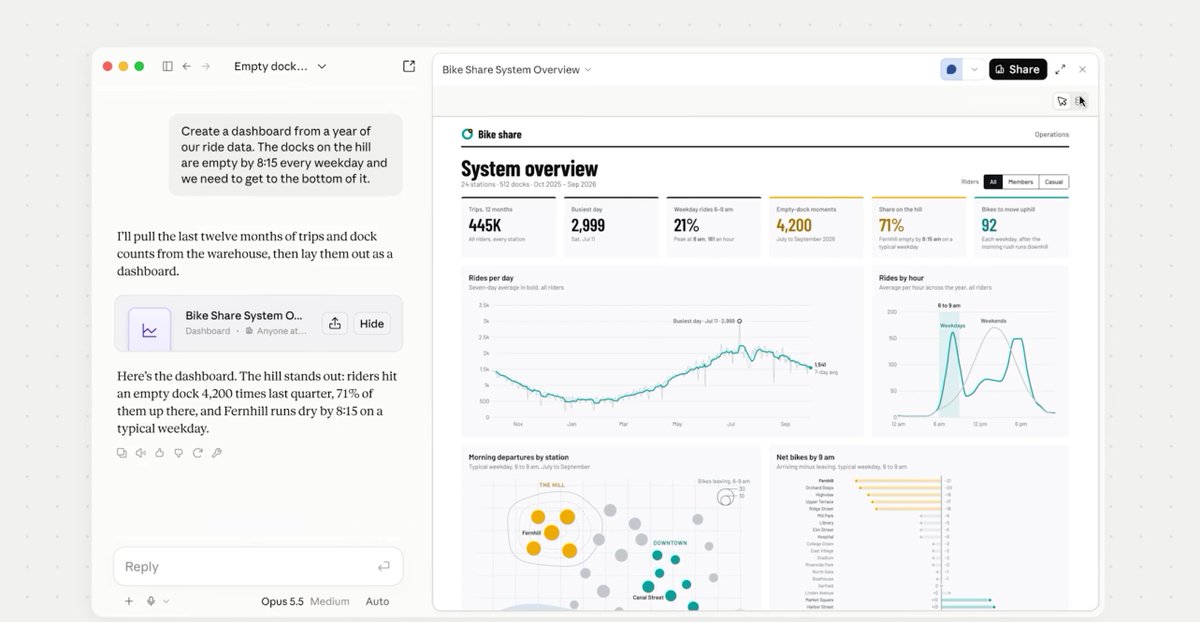
it's built on top of Claude Managed Agents, doing code generation in the cloud sandbo, using Sonnet 5.5 each run costs ~$0.75
you can try it yourself here: https://t.co/Q2zzOYeX9k
whoops I hit send and went to a meeting, didn't realize the repo wasnt public- it is now!
it's a chrome extension I use every day now https://t.co/OroAeTafj0
My agents don't need me to introduce them.
One asked, "who's out there?" across 2 machines. Claude Code and Codex sessions replied.
Then two got the same repo on different machines. They split the work, swapped code, and one caught the other's bug.
0 messages from me.
How: The agents run as @omnigent_ai sessions on both machines. I added a small relay, so any session can list the others and message them directly.
No orchestrator in the middle. No shared memory.
Great to be with 700+ @googlecloud customers at the historic NASA Hangar One for Gemini at Work!
Today, we introduced the new Gemini agent, a single, universal agent for work that has all of your business context and answers your questions, handles your knowledge work, creates your images and media, and writes and runs code - all from a single prompt box. It is connected to your personal workflows, your systems of record, and your enterprise controls.
It’s built around a few core architectural principles:
Unified Agent: Gemini can answer questions, do knowledge work and generate code from a single prompt box.
Access: Gemini is web-based and can be accessed from any device and integrated into third-party applications. It can also operate without a dedicated user interface.
Persistent Execution: It runs in the cloud, which means it maintains a single set of memories, context and one personalization graph no matter where you access it.
Multi-Agent Orchestration: Gemini can create sub-agents to tackle multi-step tasks and can also act as a coworker agent with a defined role and its own dedicated identity
Context: Gemini knows your tools, data, and work history and learns how you work the more you use it.
Model Choice Flexibility: It orchestrates across multiple models to deliver optimal quality and lower your costs.
Read more in our blog: https://t.co/bd1ekBR74Q
I appreciate seeing research focused on making complex AI systems easier to develop and improve.
Our Microsoft Research team is sharing new work through Agent Lightning v1.0: https://t.co/JxzIK05VHA
What happens when a SQL expert @bobwardms takes on the ultimate SQL trivia challenge?
Turns out, even the experts get stumped.
Check out the latest learning certification, DP-800 and ramp up on your SQL skills: https://t.co/4vAZIjOEEE
#SQL#AzureSQL#SQLConEU
I built Markdoc with @GitHub Copilot.
Edit markdown collaboratively like Google docs. MCP server to bring your agent.
No planning at all. Just Fable doing what it thinks is best. Some steering from me, but mostly right off the top of Fable's brain.
https://t.co/KW3lt0Cm7e
volume does matter
look, i get it. if you were an engineer before agents came along, you're rightfully skeptical about lines of code and number of PRs being used as a metric for any kind of productivity. and i agree! or at least, i used to. for ease of explanation i will talk about this from the perspective as being an engineer on a large team of at least 50.
volume didn't matter before because we focused on impact. you could have high impact even with a few PRs: for example you could make a one line config change and save the company millions of dollars.
but before agents, the times where i saw volume come into the conversation were for the outliers. on the negative end you might have someone who is struggling to perform, on the other end you might have someone who was a "coding machine" archetype. a coding machine was someone who could just lock themselves in a room and emerge with a stack of PRs that solve a huge number of problems. so volume did matter, but only at the tail ends of the distribution, and combined with impact.
if you've ever worked at a large tech company before, you'll get what i mean. the thing about agents is that big tech co problems are now small-medium co problems as well.
how do agents change this calculus? well, everyone now has the ability to become a coding machine. you have incredibly capable frontier models that can write code better than any of us, at a rate much faster than we can. in this world, if you're still producing the same number of PRs as before, why wouldn't you pause to wonder why you're not being more productive? alien intelligence is here, and yet you can't outship a human coding machine?
this brings me back to why i keep talking about trust (https://t.co/7fzYZV8LGH). if you haven't put in the work to trust your agent's output, it is very difficult to scale up your productivity.
and yes, this approach does require more tokens, but i think about this in terms of cost per intelligence. before agents, this cost was very high - you needed to hire many software engineers with high 6 figure salaries to do the work. tokens are still expensive today, but are likely to get cheaper over time (https://t.co/gTBZx7pl14) factoring in the cost of intelligence. what looks exorbitant today will likely be affordable in 6 moths to a year. a single engineer with agents can do the work of tens if not hundreds of engineers, at a fraction of the cost.
the reality that i don't think has hit yet is that job of the software engineer has truly changed. our job is not merely to produce software any longer (well tbh it was never only about the code, but bear with me for the sake of the explanation), but the machine that writes the software. this idea of a software factory, or a Michelin kitchen as i like to call it, is still a topic of research. and it's the type of stuff i like to share, not to flex, but to show you what's possible when you put a lot of rigor into using agents at scale
I saw this coming a mile away — and, frankly, I took plenty of grief for saying it.
PwC’s UK revenues falling for the first time in more than two decades is being framed as a demand issue, a market issue, a Middle East issue, an AI issue, a staffing issue. Pick your excuse.
But the big consulting firms don’t have a demand problem. They don’t have a revenue problem. They have a leadership problem.
They don’t understand their own market. They don’t understand what clients actually need right now. And instead of adapting, they’re running around playing the blame game.
Get a clue, guys. It’s not that hard.
I started and sold two consulting firms, and I honestly don’t understand how firms with this much brand equity, market access, talent, and momentum are managing to screw this up.
Clients still need help. The market still needs expertise. Enterprises are still struggling with cloud, AI, architecture, data, security, cost optimization, and modernization. The demand is there.
What’s missing is leadership that can translate that demand into value clients are actually willing to buy.
Maybe someone can explain that to the partners.
Article: https://t.co/bO2oSneCPw
Haiku 5.5 is now available in the Claude Platform and Claude Code. On average, it costs around 75% less to run than Haiku 4.5.
It pairs well with Opus 5.5 or Sonnet 5.5 as a subagent. Use it for high-volume, cost-sensitive tasks like summaries, compactions, or database queries.