Actually helping someone often means direct engagement.
But people would rather look away, transfer the money, and forget about it.
If AI creates mass unemployment, this is the part of the solution where we don't have the answers.
When you visit the apartment of someone on long-term disability, you realise the UBI debate is missing something.
Money is only a small part of the equation. The harder problem is helping someone build a life worth living.
In the Norwegian fairy tale Soria Moria, the protagonist Halvor sees a shining castle far away. After seeing it, he can't live an ordinary life anymore.
I think this is the best (only?) fairy tale about vision. Its called vision because it's a kind of seeing.
You can see something that doesn't exist yet, something you can't arrive at through reason.
That's what founders do, they move toward what they've seen, and that is why you can have high confidence that something can exist, even though it isnt real yet, because youve seen it.
One of the great mistakes of my life, was that I literally took a ten year break from startups in service of normality. And tbh there was no pot of gold at the end of that quest. I am strange, and I can contribute much more in the ways I’m weird than in the ways I’m not.
In Norwegian fairy tales, the hero is often Espen Askeladd. Humble, optimistic, naive, and ready for adventure. He represents humble improvisation, creativity, and simplicity. I think its such a great example for founders.
The Universal High Income debate is missing a piece.
As someone who's tried to work this out in the Norwegian government and Nomad Citizen. If the number is high, universal high income doesn't work.
Either the amount is low, or the tax rate very quickly becomes impossible. This base math doesnt get cancelled at higher level of productivity.
Universal HIGH INCOME via checks issued by the Federal government is the best way to deal with unemployment caused by AI.
AI/robotics will produce goods & services far in excess of the increase in the money supply, so there will not be inflation.
Weird history of modern regulation: We think agencies, directorates, and departments are a natural part of government.
But this intermediate layer of rule making didn't exist in the West before the 1960s, it was imported by soviet style directorates.
Since then, these directorates have been given huge mandates to make rules without lawmakers, and we've created huge amounts of regulatory texts as a consequence.
Simplifying these regulations, and maybe even bringing lawmaking back under the authority of parliament/congress is a great AI use-case. AI won't solve consensus building, but it can simplify the rules we already have.
A startup mistake I made so you don't have to:
In the early days of Superside, we were a hot company out of YC, we had a red carpet rollout, were given the option to choose valuation ourselves, and thought higher the valuation = better. That turned out to be a mistake.
Next round, we had great trajectory, but we weren't able to raise because investors priced us like a Series A when we didnt hit Series A milestones. It took us years to recover.
The lesson I took was to ignore outlier rounds you see. Instead look at the median valuations. The median data is available. You can make slight adjustments if you are over/under on revenue/growth relative to median.
This way you get a reasonable price, can close all rounds with more certainty, all your investors get a good deal so you build relationships over time, and the next round becomes way easier.
@KatieMiller@elonmusk The nonprofit is an owner of the company. It still is to this day. This is commonplace. You may investigate the accounting question on how value was moved into the company, but there is no foundational question here about "converting nonprofits to corporations"
Three days ago I left autoresearch tuning nanochat for ~2 days on depth=12 model. It found ~20 changes that improved the validation loss. I tested these changes yesterday and all of them were additive and transferred to larger (depth=24) models. Stacking up all of these changes, today I measured that the leaderboard's "Time to GPT-2" drops from 2.02 hours to 1.80 hours (~11% improvement), this will be the new leaderboard entry. So yes, these are real improvements and they make an actual difference. I am mildly surprised that my very first naive attempt already worked this well on top of what I thought was already a fairly manually well-tuned project.
This is a first for me because I am very used to doing the iterative optimization of neural network training manually. You come up with ideas, you implement them, you check if they work (better validation loss), you come up with new ideas based on that, you read some papers for inspiration, etc etc. This is the bread and butter of what I do daily for 2 decades. Seeing the agent do this entire workflow end-to-end and all by itself as it worked through approx. 700 changes autonomously is wild. It really looked at the sequence of results of experiments and used that to plan the next ones. It's not novel, ground-breaking "research" (yet), but all the adjustments are "real", I didn't find them manually previously, and they stack up and actually improved nanochat. Among the bigger things e.g.:
- It noticed an oversight that my parameterless QKnorm didn't have a scaler multiplier attached, so my attention was too diffuse. The agent found multipliers to sharpen it, pointing to future work.
- It found that the Value Embeddings really like regularization and I wasn't applying any (oops).
- It found that my banded attention was too conservative (i forgot to tune it).
- It found that AdamW betas were all messed up.
- It tuned the weight decay schedule.
- It tuned the network initialization.
This is on top of all the tuning I've already done over a good amount of time. The exact commit is here, from this "round 1" of autoresearch. I am going to kick off "round 2", and in parallel I am looking at how multiple agents can collaborate to unlock parallelism.
https://t.co/WAz8aIztKT
All LLM frontier labs will do this. It's the final boss battle. It's a lot more complex at scale of course - you don't just have a single train. py file to tune. But doing it is "just engineering" and it's going to work. You spin up a swarm of agents, you have them collaborate to tune smaller models, you promote the most promising ideas to increasingly larger scales, and humans (optionally) contribute on the edges.
And more generally, *any* metric you care about that is reasonably efficient to evaluate (or that has more efficient proxy metrics such as training a smaller network) can be autoresearched by an agent swarm. It's worth thinking about whether your problem falls into this bucket too.
Solve poverty and you get idleness.
My great-great-grandfather had 6 kids and a farm when he lost his wife at 30. No time for despair when you have that much to do.
People describe the big problem in our time is lack of economic opportunity, we're living in an age of abundance, the real problem we have is idleness.
On the contrary, the time that used to go to reflection has been eaten by social media. On the margin, you probably do way too little real reflection nowadays
Local government is like an appendix in governance history. It was never intended.
After the American Revolution everyone copied the Constitution into each municipality.
But many towns don’t have enough people to support that structure. You get a loose checks and balances system where no one is paying attention - ripe with corruption and poor management.
This is the age of building new cities. Digital nomads are the first target audience: the most mobile early adopter segment of society, almost mobile by identity.
@gmcbhutan love your project, would love to chat if we can participate!
Bhutan has announced a landmark Bitcoin Development Pledge, committing up to 10,000 BTC (≈ USD 1B) to support the long-term development of Gelephu Mindfulness City (GMC).
Guided by the vision of His Majesty King Jigme Khesar Namgyel Wangchuck, the pledge reflects a values-led, responsible approach to using digital assets for national resilience, jobs, and youth opportunity.
Read more: https://t.co/ShtGawn40F
@fgenstart I agree, I suppose there is a worry you are giving people a peak into your subconcious and might share something you yourself did not even understand
@simixn Great, I actually did not know. That said, Norway still has it, and where i now live in California just a proposal of one is causing capital flight, so highly relevant still
This is the death throes of large welfare states in 2026.
I was so motivated to stay a tax resident in Norway that I paid the wealth tax out of pure nostalgia and loyalty (I lived in the US). With an early stage startup, that was not liquid, my accountant eventually gave me the choice between bankruptcy and leaving back in 2019.
And when the damage is done, it isnt easy to reverse. People will move, buy a house, and settle down a new place. They're not going to move back. You're going to miss a generation of entrepreneurs, and reduced long-term growth.
NETHERLANDS HOUSE PASSES 36% TAX ON UNREALIZED GAINS
As expected, the Dutch House of Representatives has approved a 36% tax on unrealized capital gains, with only forward loss offsets permitted.
The proposal now moves to the Senate, where parties that supported the bill also hold a majority, making final approval likely.
Critics warn the measure could disrupt long term investment strategies, weaken compounding effects, and encourage capital outflows.
Several right leaning parties had publicly criticized the proposal in advance, but most ultimately voted in favor, citing fiscal constraints and the cost of delaying or revising the plan, stating "we don't like it either but we have to".
Dubai is the shining city in the desert.
It is incredibly unique, and a symbol of ambition that draws people from across the Middle East.
It will bounce back from this because of its optimism and willingness to build.
100% guaranteed.
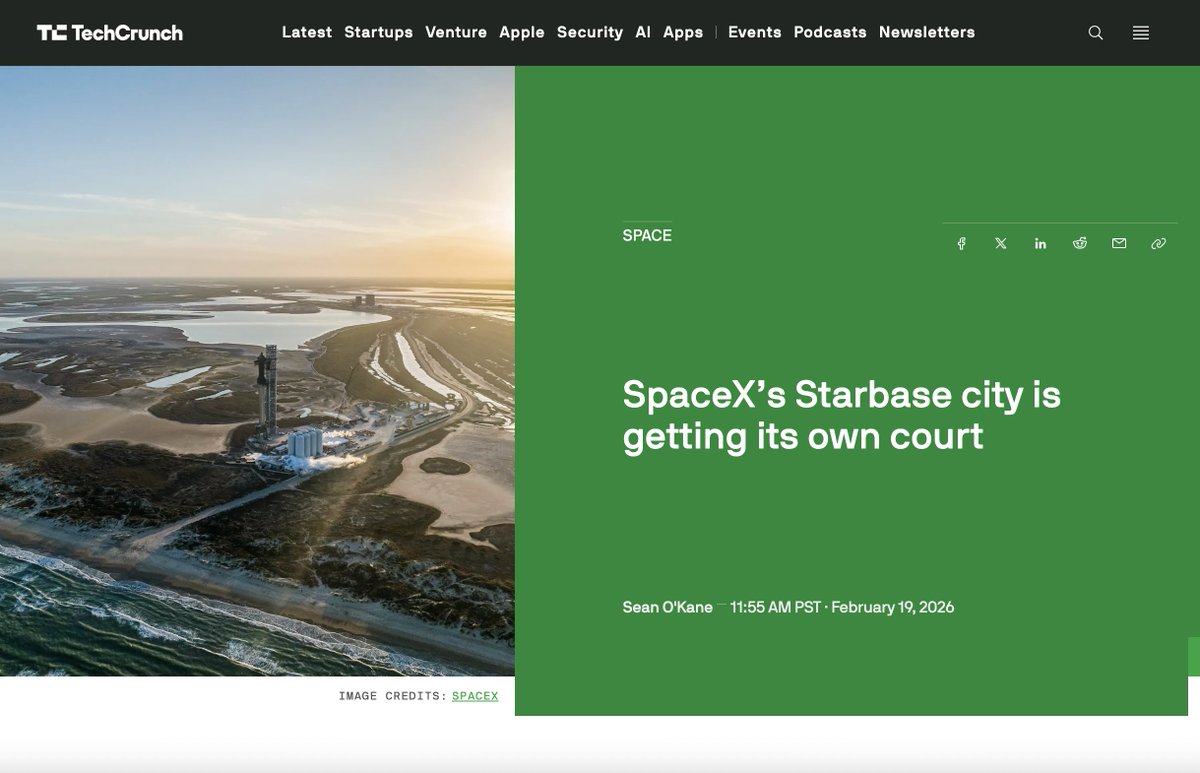
In a real company town there are benefits no local government can match.
If the town is run by SpaceX or Google, the friction of living there goes down.
A lot of people, if they are being honest, don’t care about ideology in local politics. They care if roads are maintained, electricity is flowing, and service quality is high.
People are perfectly fine with their community run by a company if it’s run excellently.