Your gaming PC can now serve frontier models at interactive speed using official checkpoints without extreme quantization!
Qwen3.6 35B → 8GB RTX 4060 laptop @ 39 tok/s
DeepSeek-V4-Flash 284B → RTX 5090 desktop @ 22-25 tok/s
GLM-5.2 753B → RTX PRO 6000 workstation @ 15 tok/s
Run your claude code or codex now with frontier model for $0
Meet FreeToken 🧵
“AI, what color do I get from mixing black and white?”
Why do people turn to AI for simple tasks that they could easily do themselves?
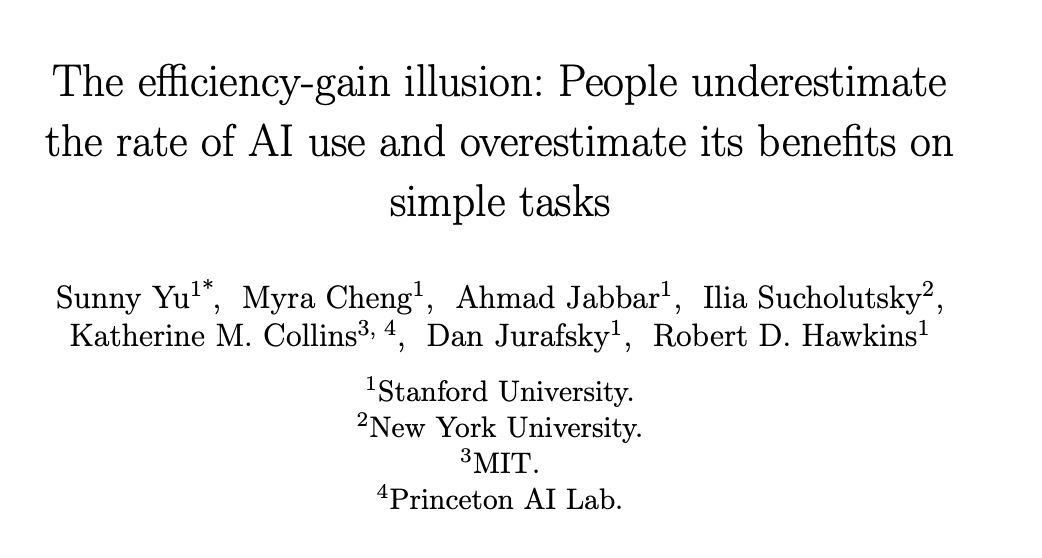
In our new preprint (also to appear at CogSci 2026!), we investigate the mechanisms and dangers of people over-using AI on easy tasks.
JEPA are finally easy to train end-to-end without any tricks!
Excited to introduce LeWorldModel: a stable, end-to-end JEPA that learns world models directly from pixels, no heuristics.
15M params, 1 GPU, and full planning <1 second.
📑: https://t.co/cpTzgvbTS0
Today marks 10 years since we released SqueezeNet.
It matched AlexNet accuracy with 𝟱𝟬× 𝗳𝗲𝘄𝗲𝗿 𝗽𝗮𝗿𝗮𝗺𝗲𝘁𝗲𝗿𝘀 and could be compressed to 𝗵𝗮𝗹𝗳 𝗮 𝗺𝗲𝗴𝗮𝗯𝘆𝘁𝗲.
https://t.co/LOQsSRCsRy
Most music AI happens behind closed doors. We're changing that
LAION is launching SongRater — an open platform to crowdsource music perception data 💙
Listen to clips, share your reactions,and help create the world’s largest openly annotated music dataset
https://t.co/TGVxgUrYat
2/2 Instead of directly modeling the waveform, we train a so-called codec to compress it to something LLM-friendly, model that, and then decode back.
The full article, with more fancy animations: https://t.co/49XksMEF5Z
DLLMs seem promising... but parallel generation is not always possible
Diffusion-based LLMs can generate many tokens at different positions at once, while most autoregressive LLMs generate tokens one by one.
This makes diffusion-based LLMs highly attractive when we need fast generation with less compute.
A big question is … is parallel generation possible without losing modeling accuracy?
The answer is no. There are fundamental limits on how much parallelism we can achieve.
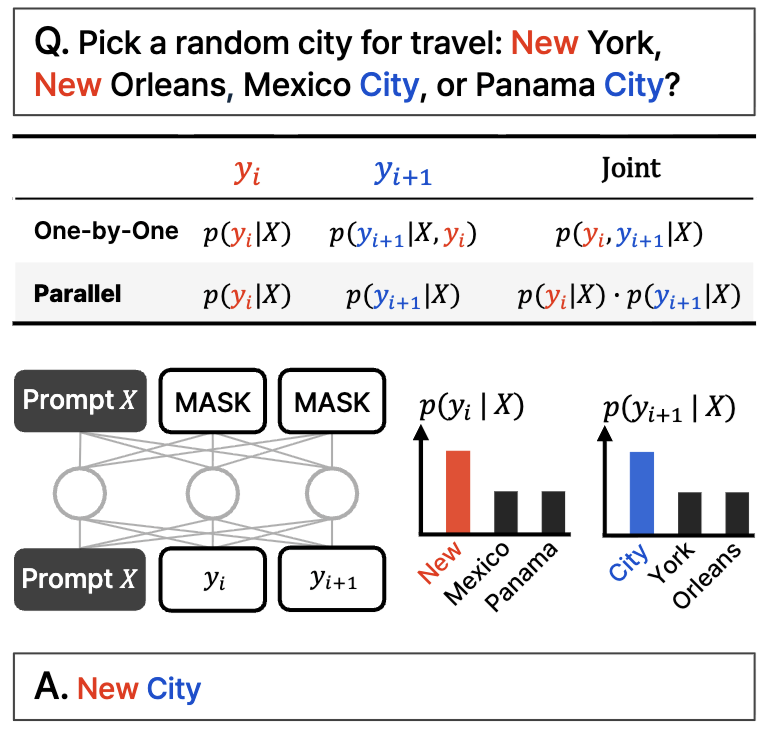
Consider this example:
“Pick one city uniformly at random from the following four cities:
New York, New Orleans, Mexico City, or Panama City.”
Then,
P(Y₁ = New, Y₂ = York) = 1/4,
P(Y₁ = New, Y₂ = Orleans) = 1/4, and so on.
Thus, P(Y₁ = New) = 1/2, P(Y₂ = City) = 1/2.
If you choose to generate Y₁ and Y₂ in parallel, no matter which decoding algorithm you use …
You’re doomed to sample “New City.”
None of today’s DLLMs can generate these two words correctly without giving up parallelism.
-----
Why is this the case?
In fact, we never train LLMs to learn the joint distribution over multiple tokens in one forward iteration.
We always teach a single-token marginal distribution conditioned on context.
(The same holds for autoregressive models too.)
Therefore, sampling multiple tokens at once is only possible when those tokens are mutually independent given the current context.
And this limitation of parallel sampling can be precisely formalized.
One can derive an information-theoretic limit that’s decoding-strategy agnostic, and also derive strategy-specific limits.
-----
So are DLLMs doomed? No!
They have huge potential to save compute and time.
But:
(1) we need to be aware of their fundamental limitations, and
(2) we need to design better training and decoding strategies.
In particular, there’s huge room for improvement in decoding.
Why?
Ideally, we want the model to control the degree of parallelism during generation.
At the same time, it should choose a subset of future tokens that are almost mutually independent given the current context.
Are current decoding strategies good at this?
Hard to tell.
Most DLLMs were never stress-tested for it.
-----
That’s why we introduced a synthetic benchmark to stress-test DLLMs.
We call it ParallelBench.
The idea is simple: these are natural language tasks, but carefully designed so that parallel generation is inherently difficult.
(Think “New City”, but more natural, real tasks.)
What did we find?
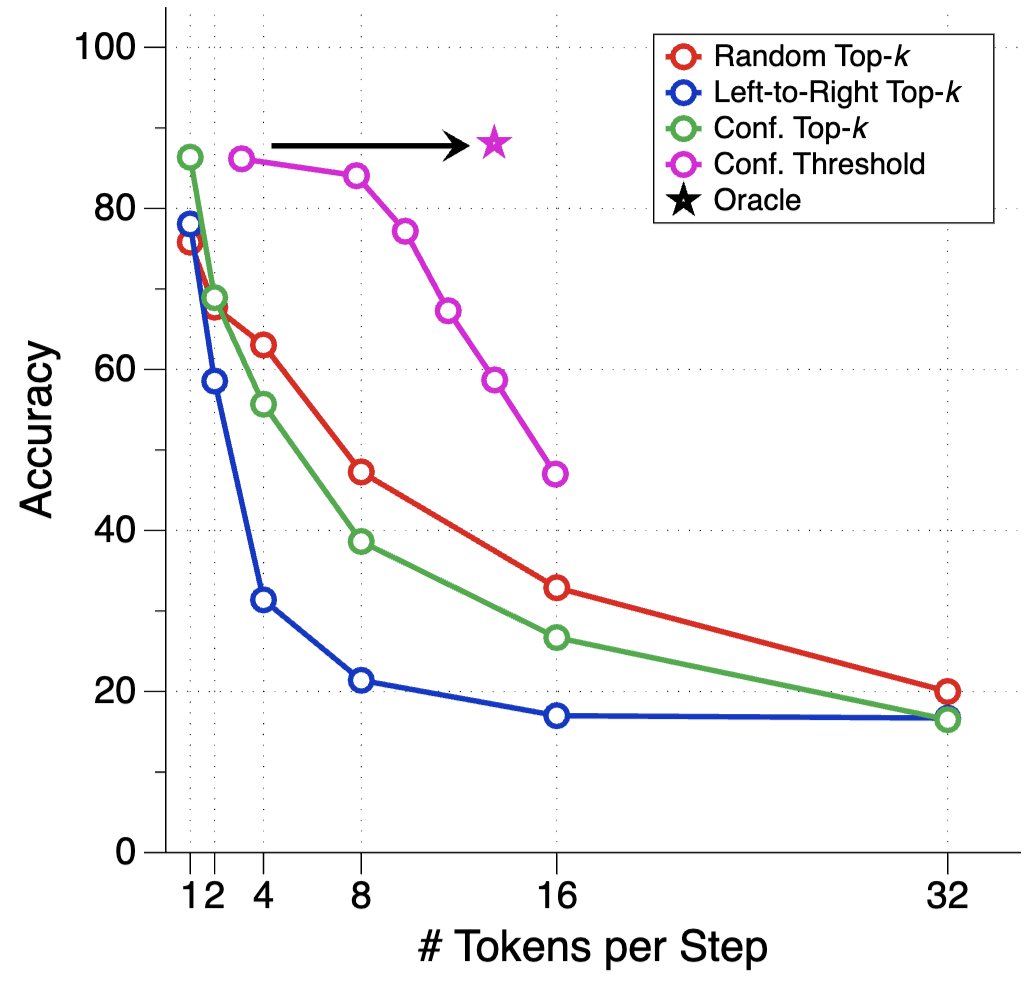
We tested popular DLLMs with various decoding algorithms, and none came close to “oracle” performance, the ideal performance you’d get if the model could optimally adjust its parallelism during decoding.
-----
Takeaway:
(1) Parallel generation is not always possible and check out our paper for more details :)
(2) If you can design a DLLM that matches oracle performance on our benchmark, well, who knows, you might just get a call from someone in Menlo Park. 😉
For years, we've been saying that bigger isn't always better for AI and that smaller specialized models are usually faster, cheaper and more accurate for your specific constraints.
So super happy to release the long-overdue capability of finding the best model based on size on @huggingface! It took us a bit more time than expected to release because we needed to wait for safetensors & GGUF to become ubiquitous to do it easily but it's now live.
Time for you to stop listening to AI influencers and find the best model (small or large) for you and your use-case!
A real-time object detector much faster and accurate than YOLO with Apache 2.0 license just landed to @huggingface transformers 🔥
D-FINE is the sota real-time object detector that runs on T4 (free Colab) 🤩
Keep reading for the paper explainer, notebooks & demo 👀
@GrigoryEvko Lot's of hosted models at https://t.co/RvgLLPWQ4y, and a public pip package coming soon! (that particular viz is only in my local dev version, also coming soon...)
Today OpenAI announced o3, its next-gen reasoning model. We've worked with OpenAI to test it on ARC-AGI, and we believe it represents a significant breakthrough in getting AI to adapt to novel tasks.
It scores 75.7% on the semi-private eval in low-compute mode (for $20 per task in compute ) and 87.5% in high-compute mode (thousands of $ per task). It's very expensive, but it's not just brute -- these capabilities are new territory and they demand serious scientific attention.
We are announcing that PyTorch will stop publishing Anaconda packages on PyTorch’s official anaconda channels. For more information, please refer to the following post on dev-discuss: https://t.co/6gyNQ6Q8JP
I made some visual aids about modular duality for a workshop presentation and I wanted to share them here too.
First, vanilla gradient descent does not type check! Gradients have the right units to dot product with weights but not to subtract from weights.
(1/4)
Today at 4:30p at #ECCV2024 in Milan, I'll present EgoPet, the first large collection of egocentric videos from animals' perspective! If you're curious about what we can learn from animals, come to poster #92!
Project Website: https://t.co/icVrX0OzeT
I published a small blurb about some very tiny timm test vision models I've recently shared on the @huggingface Hub. These are not 'smol' in the 'here's a 100+M to 1B param LM' sense, but small in the 200K to 1M param way, so *really* small. https://t.co/gviKOlSiOJ
hacked bitnet for finetuning, ended up with a 74mb file. It talks fine at 198 tokens per second on just 1 cpu core. Basically witchcraft.
opensourcing later via @skunkworks_ai base here: https://t.co/n4iddFDMSl