Kind attention, folks. Prem's account has been hacked. It's not like him to buy a car like this one and brag about it here. He has asked me to post a warning here. Kindly RT for reach.
@nixxin ➕ on Miten
Extremely sharp, straight shooter, and focused, as I discovered during my recent meeting with him. CRED is definitely in safe hands.
@krishnabgowda
The whole of Bengaluru will support you in your efforts to fix the city, as those who truly love the city are eager to see this change for future generations.
I grew up on Bangalore’s Brunton Cross Road.
I still live on the same road.
When I first came here as a 15-year-old beginning college in 1966, it was one of the most beautiful streets in the city. Tree-lined, shaded, peaceful. Bungalows stood amid gardens. There were pavements one could actually walk on. It was a residential neighbourhood, not a traffic corridor.
Today, almost every bungalow has disappeared, replaced by apartment blocks. The gardens are gone. The road has become a two-way thoroughfare carrying a relentless stream of vehicles. What was once a neighbourhood has become an artery.
The photographs below tell the rest of the story.
Broken pavements. Open drains. Excavated roads. Construction debris left strewn about. Garbage accumulating around work sites. Hazardous walkways. Traffic forced through improvised bottlenecks. Senior citizens pick their way through rubble simply to cross the street.
For more than a year, the authorities have ostensibly been repairing the road and drainage infrastructure. Yet the result has been months of disruption, chaos and inconvenience with little visible evidence of systematic planning or timely execution.
The issue is not that roads need repair. Every city requires maintenance. The issue is how it is done.
Why are roads dug up and left exposed for weeks and months? Why are drains left uncovered? Why are pedestrians treated as an afterthought? Why are debris allowed to remain on public land? Why are traffic diversions so poorly managed? Why is there no visible sense of sequencing, coordination or accountability?
These are not problems of poverty.
They are problems of governance.
India’s urban crisis is often discussed in terms of infrastructure deficits, but what I see outside my own front gate is something more basic: a deficit of civic management.
We build flyovers, metro lines and technology parks, yet struggle to maintain a pavement.
We speak of becoming a developed country, yet tolerate public spaces that would be unacceptable in much poorer societies.
This is why comments from outsiders such as Peter Thiel, however provocative, sometimes strike a nerve. When he describes India as “messed-up”, many of us instinctively object. Yet standing on Brunton Cross Road amid broken concrete, open trenches and unregulated traffic, one cannot entirely dismiss the criticism.
The uncomfortable truth is that our cities often function despite the system rather than because of it.
What is especially frustrating is that the solutions are neither revolutionary nor prohibitively expensive.
Road projects should be coordinated and completed within fixed timelines.
Pavements should be continuous, safe and accessible.
Residential roads should be protected from becoming uncontrolled traffic corridors.
Traffic rules should be enforced.
Construction waste should be removed immediately.
Public infrastructure should be maintained before it collapses rather than repaired after it does.
Most importantly, citizens should not have to negotiate danger merely to walk down their own street.
The decline of roads like Brunton Cross Road is not simply about nostalgia for a vanished Bangalore. Cities change. Growth is inevitable.
But growth without planning produces disorder. Development without civic discipline produces dysfunction.
A city is not measured only by the value of its real estate, the number of its startups, or the sophistication of its technology sector. It is measured by the quality of everyday life it offers its residents.
Bangalore still possesses extraordinary strengths: talent, enterprise, creativity, greenery and a climate most cities would envy.
What it increasingly lacks is the orderly civic management that allows those strengths to flourish.
Looking at these scenes outside my home, I cannot help but wonder: when did we begin to accept disorder as normal?
And more importantly, when will we decide that we deserve better? #Bengaluru #UrbanIndia #CityPlanning
If you have been in Bangalore since a few years, you must have observed the changing climate and reducing green cover in the city.
Many streets in Koramangala and HSR are still so densely green and breezy that one enjoys just walking there without any purpose.
Thanks to the previous generations of Bangaloreans who planted these trees.
Now it's our time to act!
On 27th June, a tree planting drive is being conducted where you will not only get to plant trees, but will also be given refreshments, snacks, etc.
Let's join hands and make the city greener!
Details in next tweet ⬇️
"My cholesterol is normal. How did I get a heart attack?"
This is one of the commonest questions I hear from patients.
The answer may explain why Indians develop heart disease 5-10 years earlier than many Western populations.
A thread. Repost for wider reach and bookmark for future reference.
1/n
I was using Fable to improve security for my apps and when it suddenly stopped working. It's only on twitter that I found out that it has been stopped for people who are not US nationals, by the US government. Here's how I'm seeing this:
1. Fable comes with security safeguards to prevent misuse, and can be used to plug security loopholes. I've seen it identify and plug security issues in my apps. The US government refusing to let non-US nationals protect themselves is deeply problematic in an interconnected internet world, especially when these issues will impact US customers of foreign apps and websites. It doesn't make sense. This hurts everyone by making all systems vulnerable.
2. Yesterday Anthropic announced a partnership with TCS in India as a commercial deal. Today Fable is banned for Indians. During the AI summit they had announced a partnership with Infosys. The fact is that these are just commercial deals but the Indian companies have no strategic leverage here. Both companies run critical systems in India: Infosys runs finnacle. TCS runs passport sewa etc, all with critical personal data at stake. They had zero access to Project Glasswing when it launched to secure systems with Mythos, while some US companies got access. This proves that for Anthropic, Indian partnerships are just about the money. To call such partnerships strategic is hogwash. I think Anthropics leadership and policy teams in India have much to answer for. I would request @nishikant_dubey to take up this bipartisan issue up in the standing committee on IT since MEITY is quite toothless.
3. We've seen this story play out before: in President Trump's last term, the US govt momentarily stopped Android security updates for China. Today China has its own Huawei OS. Where is IndusOS? We need to adopt open source tech because geopolitics is increasingly win-lose, and the win-win era is behind us. It's sad but this is where we are today. We need to invest in research, and building a culture that supports research. The Atal Tinkering Labs are a great starting point and we need to build on this, at a university level. Allow universities to monetize research and professors and students to start companies with university support. Let professors consult. Build a marketplace that rewards innovation and expertise.
4. CERT-IN, RBI and other agencies holding meetings regarding mythos was farcical. Its proof that our cybersecurity agencies are out of their depth, and doing a checkbox exercise to show the PM that they're doing something when they can't, because this is about Zero Day vulnerabilities, not predictable cybersecurity issues. We need a cybersecurity strategy overhaul. Basically fire bureaucratic-mindset people doing farcical compliance at CERT-IN and get technocrats with actual cybersecurity understanding. Hire for competence, not loyalty. Hire for competence not badges (definitely not the clueless famous IIT professor we know who does committe hopping).
5. Time to start ignoring Nandan Nilekani's ignorant comments on what India should do in AI. We need to focus on hardware, start working on small language models and get people who know AI to drive policy. As history has shown us, Vishal Sikka was right, Narayan Murthy and Nandan Nilekani were not. We have a long way to go. The AI Summit was great for increasing diffusion, and we need more of that, but not just that. The IndiaAI mission needs to speed up and become a mission critical project.
Cc @narendramodi. Hire better people please. Choose open source. Build a long term strategy.
Amisha, from Bihar, was told women don’t build businesses. When she travelled and explored, relatives whispered, “She’s getting out of hand.”
She came back to Buxar anyway. And through Maaee Courtyard, she built something no one thought she would - real jobs, real income, and a quiet dignity for women in her community who were never expected to earn.
What they called “getting out of hand” became a movement. One that keeps सूता पेंटिंग - painting from thread - alive and, somewhere along the way, proved something simple: one woman finding her footing usually helps another find hers. #womenofbihar
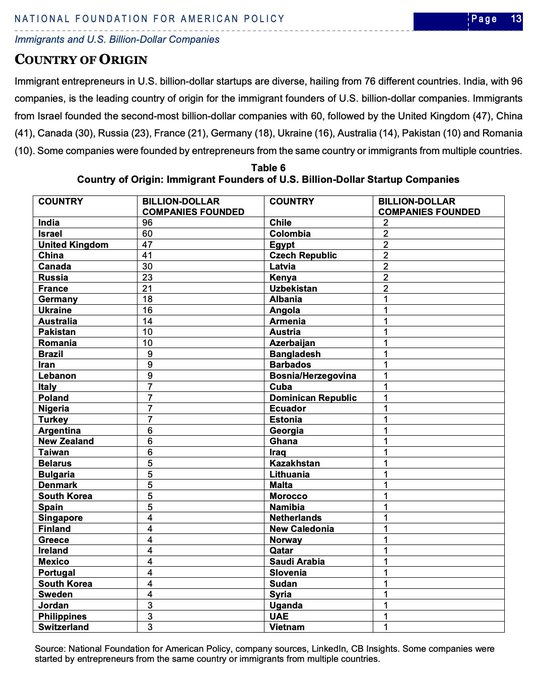
India has sent 96 people to America who started billion dollar companies. No one else is even close.
There's only about 5 million Indians in America. Almost one in 50,000 of them is a unicorn founder!
What a holy, special, beautiful people.
I will always fight for them.
Do the thing that scares you.
Just 3 days ago I travelled 4,275 miles to India. Alone. For just 72 hours. All to watch the IPL and finally experience Royal Challengers Bengaluru in person.
On paper, it sounds ridiculous. Exhausting flights, barely any sleep, navigating a country I’d never been to before, all for a cricket team.
But sometimes the best things in life begin with “this is probably a bad idea.”
What I found in India was so much bigger than cricket.
Every single person I met showed kindness. People helped me when I had questions, checked I got where I needed to be, shared conversations, recommendations, smiles, stories.
Complete strangers made a country that should have felt overwhelming somehow feel welcoming.
But the most heartfelt of thanks have to go to @poserarcher and @ishanjoshii who not only sourced the best tickets for me but made sure they looked out for me every step of the way.
Not only this but Ishan and his beautiful wife hosted me for a wonderful lunch in their home.
It’s you guys that made the whole experience what it was and i’m forever grateful 🫶
And the cricket? Unreal. The noise, the passion, the colour, the energy around RCB… it felt less like watching a sport and more like being part of something people truly live and breathe.
I went there thinking I was chasing an experience. I came back feeling like I’d left a piece of myself behind.
Its not goodbye India, its Phir milenge ❤️
@ErikaMorris79 You should get into mobilising your followers onto an agentic commentary platform and build on the follower base you have created by enabling conversations between IPLs.
Check out https://t.co/vNV4j77n5m
@RCBTweets "We will do that in front of our own."
That's how you enforce "Dreams to start the manifestation process well in advance."
Win the third one, that too in front of your own, with next year's final slated to be in Bengaluru—Great stuff!
@RCBTweets 🫡
The Next Two Years Are the Whole Decade
[I loved this interview that @shaneparrish did with @winstonweinberg . Tons of great nuggets for founders and operators. I'm enclosing an executive summary below]
Winston Weinberg, CEO of Harvey, interviewed by Shane Parrish (The Knowledge Project)
Summary: The companies that own the next decade get built in the next 24 months, so every operating decision has to be tuned for compounding speed. Winston Weinberg's playbook: rerank everything daily, ignore the parts of the company that are working, treat 99% of decisions as two-way doors, stress-max early while mistakes are cheap, and hire only people who can lose without breaking. His bonus thesis on AI and law: small skill edges now compound across every deal, and the lockstep careers and deliverable-based business models built around uniform talent are about to crack open.
1. The 2-Year Window. The next 1 to 2 years decide which companies own the next decade. If model capability is doubling every few months and competitors are reshaping their orgs around it now, anyone who waits a year is structurally behind. Weinberg uses the timing belief as his first filter when hiring executives, because anyone who doesn't accept it will, by default, optimize for the wrong horizon. The rest of his operating system only makes sense once you grant the premise.
2. Daily Reranking. Rerank your full task list every day, and treat the act of reranking as the actual work. Weinberg keeps a single Google doc with motivational reminders, the 3 dashboards he's watching, the 3 quarterly goals (usually 1 product launch and 1 broken area to fix), and a daily ranked list. His output correlates with one variable: how many times he reopens the doc during the day and reshuffles it. The reopening forces the meta-thought ("what's the real bottleneck?") that nothing else surfaces.
3. The Paragraph Test. Make yourself write a paragraph defending any meeting before you accept it. Weinberg's chief of staff enforces this when his calendar starts to drift. For 99% of meetings he quits halfway through the first sentence; for the ones that genuinely matter, he could write 20 pages. The forcing function works because saying no in the abstract feels social, but writing a fake-sounding paragraph feels stupid, and stupid wins.
4. Bottleneck Focus. Ignore every part of the company that's running well. Weinberg doesn't look at the working pieces, period. He spends the day on the single part that's burning the hottest, on the theory that improving an already-good area is a low-return use of CEO attention. The founders he admires have built a "machine" that runs without them and then turn 100% of their attention on the single bottleneck inside that machine.
5. The 6-Month Lag. Saying yes to investors pays out in days; saying no pays out in 6 months. The trap: a VC tells you the revenue miss is because you haven't hired a CRO, so you take 15 exec interviews and get a weekly pat on the back for "making progress." The actual cause is product weakness, which takes 2 quarters to fix and looks like nothing for the first 4 months. Most founders cannot stomach 6 months of looking wrong in public while they fix the actual cause, which is why most don't make it.
6. Two-Way Doors. Treat 99% of decisions as two-way doors and decide fast. The people who break in Weinberg's company freeze: they treat every choice as one-way, plan all 10 stairs before stepping on the first, and burn a week on a question they could've answered in 10 seconds by just deciding. Weinberg's own regrets are all about slow decisions, never wrong ones. Decision speed becomes a culture problem at scale: the founder's principles for how to decide have to become legible enough that everyone makes faster calls with the same logic, or the company calcifies waiting on him.
7. Cheap Mistakes. Stress-max early, while the blast radius is small, and never fire anyone for mistakes. Firing someone at a 10-person company is uncomfortable but survivable; avoiding the same conversation at 800 people can implode the org, so do the scary thing while it's cheap. Weinberg has never let anyone go for mistake count; the people who leave always break first, through decision paralysis, refusal to hire above themselves, or inability to scale through chaos. Building a company is roughly 1,000 failures and a few wins, so the hiring filter is "what's your rate of learning when things go wrong?"
8. The Stress Radius. A CEO's stress has a radius, and the radius grows with the company. At 50 people the team absorbs the founder's nerves; at 800 the whole org reorients around them, and if the CEO stresses about everything, no one can tell which fire actually matters. Weinberg over-rotated on multiple threats last year and watched it create org-wide thrash before he caught it; the fix is being more selective about which anxiety the team gets to see. Urgency scales the same way: hire leaders who already feel it, and they push it down two more layers before the founder has to.
9. The Forced No. The almost-acquisition that collapsed in early 2024 was the best thing that happened to Harvey. Weinberg signed a term sheet to buy a company 10 times their size, came up short on the $700M financing (raised about $500M in clean equity), refused the PIK debt that would have put control at risk, and walked away thinking the company was over. 24 hours later he was rebuilding; the forced no killed the shortcut and made them actually build the company. He now has a team that has failed together a dozen times and a personal pattern of "it's over → 24 hours → it's not over" that runs roughly once a week.
10. The Power Law. AI turned the 10x engineers in Harvey's company into 100x. Two reasons: the communication tax collapsed (the silent geniuses who could never manage up can now ship on a Sunday and let the work argue for them), and translation costs dropped (a coding model can render a complex legal concept as an engineering analogy in seconds, so good ideas spread without the right vocabulary). The second-order effect is that small skill edges now decide who gets the work; the rainmaker partner wins most of the deals by being slightly better at a handful of tasks that compound across every transaction. Industries built on lockstep promotion are about to crack, because the better junior will visibly out-earn the senior, and the firms that promote on merit instead of tenure will pull away.
11. The Lawyer's Moat. The lawyer's moat is reading the jury, the deal room, and the other side of the table. Drafting briefs and running diligence were always going to commoditize; AI puts a premium on year 1 of law school (critical thinking, argument construction) and erases most of years 2 and 3 (doctrine that AI knows better). Professional services splits in two: deliverables get commoditized, judgment gets more expensive, and the M&A lawyer who personally knows the players on the other side becomes more valuable because that relational data is the hardest to put in a model. Volume is also coming: data rooms in 10 years will be 50 times bigger because AI writes 50 times more contracts, agent-plus-human review becomes the only way the work happens, and the deal that took 3 weeks closes in 48 hours or loses to the firm that can.
12. Product Over Sales. Once you have distribution, spend almost all your time on product, and reearn your position every 6 months. Weinberg's most-repeated mistake is stepping away from product to do sales: it feels great for 2 quarters and helps nothing for 10, because product is the only thing that actually compounds. The closing discipline is to walk into month 7 knowing you spent everything you had in months 1 through 6, and then do it again against a bar that has doubled or tripled. He's more confident in Harvey today than ever despite 10 times more external threats, because the team has now failed enough times together that nothing genuinely surprises them anymore.