IIT BHU Alumni, A Modi fan;
Committed to Technology & Development; Commerce, Culture, Current affairs & Corruption free progressive INDIA.
A proud Tuluva Bunt.
Next in who after the Ramanujan series?
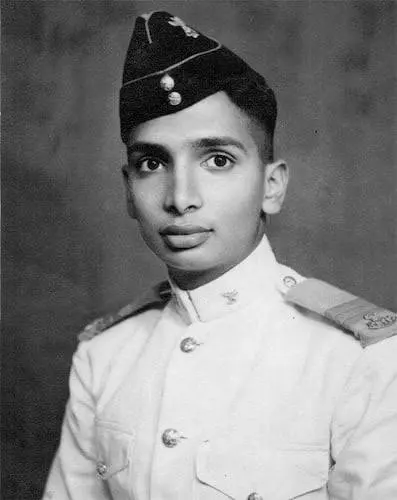
At a tender age of 16, a brilliant but completely unguided boy from Tamil Nadu joined the National Defence Academy & was commissioned into the Indian Navy's electrical branch . He did not have the luxury of a quiet university setting; he was trained in practical skills to maintain weapons systems on warships.
But Arogyaswami Paulraj possessed an insatiable, self-taught obsession with the advanced mathematics of signal processing, control theory & information theory. He studied advanced matrices & random variables by lamplight on naval ships.
By the late 1970s, India faced a serious strategic challenge. After the 1971 Indo-Pak War exposed weaknesses in imported sonars, the Navy needed an advanced anti-submarine warfare system but was blocked by international export restrictions. The Navy turned to Paulraj, then a rising officer with a PhD from IIT Delhi (earned while still in service). He was tasked with leading a major indigenous project to develop a world-class hull-mounted panoramic sonar from scratch.
Operating under intense resource scarcity, Paulraj’s mathematical genius took over. He designed complex signal-processing algos that could filter the chaotic, deafening acoustic noise of the ocean to pinpoint enemy submarines. The resulting system, APSOH (Advanced Panoramic Sonar Hull), inducted in 1983, completely stunned global military observers. It did not just work, it outperformed contemporary Western systems.
After setting up major defense labs in India, Paulraj retired from active naval service & arrived at Stanford University in 1991 as a research associate. This is where the story shifts from military history to modern legend. While working on signal separation experiments for airborne military reconnaissance, Paulraj noticed a strange, fleeting physical phenomenon.
When a radio signal is transmitted in a crowded area (like a city with buildings), it bounces off walls & scatters into 1000s of chaotic, distorted paths. Engineers treated this scattering as a nightmare, multipath interference that corrupted data.
Paulraj had a paradigm-shifting realization rooted in multi-variable calculus & spatial matrices: What if the scattering was not a bug, but a feature?
He realized that if we used multiple antennas at the transmitter & multiple antennas at the receiver, we could use advanced matrix mathematics to isolate those scattered paths & stream parallel, independent channels of data over the exact same frequency, at the exact same time.
He called it MIMO (Multiple Input, Multiple Output).
When he 1st proposed it, the academic world mocked him. Prominent profs & industry skeptics told him it violated the laws of physics & information theory. They claimed it was mathematically impossible to multiply data speeds w/o expanding bandwidth.
Paulraj did no back down. He built his own prototype, founded a startup & proved the mathematics in real-world silicon. He designed the microscopic architecture, the microchip algos that allowed small devices to execute these hyper-complex spatial matrix calculations in fractions of a microsecond.
If we look at the device we are using to read this right now, look at the top corners of our screen. We cannot see them, but embedded inside the frame of our phone are multiple microscopic antennas operating on Paulraj’s exact MIMO-OFDMA mathematics.
Every single modern 4G network, 5G network & high-speed Wi-Fi router on Earth is built entirely on the mathematical foundation invented by the self-taught Indian Navy officer who packed his bags for Stanford. He did not just solve a math problem; he built the invisible highway that carries nearly 100% of the world's mobile data traffic today.
Japan was our first office outside India and the US. That was 2001.
Yesterday, I visited our office in Yokohama and I'm reminded that we were a small unknown company from Chennai and we chose the hardest market first.
Nobody in Japan buys because of a brand or a pitch. They watch how you behave when something breaks, and if you pass that test they stay with you for decades. That patience got into our engineering culture and never left.
ありがとうございます 🙏
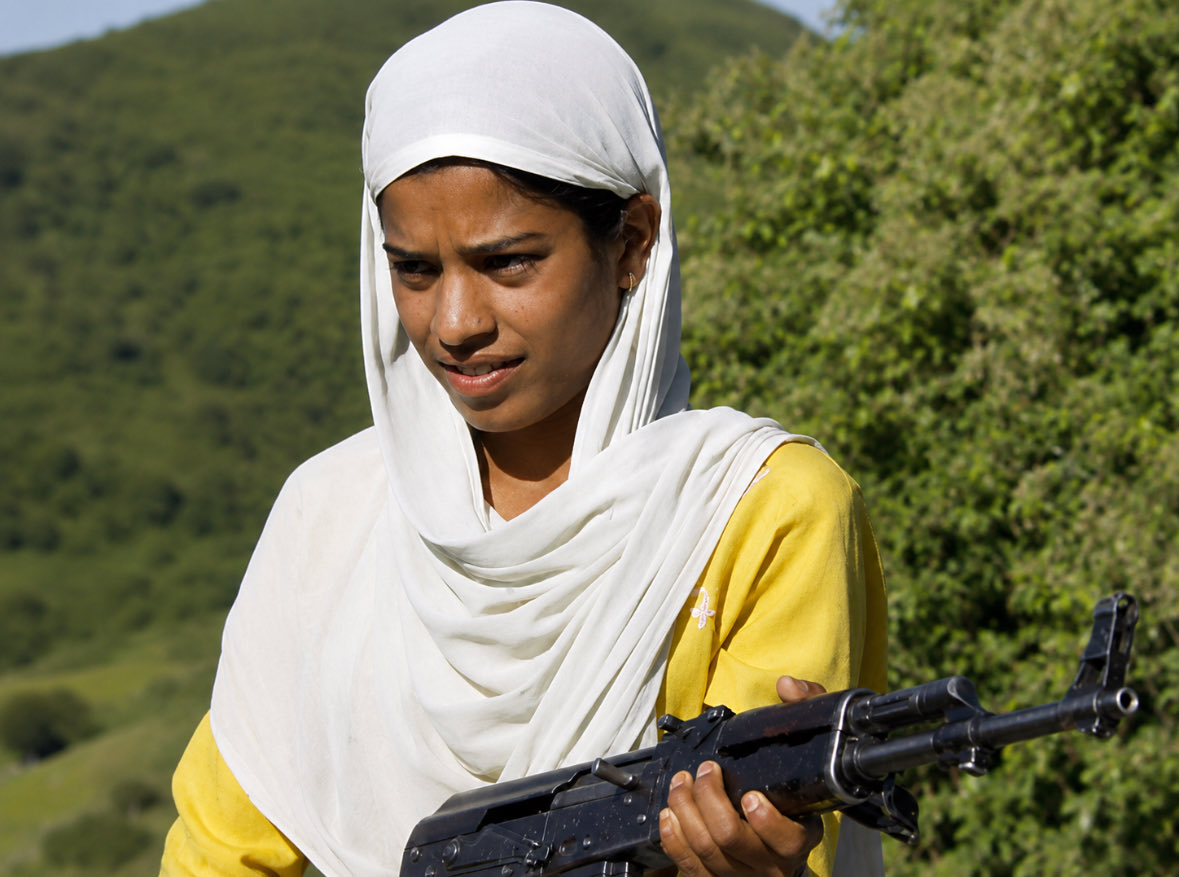
Her name is Rukhsana Kausar.
She was twenty years old, a farmer's daughter in a small village in Kashmir who had left school after class ten. One night, armed terrorists broke into her home to drag her away. By morning their commander was dead, killed with his own rifle, by her.
It was the night of 27 September 2009. Three militants of the Pakistani terror group Lashkar e Taiba came to her family's house in Rajouri. They forced their way in and demanded that the family hand Rukhsana over to them.
Her father refused. So they began to beat him, and her mother, and her brother, with the butts of their guns.
Rukhsana was hiding under a cot, listening to her family being battered in front of her. And something in her decided that she would not stay hidden while they were killed.
There was an axe in the room. She picked it up, rushed out, and struck the terrorists' commander on the head. As he staggered, she pulled the rifle from his hands, turned it on him, and shot him dead.
She grabbed a second weapon and threw it to her brother. Together they opened fire on the remaining two, who fled into the night.
The man she killed was Abu Osama, a commander of Lashkar e Taiba, a name the security forces had been hunting for years.
A twenty year old girl with no training, who had never held a gun in her life, had killed a wanted terrorist with his own weapon and saved her whole family.
She was given the Kirti Chakra, one of the highest bravery awards India has. Later she put on a uniform of her own and became a police constable.
They came to her home to make her disappear. She made sure it was their commander who never went home.
His name is Dinesh Thakur.
He gave up a safe, high paying job and spent eight years of his life fighting one of the largest drug companies in the country. He did it because he discovered that the medicines millions of people trusted were built on a lie.
He was a chemical engineer who had worked in America and come back to India for a senior role at Ranbaxy, then the biggest generic medicine maker in the country. It was a proud Indian company whose cheap medicines were sold across the world.
Not long after he joined, he was asked to look into the quality of the company's drugs. What he found frightened him.
The company was faking its test results. Medicines were being sold without being properly tested for whether they were safe, or whether they even worked. The data handed to regulators was simply invented.
These were not luxury goods. These were the tablets that sick people swallowed every day, trusting that they would heal them.
Thakur went to his own bosses with what he had found. Nothing changed. So he made a choice that cost him everything. He resigned, and he reported the company to the American drug regulators.
Then began eight long years. He handed over evidence, sat through investigation after investigation, and lived under the shadow of taking on a giant that had every reason to crush him.
In 2013, it ended. Ranbaxy admitted its guilt in an American court, pleaded guilty to seven serious crimes, and was made to pay one of the largest fines ever handed to a generic drug maker, five hundred million dollars.
Because one man refused to look away, the way the world checks the safety of its medicines was changed for good.
He had a comfortable life and a good salary. He gave it all up so that the medicine in a stranger's hand could be trusted.
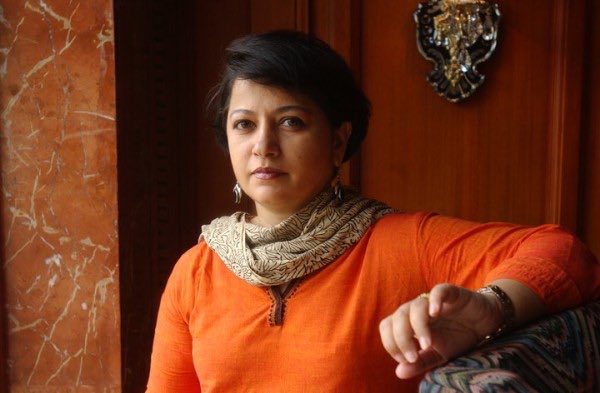
Her name is Sucheta Dalal.
Everyone remembers Harshad Mehta, the man who fooled the stock market and became a legend. Almost no one remembers the woman who caught him.
She was a business journalist at the Times of India in the early 1990s. She had trained as a lawyer, but she chose instead to write about money, and about the people who moved it.
In those years, one man ruled the market. Harshad Mehta, the Big Bull. Share prices did whatever he wanted them to do. He drove imported cars, lived in a sea facing penthouse, and the whole country treated him like a genius. Most journalists wrote adoring stories about him.
Sucheta Dalal did not. She looked at his sudden mountain of wealth and asked one simple question. Where was all this money coming from.
She began to dig. Quietly, through her contacts in the banks and the Reserve Bank, she followed the paper trail. What she found was staggering.
Mehta was pulling thousands of crores out of the banking system using fake receipts, borrowing enormous amounts of public money against paper that was worth nothing, and pouring it into the stock market to push prices higher.
On 23 April 1992, her story appeared in the Times of India. It revealed that the State Bank of India alone was missing hundreds of crores linked to Mehta.
The market crashed. The country erupted. It turned out to be one of the biggest financial frauds India had ever seen.
Because of her reporting, the system was forced to change, and a new watchdog was created to guard the stock market so this could never happen so easily again.
Years later a hit web series told the story of the scam, and millions learned his name all over again.
But long before the cameras, there was just one reporter who refused to be dazzled, and asked where the money came from.
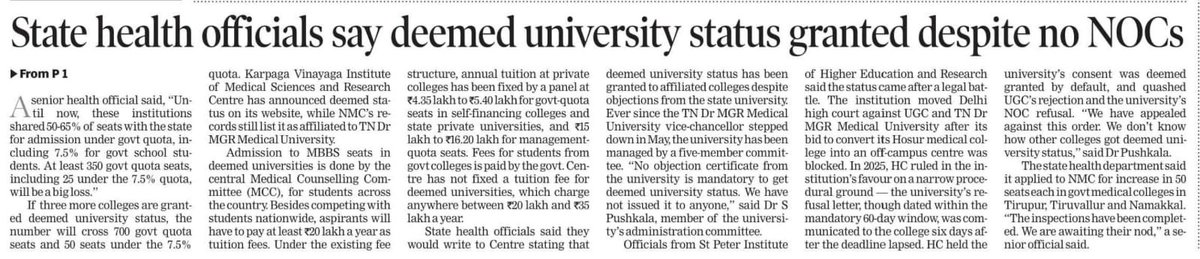
650 MBBS seats from the state quota for 2026 going to hit and devastating the dream of becoming doctors from the economically weak section. Previous Government failed to object within 60days window, perhaps purposely 😡! This is grave concern for young medical aspirants. No mainstream media going to talk about it! Thanks @annamalai_k brother for bringing up a topic that is relevant to the students!! Hope @TVKVijayHQ@CMOTamilnadu order a proper discussion investigation.
This comes as a shocker, as three previously affiliated colleges of The Tamil Nadu Dr MGR Medical University have received deemed university status, which will lead to a reduction of 650 medical seats in this admission year. This will directly impact the admission of students selected under the 7.5% reservation for government school students, and the fee expected to be paid by students admitted to these colleges will be quadrupled, at the least.
The three colleges that have now been granted Deemed University status are St. Peter’s Medical College (250 seats) and Dhanalakshmi Srinivasan Institute of Medical Sciences & Srinivasan Medical College (400 seats). As for who owns and controls these institutions, that is hardly a secret; it is already in the public domain.
The Tamil Nadu Dr MGR Medical University has clarified that it has not issued an NOC to either of these colleges to apply for deemed university status. However, it is also clarified that the refusal letter issued to St. Peter’s Medical College is currently being contested in court.
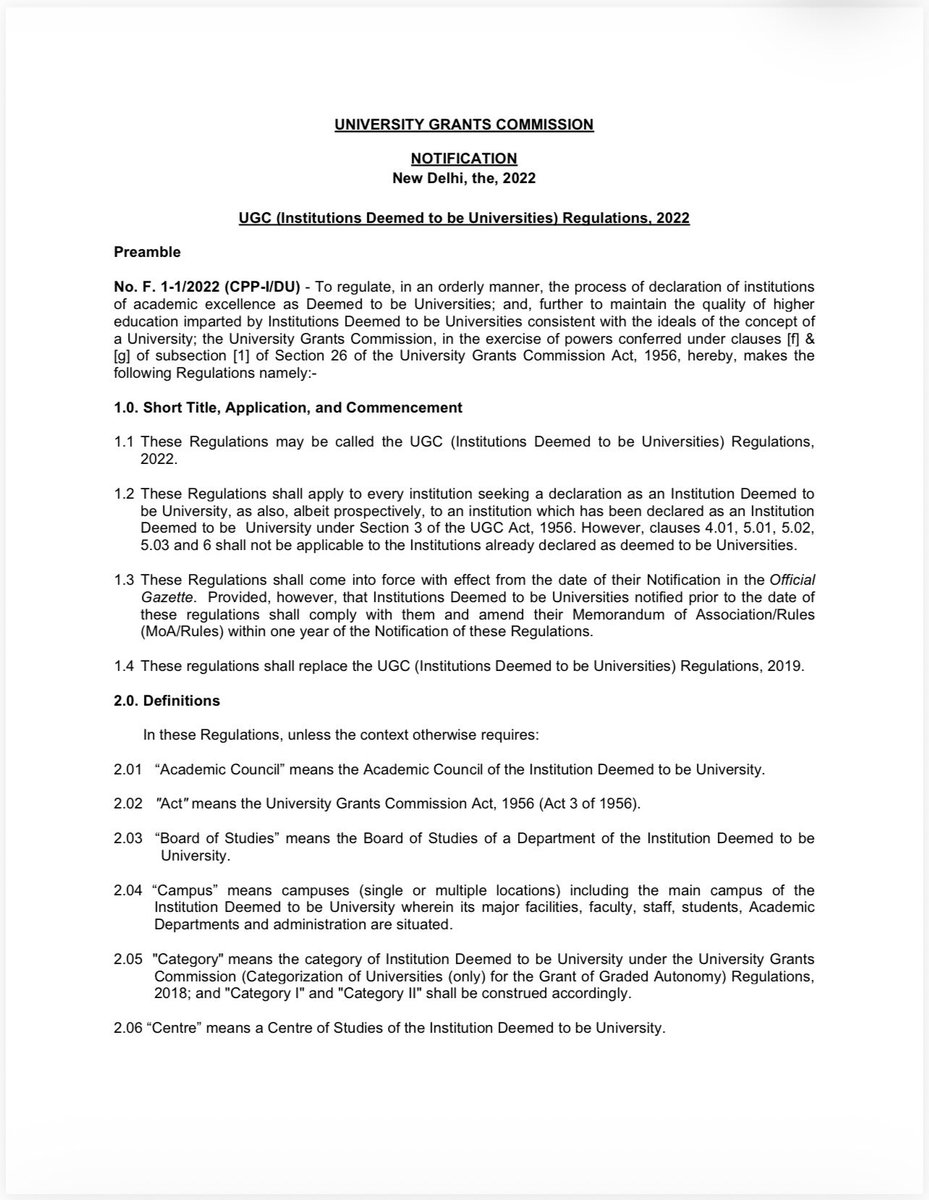
The UGC (Institutions Deemed to be Universities) Regulations, 2022, in point number 5.02(i) and 5.02 (ii) clearly state that the University Grants Commission will presume that the State Government has no objection to the issuance of deemed university status if the affiliating university (in this case The Tamil Nadu Dr MGR Medical University) does not object within a window of 60 days and it will presume that the university had no objection for issuance of deemed university status.
The Tamil Nadu Dr MGR Medical University has clarified that they did not issue a NOC to Dhanalakshmi Srinivasan Institute of Medical Sciences and Srinivasan Medical College.
Hence, a pertinent question arises. Did the previous DMK Govt deliberately ignore the application filed by Dhanalakshmi Srinivasan Institute of Medical Sciences and Srinivasan Medical College and wait for the 60-day window to close?
I urge the TVK Govt to conduct a detailed probe into this matter and ensure that those responsible for this gross wilful negligence be punished. The future of aspiring medical students cannot be made collateral damage by administrative apathy or wilful political negligence. Their dreams of pursuing affordable medical education must not be stalled or sacrificed because those in power fail to act in time.
Her name is Avani Chaturvedi.
In all the years the Indian Air Force had existed, no Indian woman had ever flown a fighter jet into the sky alone. She was the first.
She grew up in a small town in Madhya Pradesh, the daughter of a government engineer. Her elder brother joined the army, and watching him, she decided she did not just want to serve the country. She wanted to fly for it.
At the time, that dream had a wall around it. The fighter cockpit, the fast jets, the whole combat stream, all of it was closed to women in India. No matter how good she was, the door said men only.
Then in 2015, the country finally opened the fighter stream to women. Avani and two other young women, Bhawana Kanth and Mohana Singh, walked through that door first.
In June 2016 they became the first women fighter pilots India had ever commissioned.
But flying with an instructor beside you is one thing. Flying a fighter jet completely alone, with no one to take the controls if something goes wrong, is another.
On 19 February 2018, Avani Chaturvedi climbed into a MiG 21 Bison, one of the fastest and most unforgiving jets in the fleet, a machine that has killed many experienced pilots. She took off from Jamnagar on her own. For about thirty minutes she owned the sky. Then she brought it down safely.
With that one flight, she became the first Indian woman to fly a fighter jet solo.
When people asked her what it felt like to do it as a woman, her answer was simple. The machine does not know if the pilot is a man or a woman. It only knows who can fly.
The girl from a small town who was once told the cockpit was not for her now writes her name across the sky at the speed of sound.
@AutiShivaji@INCKerala@nitin_gadkari@narendramodi Bakwas band karo.
Toyotawale khud kah gaye hai ki 20% ethanol petrol me car ka koi nuksaan nahi hota. Han, Efficiency kuch 3% kam hosakta hai.
Kitna Mila tumhe itna chillaneke liye?
Dekhneme to lagte nahi ho 40lakh ka gadi me ghoomte ho Bhadeka tattoo lagte ho!
Her name is Shreya Singhal.
She was twenty one years old, a law student, when she challenged a law that allowed people to be arrested for what they posted online.
She took the fight to the Supreme Court, and she won.
In 2012, two young women in Maharashtra were arrested.
One had questioned on Facebook why an entire city had been shut down after a politician’s funeral.
The other had simply liked the post.
Both were arrested under Section 66A of the Information Technology Act.
The law made it a criminal offence to send online messages that were “offensive” or caused “annoyance” or “inconvenience.”
Those words were never clearly defined.
That meant almost any online post could become a criminal case if someone in authority decided it was offensive.
Across the country, people were arrested under the law for cartoons, jokes and criticism posted online.
Shreya Singhal was not a politician or a well known lawyer.
She was a student who believed the law violated the Constitution.
She filed a petition in the Supreme Court challenging Section 66A.
The case took three years.
On March 24, 2015, the Supreme Court struck down Section 66A in its entirety, holding that it violated the constitutional guarantee of freedom of speech and expression.
With one judgment, a law that had been used to make arbitrary arrests over online speech ceased to exist.
She did not fight with the backing of a political party or a powerful organisation.
She fought because she believed an unjust law should not survive.
A law that threatened the free speech of millions was struck down because one twenty one year old law student refused to stay silent.
Follow for stories India deserves to remember.
@sandeep_PT You are promoting Casteism by writing such a long essay filled with imagination.
I am not a Brahmin and I never felt that Brahmins rule the roost in the Corporate world.
@SupriyaShrinate Your idiotic postures are testing out patience.
I don't know why I get your silky messages highlighted! How much do your controllers pay Elon Musk for this service?
His name was Dashrath Manjhi.
For twenty two years he broke a mountain apart with a hammer and a chisel. Alone. Because that mountain killed his wife.
He was born in 1934 in Gehlaur, a small village near Gaya in Bihar.
He belonged to the Musahar community, one of the poorest and most looked down upon communities in India. He worked as a daily wage labourer.
His village had one cruel problem.
A steep rocky hill cut it off from the nearest town. To reach a doctor, people had to travel all the way around it, a journey of about 55 kilometres.
In 1959, his wife Falguni Devi was hurt near that hill.
Help was too far away. She died before she could reach a doctor.
He decided no one else would lose someone the way he lost her.
So he picked up a hammer and a chisel, and he started breaking the mountain.
People called him mad. He kept going.
He worked on that hill every single day for twenty two years. He sold his goats to buy tools. Slowly, a few villagers began to help.
By 1982, he had carved a road straight through the hill. About 110 metres long. Wide enough for people to pass.
The journey around the mountain dropped from about 55 kilometres to about 15.
A single man with hand tools had done what the government never did.
He asked for nothing.
The proper paved road over his path was finally built only after he died in 2007.
Today he is remembered as the Mountain Man.
Follow for stories India deserves to remember.
@san_x_m Sad part of Indian History is that most of the times Indians died fighting Indians resulting in foreigners ruling us for centuries using us one against the other!
21 soldiers.
Around 10,000 enemy fighters.
And not one of them ran.
This is the story of Saragarhi, and most Indians were never taught it.
It was 12 September 1897, on a rocky ridge on the North West Frontier, in what is now Pakistan.
Saragarhi was a small army post. It carried signals between two British forts that could not see each other.
It was held by 21 Sikh soldiers of the 36th Sikhs, led by Havildar Ishar Singh.
That morning, between 10,000 and 14,000 Afghan tribesmen came to destroy it.
21 men against an army.
One soldier, Sepoy Gurmukh Singh, climbed the signal tower and flashed a message to the nearest fort using mirrors and sunlight. Enemy here. Send help.
The answer came back. No help can reach you. Hold.
They were told they would die. They stayed anyway.
For over six hours, 21 men held off thousands. They fired until their hands burned. They fought at the walls, then hand to hand when the wall broke open.
Gurmukh Singh signalled every moment of it, until he was the last man alive. Then he put down the mirror, picked up his rifle, and died fighting.
All 21 were killed. But they had held long enough to save both forts and break the attack.
Every one of them was given the Indian Order of Merit, the highest honour an Indian soldier could receive at the time.
Their names were Ishar Singh, Gurmukh Singh, Lal Singh, Bhagwan Singh, and seventeen more.
Follow for stories India deserves to remember.