Today we are releasing the first model in the NVIDIA Nemotron 3 family: Nemotron 3 Nano!
Nemotron 3 Nano is truly open, efficient, and achieves class-leading accuracy on reasoning and agentic tasks. Check it out today! 🚀
https://t.co/TfJZMfnWh0
Sharing our team’s latest work on Hymba - an efficient small language model with hybrid architecture.
Tech report: https://t.co/pnGbPQupuy
Discover the tradeoff between Mamba and Attention, how they can be combined, how attention sink and forced-to-attend phenomena can be mitigated, and how KV cache can be shared across layers.
Learn how we built a model with end-to-end ecosystem: data selection, architecture analysis and design, training Base and Instruct models and open them to the community.
Did I mention that our Hymba-1.5B Base model outperforms LLaMA 3.2-3B while being trained on 7× fewer tokens and achieving 12× higher throughput?
More details and model links come soon!
We are hiring researchers working in LLM and VLM efficiency!
Applications are open for PhD students graduating in 2025; and senior researchers with PhD. Check requirements for the position.
Apply here: https://t.co/cLiRJ5Kb97
Senior researchers:
https://t.co/iN15UBfmdq
Check our teams webpage: https://t.co/ZiIjjJRlRu to learn more about the work we are doing.
🚀 @NeurIPSConf Spotlight! 🥳 Imagine fine-tuning an LLM with just a sparsity mask! In our latest work, we freeze the LLM and use 2:4 structured sparsity to learn binary masks for each linear layer. Thanks to NVIDIA Ampere’s 2:4 sparsity, we can achieve up to 2x compute acceleration for downstream tasks! 💥
📄 Paper: https://t.co/tn5L8pIQfE
🔗 Code: https://t.co/NF1ha9mLJs
🌐 Webpage: https://t.co/YZaAnSfIlx
🔑 Key insights:
- Gumbel-Softmax trick for differentiable binary mask training
- Learnable Sparsity scales effectively to large-scale datasets and can fully leverage computational resources to learn precise masks through end-to-end training.
- Using mask priors (i.e. SparseGPT, Magnitude) boosts efficiency & quality
- Annealing stochastic sampling is crucial for effective mask learning
- Maximizing resulting weight magnitudes improves downstream task performance
🏆 Results:
- Effective 1.4x GPU speedup & 73% memory reduction with near-lossless performance!
- MaskLLM outperforms one-shot techniques with just 1280 samples.
- Our method improves with more data, unlike previous one-shot approaches!
Kudos to Gongfan Fang (NUS) for great internship! Together with @yin_hongxu@jankautz@srv_m@gLeHeinrich@XinchaoWang3, Jeff Pool
👀 Experience high-efficiency NVIDIA Llama-3.1-Nemotron-51B - a NAS-optimized model achieving 2x throughput while preserving accuracy runs on a single H100 GPU.
✨Try out the Llama-3.1-Nemotron-51B NIM through the API from https://t.co/3umcvzDpfj or download from @huggingface.
Technical deep dive ➡️ https://t.co/wH4P46SU5t
Introducing NVLM 1.0, a family of frontier-class multimodal LLMs that achieve state-of-the-art results on vision-language tasks, rivaling the leading proprietary models (e.g., GPT-4o) and open-access models (e.g., InternVL 2).
Remarkably, NVLM 1.0 shows improved text-only performance over its LLM backbone after multimodal training!
We are working towards releasing the model weights very soon 🤗 and will open-source the training code for the community.
For further details, please visit our project website:
https://t.co/1ZPGp3zFes
LLM Pruning and Distillation in Practice: The Minitron Approach
abs: https://t.co/mDQCuz1SFD
models:
https://t.co/x1Y540ewSa
https://t.co/KSDibmqPp9
https://t.co/fhPI3HzwqD
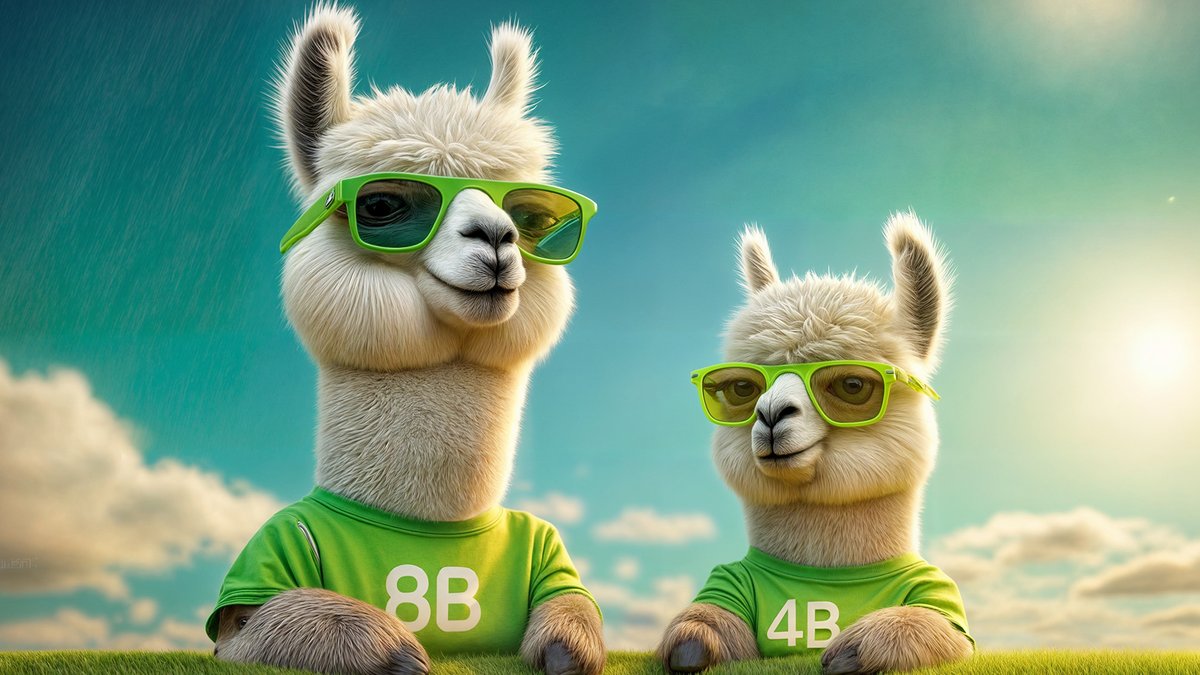
Compressing Llama 3.1 8B and Mistral NeMo 12B to 4B and 8B, respectively, with teacher correction, weight pruning, and distillation (Minitron approach from NVIDIA).
Today we released Mistral-NeMo-Minitron 8B, a pruned and distilled version of the open @MistralAI NeMo 12B model, achieving high accuracy across nine popular benchmarks for chatbots, virtual assistants, content generation, coding, and educational tools.
➡️ https://t.co/JxQF3KtuRV ✨
Experience now on the NVIDIA API catalog or download from @HuggingFace.
🌟 The best 8B Base model via pruning and distillation!
🚀 Introducing Mistral-NeMo-Minitron-8B-Base model we derived from the recent Mistral-NeMo-12B.
Our recipe: finetune teacher on 100B tokens, prune to 8B params, run teacher-student distillation on <400B tokens.
Result: the best -Base model for 8B range.
📚 Technical report: https://t.co/oYPtXtDcJZ
📝 Blog post: https://t.co/y8MiwqbCZ8
🤗 HF model checkpoint: https://t.co/6s7onn9Pni
📌 Key Benefits:
• Significant training reduction: only 400B tokens
• Outperforms Mistral-7B and LLaMa-3.1-8B across 8/9 benchmarks
• Enhanced model accuracy via distillation
• Ready for commercial use with permissive license
⚙️ Model architecture:
• 8.4 B total parameters
• 7.3B active non-embedding params
• 131k vocab size
• Hidden size: 4096
• Depth: 40 layers
• MLP hidden size: 11520
• Query heads: 32
• Head dimension: 128
• Attention groups: 8
👐 Permissive license!
🔑 Key Learnings:
• Fine-tune the teacher with 100B tokens when original training data isn’t available before distillation.
• Teacher fine-tuning can run in parallel with distillation.
• Pruning focuses on MLP & embedding dimensions, leaving Attention layers untouched.
• Handle embedding dimension pruning carefully, especially on the LN side—details in the paper.
• Some benchmarks even show improvements over the original teacher model!
👥 Contributors:
Foundational Model: Sharath Turuvekere Sreenivas*, Saurav Muralidharan*, Raviraj Joshi, Marcin Chochowski, Pavlo Molchanov, Mostofa Patwary, Daniel Korzekwa, Ashwath Aithal, Mohammad Shoeybi, Bryan Catanzaro and Jan Kautz
Alignment: Ameya Sunil Mahabaleshwarkar, Hayley Ross, Brandon Rowlett, Oluwatobi Olabiyi, Shizhe Diao and Yoshi Suhara
Datasets: Sanjeev Satheesh, Jupinder Parmar, Shengyang Sun, Jiaqi Zeng, Zhilin Wang, Yi Dong, Zihan Liu, Rajarshi Roy, Wei Ping, Makesh Narsimhan Sreedhar and Oleksii Kuchaiev
TensorRT-LLM: Bobby Chen, James Shen and Chenhan Yu
Hugging Face Support: Ao Tang, Yoshi Suhara and Greg Heinrich
* Equal contribution.
#NVIDIAAI #NVIDIA #NVIDIAResearch
@NVIDIAAI
See how our #NVIDIAResearch team has developed a method to efficiently create smaller, accurate language models by using structured weight pruning and knowledge distillation - offering several advantages for developers:
✅ 16% better performance on MMLU scores
✅ 40x fewer tokens for training new models
✅ Up to 1.8x cost saving for training a family of models
🦙 The effectiveness of these strategies is demonstrated with the @AIatMeta Llama 3.1 8B model, which was refined into the Llama-3.1-Minitron 4B. This new model will soon be available in the NVIDIA @huggingface collection.
➡️ Technical Deep Dive: https://t.co/OBYumUr8WK ✨
🚀 We've pruned LLaMa3.1 down to 4B parameters, delivering a smaller and more efficient model! Based on our recent paper: https://t.co/Mo3JmQEV8V
📖 Learn all about it in our blog: https://t.co/oSHHp9zVif
🔗 META's announcement: https://t.co/cJZ2rP6zxr
👐 Checkpoints at HF this week: https://t.co/VeHWcKl3vZ
Key Learnings:
🌟 Width pruning delivers better accuracy with MMLU at 60.5%, while depth pruning yields 58.7%.
🧠 Reasoning ability is more impacted, with GSM8K accuracy at 41.24% for width and 16.8% for depth -consistent with findings from our recent depth pruning paper (https://t.co/aqPOSiBDy0).
⚡ Depth pruning boosts throughput, achieving ~2.7x speed up over LLaMa-3.1-8B, while width pruning provides ~1.7x speed up.
#NVIDIAAI #META #llama
@cataluna84 Hi, we do have plans to release the code, but the timeline is a bit unclear due to the legal approvals we need to obtain. In the next few weeks, hopefully!
🤖 Excited to announce Minitron, a new family of language models obtained through a combination of weight pruning and knowledge distillation!
Our models are available on HF with a permissive license. Give them a try today!
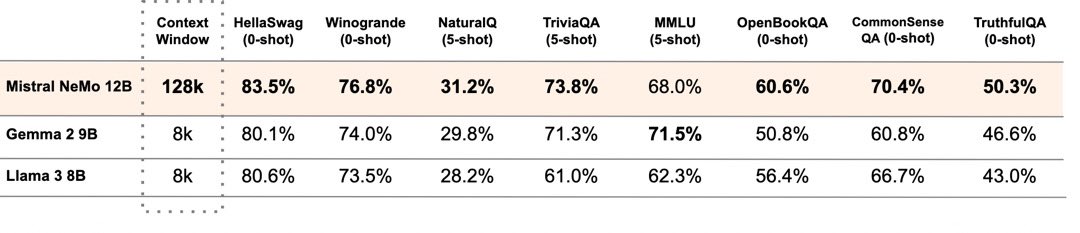
@MistralAI and @nvidia announce Mistral-NeMo 12B, an awesome bite-size model released under Apache 2.0 that we jointly trained. FP8 aligned checkpoint and 128k context window, great benchmark scores.
https://t.co/gKG3Eewr0p
https://t.co/YNkeQpPLlv
🚀 Introducing Flextron - a Many-in-One LLM - Oral at ICML!
Train one model and get many optimal models for each GPU at inference without any additional retraining. 🌟
🔗 Paper: https://t.co/u78fb3kuo4
Main benefits with only 5% post-training finetuning:
✅ Best model for every GPU (small & large) without retraining
✅ Change inference cost on the fly based on load
✅ Input-adaptive inference (heterogeneous weight-shared MoE, Attention)
✅Instead of training many models, we train only 1: LLaMa2-7B ➡️ 3B, 4B, 5B, 6B, etc.
Method in observation in thread. 🧵👇
Check out our latest work, Flextron, an elastic LLM that supports zero-shot flexible deployment at a variety of model scales and sizes. Flextron models achieve SoTA performance and are also input-adaptive (heterogeneous MoE).
Tired of training varying-size LLMs to fit various GPU memory and latency requirements? Check out Flextron! Our new ICML (Oral) paper shows how to train one model deployable across GPU series. Learn more: https://t.co/aPEgVIyfqq🚀
We are now having full conversations with Figure 01, thanks to our partnership with OpenAI.
Our robot can:
- describe its visual experience
- plan future actions
- reflect on its memory
- explain its reasoning verbally
Technical deep-dive 🧵: