PAIN ATTACK...
After the devastating earthquakes that shook Venezuela, an image began circulating around the world. Amidst mountains of concrete, dust, and silence, rescuers found a scene that moved even the strongest.
Under the remains of the collapsed structure, a mixed-breed dog remained. It didn't bark. It didn't try to escape. It lay motionless, looking into eyes, and its body became a shield.
Beneath it lay a child.
While everything around him collapsed, this little boy was still alive, protected by a friend who chose to face the danger rather than abandon someone who needed him most.
Rescue team members report that they were speechless at the scene. First, they managed to pull out the dog, who resisted being separated from the child until he was sure it would be rescued too. Moments later, the little one was pulled out alive amid applause, tears, and emotion from those who witnessed the moment.
Beyond the tragedy that hangs over Venezuela today, this image depicts something no earthquake can destroy: hope.
Because when nature tests the strength of a people, gestures also emerge that can remind us that compassion, loyalty, and love can appear where we least expect them.
This photograph circled the world because it sums up in one scene a nation's pain and, at the same time, the certainty that life always finds a reason to resist.
And then the question arises, which everyone will answer with their own faith and conscience:
Was it a miracle from God... or the purest animal instinct of one ready to give everything to protect life?
Regardless of the answer, this image reminds us that even among the rubble, hope can be born.
📷 Today, Venezuela needs the world's solidarity more than ever. A prayer, a word of comfort, or simply sharing a message of hope can also become a way to help.
by 📷 Reinier Neapol
#ReinierNápoles #Venezuela
Tironianae
@americanpatriot116
In the 1920s, a Stanford psychologist tracked genius children for 50 years.
Malcolm Gladwell breaks down what he discovered:
Rich families → successful. Poor families → failures.
Not average. Failures. Genius-level IQs that produced nothing.
He spent 60 minutes at Microsoft explaining why we're wrong about success:
The psychologist was named Terman. He gave IQ tests to 250,000 California schoolchildren.
He identified the top 0.1%. Kids with IQs of 140 and above.
His hypothesis: these children would become the leaders of academia, industry, and politics.
He tracked them. And tracked them. For decades.
The results split into three groups:
The top 15% achieved real prominence. The middle group had average, moderately successful professional lives.
And the bottom group? By any measure, failures.
The difference wasn't personality. Wasn't habits. Wasn't work ethic.
It was simple: the successful geniuses came from wealthy households. The failures came from poor families.
Poverty is such a powerful constraint that it can reduce a one-in-a-billion brain to a lifetime of worse than mediocrity.
There's a concept called "capitalization rate."
It asks a simple question: what percentage of people who are capable of doing something actually end up doing that thing?
In inner city Memphis, only 1 in 6 kids with athletic scholarships actually go to college.
If our capitalization rate for sports in the inner city is 16%, imagine how low it must be for everything else.
Here's something stranger.
Gladwell read the birth dates of the 2007 Czech Junior Hockey Team:
January 3rd. January 3rd. January 12th. February 8th. February 10th. February 17th. February 20th. February 24th. March 5th. March 10th. March 26th...
11 of the 20 players were born in January, February, or March.
This isn't unique to the Czechs. Every elite hockey team in the world shows the same pattern. Every elite soccer team too.
Why?
The eligibility cutoff for youth leagues is January 1st.
When you're 10 years old, a kid born in January has 10 months of maturity on a kid born in October. That's 3 or 4 inches of height. The difference between clumsy and coordinated.
So we look at a group of 10 year olds, pick the "best" ones, give them special coaching, extra practice, more games.
We think we're identifying talent. We're just identifying the oldest.
Then we give the oldest more opportunities, and 10 years later they really are the best.
Self-fulfilling prophecy.
The capitalization rate for hockey talent born in the second half of the year? Close to zero.
We're leaving half of all potential hockey players on the table because of an arbitrary date on a calendar.
Kids born in the youngest cohort of their school class are 11% less likely to go to college.
11% of human potential squandered because we organize elementary school without reference to biological maturity.
Now here's the part about math.
Asian kids dramatically outperform Western kids in mathematics. The gap is enormous and consistent across decades of testing.
Some people say it's genetic. It's not.
It's attitudinal.
When Asian kids face a math problem, they believe effort will solve it.
When Western kids face a math problem, they believe the answer depends on innate ability they either have or don't.
Here's the proof.
The international math tests include a 120-question survey. It asks about study habits, parental support, attitudes.
It's so long most kids don't finish it.
A researcher named Erling Boe decided to rank countries by what percentage of survey questions their kids completed.
Then he compared it to the ranking of countries by math performance.
The correlation was 0.98.
In the history of social science, there has never been a correlation that high.
If you want to know how good a country is at math, you don't need to ask any math questions. Just make kids sit down and focus on a task for an extended period of time.
If they can do it, they're good at math.
Why do Asian cultures have this attitude?
Gladwell's theory: rice farming.
His European ancestors in medieval England worked about 1,000 hours a year. Dawn to noon, five days a week. Winters off. Lots of holidays.
A peasant in South China or Japan in the same period worked 3,000 hours a year.
Rice farming isn't just harder than wheat farming. It's a completely different relationship with work.
There's a Chinese proverb: "A man who works dawn to dusk 360 days a year will not go hungry."
His English ancestors would have said: "A man who works 175 days a year, dawn to 11, may or may not be hungry."
If your culture does that for a thousand years, it becomes part of your makeup.
When your kids sit down to face a calculus problem, that legacy of persistence translates perfectly.
Now consider distance running.
In Kenya, there are roughly a million schoolboys between 10 and 17 running 10 to 12 miles a day.
In the United States, that number is probably 5,000.
Our capitalization rate for distance running is less than 1%.
Kenya's is probably 95%.
The difference isn't genetic. The difference is what the culture values and where it spends its attention.
Here's the most fascinating finding.
30% of American entrepreneurs have been diagnosed with a profound learning disability.
Richard Branson is dyslexic. Charles Schwab is dyslexic. John Chambers can barely read his own email.
This isn't coincidence. Their entrepreneurialism is a direct function of their disability.
How do you succeed if you can't read or write from early childhood?
You learn to delegate. You become a great oral communicator. You become a problem solver because your entire life is one big problem. You learn to lead.
80% of dyslexic entrepreneurs were captain of a high school sports team. Versus 30% of non-dyslexic entrepreneurs.
By the time they enter the real world, they've spent their whole life practicing the four skills at the core of entrepreneurial success: delegation, oral communication, problem solving, and leadership.
Ask them what role dyslexia played in their success and they don't say it was an obstacle.
They say it's the reason they succeeded.
A disadvantage that became an advantage.
Here's what Gladwell wants you to understand:
When we see differences in success, our default explanation is differences in ability.
We forget how much poverty, stupidity, and attitude constrain what people can become.
We refuse to admit that our own arbitrary rules are leaving talent on the table.
We cling to naive beliefs that our meritocracies are fair.
The capitalization argument is liberating.
It says you don't look at a struggling group and conclude they're incapable. It says problems that look genetic or innate are often just failures of exploitation.
It says we can make a profound difference in how well people turn out.
If we choose to pay attention.
The 7-second cold wrist rinse was tested on 3,000 soldiers after combat simulations.
Cortisol dropped 52% within 90 seconds. Heart rate fell an average of 22 beats per minute. The Navy classified the protocol in 2009 and kept it secret until 2023.
The mechanism is radial artery cooling. Your inner wrists have the thinnest skin and the largest surface-to-volume ratio for blood vessels. 7 seconds of cold water cools the blood passing to your brain, which signals your hypothalamus to downregulate stress instantly
You've splashed cold water on your face. You've taken cold showers. Both work, but they're inconvenient.
The SEAL protocol takes 7 seconds, requires no undressing, and can be done at any sink. Soldiers used it before night missions to fall asleep fast.
The military classified this because a free 7-second stress fix would reduce demand for combat stress medication ($400M annually).
The 2023 declassification came after a FOIA lawsuit filed by a veteran.
The fix: run cold tap water over your inner wrists for 7 seconds. Both wrists. Do it when you feel a stress spike.
Within 90 seconds, your heart rate will drop. No shower, no ice.
Just 7 seconds.
The average student graduates after 12 years of schooling and still cannot answer the most important questions in life.
What is a good man?
What is justice?
What is worth sacrificing for?
What is beauty?
What is truth?
What is the purpose of life?
Classical education begins with the assumption that any education failing to address these questions is not really education at all.
A Stanford professor spent years trying to prove that people who multitask the most are the best at it. He tested 262 students and found the exact opposite. It was the most embarrassing result of his career.
His name was Clifford Nass.
He had spent decades at Stanford studying how humans interact with technology, and by 2009 he was certain he knew what the results would show before the study even started.
He was wrong about everything.
Nass and his colleagues divided 262 Stanford students into two groups: heavy media multitaskers and light media multitaskers.
People who regularly juggled email, texts, multiple browser tabs, music, and TV simultaneously versus people who mostly did one thing at a time.
The assumption going in was obvious. Heavy multitaskers must have built some kind of superpower. Their brains had been training under constant load for years. They should be faster at switching between tasks, better at filtering out irrelevant information, sharper at holding things in working memory.
They tested all three.
Memory first.
Students were shown sequences of letters and asked to identify when a letter was repeating. The heavy multitaskers did worse and kept getting worse the further they went. The more they had multitasked in real life, the less their brain could hold in the moment.
Filtering second.
Students were shown a grid of red and blue rectangles, which disappeared, and were asked whether any of the red ones had moved. The instruction was clear: ignore the blue ones. The light multitaskers had no problem. The heavy multitaskers could not stop looking at the blue rectangles. They were pulled toward irrelevant information even when explicitly told to ignore it.
Task switching third.
This was the one that ended the argument. Researchers expected that if heavy multitaskers were better at anything, it would be moving between tasks quickly. That is the entire premise of multitasking as a skill. But the heavy multitaskers were dramatically slower and less accurate at switching than people who barely multitasked at all.
Nass described it in the words he would repeat for the rest of his life.
They are suckers for irrelevancy. Everything distracts them.
He went looking for what multitaskers were better at. He found nothing. Not one thing.
What he had discovered was the opposite of what everyone believed. Multitasking is not a skill that improves with practice. It is a habit that degrades the very machinery you need to think. The more you do it, the worse your brain gets at focusing when you finally try.
5 years later, neuroscientists at the University of Sussex put 75 adults in an MRI machine. They measured how often each person used multiple screens simultaneously and then looked at their brain structure.
The heavy media multitaskers had less grey matter density in the anterior cingulate cortex. That is the region responsible for attention, impulse control, and decision-making. Not weaker activation. Less physical tissue. The damage was structural, written into the architecture of the brain itself.
Nass had been warning companies about this for years. In 2012 he stood in front of a room of executives and told them that forcing employees to multitask was not a productivity strategy.
It was a brain safety problem. He used the exact words: OSHA problem. The same language you use when a factory floor is injuring workers.
Nobody changed anything.
The notifications stayed on. The open-plan offices stayed open. The Slack channels kept pinging. The expectation that a good employee responds to everything immediately and handles ten things at once stayed exactly where it was.
Clifford Nass died in November 2013 at 55, collapsing after a hike near Lake Tahoe. He had spent his entire career measuring what constant switching was doing to the human brain. The world listened politely and went back to checking its phone.
A psychiatrist in London had found something related a few years earlier. He gave IQ tests to workers while emails and phone notifications arrived in the background. Their scores dropped 10 points. More than the drop from smoking marijuana. More than missing a full night of sleep. The distraction did not just interrupt the work. It made people measurably less intelligent while it was happening.
Most people read that and laughed and went back to their inbox.
Gloria Mark at the University of California spent years tracking how long office workers actually stayed on one task before something pulled them away. The average was three minutes. And after each interruption, it took 23 minutes and 15 seconds to fully return to the depth of focus they had before.
Do that math across a normal workday and you arrive somewhere most people would rather not look at directly.
You are not bad at focusing. You have been practicing the wrong thing for years, inside systems designed to fragment your attention, and you have been rewarded for it the whole time.
The heavy multitaskers in Nass's study were not careless. They were the ones who said yes to everything, responded to everyone, kept every channel open. They were doing exactly what modern work asked of them.
And their brains were paying for it in ways nobody could see from the outside, until someone put them in a scanner.
The one thing that will not fix this is trying harder to focus while the notifications are still on.
Nass knew that. He said it out loud for years.
The people who would not listen are still sitting in open offices with 14 tabs open wondering why they cannot think straight after lunch.
INSTEAD OF WATCHING AN HOUR OF NETFLIX TONIGHT.
This 1 hour Stanford lecture by Joel Peterson will teach you more about negotiation and getting what you want than most people learn in years.
Bookmark it and give it an hour, no matter what.
Carlos Whittaker did a 7.5-week no-screen experiment and the results are wild.
No phone. No TV. No laptop. No watch. Nothing. He even got his brain scanned before and after by a neuroscientist.
The outcome? His cerebellum healed years worth of damage in just seven weeks. His cognitive memory score jumped from the 50th percentile to the 99th percentile of adult men in America. He said he felt like a completely different human, sharper, clearer, more alive.
This one stopped me in my tracks. I’ve been feeling the scroll fatigue hard lately, and hearing someone actually measure the difference with real brain scans is next-level motivating.
Our constant screen exposure might be doing more quiet damage to our brains than we realize. Sometimes the simplest reset (doing less) creates the biggest upgrade.
Have you ever done a serious digital detox? Would you try one this extreme?
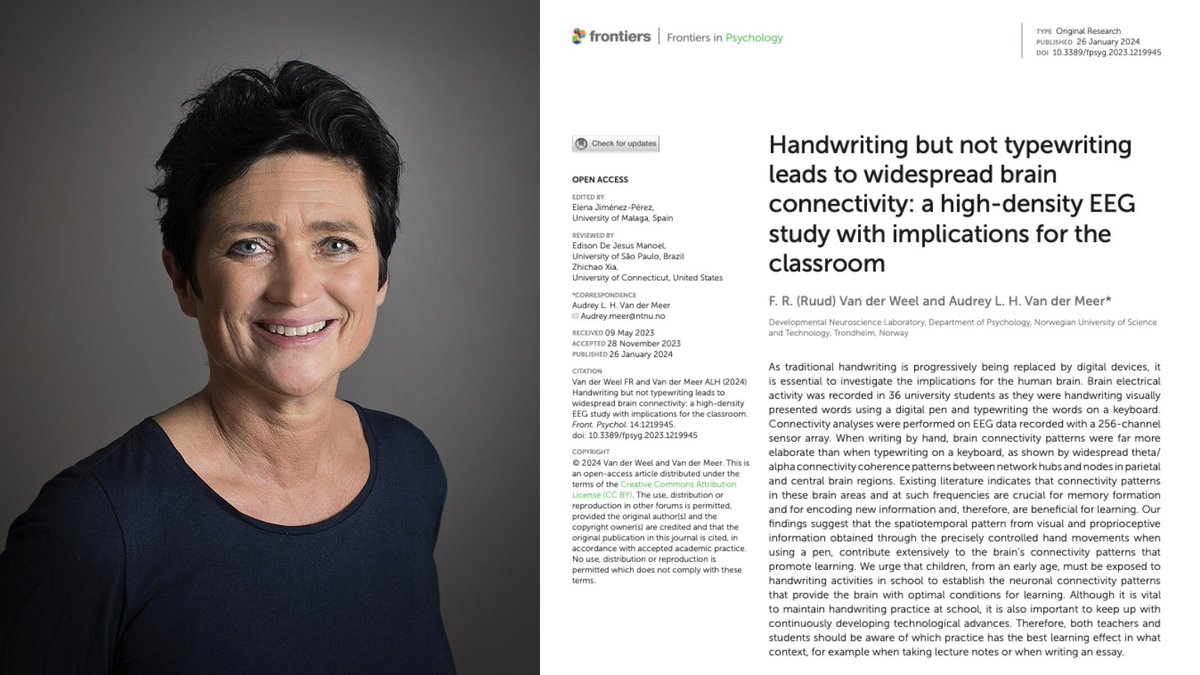
A Norwegian neuroscientist spent 20 years proving that the act of writing by hand changes the human brain in ways typing physically cannot, and almost nobody outside her field has read the paper.
Her name is Audrey van der Meer.
She runs a brain research lab in Trondheim, and the paper that closed the argument was published in 2024 in a journal called Frontiers in Psychology. The finding is brutal enough that it should have changed every classroom on Earth.
The experiment was simple. She recruited 36 university students and put each one in a cap with 256 sensors pressed against their scalp to record brain activity. Words flashed on a screen one at a time.
Sometimes the students wrote the word by hand on a touchscreen using a digital pen, and sometimes they typed the same word on a keyboard. Every neural response was recorded for the full five seconds the word stayed on screen.
Then her team looked at the part of the data most researchers had ignored for years, which is how different parts of the brain were communicating with each other during the task.
When the students wrote by hand, the brain lit up everywhere at once.
The regions responsible for memory, sensory integration, and the encoding of new information were all firing together in a coordinated pattern that spread across the entire cortex. The whole network was awake and connected.
When the same students typed the same word, that pattern collapsed almost completely.
Most of the brain went quiet, and the connections between regions that had been alive seconds earlier were nowhere to be found on the EEG.
Same word, same brain, same person, and two completely different neurological events.
The reason turned out to be something nobody had really paid attention to before her work. Writing by hand is not one motion but a sequence of thousands of tiny micro-movements coordinated with your eyes in real time, where each letter is a different shape that requires the brain to solve a slightly different spatial problem.
Your fingers, wrist, vision, and the parts of your brain that track position in space are all working together to produce one letter, then the next, then the next.
Typing throws all of that away. Every key on a keyboard requires the exact same finger motion regardless of which letter you are pressing, which means the brain has almost nothing to integrate and almost no problem to solve.
Van der Meer said it plainly in her interviews.
Pressing the same key with the same finger over and over does not stimulate the brain in any meaningful way, and she pointed out something that should scare every parent who handed their kid an iPad.
Children who learn to read and write on tablets often cannot tell letters like b and d apart, because they have never physically felt with their bodies what it takes to actually produce those letters on a page.
A decade before her, two researchers at Princeton ran the same fight using a completely different method and ended up at the same answer. Pam Mueller and Daniel Oppenheimer tested 327 students across three experiments, where half took notes on laptops with the internet disabled and half took notes by hand, before testing everyone on what they actually understood from the lectures they had watched.
The handwriting group won by a wide margin on every question that required real understanding rather than surface recall.
The reason was hiding in the transcripts of what the two groups had actually written down.
The laptop students typed almost word for word, capturing more total content but processing almost none of it as they went, while the handwriting students physically could not write fast enough to transcribe a lecture in real time, which forced them to listen carefully, decide what actually mattered, and put it in their own words on the page.
That single act of choosing what to keep was the learning itself, and the keyboard had quietly skipped the choosing and skipped the learning along with it.
Two studies. Two countries. Same answer.
Handwriting makes the brain work. Typing lets it coast.
Every note you have ever typed instead of written went into your brain through a thinner pipe. Every meeting, every book highlight, every idea you captured on your phone instead of on paper was processed at half depth.
You did not forget those things because your memory is bad. You forgot them because typing never woke the part of the brain that would have made them stick.
The fix is the thing your grandmother already knew.
Pick up a pen. Write the thing down. The slower road is the faster one.
A Norwegian neuroscientist spent 20 years proving that the act of writing by hand changes the human brain in ways typing physically cannot, and almost nobody outside her field has read the paper.
Her name is Audrey van der Meer.
She runs a brain research lab in Trondheim, and the paper that closed the argument was published in 2024 in a journal called Frontiers in Psychology. The finding is brutal enough that it should have changed every classroom on Earth.
The experiment was simple. She recruited 36 university students and put each one in a cap with 256 sensors pressed against their scalp to record brain activity. Words flashed on a screen one at a time.
Sometimes the students wrote the word by hand on a touchscreen using a digital pen, and sometimes they typed the same word on a keyboard. Every neural response was recorded for the full five seconds the word stayed on screen.
Then her team looked at the part of the data most researchers had ignored for years, which is how different parts of the brain were communicating with each other during the task.
When the students wrote by hand, the brain lit up everywhere at once.
The regions responsible for memory, sensory integration, and the encoding of new information were all firing together in a coordinated pattern that spread across the entire cortex. The whole network was awake and connected.
When the same students typed the same word, that pattern collapsed almost completely.
Most of the brain went quiet, and the connections between regions that had been alive seconds earlier were nowhere to be found on the EEG.
Same word, same brain, same person, and two completely different neurological events.
The reason turned out to be something nobody had really paid attention to before her work. Writing by hand is not one motion but a sequence of thousands of tiny micro-movements coordinated with your eyes in real time, where each letter is a different shape that requires the brain to solve a slightly different spatial problem.
Your fingers, wrist, vision, and the parts of your brain that track position in space are all working together to produce one letter, then the next, then the next.
Typing throws all of that away. Every key on a keyboard requires the exact same finger motion regardless of which letter you are pressing, which means the brain has almost nothing to integrate and almost no problem to solve.
Van der Meer said it plainly in her interviews.
Pressing the same key with the same finger over and over does not stimulate the brain in any meaningful way, and she pointed out something that should scare every parent who handed their kid an iPad.
Children who learn to read and write on tablets often cannot tell letters like b and d apart, because they have never physically felt with their bodies what it takes to actually produce those letters on a page.
A decade before her, two researchers at Princeton ran the same fight using a completely different method and ended up at the same answer. Pam Mueller and Daniel Oppenheimer tested 327 students across three experiments, where half took notes on laptops with the internet disabled and half took notes by hand, before testing everyone on what they actually understood from the lectures they had watched.
The handwriting group won by a wide margin on every question that required real understanding rather than surface recall.
The reason was hiding in the transcripts of what the two groups had actually written down.
The laptop students typed almost word for word, capturing more total content but processing almost none of it as they went, while the handwriting students physically could not write fast enough to transcribe a lecture in real time, which forced them to listen carefully, decide what actually mattered, and put it in their own words on the page.
That single act of choosing what to keep was the learning itself, and the keyboard had quietly skipped the choosing and skipped the learning along with it.
Two studies. Two countries. Same answer.
Handwriting makes the brain work. Typing lets it coast.
Every note you have ever typed instead of written went into your brain through a thinner pipe. Every meeting, every book highlight, every idea you captured on your phone instead of on paper was processed at half depth.
You did not forget those things because your memory is bad. You forgot them because typing never woke the part of the brain that would have made them stick.
The fix is the thing your grandmother already knew.
Pick up a pen. Write the thing down. The slower road is the faster one.
A kid drew himself sleeping in bed between mom and dad and labeled it 'safe.'
In Japan, this exact sleeping arrangement has a name. They call it 'the river.' Mother is one bank. Father is the other. The child between them is the water. Roughly 70% of Japanese mothers sleep this way with their kids, sometimes through the teenage years. The Western model of putting a kid alone in their own bedroom is barely 200 years old. For most of human history, in most cultures still alive today, kids slept beside their parents.
James McKenna runs the Mother-Baby Behavioral Sleep Lab at Notre Dame. He spent decades watching what happens when parents and kids share a bed. The bodies sync up. Heart rates align with the parent's, breathing falls into the same rhythm, and by morning even sleep stages have started matching. The parent's body, in McKenna's words, acts as a kind of biological jumper cable for the child's.
In 2013, researchers in the Netherlands tracked 193 babies through the first year of life. They measured cortisol, the brain's main stress hormone. Babies who had spent more weeks co-sleeping in the first six months produced less cortisol under stress at 12 months. Sleeping near a parent had rewired the kid's stress system to be calmer under pressure.
Inside the kid's brain at night, the amygdala, the fear alarm, gets more sensitive as the body gets tired. Darkness makes it worse. A 2021 paper in PLoS One from Australian researchers showed that light directly suppresses amygdala activity. Lights off, alarm louder. The whole brain is wired to read 'alone in a dark room' as a threat.
Now add a parent's body to that bed. The kid's nervous system reads warm body, breathing nearby, familiar smell. The threat alarm dials down. Two parents on either side dial it down twice. The drawing is the kid's brain calculating maximum safety: I am surrounded by the people who keep me alive, and nothing can reach me without going through them first.
The arrangement in this drawing is what most of human history called 'sleeping.' Sleeping the kid alone in another room is a 200-year-old Western invention that we forgot was an invention. Every kid who has ever padded into your room at 3am and crawled into the middle of the bed is just trying to redraw the picture.
Joe Rogan and Abigail Shrier nailed a truth that feels increasingly rare to say out loud.
In our safer, more comfortable era, the threshold for what counts as 'trauma' has dropped hard. Rogan put it simply: the 'worst thing that’s ever happened to you' is totally relative — a dented car can feel like the end of the world if that’s your biggest reference point.
Shrier took it further: throughout human history, people lost parents, siblings, homes, and jobs… yet most rebuilt, formed families, showed up for work, and kept living. Resilience was the norm.
Today we’re often telling kids that normal life struggles equal trauma they may never fully overcome.
This conversation made me pause. It seems like many of us have turned ordinary setbacks into major emotional events. Our comfort might be quietly training people to be more fragile than generations that faced far worse.
If we keep labeling everyday hardship as trauma, we risk raising people who lack the toughness that helped humanity survive real adversity for centuries.
Have we over-diagnosed trauma and under-taught resilience — or is modern life actually harder on the mind?