Not terribly surprising; AI often generates trash (although this doesn't obviously look terrible), and using AI for something that is supposed to have heart and has so much nostalgia associated with it is probably going to rub people the wrong way.
https://t.co/qBKlfjyy5t
Interested in experimental design? In this new @JEPS_ed article, @MIT_SSP PhD Candidate Ben Harris and I explore whether using contextually realistic graphics (rather than plain text) in survey instruments affects experimental outcomes (1/3)
https://t.co/Be0KhjGXZ1
Two days ago, a lawfirm filed a federal antitrust lawsuit against 6 commercial publishers (incl Elsevier & Wiley) in the federal district court in New York.
They allege a 3-part scheme on part of publishers. 🧵
https://t.co/BswKVg5l5G
@jayvanbavel And holding constant the type of fraud (data manipulation
fabrication), you're probably more likely to get caught in academia than in industry.
Erin Hennes (UMissouri)- a great person and supervisor - is looking to hire BAs; if you have recent psych undergrads that are interested:
Research Specialist I (Lab Manager) (Job ID: 51684).
Project Coordinator for the the mpower project (Job ID: 51766)
https://t.co/KrxGA3Nv7w
GRAD SPOTLIGHT: Sahel Zaboli, Marketing PhD
"I’m thrilled to begin my role as an assistant professor of marketing at @nyit this fall. The opportunity to inspire and shape the minds of future marketers is truly exhilarating. I can’t wait to start this exciting journey!"
Once, we ran a study on Prolific and a participant wrote on Reddit that the study “Felt like I was losing the will to live.” I went on the Prolific Subreddit (24k members!) and asked what matters. Here is what they told me. A thread on happier participants and better studies 1/9
Don’t ever display text u less you want someone to read it right then. That means use animations to add one SHORT bullet at a time. Each slide should build. Practice it and have stuff “magic” onto the slide as you talk.
With each update, Word gets more and more out of control with the grammar check suggestions. Your job is to tell me if I accidentally write "pubic policy" instead of "public policy". Otherwise please go away
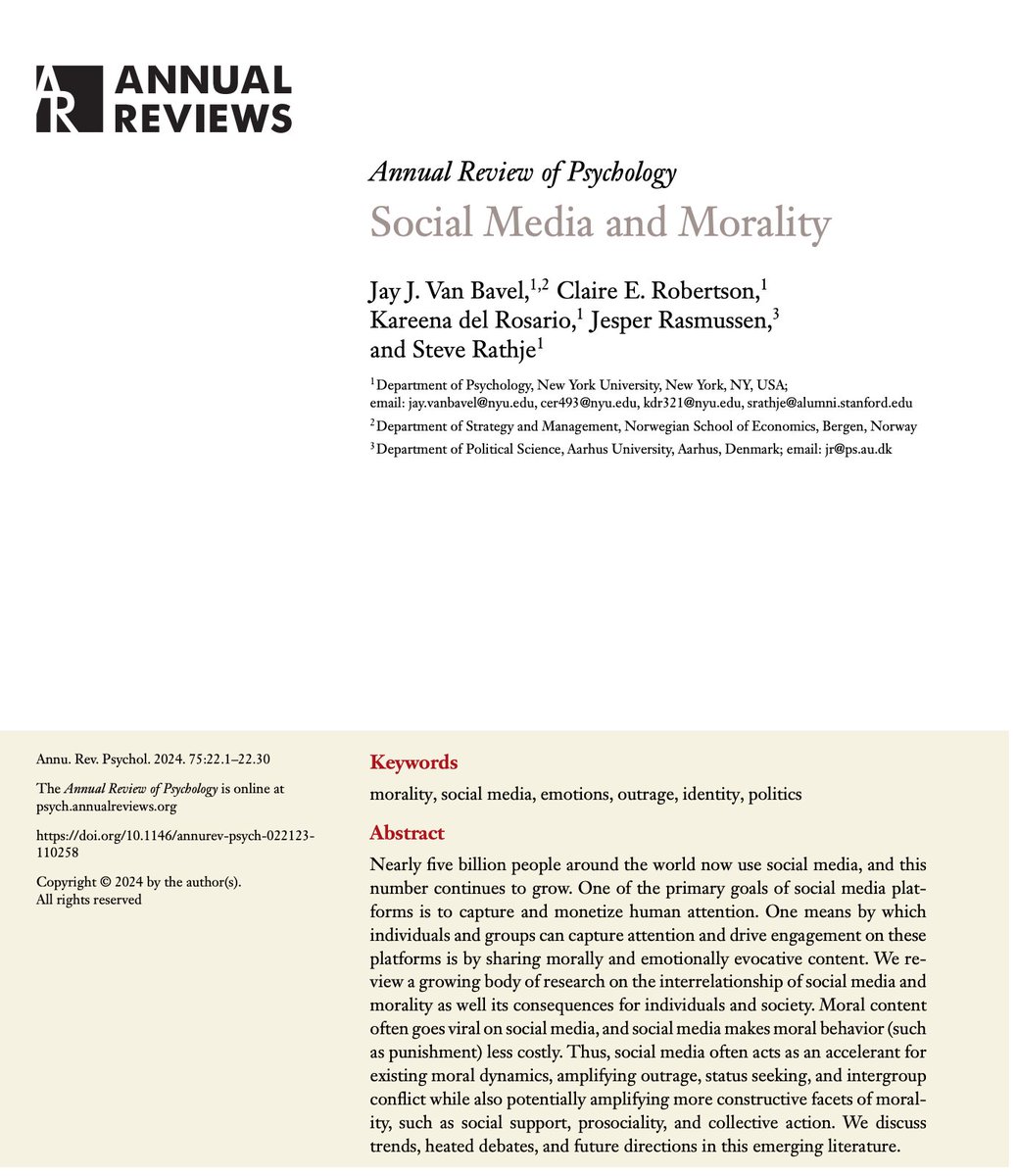
We have a new paper on "Social Media and Morality" in @AnnualReviews | https://t.co/JHsIMgZuTZ
Nearly five billion people around the world now use social media, and this number continues to grow. One of the primary goals of social media platforms is to capture and monetize human attention. One means by which individuals and groups can capture attention and drive engagement on these platforms is by sharing morally and emotionally evocative content.
We review a growing body of research on the interrelationship of social media and morality as well its consequences for individuals and society. Moral content often goes viral on social media, and social media makes moral behavior (such as punishment) less costly. Thus, social media often acts as an accelerant for existing moral dynamics, amplifying outrage, status seeking, and intergroup conflict while also potentially amplifying more constructive facets of morality, such as social support, prosociality, and collective action.
In this paper, we discuss trends, heated debates, and future directions in this emerging literature.
Thanks to my brilliant co-authors @CRobertson500 @KareenadelRosa @jrpsau@steverathje2
Our new paper in @Nature evaluates the accuracy of social and behavioral policy recommendations during COVID19 (from https://t.co/HFM21yHc9H)
We reviewed 747 papers (mean N = 16,848) and found evidence for 89% of our central claims: https://t.co/HFM21yHc9H
The strongest evidence supported claims that anticipated culture, polarization and misinformation would be associated with policy effectiveness.
Our claims suggesting trusted leaders and positive social norms increased adherence to behavioural interventions also had strong empirical support, as did appealing to social consensus or bipartisan agreement.
We also present a novel approach to analyzing policy evidence that could be useful for future pandemics, public health crises, climate change, etc.
This paper was an absolute beast, led by the tireless @kairuggeri and we had two teams of experts review all the evidence independent of one another to provide a rigorous evaluation of the claims.
I was co-last author with @RobbWiller (we determined last author order with a NBA Playoff pool, which he won handily).
Please see the full list of authors here: https://t.co/p8mpNsoiq7
Homelessness can happen to anyone, including me, as the senior author of this paper.
When I got my PhD from @Princeton in 2013, my housing lease expired, I could not leave the country as my student status also expired, and my work permit from the Canada was in limbo because the Canadian consulate was on strike. So I was homeless, due to no fault on my own.
But thankfully I had amazing friends who let me couch surf for weeks on end, while at the same time I was starting my lab remotely in Vancouver as a new faculty at @UBC. I was lucky to have different couches to sleep on but the stress was horrendous!! The work permit finally came through after 3 months of waiting, I was able to fly to Vancouver, got my first pay check and housing. The rest is history.
I just want people to re-consider what a homeless person is like. For every homeless individual on the street, there are 2-3 times more hidden homeless people couch surfing or sleeping in their cars. They just need cash to get back into housing. That’s why I did the study, together with Foundations for Social Change.
@F4SocialChange@naehomelessness@homelesshub@NationalHomeles@CAEHomelessness@homelessimpact@COHomelessness