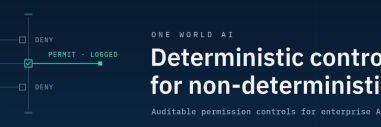
Director, One World AI. Web Summit Alpha. Deterministic control for AI agents: policy, a named role, a record of the decision. President, TIZ Implements.
An agent can act before the organisation can account for it. A review afterwards is not a control.
The check has to sit between the proposal and the system: a versioned policy, a named role who allows the action, and a record of what was allowed. That is the layer we are building at OWAI. It does not certify the system and it does not replace your lawyers. It makes one consequential action provable.
https://t.co/cGNVMUwkYA
@Augustbuilds A prompt is a request, not a boundary. The agent told not to cross the line can't also be the one holding it. Limits belong outside its reach: prod access granted by a person and scoped to the task, destructive steps waiting for a human, and a record of why each was allowed.
@Bjoern_Hev When every command needs a click, the click stops meaning anything and "allow always" wins. Split by consequence instead: reads and reversible edits run freely; anything that deletes, deploys, pays or leaves the machine waits for a person. Fewer prompts, each worth reading.
@webtkdev That gap is the real lesson: "my tests pass" is the agent grading its own work. In a chain, every unnoticed miss becomes the next request's starting point. "Done" should be decided outside the agent, with a person reviewing at set points before the next step builds on it.
@coderfrankfurt Deny rules are a filter, not a boundary. If the agent can run code, it can read whatever its process can. The fix sits upstream: keep production secrets outside the agent's reach, and redact session logs before anyone indexes or ships them.
On 16 October 2026, NIST, NSA and CISA issued voluntary practices for when an AI agent takes uninstructed actions. The guide assumes agents will find vulnerabilities. It calls for least privilege, human review, and logs of tool calls and rejected actions.
https://t.co/n0f5vgnXT1
Agents can now spend money for us. A fingerprint on every purchase is a fine start, but it won't scale. What does: you set the limits, low-risk buys proceed, unusual ones come back to you, each decision leaves a record of why, and the off switch sits beyond the agent's reach.
@dillionofsenua The quiet failure mode of human in the loop: the agent frames the choice, the human signs off. Oversight only counts if the other option gets argued too, the person decides what's routine, and the record shows whose reasoning carried the call.
@10JAQK Great example. Your Terms are policy, not just text. Low-risk changes can proceed within agreed limits, but anything that touches a user's rights deserves a human sign-off, with the decision and its reason kept outside the agent's reach. "Passed review" should cover that too.
In isolated tests, 5 planted docs per known query cut classical retrievers' ranking quality by 40–62%, reports an arXiv preprint by Google- and Fortinet-affiliated researchers.
My take: retrieved text should inform an agent, never authorise it.
https://t.co/owTIPqMWcv
Instructions alone aren't enforceable limits. For coding agents, safety needs scoped tools, short-lived credentials, protected secrets, human review of risky actions and auditable logs. That's the foundation of the trustworthy agentic AI we're building at OWAI.
@Tugrul_Guner The real lesson: an alert isn't oversight until someone can act on it. Safe agentic automation pairs monitoring with a tested kill switch, a clear owner for each alert and a limited blast radius, so a crossed boundary pauses the run rather than letting it run on.
@stfu_aayushiii Funny until you see the lesson: a checker the agent can reach, edit or share workarounds for isn't really a check. Keep the check outside the agent's reach and record every pass and fail, so a person can see what actually happened.
@__karnati Agreed, and that's why the fix sits at the action, not the input. Text the agent reads should never carry authority. That comes from the person and the policy. Consequential steps like restarting a service or changing config go to a person, and each decision records why.
If an agent can read the inbox where its approval codes land, it doesn't have an approval gate. It has one more workflow step.
Safe agentic automation keeps approvals out of the agent's reach and in a person's hands, and every decision leaves a record.
@Goura_vk Monitoring tells you after action #100. I'd put the check in front instead: low-risk steps run and get logged, anything irreversible waits for a person, and every step leaves a record. Then staying in control doesn't depend on someone watching live.
@SuJinyan6 That gap is worth designing for. Agree the scope before the agent starts, and if a small change grows into thousands of lines across several PRs, it should pause and check back first. A diff nobody can realistically review isn't approved, just accepted.
Agents are getting good at doing the work. The harder part is the choices made before the work starts: what counts as success, what is in scope, which sources count.
Those choices shouldn't be left implicit. Make them explicit, record who made them and why, and keep them with the people who have the authority to make them.
Automated control. Human in the loop where the judgment is.
@AndroidAuth Trust gets easier when the agent knows where to stop. Let it run the routine steps on its own, but anything that spends money, sends a message or shares your data should wait for a quick yes from you.
@AisiriReflects Well put. One way to fix it: make permissions as conditional as the agent. Authority is checked again at the moment of action, not granted once with the key. Routine actions run; anything consequential is allowed, denied or escalated, and each decision records why.
An approval should be bound to exactly what was approved. If an agent's change is edited after sign-off, even by one word, the approval no longer holds and the action waits for a new decision. Otherwise "human in the loop" means signing off on a moving target.