Nonprofit consulting firm supporting efforts to advance the role of strong curriculum, value of deep content knowledge, & evidence-based instructional practice.
Critical thinking is a cornerstone of education. In the age of AI, the challenge isn't accessing info—it's teaching Ss how to question, analyze, and make meaning of it. Yes, knowledge is one ChatGPT away; thinking is not. 📚 →🧠 → 💡@Chalkbeat@rastokke https://t.co/CjSuQhhQu4
In 𝘏𝘰𝘸 𝘞𝘦 𝘓𝘦𝘢𝘳𝘯, Stanislas Dehaene—one of the world’s leading cognitive neuroscientists and winner of the Nobel-equivalent Brain Prize—identifies the 4 Biological Pillars of Learning. Without all 4 of these pillars in place, learning is fragile and will not last: 🧵
Scaffolding isn't just for little learners. It's the secret to unlocking writing for high schoolers, too. 🪜
"This workshop gave relevant examples of how to integrate and modify activities while maintaining the integrity of the program. The scaffolding examples were wonderful!"
— Teacher, Grades 9-10, Cut Off, LA
TWR builds teacher efficacy by modeling strategies in action and putting practical tools right into educators' hands — including Judy, our AI assistant that co-creates custom, on-topic activities for any class. Ready to see how it fits in yours? #TheWritingRevolution #SecondaryEducation #WritingInstruction
Sometimes you read something and immediately think, we need to talk to this person.
That’s exactly what happened when we read Luke Morin’s article about what readers need when texts get complex. https://t.co/SVEEQSUMmR
So… we invited him on the podcast. Episode drops Friday.
Teacher read alouds still matter.
They build: • vocabulary • comprehension • fluency • engagement • community around text
Students benefit from hearing what skilled reading sounds like.
A great read aloud can change how students feel about reading.
#ReadAloud#Literacy
Passing science of reading laws is only the beginning.
As @The74 reports, our latest study finds uneven teacher knowledge, persistent gaps in high-poverty schools, and continued use of discredited reading methods.
Read more: https://t.co/ts4m62s9u1
Luke Morin uses lily pads as a metaphor. 🪷 Readers need enough support to make progress through a challenging text, but not so much that the thinking is done for them. 📖 🧠 https://t.co/tz8no9zZ6A
New episode w/ Luke drops TOMORROW!
As @natwexler recently shared, one of the biggest myths in education is that young kids aren’t interested in “big” topics.
Knowledge-building curriculum keeps proving the opposite.
🔗 https://t.co/03jRr3gzzN
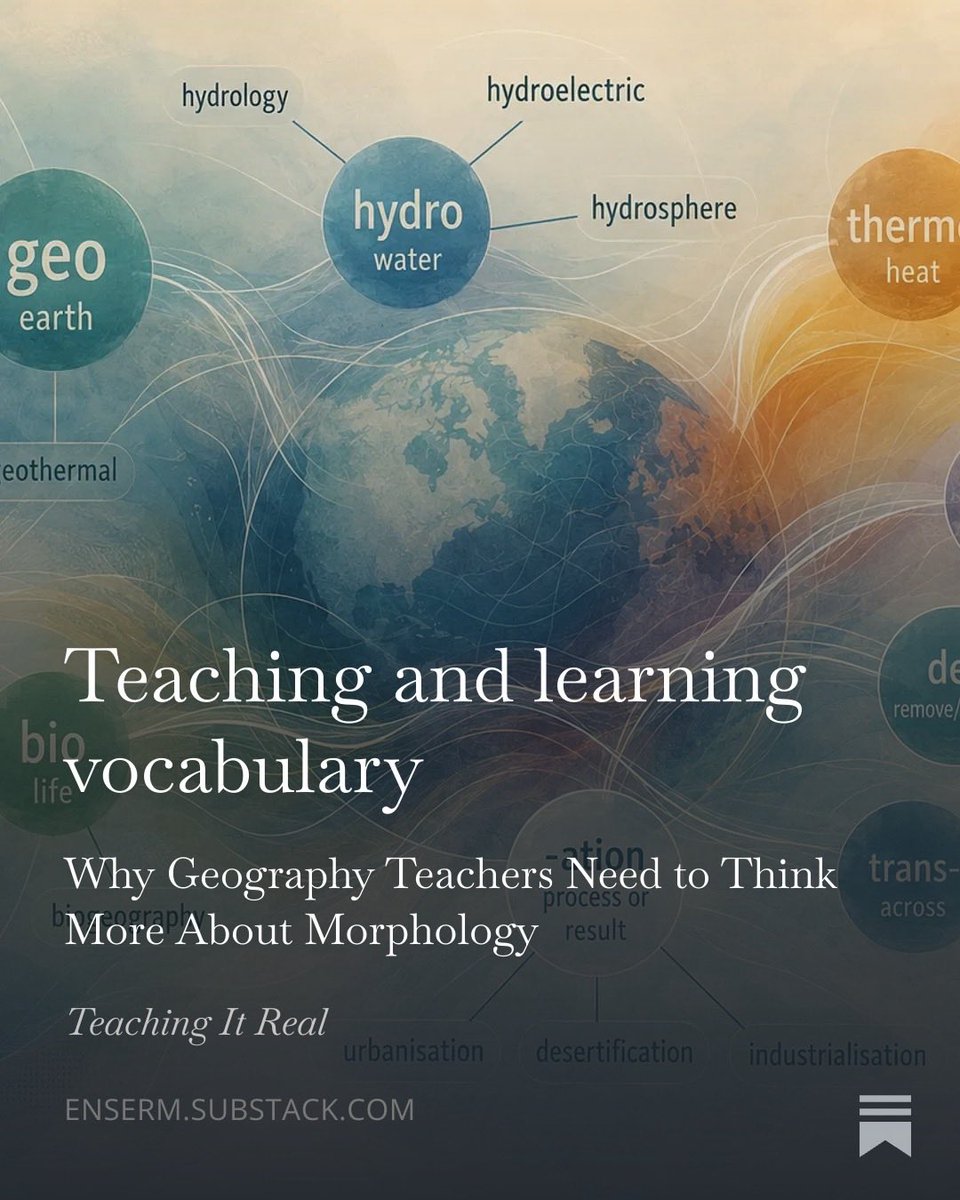
An excellent blog by @EnserMark on ‘Teaching and learning vocabulary’ in geography.
“Once we begin to look for morphology in geography, it becomes impossible not to notice how saturated the discipline is with these patterns.
https://t.co/QpLtdoKFHg
Here’s the big problem, in my opinion, with standards like this: there is no explicit mention of the knowledge students should acquire before engaging in inquiry. Standards like this, whether intentionally or not, bury a very important headline: students need knowledge before they can successfully engage in inquiry, application, and analysis.
For teachers, this can be very misleading. I’ve fallen into this trap myself, assuming the intention was to lead with inquiry and application first. But inquiry is not a substitute for knowledge acquisition; it depends on it. Students cannot meaningfully analyze, evaluate, or investigate concepts if they lack the background, domain-specific knowledge those processes require.
When prerequisite knowledge is left implicit instead of explicit, it can create the impression that inquiry itself is the starting point rather than something built upon a strong foundation of knowledge. The result is often students being asked to “think critically” about content they do not yet know well enough to think critically about.
@SoLInTheWild@KnowledgeMatrs So agree! Then we wonder why the inquiry model leaves students short of depth and rigor. We end up with lots of “I see…I think…I wonder” let’s add in “I know…therefore…” I don’t yet know…so I wonder..”
After my first full school year committed to explicit instruction, cognitive science, and knowledge-building curriculum, my summer work looks very different.
I’m not spending the summer overhauling my instructional approach. That work has been done. This summer is all about refining:
1️⃣Automating Knowledge for Future Use and Learning
2️⃣Sequencing Curriculum for Cognitive Coherence
3️⃣ Routines as Cognitive Supports
All of this work will be through the lens of the Modal Model of Memory.
New blog: “What I’m Refining After a Year of Explicit Instruction”👇
The new @educationweek piece highlights our #HistoryMatters Review Tool and how it helps schools evaluate whether history curriculum actually builds coherent knowledge across grades instead of disconnected activities and worksheets.
https://t.co/Mju2mgzIs3
As I begin refining how I sequence our curriculum around the idea of, “We are learning this today because of what we learned yesterday and because it prepares us for what we will learn tomorrow,” it has become increasingly apparent that one of the most significant problems with how curriculum is packaged and presented to teachers is that it is often not informed by evidence related to the limitations of working memory and memory consolidation.
For example, one chapter I’m reviewing on the regions and cultures of Nigeria recommends that students spend 30 minutes reading a 13-page chapter covering three different regions, including differences in culture, economy, history, and ways of life. Strong readers may be able to complete the reading in that amount of time, but their working memory will likely be overloaded as they attempt to juggle so much unfamiliar information while rapidly moving from region to region and only briefly pausing to take a couple notes.
As a result, very little of the content is likely to be strongly encoded into long-term memory or connected to prior knowledge in a meaningful way. I also know of teachers who regularly attempt to cover an entire chapter like this in a single class period, which only compounds the problem by prioritizing coverage over learning.
Instead, I would modify the sequence by devoting a full class period to each of the three regions so students have the time to build and consolidate knowledge about one region at a time. Then, I would dedicate a fourth lesson to comparing the regions, allowing students to retrieve and connect prior learning rather than encounter all of the information simultaneously. This approach is far more aligned with what we know about working memory, schema development, and meaningful learning.
At the end of the day, this creates a significant challenge for teachers, assuming they are knowledgeable enough about cognitive science and evidence-informed practice to recognize that these changes need to be made and have the expertise to implement them effectively.
"The data from this research sheds light on the importance and impact of language in the classroom. Educators can positively impact students’ decoding ability by being word-conscious and elevating and expanding the vocabulary they use every day."
https://t.co/AzdYk5SNzT
Another post related to refining curriculum coherence. More issues with curriculum providers.
From my understanding, one of the key characteristics of a true knowledge-rich curriculum, not just in the buzzword sense, is how knowledge intentionally builds and connects throughout units, lessons, and chapters. Today’s lesson is not isolated. It is building on knowledge previously learned while also preparing students to learn future knowledge.
Based on my experience with curriculum providers, including the one I currently use, these characteristics are frequently missing. There are often no intentional or explicit connections made between prior knowledge or or lessons, recurring concepts, and understandings embedded throughout the curriculum.
Because of this, one of my current refinement focuses is putting together a reference page for each unit for both myself and my PLC that helps us intentionally make those connections more explicit.
We love how Ms. Suri-Kumra (Woodbury Elementary School in MN) is scaffolding TWR strategies for her first graders!
In her words: "After reading Stellaluna, we completed the TWR topic sentence and details activity. We completed this activity whole group using the pocket chart (pic attached). We talked about where each detail belonged and why. My class has the multilingual learners, so we did lots of oral rehearsal and partner share. The next day we went back to the pocket chart and filled in the details again. After completing the chart we worked together and rehearsed how to turn the fragments into complete sentence. We did this for the topic sentence how Stelllaluna is similar to birds. After this about half of the class worked to turn their topic sentence and supporting details into a paragraph. The remaining students stayed on the carpet, and we looked at how we could turn the fragments into complete sentences for how Stellaluna is different. These students have stronger writing skills so I rehearsed with them how to use but to write a compound sentence. They then worked on turning their topic sentence and details into a paragraph."
"Customers find the book highly informative, noting it provides an excellent introduction to the science of learning. The book receives positive feedback for its concise instructions and how it clearly explains what explicit instruction entails."
https://t.co/xrm3xiWEM9
Two-fifths of secondary students—and about half of disadvantaged students—aren’t assigned enough full-length books.
Misguided curriculum is part of the problem. But it’s not the whole story.
Read Meredith Coffey:
https://t.co/HJMnuuZmGc