@TheFlowHorse This used to be like that:
"They start believing in the coin, the community, the movement, and suddenly nobody wants to be the asshole who sells first."
Now its max 5 mins hold and cya
My brother in crypto @ExUnico here dropping some truth.
memes aren't bad, rug pulls are.
also, most of the reasons why people don't like memecoins is because they haven't hit any runners aka pure tasty salt. I get it.
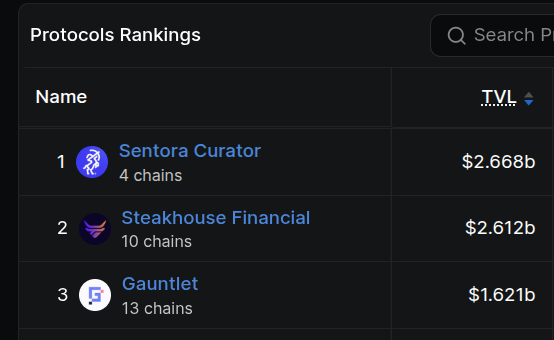
Congrats to @SentoraHQ on reaching #1 on the Curation TVL leaderboard.
Did Steakhouse just lose $500M in TVL?
Nope, @DefiLlama just fixed a double-count bug in how they track Morpho V2 vaults.
Good to see curator TVL getting cleaner 🫡
From an average lender’s perspective, I’m increasingly skeptical of RWA lending markets where the underlying asset has no secondary market and liquidity depends primarily on slow redemption.
Reported NAV can tell me the accounting value of the backing, but it tells me much less about how much stress that portfolio can absorb before lenders take losses, or what price the asset would clear at if liquidity is needed immediately (imagine immediate stress and 60% of portfolio backing is 90+ days loans).
Without a secondary market, there is also no continuous price signal showing deterioration in credit or liquidity conditions. Underwriting then depends much more heavily on understanding the underlying legal structure, creditor rights and redemption mechanics, which is difficult for an external lender without access to internal documentation.
For a crypto-native lender, that feels especially alien. We are used to imperfect but observable systems where activity can usually be reconstructed onchain. With many RWAs, a material part of the underwriting moves offchain and becomes opaque precisely where you need the most confidence.
Maybe the longer-term answer is to bring more asset issuance, credit origination and servicing onchain. Before that, the simpler step is probably to make enough of the underwriting surface public (all those docs that get in curators' hands).
Technically, probably yes. Economically, Morpho is trickier because the fee would hit lending economics that are already pretty thin for most curators outside the largest ones. I think there is a fee level where it works, but it depends on who ultimately absorbs it. Value accrual complicates it further because it is not obvious what the best use of that revenue is: buybacks, market incentives, treasury accumulation, or some combination of those.
It’s an open secret that vault curation is a low-margin business unless you have enough AUM, distribution, or adjacent revenue streams. For anyone outside the top few curators, vault fees alone are unlikely to support operating leverage.
There is also a clock on Morpho monetization. The longer the protocol grows without a fee switch, the more integrations, vault economics and distributor agreements get built around the existing zero-protocol-fee structure. Introducing a protocol take later means repricing an ecosystem that has already optimized around the absence of one, so the commercial friction increases with time.
I think it’s cool that we have Herd for mapping contract and economic dependencies.
But who is building the equivalent for RWA legal dependencies? Because as more RWAs come onchain, we’re going to spend a lot more time tracing/reviewing those structures.
@AzFlin@Stefan_3D_AI Lol @AzFlin went through the actual struggle of creating and monetizing a game, so now he probably wants to throw at least a little shade at every AI-generated game demo. I feel you.
And btw, have you heard all that stuff about legal people getting completely annihilated by LLMs?
In some instances, sure. Like “oh Mr. Powerful Lawyer, please provide a Very Serious Legal Opinion™” that may say almost nothing but is somehow sometimes required.
But “help me structure the legal entities for my obscure RWA”? Yeah, good luck replacing actual lawyers with an LLM there lol (for now?).
I think it’s cool that we have Herd for mapping contract and economic dependencies.
But who is building the equivalent for RWA legal dependencies? Because as more RWAs come onchain, we’re going to spend a lot more time tracing/reviewing those structures.
read the SEC's new crypto assets FAQ
the securities laws are starting to look opt-in now, at least as applied by the SEC to crypto
if you raise money by selling a non-rights-bearing token, are careful about what you represent or promise, and have a functional crypto system, there is now an extremely broad path outside the securities laws--arguably 'functionality' is not even necessary but there's some equivocation on this
the buyback guidance goes further than I expected. once the system is functional, even announcing a token buyback *program* (which I guess even could be a 'perpetual program') does not, in the staff's view, constitute a promise of essential managerial efforts. same for promises to improve the system or grow its network effects
so you can retain enormous influence over the thing, keep developing it, support its price with buybacks (including under a permanent "program"), and get many of the benefits of having a public investment instrument, without giving holders the rights or protections that normally come with one
they have opened a loophole in a regulatory regime whose whole point was supposed to be that you couldn't draft your way around economic reality (see e.g. https://t.co/mrH9hPUUMU)
can't really say if this is good or bad, but VCs etc. got a lot of what they wanted & the market should absorb all the implications of this
among others, I am growing skeptical how much of a 'long tail' there will be for tokenized equity. . .if you can get people to buy a coin in the style of BNB, HYPE, PUMP, etc., with minimal regulation, why voluntarily take on the burdens of selling them equity? if you are not mag-7 level, it doesn't seem there would be much reason to focus on equity securities for your capital-raising. . . if you want to access 'traditional buyers' you can wrap the token in an equity instrument like an ADR for those institutions. . .
the obvious next question is how far this extends beyond crypto businesses. can an ordinary company attach a functional token to its business and apply 100% of its profits to discretionary buybacks, without giving holders any right to those profits or making representations about future business efforts that independently trigger Howey? the FAQ doesn't expressly resolve that, but it opens a pretty enormous door
equity still gives investors something a discretionary buyback token doesn't. . .the question is whether the market will pay enough for those rights to make granting them worthwhile. otherwise the incentive is to keep the equity for insiders and sell everyone else the coin
crypto's current focus on hyping tokenized equity may be misguided, the bigger trend is "get all the benefits of equity with none of the burdens"
of course this is SEC guidance, not a repeal of the statutes or a command to the courts. a private plaintiff or a future SEC could have other ideas
but did not think I'd see it in my lifetime. . .the securities laws are being "disrupted" in substantial part by incentivizing making fewer commitments to investors. and if Warren Dems eventually take control and try to undo all this, after an entire market has organized around it, the resulting chaos will be something to behold
https://t.co/eqaJCVljEL
I’m open to any intern role where I can guarantee that your official X account produces zero reputation-destroying posts and has zero dependency on AI-driven tools.
If this long-tail risk somehow still materializes, I’ll take the fall for you.
DMs open.
@DrPayFi@arc@humafinance Hey @DrPayFi, please check your DMs when you get a chance. I’m doing independent DD on PST and have a few legal-structure questions.
@francescoweb3 I think it’s quite crazy the other way around if they wouldn’t leverage AI for content and marketing. It should absolutely be used for research, ideation, etc., but the final output should still be reviewed and adapted by a human.
Will read, but before that I’ve always had this tension in mind. Especially when agents are allocating capital, we want to constrain and bound them so they don’t have 100% freedom, right?
But then if we want to bound agents and make their probabilistic nature more deterministic, why not just use algos or scripts where needed?
You know what sucks about doing RWA DD? Before anything else, you need to dig through obscure legal docs and understand all the legal protections and how the different entities are connected.
I think that’s mostly doable for risk operators who get access to internal docs. For anyone outside that circle, it’s often close to impossible.
So yeah, RWA projects, please be more transparent.
Aave/LlamaRisk V4 on Base is proposing a dedicated market where Coinbase B20 versions of the Mag 7 can collateralize USDC debt.
equity trading is session-bound while DeFi credit is continuous. Chainlink holds the last published equity mark through weekends and holidays, so off-hours price discovery is realized onchain as a discrete oracle repricing at reopen. a position can cross liquidation thresholds in that jump, while executable exit liquidity may still be constrained by the underlying market’s trading and redemption windows.
the parameters are calibrated to liquidation execution. collateral factors cover the drawdown from the last published mark to the next executable exit, while caps constrain exposure to the amount that can be cleared through available liquidation capacity.
this is the path for tokenized equities to become usable balance-sheet assets in DeFi.
Stocks close for the weekend. @aave doesn't.
Over weekends and holidays, the price feed holds its last value and the reopen reprices everything in one step. Our parameters are built around that gap.
Parameters: https://t.co/YJr3tFwfVC
Token review: https://t.co/S8S2cqUiea