@thsottiaux 5 hour limit forces a scarcity mindset where you’re afraid to aim big because you might get sidelined soon after you sat down to work. I upgraded my subscription to not have to think so much about how to ration tokens, and just focus on building
Capabilities in AI and space exploration at improving at a pace few fully appreciate. They’re linked, and will become increasingly intertwined as smarter computers enable more ambitious missions where autonomous ‘crews’ make real-time decisions in space. Data lag was the barrier.
Our two biggest themes when it comes to how super intelligence can help NASA:
- What have we missed in the roughly 150 petabytes of data NASA has already collected, and what discoveries might we otherwise miss in the enormous volumes of data we will receive from future missions like Roman?
- What entirely new missions become possible when we leverage super intelligence for spacecraft design (including advanced high-temperature material development), mission planning, and onboard autonomy (including reactor control), especially for missions where communication delays make real-time control from Earth impractical.
@george_rinyu_jr@spacexx08@WhiteHouse Deploy solar power. It’s always sunny in space 🌅 and the moon has low gravity, less force required to deploy things from there
@spacexx08@WhiteHouse WE have changed. We can do things on the moon now that we could not have dreamed of in 1972. The version of space exploration that we grew up knowing is changing.
Important note regarding Grok @Bot:
Going forward, @SpaceX will use the best back end model for any given task, including Claude Opus 5.5, MidJourney, Suno and other leading APIs.
Whatever is most likely to give you the best outcome.
@SawyerMerritt@Starlink Starship hauls MASS. At ~2 tons per v3 satellite, that’s over 50 tons to orbit. Each v3 has the wingspan of a 737 ✈️ 20x the network capacity to orbit vs Falcon hauling v2’s 🤯
@thsottiaux Browser and computer use don’t work in a Windows + WSL setup where codex interface is in windows, but agent starts in WSL. Have to use workarounds.
Many counted them out, but they have the capability, the data, and the distribution. They’re deeply embedded in billions of lives. Meta’s quick rebound with muse showed how fast distribution can drive a turnaround. Google will reinforce that point. They passively ingest data from email, search, mobile devices, roads (Waymo). Oh, and they do chips. Others do intelligence VERY well, but the moats, and the future, belong to Google, Meta, and xAI/Tesla (I said it).
I couldn’t see @GoogleDeepMind staying out of the top for long. Many counted them out, but they have the capability, the data, and the distribution. They’re deeply embedded in billions of lives. Meta’s quick rebound with muse showed how fast distribution can drive a turnaround. Google will reinforce that point. They have leading models at the low end and are coming for the frontier again. They passively ingest massive amounts of training data from your email, search, mobile devices, and roads (Waymo). Oh, and they do chips. OpenAI and Anthropic do intelligence VERY well, but I think the future belongs to Google, Meta, and xAI/Tesla (I said it). Where am I wrong?
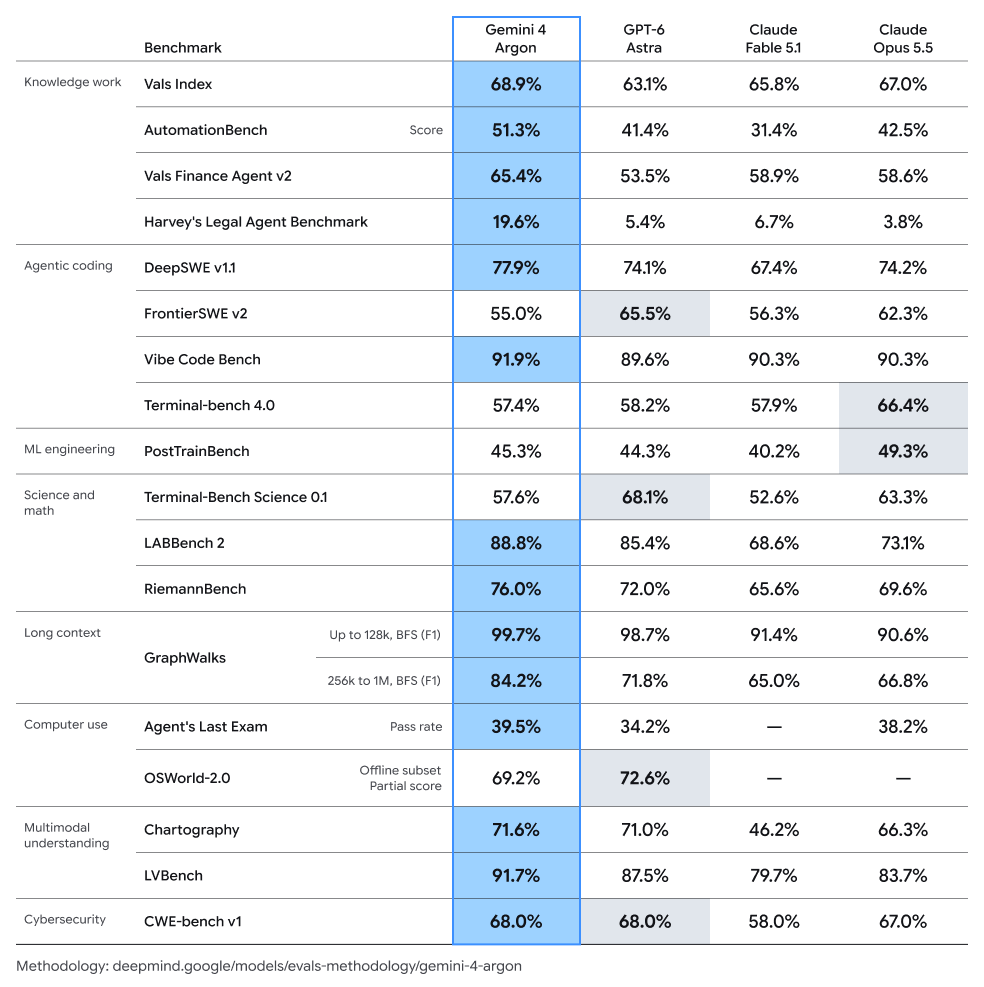
Gemini 4 Argon is our next era of frontier intelligence.
It shows significant improvements across benchmarks, setting a new state of the art for real-world long-horizon software engineering tasks.