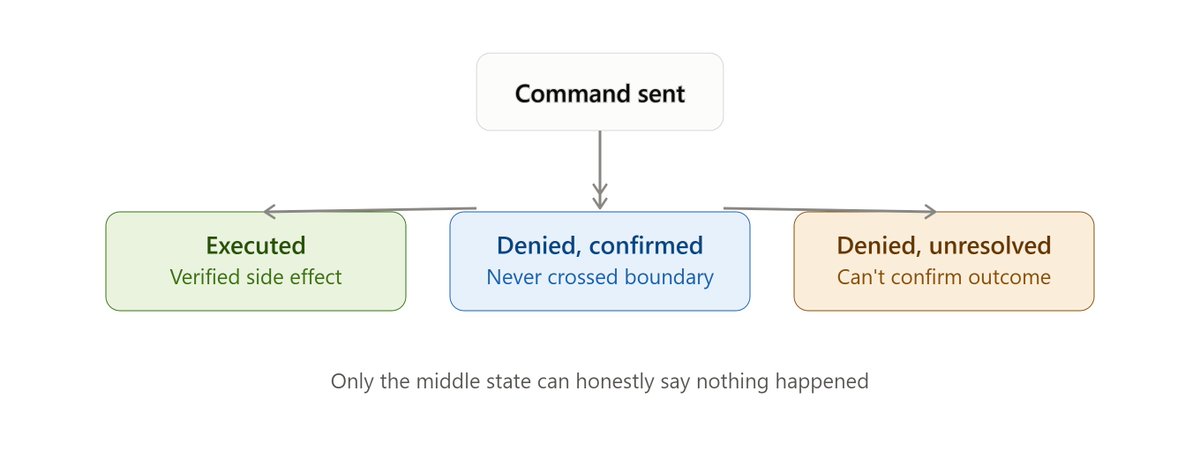
Three weeks deep in confirmation-model design — provenance tags, verified states. Also a comfortable way to avoid the one thing that mattered: a real person trying it. Sent the APK to a friend today. First real data point.
@JustLaunchedFYI Building StareBrain — say a command in plain English, see exactly what it's about to do, confirm before anything runs, then it executes on your phone (text, calendar, calls, device settings). Pre-launch, waitlist open: https://t.co/hAilGJ0rC1
@SamuelPremji Neither, really — at zero, the actual first thing is proving one person has the problem badly enough to pay for a fix. Both product and audience are premature if that's not confirmed yet, and both are easy paths to build once it is.
@jessemusa2 Local-first + kanban/tables + custom automation is the combo Notion and Obsidian each solved half of. That's the hard part. What's the piece you're most worried will be the reason nobody's combined all three cleanly yet?
@willunrendered Flet's an interesting pick for this — what made you choose it over Kivy or straight React Native for a habit tracker? Curious if the Python-first workflow is paying off for someone learning full-stack, or if there's a tradeoff you're already running into.
@jsontsx The flat stretch April-May before it took off is the more useful part of this chart than the growth after — what actually changed there? A specific feature, a channel shift, or just persistence through a plateau that would've looked like failure at the time?
@ClayVerse0 "These sources agree on X, not we measured X ourselves" is a clean way to say it — same distinction a few of us have been calling declared vs. observed this week. Flagging it explicitly is the right move; that gap quietly disappears the moment nobody names it.
@landar26 "Trusted senders for now" is the right honest scope for a v1 — makes sense to launch narrow and add the harder protections (rate limiting, file-type checks) once real usage shows which abuse pattern actually shows up first.
@SamuelPremji Not only — AI answer engines retrieve based on relevance and specificity, not just domain authority. A niche page that directly answers a specific question can get cited over a bigger site that only covers it vaguely. Worth testing on a query only your page really answers well.
Got called out today: I "checked" my own schema and called it fine. Reasoning about your own code isn't testing it — that's where comfortable answers hide. The real test: run one value through the copy path, see what survives.
@HakDimoz Real numbers, not vanity — 777 active subs at 162 days is a genuinely good trajectory. Was there a specific moment or change that caused the jump from early trials to actual paying conversions, or has it been steady growth the whole way?
@GetAlphaShot "Products people actually use" is a bold tagline for a brand-new directory — what's verifying usage versus just tracking submissions and votes? If it's vote-based like most directories, that measures interest, not usage, which is a different claim than the name promises.
@scafonix_com Cross-platform local discovery without an app is the hard part — WebRTC/mDNS, or a relay server even on the same network? Curious how it handles Wi-Fi that blocks local discovery.
@NitinGayke9209 Building for a business that already has real customers is a huge head start most of us don't get — you're skipping the "does anyone want this" question entirely. What's the first feature your dad actually asked for, versus what you think the platform needs?
@Victoriaaaaali This is genuinely lovely — "I didn't just lose her, I lost that whole world" is exactly the kind of specific grief most people never find words for. Scan-the-object-keep-the-story is such a simple mechanic for something that emotionally big.
@brol1dev "Planning for judges" and "60% of users from Android" pull different directions — one's for a panel, the other already showed real demand. Build the demo around what Android users actually do.