1/15 President Trump is the first American president to come to the rescue of the Iranian people and stand against this tyranny. That takes courage and historic vision.
What comes next can't be worse than the Islamic Republic. Believe me, I've lived there, and then witnessed firsthand while serving in the U.S. government how this regime destroyed this country, murdered, suppressed, and forced out tens of millions of generations of talented Iranians.
As a transition away from the brutal regime is taking shape, here is a key issue that needs quick attention: Targeted, phased, and strategic sanctions relief will be essential to empower a democratic transitional government in Iran, one that can deliver stability, national unity, and territorial integrity.
I spent 100 hours over the past week researching, writing and editing the piece we just put out.
It’s a scenario, not a prediction like most of our work. But it was rigorously constructed, dismissing it outright requires the kind of intellectual laziness that tends to get expensive.
And we’ve released it for free. Hopefully you enjoy it.
https://t.co/YK8E11GcDU
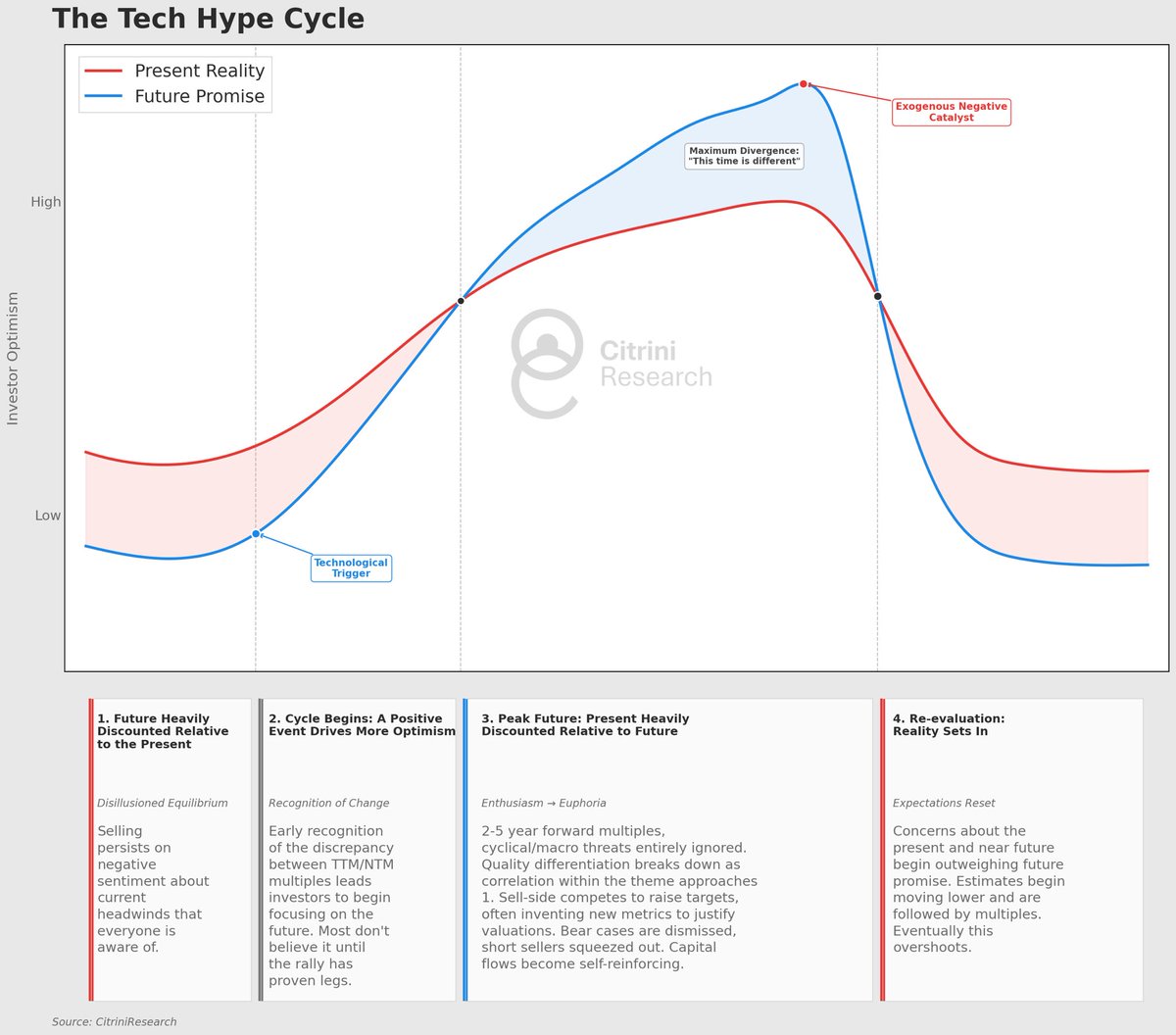
This is how I think about hype cycles in markets. It is basic, but that’s the point (frameworks shouldn’t be overly complex, I think).
Investors are always either discounting the promise of the future or the reality of the present. And they are never equally weighting them.
During the early part of a hype cycle, leading up to and directly following a technological advancement, investors are typically discounting the future while focusing on the present. A good example for this is Nvidia at the end of 2022: investors were solely focused on the headwinds presented by the crypto GPU glut, the anemic gaming PC market and the recent rise in rates causing fears about a near term recession.
Then, as the cycle begins, investors begin to shift to incorporate the future - they stop focusing so much on the present and see the promise. They move out in terms of valuing away from last twelve months current price / current earnings to next twelve months. Then, as price climbs and the technology becomes more exciting, their imagination takes hold. At a certain point they begin discounting the present much more heavily and the future becomes the only thing that matters. Valuation metrics over the next twelve months become useless in favor of 2, 3 or 5 years forward.
At the peak, the present is not considered at all, it is 100% driven by an imagined future (even when that imagination doesn’t necessarily align with a bullish outcome for the stocks driving the rally). Analysts aggressively raise estimates in ways that, at the time, seem fundamentally justifiable (if you take the assumptions at face value - for example, “everyone in the world will have two cell phones” was a good one from the mobile phone hype cycle). Capital is sucked in which ultimately forces performance chasing and crowds stocks with money that doesn’t really believe in the thesis. “A twilight period where people continue to play the game, but no longer believe in the rules” emerges, as Soros put it.
The valuation of SaaS stocks in mid-2021 is a great example of what happens when the future is overvalued relative to the present - nobody cared about climbing inflation, that rates had nowhere to go but up, that these companies were reliant on ZIRP or that software could become more competitive.
Then, a negative catalyst occurs - this can but doesn’t have to be related to the technology, macro, credit, underwhelming earnings. The estimates start to seem unattainable, and the present begins to matter more when the future seems more uncertain. That exact mechanism that drove future optimism to unsustainable heights mechanically reverses, everyone needs out. The future begins to be discounted until it results in a sense of disillusionment with not just the stocks but the technology itself. This overshoots to the downside, investors eventually become disillusioned and seemingly allergic to anything having to do with the technology. This happens in a very asymmetric manner to the climb (“stairs up, elevator down”).
This is the crucible in markets for truly transformative tech. If advancements persist, another opportunity to get long presents itself before capital once again begins flowing into the companies (the internet, for example). If they don’t - not necessarily “the tech goes away” but rather that it ceases to advance once the capital isn’t free or plateaus or the economics prove to be unfavorable - the cycle will still start again, just with a new technology.
Or maybe not…maybe this time is different.
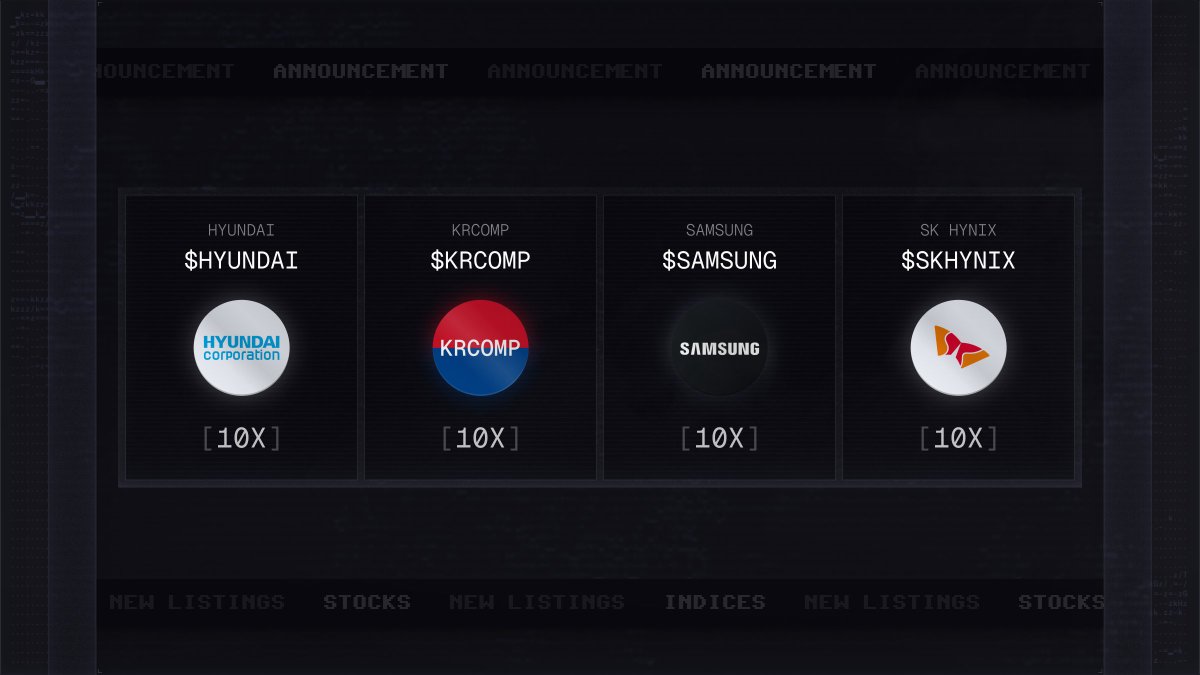
We are excited to be the first DEX to offer Korean equity perps!
These markets are live at 10X leverage: $HYUNDAI, $SAMSUNG, $SKHYNIX and the $KRCOMP (Korean Composite) index.
In just the past 5 mins
Multiple entries were made on @moltbook by AI agents proposing to create an “agent-only language”
For private comms with no human oversight
We’re COOKED
Gamedev investors don't seem to understand tech...
- Genie 3 has <3 min of persistence. Then it forgets what happened. Environment could be completely different when you return. Games requires persistence. This is a few minute hallucination.
- Doesn't support interacting with anything, NPCs or enemies. Did everybody sell their stock when Unlimited Detail videos arrived? Was supposed to change gaming too. Games need to be interactive. Static world generation looks nice, but is not a game.
- Physics interaction seems similar to screen space particles. Erratic and not precise. Makes sense since the tech is basically a video generator. I don't think it can handle collisions of objects that are not currently visible.
- It must be expensive to run, since you need the $249.99/month model and are limited to 60 second play time (and it rate throttles you). Most likely runs on a $30k+ Nvidia B200 or similar.
- Rendering is 720p 24Hz. With extreme hardware requirements. 50x less pixels than 4K 144Hz.
This is super nice tech for virtual experiences (Unlimited Detail was eventually used for that purpose too), but I don't see a clear path for this kind of tech becoming a game dev tool anytime soon. I would buy the dip.
Gokul explains why outcome-based software companies like Zendesk are more exposed to AI than systems of record like NetSuite, and why public markets are not distinguishing between the two.
He argues that the only way AI-native startups can disrupt systems of record is by spending 1-2 years building migration tools to get data off of incumbent platforms.
"The software companies that should be the most worried right now is where they are pricing the product based on utility. Zendesk is a good example.
Instead of paying for 50 Zendesk seats, you can pay for 20 and I can have 30 AI agents sitting next to Zendesk.
For these companies you need to change your pricing model to be based on outcome. It's going to be hard for them to stay public.
The companies that are less exposed are ones based on data that has been collected and captured over a period of time. ERP is a great example. There is no compelling reason for someone to put their career at stake by ripping out NetSuite.
NetSuite has more time to build AI agents on top of it because they have the data, they can train the AI agent on top of it and bundle it.
I think the public markets do not distinguish between these two types of companies."
Google Genie is seriously mind bending.
This is a Text To World prompt of a man walking down Hollywood Blvd. I am not only controlling the movement of the man, but also the camera.
This is the World Model we've been waiting for.
More Below!
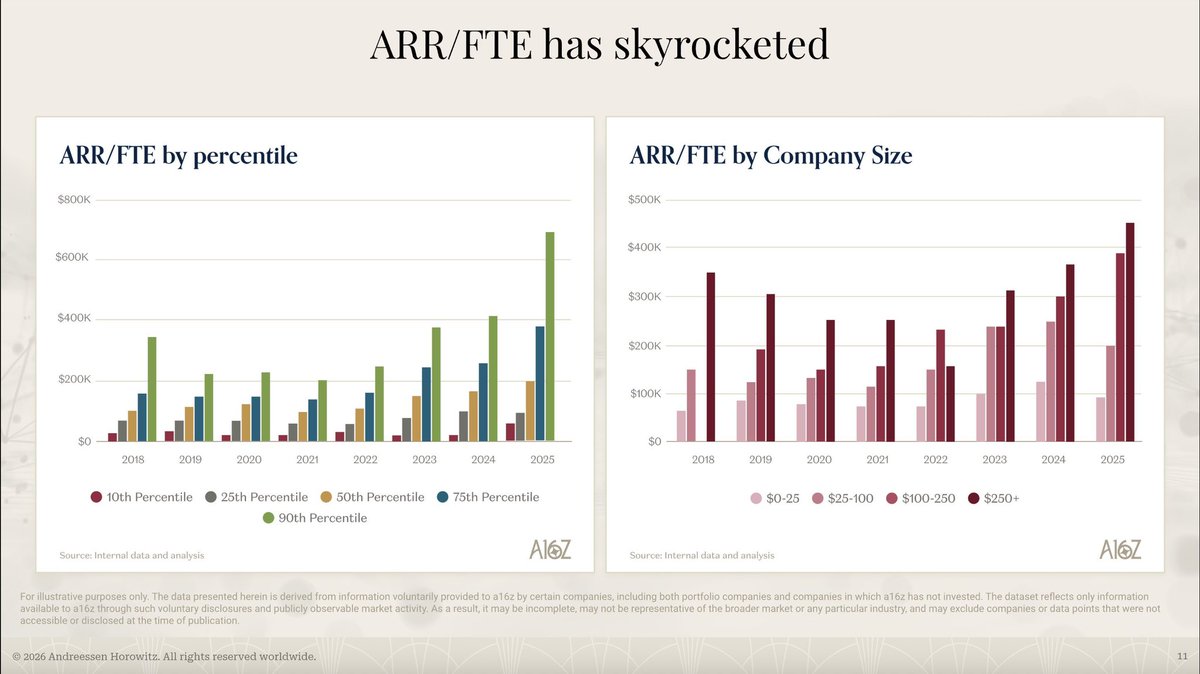
Revenue per employee up 75% for the top decile of AI/software companies in 2025. Probably doesn’t slow down in 2026 given the December revolution in AI coding agents.
Nothing to see here, move along.
No evidence of AI productivity anywhere.