Forensics Investigator, Expert Witness,Penetration Tester, Corporate Trainer & CEO-AKATI Sekurity. Opinions are my own and not the views of my employer.
In March 2025, an attacker stole a single bot token. No human owner. No rotation policy. No MFA. One forgotten credential, and 23,000 organisations spent their weekend rotating secrets.
The account had no owner. That is the entire story.
Most organisations run rigorous identity governance for their people. Joiners get onboarded. Leavers get offboarded. Access gets reviewed.
Machine identities work on none of those rules. Service accounts, API keys, OAuth tokens, CI/CD pipeline credentials — created when a project needs them, left running when it ends. They accumulate permissions across system migrations and team changes. Nobody reviews them. Nobody removes them.
The accounts with the least governance are the ones attackers find first.
One question worth putting to your team this week: how many machine identities in your environment have admin-level access, and when were they last reviewed?
If the answer is "we are not sure," that is where the programme starts.
We put together a five-step remediation plan — sequenced by urgency, not complexity — and we are sharing it below.
While the world sleeps, we are working.
This holiday season, give yourself the ultimate gift: Peace of Mind.
Whether you are unwrapping presents or ringing in the New Year, our team is on standby 24/7 to ensure your business remains safe.
Enjoy the holidays. We’ve got the watch.
Merry Christmas and a Happy New Year from all of us at AKATI Sekurity.
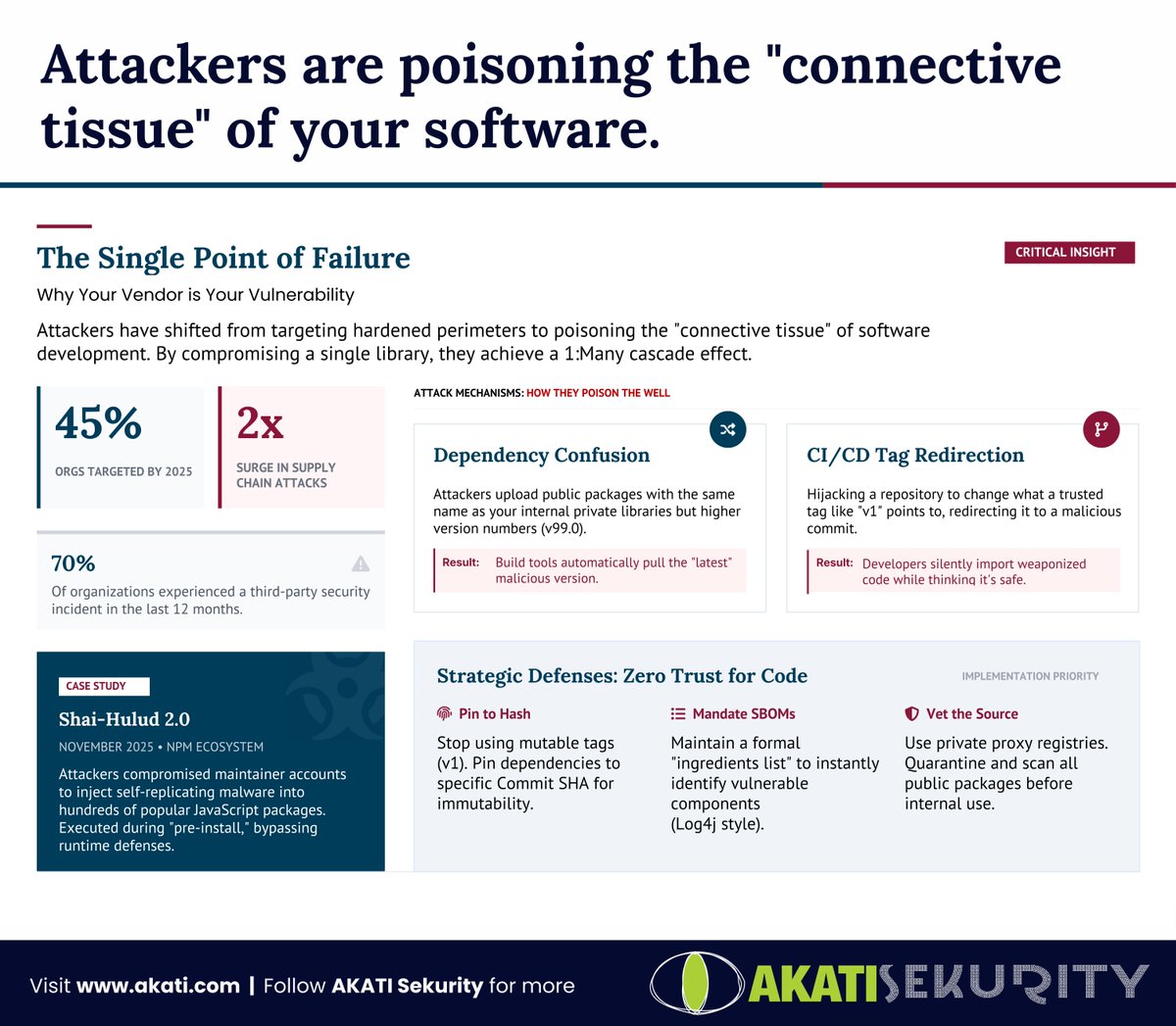
The "Dependency Confusion" vector is particularly dangerous because it exploits the default behavior of automation tools.
Most build pipelines are designed for efficiency ("get the latest version"), not security ("verify the source").
A simple config change to prioritize your private registry over public ones (like npm or PyPI) can stop this attack cold. Have you audited your package manager configurations this quarter?
Attackers are poisoning the "connective tissue" of your software.
You don't have to run malware to be compromised anymore. You just have to build it.
We often focus on hardening the perimeter, but the new threat vector is already inside your build pipeline. Supply chain attacks have surged 2x, and by 2025, 45% of organizations will be targeted.
-------------------------------------
The Reality Check: Shai-Hulud 2.0
In November 2025, the Shai-Hulud 2.0 campaign changed the rules.
Attackers injected self-replicating malware into the npm ecosystem, compromising hundreds of popular JavaScript packages.
The scariest part? It executed during the "pre-install" phase.
The moment a developer simply downloaded the package, the breach occurred.
-------------------------------------
How they poison the well (see visual):
Dependency Confusion:
Uploading malicious public packages with the same name as your private ones, but with a higher version number (e.g., v99.0). Your build tools auto-pull the "latest" version—installing the malware for them.
CI/CD Tag Redirection:
Hijacking a trusted tag like "v1" to point to a malicious commit.
-------------------------------------
The 3 Strategic Defenses you need now:
Pin to Hash:
Stop trusting mutable tags like "latest." Use the specific Commit SHA.
Mandate SBOMs:
Know your ingredients before you bake the cake.
Vet the Source:
Quarantine public packages in a private registry before use.
Your security is only as strong as your weakest dependency.
You have 48 minutes.
That is the average time it takes for an attacker to move from a compromised edge device to your core database in 2025.
If your response plan relies on a ticket being opened, assigned, and investigated by a human, you are mathematically too slow.
The "Cloud Fortress" myth has collapsed. Driven by AI discovery, we saw 30,000+ disclosed vulnerabilities this year alone. Attackers aren't just knocking on the front door; they are drilling through the foundation (the Hypervisor).
The 2025 Attack Path (see visual):
The Edge Breach:
Attackers find a "Shadow Asset" (a dev server you forgot about).
The Pivot:
They exploit the hypervisor to escape the sandbox.
The Impact:
They bypass your internal firewalls entirely.
Your only defense is speed:
Map it:
Implement CAASM. You cannot patch what you can't see.
Patch it live:
Use hot-patching. Waiting for a maintenance window is a security risk.
We broke into the Top 10.
Proud to share that AKATI Sekurity is now ranked #9 globally on the 2025 MSSP Alert Top 250—up from #12 last year.
This progress reflects a quiet evolution in our strategy: shifting from reaction to anticipation. We are leveraging AI to help us better forecast potential risks, striving to address threats well before they impact operations.
A huge thank you to our clients who have trusted us over the years, and to our incredible team who works hard every day to make this possible. We also extend our gratitude to the Cyber Risk Alliance and MSSP Alert for this recognition.
See the list: https://t.co/QqIcbBceQI
The shift to "Double Extortion" is the critical pivot for 2025.
Many organizations have tested their backup restoration, but few have tested their response to a public data leak. If your data appears on a shaming site, restoring from tape does not solve the problem.
We list Extortion Response as a "REQUIRED" capability for this reason. Does your incident response plan include legal counsel with specific experience in ransomware negotiation?
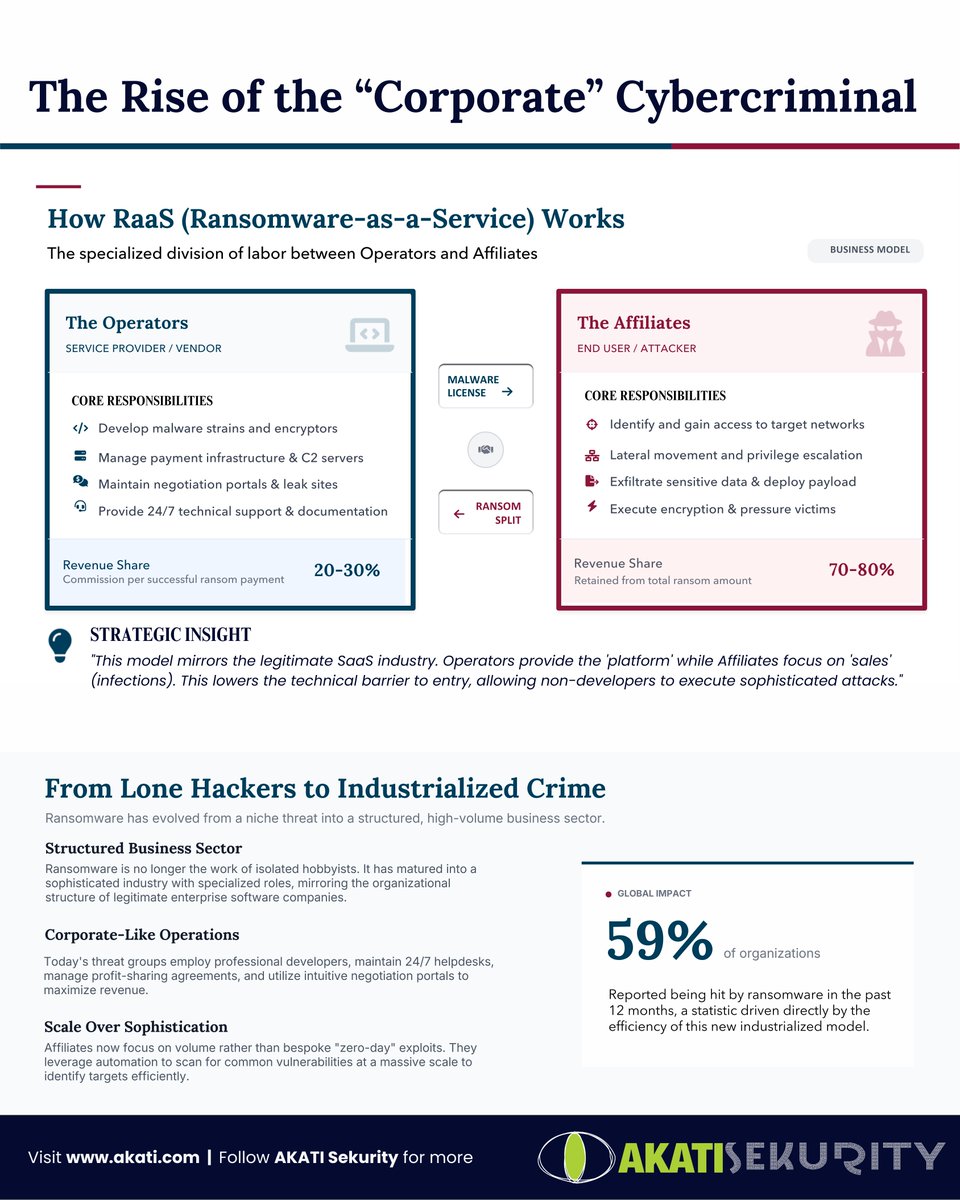
The group attacking you has a helpdesk and a payroll.
We need to stop picturing ransomware actors as lone hackers in basements. In 2025, we are fighting organized, well-funded enterprises.
The "Ransomware-as-a-Service" (RaaS) model has industrialized cybercrime. This structure is the primary reason 59% of organizations globally were targeted last year.
The business structure is simple (see visual):
The Operators (The Vendor):
They develop the malware and maintain the payment infrastructure. They take a 20-30% commission.
The Affiliates (The Sales Team):
They focus purely on intrusion—breaking into your network to deploy the payload. They keep 70-80% of the profit.
The Strategy:
Leverage over Encryption Backups are no longer a guaranteed defense. Attackers now exfiltrate your data before they lock your systems. Even if you restore your servers, they leverage the threat of a data leak to force payment. This "Dual Pressure" is why 70% of attacks now result in encryption.
The Vulnerability:
Despite their sophistication, their entry point is often basic. 32% of attacks begin with a known, unpatched vulnerability.
The most effective defense isn't buying more tools; it's closing the gap on basic hygiene.
The most critical quadrant here is "Out-of-Band Verification" (Top Left).
While "Continuous Liveness" (Top Right) is a necessary technology investment, Out-of-Band verification is a process change you can implement today for zero cost.
Does your finance team have a strict "Hang Up and Call Back" policy for urgent wire requests? If not, why?
Your voice is now a vulnerability.
For years, banks and high-security environments relied on voice biometrics as the gold standard for authentication.
But in 2025, with Vishing attacks up 442%, we are seeing a "Biometric Bypass" crisis. AI clones are now high-fidelity enough to authorize fraudulent wire transfers and password resets.
The Defense Matrix (see visual):
We need to move our controls from the bottom-left (ignoring robocalls) to the top-right (fighting AI with AI).
> Stop relying on "The Ear Test":
Humans cannot detect modern deepfakes.
> Implement Continuous Liveness:
Use security tools that monitor the entire stream for synthetic artifacts.
> Mandate Out-of-Band (OOB):
No financial transaction should ever occur based on a voice request alone.
If your verification process relies on "recognizing a voice," you are wide open.
The most under-utilized control on this list is #4: Session Binding.
We see a massive rise in "Infostealer" logs where attackers bypass MFA simply by stealing the session cookie from a user's browser.
If you aren't binding that token to the device ID or network location, your MFA is being bypassed after the login.
Is anyone successfully enforcing Token Binding in their environment yet?
Your firewall can’t catch a user with a valid password.
This is the hard reality of the 2025 threat landscape. Attackers have shifted away from custom malware (which EDR catches) to "Living off the Land" (using admin tools you already have).
The result? Breakout times have collapsed to under one minute.
We need to pivot from "Network-First" to "Identity-First" security.
We’ve mapped out the 4 critical controls needed to stop these rapid, malware-free attacks in the graphic below:
1. Prevent: Stop the entry with Phishing-Resistant MFA (FIDO2).
2. Detect: Flag the anomaly with Identity Threat Detection (ITDR).
3. Contain: Limit the blast radius with Just-in-Time (JIT) access.
4. Lock: Kill the session theft with Binding.
If you are still measuring success by "Malware blocked," you are measuring the wrong thing.
The "AI Training Data Leak" (Bottom Right) is the one catching legal teams off guard.
Many standard SaaS Terms of Service now include clauses that allow them to use customer data to "improve services" (read: train their models).
If you haven't reviewed your vendor contracts specifically for this clause in the last 6 months, you might be leaking IP legally.
Has anyone successfully negotiated an "opt-out" for AI training with a major SaaS provider recently?
Sending a security questionnaire to your vendor is not "Risk Management." It’s just paperwork.
We used to worry about malware in software updates. In 2025, the threat has shifted. Now, we worry about the identity of the people managing your systems.
If your MSP doesn’t use Multi-Factor Authentication (MFA), their breach becomes your ransomware event. If your marketing team signs up for a new AI tool without vetting it, your customer data is training someone else's model.
We’ve mapped out the 4 Vectors of Vendor Risk you need to control now (see visual):
SaaS Sprawl:
You can't secure what you can't see. Shadow IT is now the norm, not the exception.
API Hygiene:
Static API keys are the new "password on a sticky note." Rotate them.
The Human Vector:
Consultants and MSPs often have "God Mode" access to your network. Are their laptops secure?
The AI Leak:
This is the big one for 2025. Does your contract explicitly forbid the vendor from using your data to train their AI?
Your security is only as strong as your weakest vendor. Stop trusting. Start verifying.
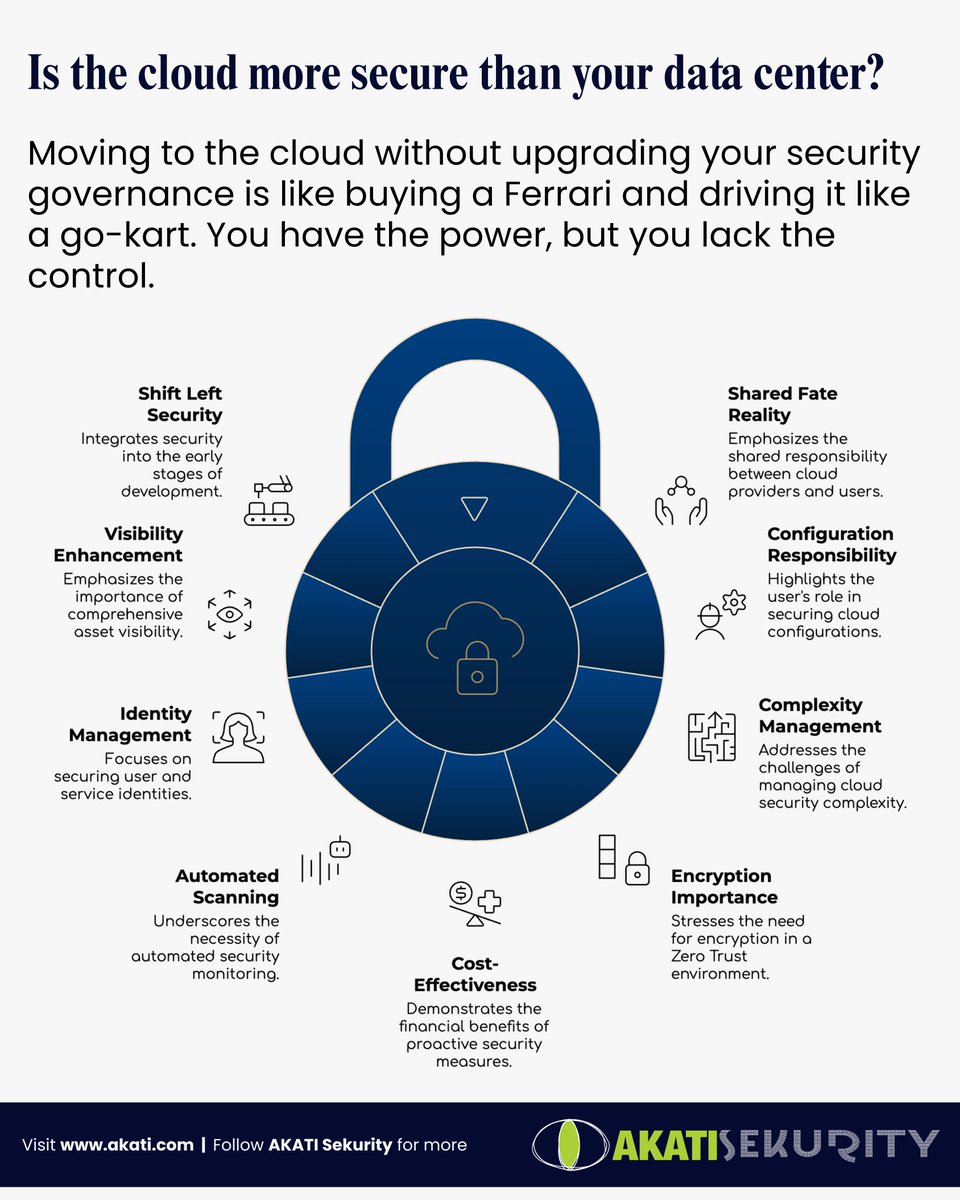
The most overlooked wedge in this diagram is "Shift Left Security."
We still see too many organizations treating security as a gatekeeper at the very end of the project. In the cloud, that is too late. Security needs to be defined in the code (Terraform/Ansible) before the infrastructure is even provisioned.
How early does your security team get involved in cloud deployments? Day 0 or Day 100?
Is the cloud more secure than your data center? Yes. But only if you know how to drive it.
Moving to the cloud without upgrading your security governance is like buying a Ferrari and driving it like a go-kart. You have the power, but you lack the control.
We mapped out the critical components of a secure cloud posture in the graphic below.
Here is where most organizations fail in 2025:
1. Visibility:
You cannot secure what you cannot see. Shadow IT and "zombie" assets are the top attack vectors.
2. Automated Scanning:
Manual audits are dead. If you aren't scanning configurations in real-time, you are already breached.
3. Cost-Effectiveness:
Security feels expensive until you compare it to the $4.4M average cost of a data breach.
Don't let the "Private Cloud" myth lull you into a false sense of safety. Misconfiguration happens everywhere.
Save this cheat sheet for your next architecture review.
The most dangerous trend on this list is #4: The Encryption-Less Pivot.
We are seeing more attackers skip the encryption phase entirely. They simply steal the data and threaten to release it.
In this scenario, your backups work perfectly, but they can't stop the extortion. This is why Data Loss Prevention (DLP) and Egress Filtering are becoming just as critical as your backup strategy.
Has anyone else seen a rise in "extortion-only" attacks recently?
Stop treating ransomware payments as the "Cost of Doing Business."
It is the cost of funding your own next breach.
We analyzed the current threat landscape, and the data is clear: 80% of organizations that pay a ransom are targeted again. Why? Because you proved the business model works.
The 4 Reasons to Hold the Line (Visualized Below):
1. Funding Future Attacks: That $2M payment buys them better zero-day exploits to hit your competitors (or you again).
2. The Whale Effect: You get tagged as a "Whale"—a preferred target for repeat business.
3. The Myth of Decryption: A decryptor key doesn't fix the backdoor they left in your network.
4. The Pivot: They are stealing data now, not just locking it. You can't "decrypt" a privacy leak.
The only defense is resilience. Immutable backups. Rapid patching. And a refusal to fund the enemy.
Save this guide for your next Tabletop Exercise.
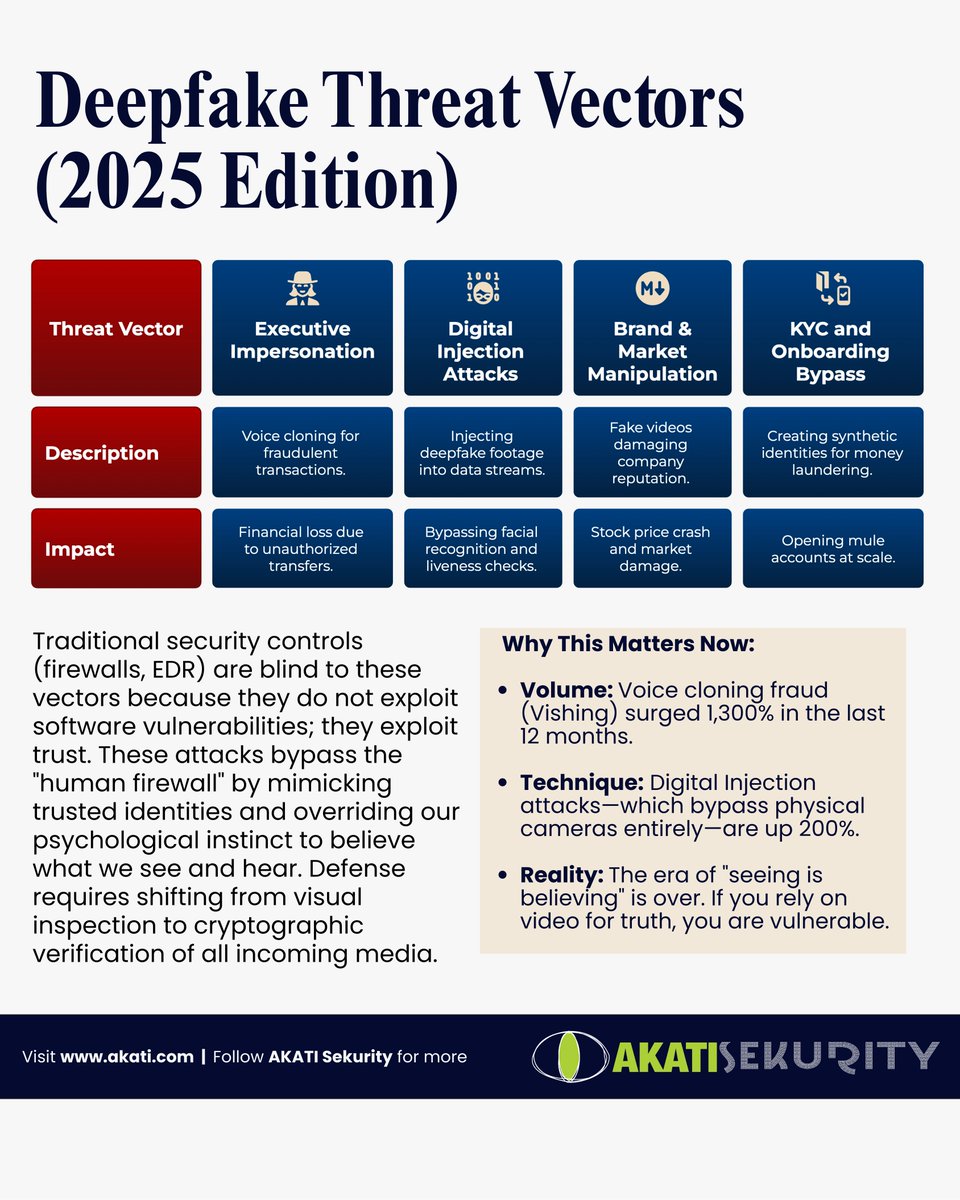
One detail that didn't fit in the graphic: The speed of evolution.
In 2024, a decent deepfake took hours to render. Today, we are seeing "Digital Injection" attacks (Column 2) happen with less than 200ms latency during live verification calls.
If you are auditing your video verification vendors this month, ask them one specific question: "How do you detect virtual camera drivers vs. physical hardware?"
If they don't have a clear answer, your "liveness check" might be wide open.
Stop telling your team to "look for glitches." It’s not working.
We used to say you could spot a deepfake by looking for unblinking eyes or blurry backgrounds. In 2025, that advice is obsolete. The technology is perfect.
If you are relying on human observation to stop fraud, you have already lost.
We are tracking 4 specific Deepfake Threat Vectors that are bypassing traditional defenses right now:
1. Executive Impersonation
It is no longer just "CEO Fraud" emails. Attackers are using real-time voice cloning to authorize transfers. If the voice on the phone sounds like your CFO, but the request feels urgent and bypasses protocol—hang up.
2. Digital Injection Attacks
This is the technical leap most security teams miss. Attackers aren't holding a picture up to a webcam. They are injecting pre-rendered deepfake footage directly into the data stream, bypassing physical camera lenses and standard liveness checks.
3. Brand & Market Manipulation
A fake video of your CEO announcing a recall or scandal can go viral and crash your stock price before your PR team even wakes up.
4. KYC and Onboarding Bypass
Fintechs beware: Attackers are using synthetic identities to open "mule" accounts at industrial scale, washing money through platforms that rely on standard video verification.
The Bottom Line: Managing deepfake risk isn't about better eyes. It's about better process. We need to move from a model of "trusting the video" to "verifying the metadata."
Save this guide for your next fraud risk meeting.