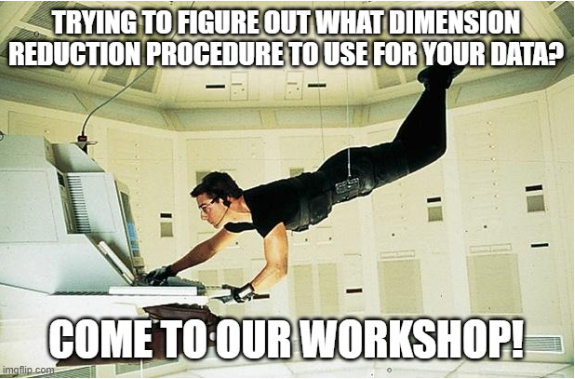
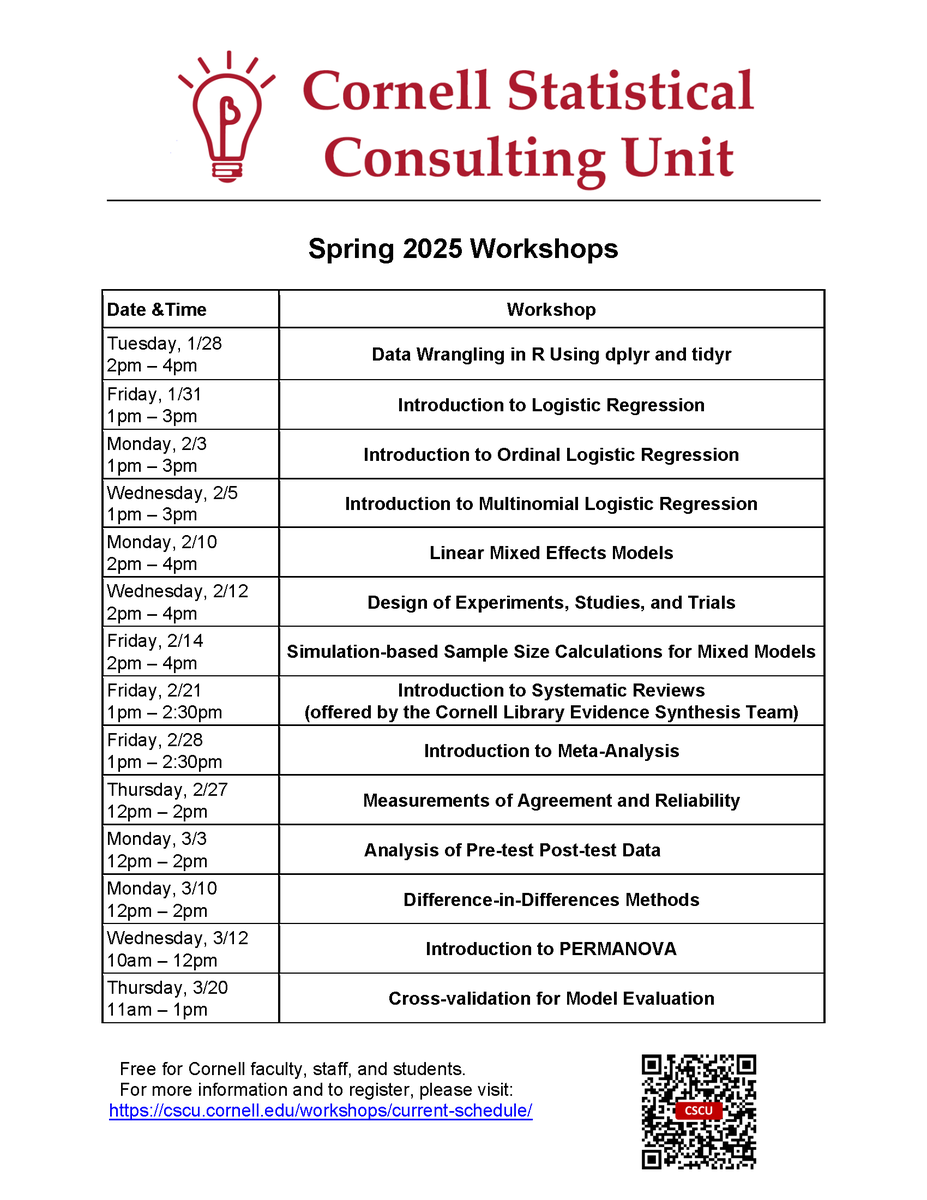
Our first summer workshop is tomorrow (6/5) at 10am! Join us for an Overview of Dimension Reduction Methods. Free and open to all @Cornell. To learn more: https://t.co/k1FEyAmiTt
@CornellGrad@CornellRsrch@CornellCALS
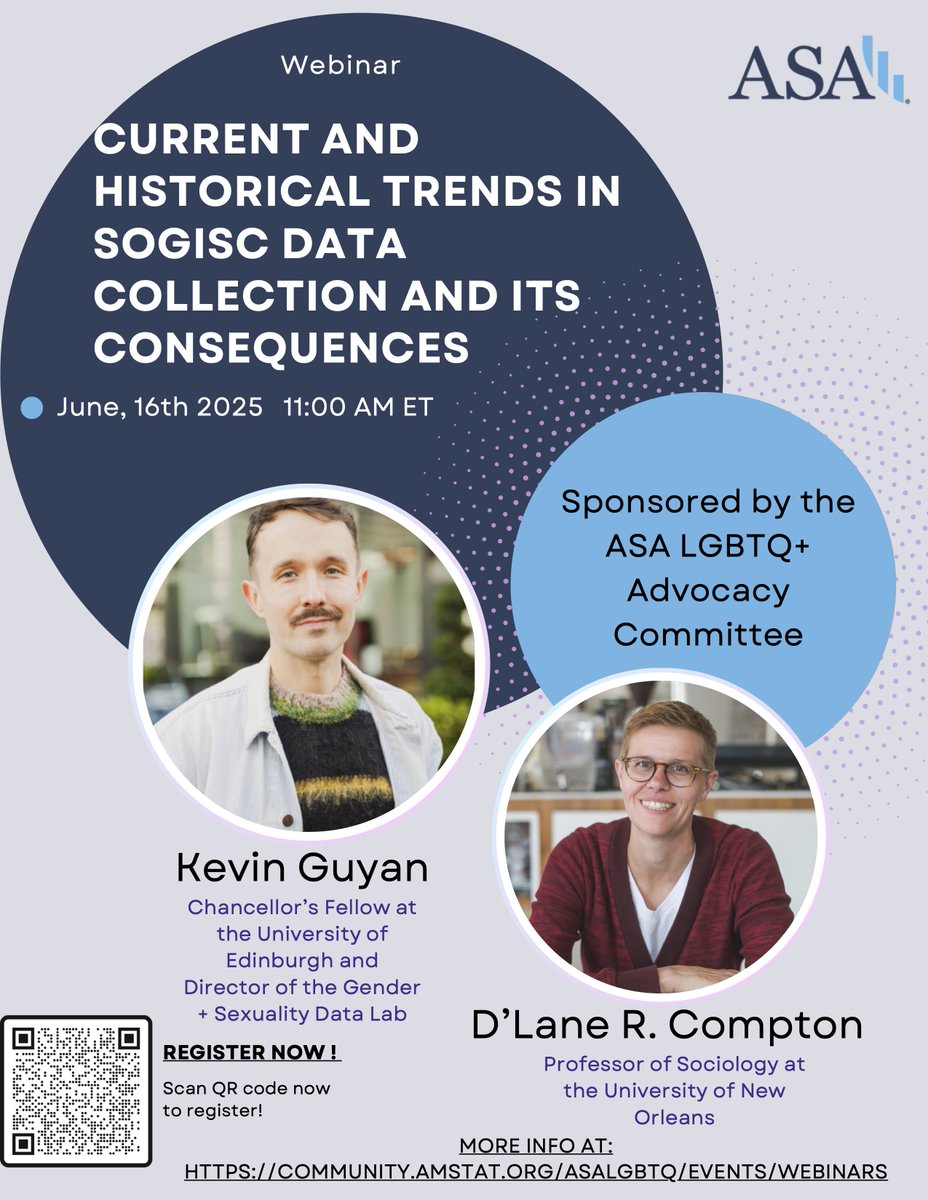
Upcoming and relevant webinar: Current and Historical Trends in SOGISC Data Collection and Its Consequences. More information at: https://t.co/jiQ1wq5maW @AmstatNews
My workshop tomorrow is on Agreement and Reliability. I'll discuss Cohen's Kappa, Krippendorff's Alpha, Gwet's AC1, as well as different measures for ICC.
Join us tomorrow (2/27) at 12pm for a workshop on Measurements of Agreement and Reliability. Free and open to all @Cornell. For more info:
https://t.co/9CyZxTFcaR
@CornellGrad@CornellRsrch
CSCU Assisted Pub: An Interdisciplinary Panel of Scientists Discuss Trans- and Gender-Nonconforming-Inclusion in STEM https://t.co/X6xIn0swss
Congratulations, @statsysteve!
@AmstatNews
I just pushed a new paper to arXiv. I realized that a lot of my previous work on robust losses and nerf-y things was dancing around something simpler: a slight tweak to the classic Box-Cox power transform that makes it much more useful and stable. It's this f(x, λ) here:
I am increasingly convinced we have a reproducibility crisis in Ecology because of the abuse of statistics and its explanatory power, particularly of complex models and analysis that many researchers do not fully understand. This paper should be an alarm call.
We are pleased to announce our new book: The World of Zero-Inflated Models: Using GLLVM. Zuur and Ieno (2025)
This book explores modern statistical methods for analyzing complex datasets, focusing on multivariate models, mixed-effects models, and latent variable models. GLLVMs integrate GLMs and GLMMs with multivariate analysis techniques, allowing multiple response variables to be modeled within a single framework.
Key topics include count data models with excess zeros and distributions such as Poisson, negative binomial, zero-inflated Poisson, zero-inflated negative binomial, and Tweedie. The book also provides practical guidance on implementing these models in R using the gllvm package.
Designed for researchers, statisticians, and analysts working with multivariate ecological, environmental, or social science data, this book is also a practical resource for R users looking to apply complex statistical models effectively. Each chapter includes detailed R code and case studies, demonstrating how to fit and interpret complex models, diagnose potential issues, and refine model performance. Emphasizing practical solutions, the book helps readers apply these methods to real-world datasets.
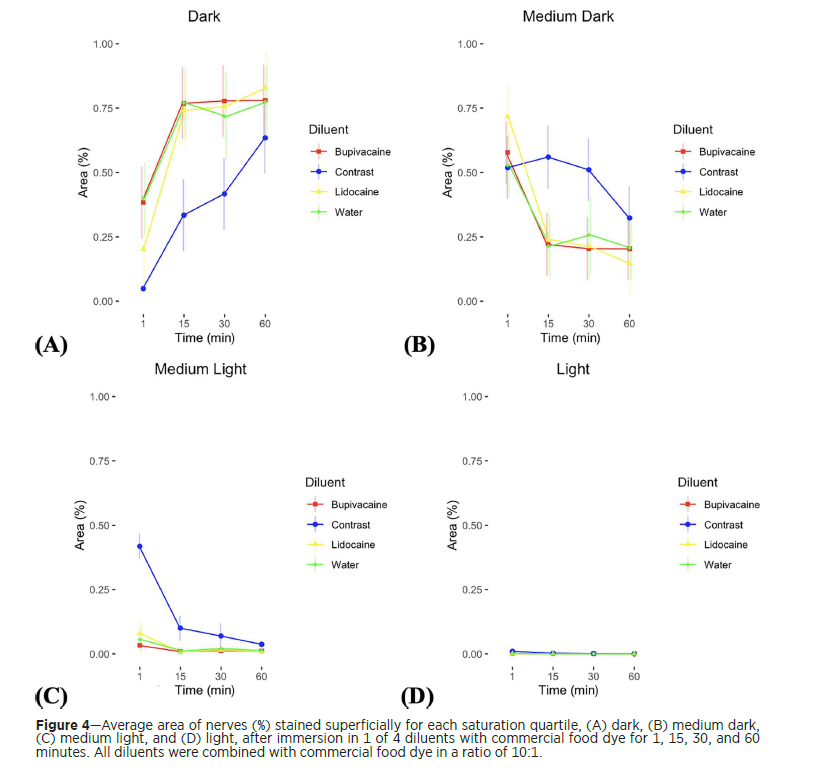
CSCU Assisted Pub: Iodinated contrast dye-diluent combination exhibits longer time to full dye saturation compared to lidocaine, bupivacaine, and water in porcine cadaveric nervous tissue https://t.co/6KKCfiK1Me
@cornellvet@statsysteve
Back in June, I had the pleasure of moderating a webinar with the American Statistical Association's LGBTQ+ Advocacy Committee on Trans- and Gender-Nonconforming-Inclusion in STEM. The panel discussion from that webinar is now available as an article.
https://t.co/MKsONFyNKf
Your brain has been fooling you your entire life.
This Nobel Prize winner spent 40 years proving it.
Here are the 10 mental traps controlling every decision you make: 🧵
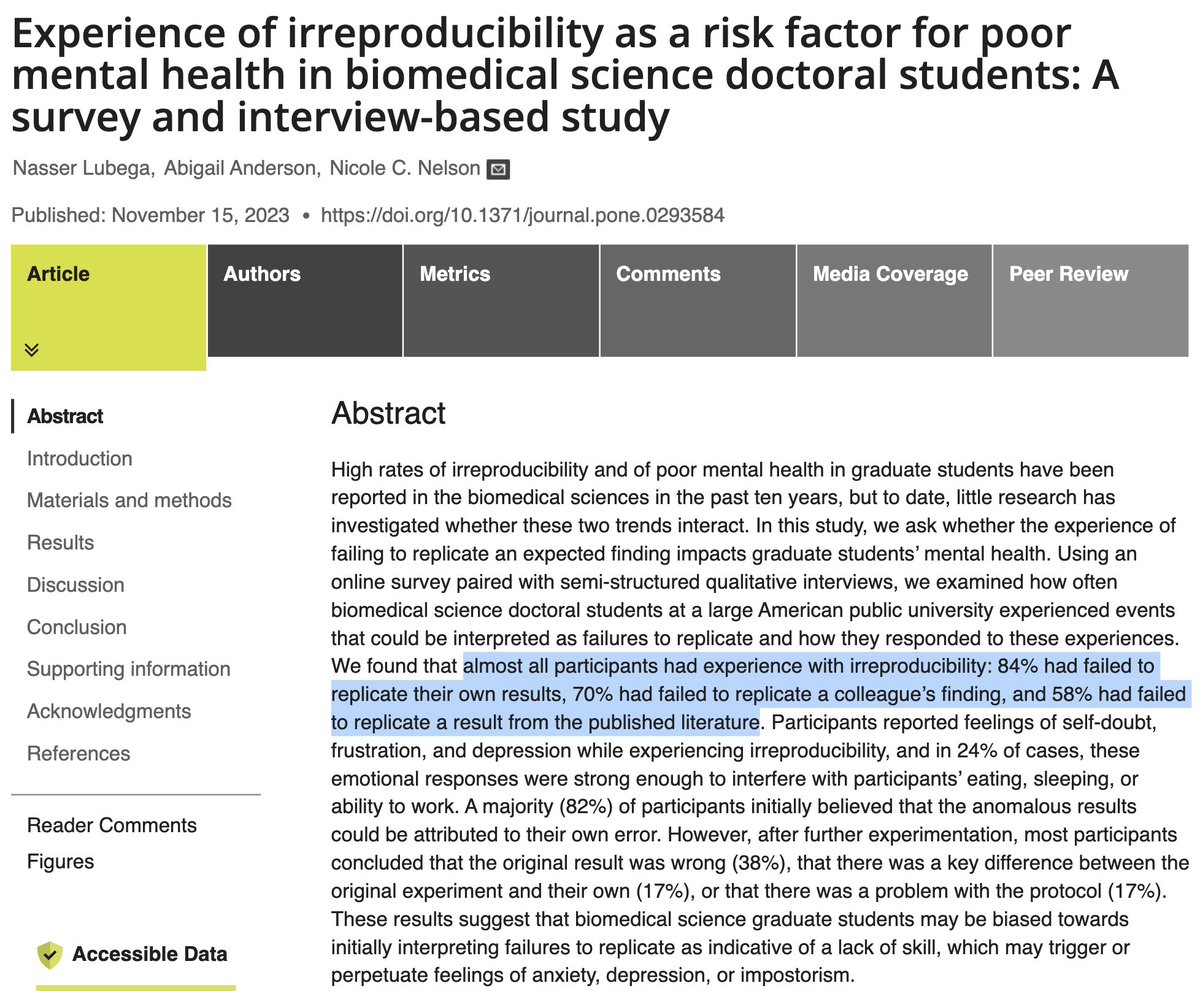
People usually think replication attempts in science are rare. Journals don't publish replications, so scientists don't do them.
In reality there are countless replication attempts (and failures), it's just PhD students assume they did something wrong
https://t.co/cxGGexVOw2
@donaldmcknight2 This is a great thread, but please remember that this is only half of the story. You need to change the contrast settings as well. This resource may be useful: https://t.co/pYx9zYvB0m
The informal poll results are in, & as I feared, most people are running ANOVAs in #R with functions that can give highly misleading (or flat out wrong) results. Follow along to see why using anova() and aov() is usually inadvisable & why you should be using car::Anova() 🧵