@internpierre@vickers9 You know that Costco has sold Birkins, too, right? I suspect Hermès is not happy with it but Costco sources these through the parallel market — buying authentic units via third parties and reselling — the same model it has long used for Rolex watches too.
It’s not just a historical parallel, it’s a full cycle!
$GOOG actually bought Motorola Mobility in 2012, stripped the patents, and sold the rest. They didn't just repeat its history; they still own the vast majority of those Motorola patents (plus, you know, Search and YouTube).
After reading $INTC 4Q25 earnings last night, I'd title it: "Intel’s Treadmill: Sweating Profusely to Stay in Second Place"
However... Bernstein's title is poetry!
Bernstein: Intel (INTC) Q425 Recap - "I'm off tonight, you know I'm short supply and I'm starting to feel it's tight..."
Intel's Q4 results were admittedly solid ($13.7B/$0.15 vs Street $13.4B/$0.09). Datacenter in particular was strong, given robust demand amid AI infrastructure build outs (at ~$4.7B >$400M above consensus) and management noted revenues would have been higher if not for supply constraints; client was light as (limited) capacity gets prioritized towards datacenter. Gross margins at 37.9% beat on higher revenues and lower reserves.
Q126 outlook was however well below ($12.2B/$0.00/34.5% vs Street $12.6B/ $0.07/36.5%) as the company noted supply constraints maintaining with continued prioritization of server over client (hence while both segments are expected to decline the QoQ headwind in CCG Revenues will be "more pronounced" than in DCAI). Gross margins are seen down ~340 bps QoQ on lower revenues, higher (early ramp)18A volumes, and product mix. They do expect constraints to ease as we go through the year however, suggesting above-seasonal growth beyond Q1 and "double digit" DCAI growth for the year, though noted higher memory and component prices might weigh on the client market.
For a stock up 47% in 3 weeks (mostly on vibes and tweets) the print had to be perfect; it was not. And while the things driving investors crazy (server refresh hopes, 18A ramp, potential for 14A customers etc) are still there in theory, it appears Intel's hips do, in fact, lie. Yes the server cycle seems real, but the company appears to have woefully misjudged it with their capacity footprint caught massively off guard. The 18A ramp is progressing but not any faster than expected, and seems likely to remain margin dilutive through much of the year. While they suggested we may hear more about 14A customers (2H26 or 1H27) they do not expect risk production until 2028 or volume probably into 2029 (note that Lip-Bu appears to have missspoken about this schedule on the call). And it seems likely that the Street has been mismodeling non-controlling interest from the SCIP deals which will act as another material earnings headwind.
We stay sidelined while we wait to see if they really can dance like that...tweaking estimates, maintaining our $36 PT and MP rating.
$INTC
For the past decade-plus, Hsinchu and Cupertino have operated like one integrated engineering organization, pushing Moore’s Law forward with a ruthless cadence. Apple's "One Team" model embedded hundreds of engineers alongside TSMC, treating the foundry as an extension of Cupertino. The work went all the way down to the plumbing. Co-developing PDKs, tightening design rules, and hardening the DTCO loop so that when a node like 5nm hit volume, Apple's chips were already optimized for that transistor. (1/3)
A MUST-read interview with a former $GOOGL employee who worked on TPUv5,v6, & v7 on TPUs vs GPUs. I will be posting the interview in two parts, the first one today and the second one tomorrow:
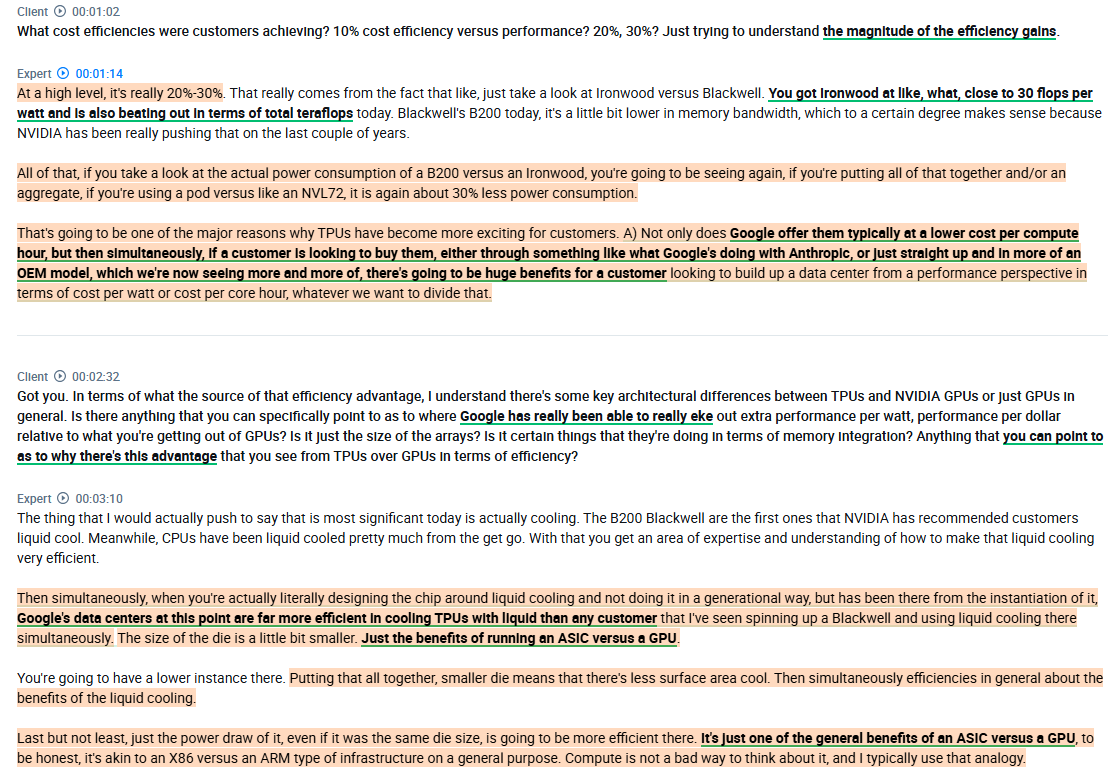
1. According to him, $GOOGL TPUs are 20-30% more cost-efficient on perf per watt vs the GPU alternative. He mentions that if you are using an Ironwood pod vs an $NVDA NVL72 B200, the TPU pod consumes 30% less power. Part of it is the smaller die, but he believes that even if the die size were the same, the power draw of an ASIC would still be smaller than a GPU.
2. Part of $GOOGL's edge with TPUs is that they were designed for liquid cooling from the start. He believes $GOOGL's data centers are currently far more efficient with liquid-cooled TPUs than any customer spinning up a Blackwell with liquid cooling.
3. He agrees that Mixture of Expert models (MOEs) are running less efficiently on TPUs than some of the denser models. He thinks that the main reason for that is that they weren't designed for that, but at the same time, MoE models have so far been optimized around GPUs with the help of the »DeepSeek moment«. TPUs are not yet available to people for experimentation.
4. In his view, $GOOGL would only need a year to change the architecture to handle MoEs better.
5. He thinks that over time, the 95% market share of $NVDA will go down to 80-75% with $GOOGL TPUs taking a significant share of 20-25%. He believes that a substantial share of the gains for $GOOGL's TPUs will also come from $AMD. He thinks $NVDA will trigger a pricing war to improve its TCO. With it, he believes the $NVDA margin will come down substantially.
6. One of the main things $GOOGL needs to do if it wants to sell TPUs externally is to improve its PyTorch support and the gaps there. He believes these gaps will be addressed. At the same time, he thinks the lack of CUDA support on TPUs is a smaller problem than it is for $AMD. The value proposition of TPUs is their greater energy efficiency, driven by their architecture; $AMD doesn't offer that.
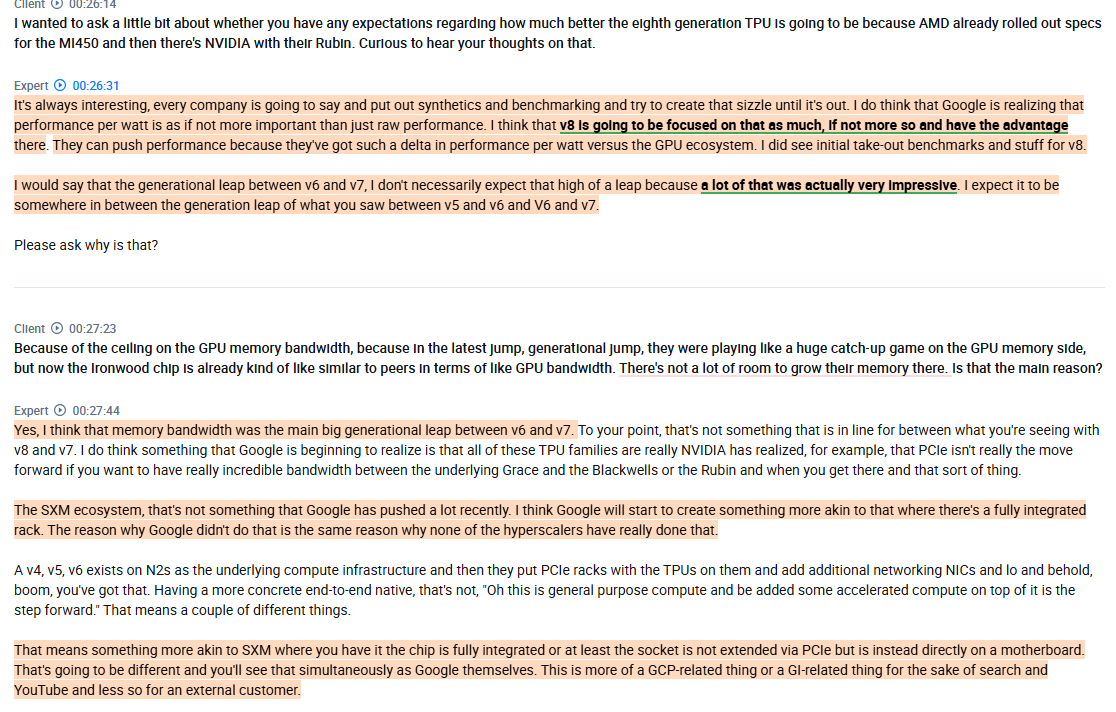
7. When it comes to TPUv8, he thinks that $GOOGL is realizing that performance per watt is more important than raw performance and that v8 will be focused on that as much, if not more so, and have the advantage there: »They can push performance because they've got such a delta in performance per watt versus the GPU ecosystem«. At the same time, he doesn't expect the leap between v7 and v8 to be as big as the leap was between v6 and v7. The main leap from v6 to v7 was the memory bandwidth.
8. He thinks $GOOGL will move more towards an SXM ecosystem to have a chip fully integrated or at least the socket not extended via PCIe but instead directly on a motherboard.
found on @AlphaSenseInc
I will publish the second part tomorrow, where he explains the key advantage of TPUs.
The semiconductor industry has evolved from a flat playing field into a steep mountain where the air gets thinner at every node.
In 2002, there were 26 companies manufacturing at the leading edge. Today, there is effectively one. TSCM $TSM
(1/3)
My latest research note, "The Physics of Money," argues that TSMC’s dominance is no longer just about technology—it’s about a "Monopoly on Certainty."
Full analysis below 👇
(2/3)
Notes from visit to Côte d'Azur for Robertet $RBT very first Capital Markets Day. RBT layed out its "Seed to Success" strategic plan, its recipe for blooming into an even bigger, and, crucially, more valuable entity. So, let's uncork this story and see if the notes are harmonious
@banana_capital_@dipinvest Great! Didn't know they had Bananas there 🍌
In all seriousness, here you may find some background info on the sector, Vidrala and even on that particular plant (aquired in 2017)
https://t.co/WQ82tadBlF