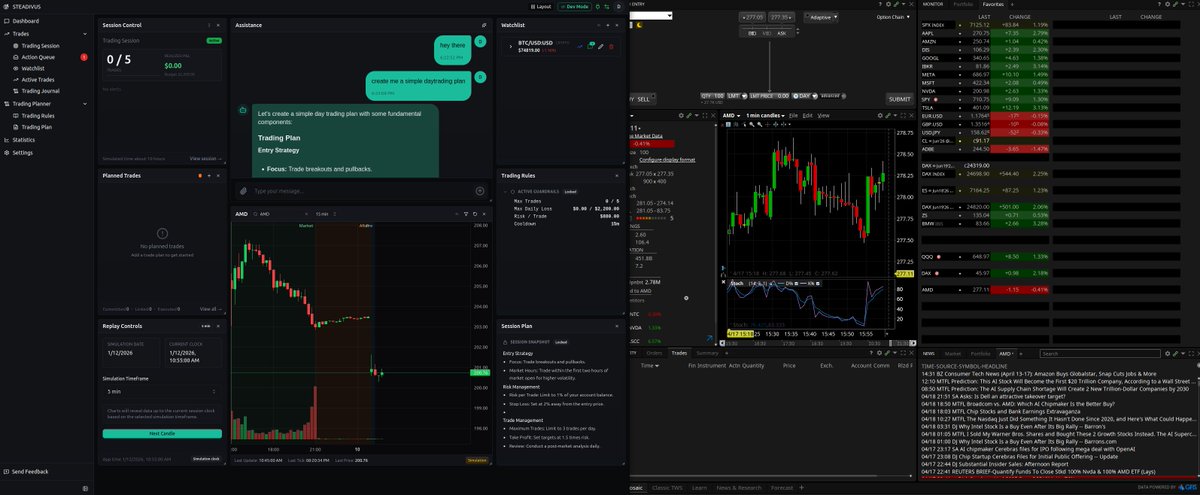
Big update from Steadivus!
We've built the core loop every discretionary trader needs:
Plan → Check → Trade → Review
A structured workflow to help you prepare, stay disciplined during execution, and review your decisions with real context.
Also rolling out:
— Interactive Brokers integration (real-time market & account data)
— Kraken Futures API integration
Subscriptions are launching soon. Early users get 3 months free — and if you stay active and share feedback, we'll extend your access even further.
Start trading with more discipline → https://t.co/mXqz3SbWLd
Hey @X , show this post to developing traders.
Traders working on:
• discipline
• execution
• consistency
• psychology
If that’s you, say hi 👋
Would be great to connect and exchange experiences.
Gartner now expects global semiconductor revenue to reach $1.6 trillion in 2026.
Memory alone could generate $837B.
And AI data centers are expected to grow from 36.5% of semiconductor revenue today to 53% by 2030.
At some point AI stops looking like a software trend.
It starts looking like an industrial buildout.
For now, we support only 2 broker APIs in Steadivus:
- IBKR via TWS API and HTTP Gateway API
- Kraken Futures
Why only these two?
Because our active users actually use them.
We are not trying to build a huge integration list for marketing.
We are trying to make the integrations that matter work well.
Small team. Real usage. Clear priorities.
A trader's most dangerous moment isn't the loss.
It's the sixty seconds after.
That's when frustration overrides logic and you enter a trade just to win the money back. No setup. No edge. Just emotion.
https://t.co/mXqz3SbWLd enforces your rules after losses so your worst decisions never reach the market.
Big update from Steadivus!
We've built the core loop every discretionary trader needs:
Plan → Check → Trade → Review
A structured workflow to help you prepare, stay disciplined during execution, and review your decisions with real context.
Also rolling out:
— Interactive Brokers integration (real-time market & account data)
— Kraken Futures API integration
Subscriptions are launching soon. Early users get 3 months free — and if you stay active and share feedback, we'll extend your access even further.
Start trading with more discipline → https://t.co/mXqz3SbWLd
Most traders don't blow up on bad setups.
They blow up on trades that had no setup at all.
Price moves. You feel the pull. You enter. No defined risk, no target, no criteria. Just a feeling that something is happening and you need to be in it.
That's not trading. That's reacting.
https://t.co/mXqz3SbWLd makes you define the trade before you take it. Entry, stop, target, risk — all locked in before you click. If you can't fill in the plan, you don't take the trade. That's the filter most traders are missing.
We just added a new feature to Steadivus that is still in active development, but already available inside the product.
It’s called Behavior Signal.
The idea is simple:
It does not try to predict the market.
It tries to detect what the trader is most at risk of doing next based on recent behavior.
Things like:
- impulse entry risk
- rule deviation pressure
- review skip risk
So instead of only showing what already went wrong, it tries to surface the behavioral risk before it turns into another bad trade.
There is also a Trend & Drivers view behind it, so you can see whether this is just a one-off warning or part of a repeating pattern, and what may be feeding it.
Still dev state.
Still improving.
But already available.
This is the kind of feature I wish more trading tools had:
not more signals, not more noise, but earlier visibility into the behavior that usually causes the damage in the first place.
The traders who take the most trades are rarely the most profitable.
Watch any trading community for a month. The people posting fifteen trades a day, jumping between setups, always in a position — they're almost always the ones whose accounts are shrinking. They'll tell you they're active. That they're working hard. That more opportunities mean more profit.
They're confusing activity with edge.
Here's what's actually happening. After the first two or three good setups of the day, the quality drops. Setups four through ten aren't real setups — they're justifications for staying in front of the screen. The trader isn't finding opportunities. They're manufacturing them because doing nothing feels unproductive.
Boredom drives more bad trades than bad analysis ever will. The market doesn't reward effort. It rewards selectivity. The best sessions often have one or two trades. Sometimes zero. The worst sessions have twelve — not because there were twelve real setups, but because the trader couldn't sit still.
If you track your results by number of trades per day, you'll almost certainly find that your per-trade performance drops sharply after the third or fourth trade. The best version of your trading is the most selective version.
There's a specific moment when a bad trading day becomes a disastrous one.
It's not the first loss. That one stings but you handle it. It's not even the second. You're frustrated, but you're still thinking.
It's the third. Something breaks. The frustration turns into something sharper — anger, recklessness, a feeling like the market owes you something. Suddenly you're not reading charts anymore. You're reacting. Clicking. Guessing.
That's tilt. And by the time you notice it, you've already made two or three decisions you can't take back.
Tilt doesn't announce itself. It builds quietly behind each consecutive loss until rational thinking gets replaced by emotional impulse. The scariest part is that traders on tilt still believe they're making logical decisions. They're not. They're running a pattern that ends one way — account damage.
The only reliable fix for tilt is a system that stops you before you get there. A hard loss limit. A trade count cap. A forced cooldown. Rules that were set when you were thinking clearly and can't be renegotiated when you're not.
You set the stop for a reason.
You looked at the chart. You found the level. You calculated the risk. You placed the order.
Then price started moving toward it and something shifted. Not in the chart — in your chest. That tightness. That voice: "It's going to reverse right after it hits my stop."
So you moved it. Just a little. Just to give it more room. Just this once.
But it's never just this once. Moving a stop loss is never a technical decision in the moment. It's an emotional one. You're not giving the trade room. You're running from the feeling of being wrong.
And every time you move the stop, you're teaching yourself that your plan is negotiable. That your rules are suggestions. That your emotions get a vote.
Small losses are part of the process. Refusing to take them turns them into the kind of losses that end months.
https://t.co/mXqz3SbWLd locks your stop level into the trade plan before you enter. You define the risk when you're thinking clearly. When price gets close, there's nothing to negotiate. The plan holds — because you can't renegotiate it under pressure.
Every trader has a risk rule.
Almost nobody follows it consistently.
You risk 1% per trade. Until you get a "perfect" setup and size up to 3%. Then that trade loses and suddenly you're down more than your last five winners combined.
The rule wasn't wrong. You just made an exception. And exceptions are where discipline goes to die.
The problem isn't that traders don't understand risk management. It's that they give themselves permission to override it when they feel certain. And certainty is just confidence wearing a disguise.
Be honest with yourself:
What percentage of your trades last week were actually planned before the session started?
Not "I had a rough idea." Not "I was watching that level."
Actually planned. Written down. Entry, stop, target defined before you opened the chart.
If the answer is less than 80%, your biggest edge isn't a new strategy. It's a pre-trade checklist.
What does your planning process look like? Or do you even have one? Drop it below.
The scariest trade isn't a losing trade.
It's the trade you can't explain why you entered.
No setup. No checklist. No predefined risk. You just saw price moving and clicked buy.
When you can't explain the entry, you definitely can't manage the exit. You'll hold too long because there's no target. You'll exit too early because there's no plan telling you to stay. Every decision becomes emotional because there's no framework underneath it.
https://t.co/mXqz3SbWLd forces you to define your plan before you enter. Entry criteria. Risk level. Target. Exit rules. If you can't fill in the checklist, you don't take the trade. That one rule alone eliminates most of the trades that drain accounts.
The four most expensive words in trading:
"Just one more trade."
You're down on the session. You know you should stop. But closing the charts means accepting the loss as final.
So you take one more. Then one more after that.
It's not about the setup. It's about delaying the moment where you have to sit with the result.
The traders who protect their capital aren't the ones with iron willpower. They're the ones who built a system that shuts them down before "one more" becomes five more.
The most expensive emotion in trading isn't fear or greed.
It's boredom.
When nothing sets up, disciplined traders wait. Undisciplined traders manufacture a reason to click.
They scroll through charts looking for something — anything — that justifies a trade.
That's not analysis. That's entertainment with a margin account.
If your best trades come from patience, your worst trades come from the inability to sit still.
Hot take:
Your strategy didn't stop working. You stopped following it.
Three losses in a row and most traders start tweaking entries, switching timeframes, adding indicators.
They call it "adapting." It's usually just reacting to discomfort.
The traders who stay profitable long-term aren't the ones with the best systems. They're the ones who can endure a losing streak without abandoning their process.
https://t.co/mXqz3SbWLd tracks whether you followed your rules — not just whether you made money. Because a losing trade taken with discipline is worth more than a winning trade taken on impulse.