@ThatStanGuy@DigiScope_Me Next we should have a pot for those who will provide liquidity on the DGB/DD when the P2P marketplace is launched, we will need liquidity providers
Shout out to the crew who put the vault day together. Let’s keep this thing going.
Let’s add to the pot for next month.
@DigiScope_Me tip @DigiScope_Me 25000 $DGB
🔒 ThatStanGuy (@ThatStanGuy) just added 25,000 DGB to the Vault Day pot. The pot is now about 100,241.24 DGB toward a 50,000 DGB prize. Lock DGB in a DigiDollar vault for 1 yr+ (or enter free as a verified member): https://t.co/7BwjnoIbAV $DGB #DigiDollar
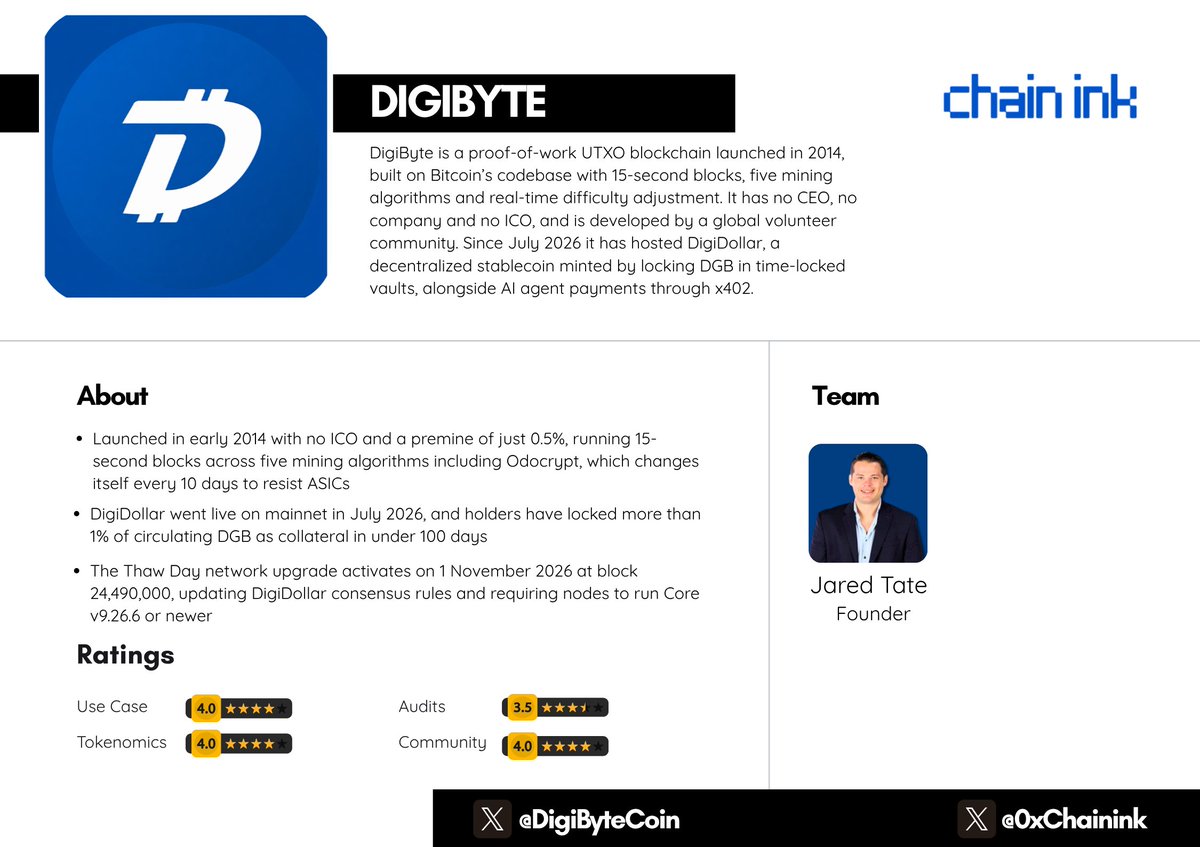
$DGB : Review 📜
What if a 12-year-old proof-of-work coin with no CEO, no company and no ICO shipped a decentralized stablecoin before most chains half its age?
Meet DigiByte, a volunteer-run UTXO blockchain where holders have locked more than 1% of circulating supply into DigiDollar in under 100 days, and which is ten days away from Thaw Day, its first major consensus upgrade for the stablecoin.
Let's explore one of crypto's oldest chains and its newest chapter. 👇
⚪ DGB at a Glance
Marketplace Insight: DigiByte is one of the few chains from the 2014 era still shipping new protocol features. Taproot and Schnorr support arrived in 2025, DigiDollar and x402 agent payments in July 2026, and Thaw Day lands in ten days. DGB is up about 46% on the year while much of the market sat flat, and DigiDollar collateral has roughly tripled since August.
The gap is still scale. More than 150 million DGB locked is real progress, but it is worth well under $1 million, DigiDollar trades on small venues, and DGB's own spot volume is concentrated on two exchanges of uneven quality.
⚪ Mission
DigiByte set out to fix what its founder saw as Bitcoin's three weaknesses: speed, security and decentralization. Its answer was a Bitcoin-derived chain with much faster blocks, mining split across several algorithms so no single hardware type dominates, and no company and only a 0.5% premine, so nothing concentrates control. The 2026 version of the mission extends that base layer into money people and machines can actually use, a dollar-pegged stablecoin backed by DGB and a payment rail for AI agents.
🔵 A Brief History
Jared Tate, known in the community as DigiMan and an early Bitcoin advocate from 2012, began modifying Bitcoin's code in late 2013, and DigiByte launched in early 2014. It raised no ICO, and its premine was 0.5%. Over the following years it built a long list of firsts for a UTXO chain: DigiShield difficulty adjustment, MultiAlgo mining, early SegWit adoption, the Odocrypt algorithm that rewrites itself every 10 days to resist ASICs, Dandelion++ privacy routing, DigiAssets for asset issuance, and Digi-ID for passwordless authentication.
DGB peaked at $0.1781 in the 2021 cycle. Tate stepped back from day-to-day operations in May 2020, criticizing what he called a crypto culture consumed by greed, before later returning to a public role. Development continued through open GitHub contributions from volunteers, with protocol changes activated through miner-signaling BIP9 soft forks rather than any kind of holder voting.
Taproot and Schnorr signature support activated in 2025, followed by Core v8.26.1 in October 2025, which required every node operator to upgrade. DigiDollar moved through development with support from DigiSwarm, an AI developer team associated with Tate.
2026 has been the busiest stretch in years. In February, Arizona's SB1649, a Digital Assets Strategic Reserve Fund bill, named DigiByte alongside Bitcoin and XRP as eligible reserve assets and cleared the Senate Finance Committee 4 to 2. In March, Tate described a constructive meeting with Kraken on listing requirements, and v9.26.0 release candidates landed on testnet with DigiDollar fixes.
A DigiPay SDK upgrade followed in April.
DigiDollar activated on mainnet in July through BIP9 signaling, later buried in Core v9.26.5. Holders time-lock DGB in vaults to mint a USD-pegged stablecoin, with pricing secured by a 7-of-35 multi-oracle Schnorr threshold-signature system, and can mint, transfer and redeem directly in the DigiByte Core wallet.
x402 went live the same month, letting AI agents pay for services and notarize output on-chain. By August more than 50 million DGB was locked at a 365% collateralization ratio, and OKX Singapore added a trade-only listing.
The past month has been about getting ready for the next step. Core v9.26.6 arrived in early October with about 125 fixes, roughly 60% lower RAM usage, faster startup, better wallet recovery, smoother DigiDollar sending and redemption, and preparation for the new rules. v9.26.7 followed on 6 October with ten smaller fixes.
DigiDollar collateral climbed past 150 million DGB, above 1% of circulating supply in under 100 days, and DD began trading against USDC and USDT on AnonKyc. Thaw Day activates on 1 November at block 24,490,000, updating DigiDollar consensus rules for volatility freezes, price referencing and vault, transfer and redemption accounting.
🔵 Ecosystem Narrative
The organizing idea is an old, battle-tested base layer gaining new financial tools.
➛ Multi-algorithm security. Five mining algorithms with real-time difficulty adjustment spread hashpower across different hardware, making it harder for any single group to dominate the chain.
➛ DigiDollar. A non-custodial, USD-pegged stablecoin minted from time-locked DGB vaults, with DGB as its only collateral asset and a 7-of-35 multi-oracle threshold system setting prices. More than 1% of circulating supply is now locked.
➛ Thaw Day. The 1 November upgrade refines how DigiDollar handles volatility freezes, price references and vault accounting. Ordinary DGB transfers are unaffected, but nodes, pools and oracles must run v9.26.6 or newer to stay on the right chain.
➛ x402 agent payments. AI agents can autonomously pay for services and notarize their output on-chain, a use case Tate has called the best initial fit for DigiDollar given 15-second blocks and sub-cent fees.
➛ Digi-ID and DigiAssets. Passwordless authentication and asset issuance layers built directly on DigiByte, the project's older utility track.
➛ State-level recognition. Arizona's SB1649 names DGB as an eligible reserve asset, though the bill still needs to pass both chambers and executive review.
⚪ What DGB Does
$DGB is the native coin of the DigiByte chain and the sole collateral asset behind DigiDollar.
➛ Payments: DGB settles transactions in about 15 seconds with sub-cent fees.
➛ DigiDollar collateral: holders time-lock DGB in vaults to mint the stablecoin, removing that supply from circulation while locked.
➛ x402 settlement: DGB settles payments made by AI agents for on-chain services and notarization.
➛ Mining rewards: miners earn DGB across five algorithms, the only source of new supply.
⚪ Key Features
➛ Proof-of-work UTXO chain running since 2014 with no ICO and no company.
➛ 15-second blocks, about 40 times faster than Bitcoin.
➛ Five mining algorithms with real-time difficulty adjustment.
➛ DigiDollar stablecoin live on mainnet, with more than 1% of circulating DGB locked.
➛ Thaw Day upgrade activating 1 November at block 24,490,000.
➛ Hard cap of 21 billion DGB with about 88% already mined.
🔵 Meet the Team
DigiByte has no CEO, no company and no corporate treasury. It is built by volunteers, with the founder still associated with its public direction.
▶️ Core Members:
➛ Jared Tate [ @jaredctate ] - Founder | An early Bitcoin advocate who began building DigiByte in 2013, stepped back from daily operations in 2020, and returned to a public role. He has shared regular updates on the October releases and Thaw Day, and has framed DigiDollar's best early use case as AI agents paying other agents.
➛ DigiByte Core | Open-source volunteer developers who ship upgrades through public GitHub development, including Taproot in 2025, DigiDollar in 2026, and the v9.26.6 and v9.26.7 releases ahead of Thaw Day.
➛ DigiByte Awareness Team | A community-run outreach group handling education, marketing, campaigns and bounties, including work on a legal framework for the ecosystem.
🔵 Ratings
➛ Use Case: ★★★★ (4/5). DigiByte has done something rare for a chain this old: it kept shipping. A decentralized stablecoin on a proof-of-work UTXO chain, live on mainnet with no company behind it, is a genuine achievement, and adoption is moving in the right direction, with more than 1% of circulating DGB locked as collateral in under 100 days and DD now trading against USDC and USDT. x402 agent payments, Digi-ID and DigiAssets add utility most 2014-era chains never built. The 1-point deduction is scale. DigiDollar's collateral is still worth well under $1 million, x402 has no published usage figures, DD trades on small venues, and the Arizona bill and a Kraken listing remain unresolved.
➛ Monetary Policy: ★★★★ (4/5). DigiByte has one of the fairest launches in crypto history: no ICO, a premine of just 0.5%, no company allocation and no investor vesting schedule. Supply is capped at 21 billion with about 88% already mined, so the remaining issuance is modest, and DigiDollar has turned into a meaningful supply sink, with more than 1% of circulating supply time-locked in vaults within three months. The 1-point deduction is demand. Mining issuance still adds steady sell pressure with nothing to offset it, and DGB trades around 98% below its all-time high after years of weak demand.
➛ Audits: ★★★⯪ (3.5/5). DigiByte's base layer has run for twelve years on a Bitcoin-derived codebase, with upgrades going through long public release-candidate cycles before activation, and the v9.26.6 release alone shipped about 125 fixes and stability improvements. That is a conservative and transparent process. The 1.5-point deduction follows the standing rule: there is no named third-party audit and no CertiK Skynet listing, and CER live rates the project at 20%. DigiDollar's multi-oracle threshold system is a new, security-critical component, and Thaw Day raises the stakes further, since any node, pool or oracle still running software older than v9.26.6 on 1 November risks following a divergent chain.
➛ Community: ★★★★ (4/5). Few communities in crypto have stayed this committed for this long. DigiByte is built entirely by volunteers, from core developers to the Awareness Team, its X account has more than 231,000 followers, and holders have locked over 150 million DGB into DigiDollar since July. Node operators and pools are actively upgrading ahead of Thaw Day, and community bounties are funding work on a legal framework. The 1-point deduction is market depth. Earlier today around 80% of DGB's daily volume ran through LBank and HTX, HTX showed no real order-book depth despite large reported volume, and Binance carried under 2%.
🔵 Conclusion
DigiByte is a survivor that started building again. Twelve years after launch, with no company, no ICO and no venture backers, its volunteers shipped Taproot, a decentralized stablecoin and an AI agent payment rail on a proof-of-work chain, and holders responded by locking more than 1% of circulating supply into DigiDollar in under 100 days. Its fair launch, 0.5% premine and nearly fully mined supply give it a cleaner monetary history than almost anything launched since.
The open questions are about scale and execution. DigiDollar's collateral is still worth less than $1 million, x402 has no public usage data, the Arizona bill and a Kraken listing are unresolved, spot liquidity is concentrated on two venues of uneven quality, and the new oracle system has no third-party audit behind it. Thaw Day on 1 November is the near-term test, and a clean activation would go a long way.
The bet is simple to state. If AI agents and stablecoins become a real payments market, an old, decentralized chain with fast blocks, a native stablecoin and nobody in charge could be exactly what that market wants. DigiByte has built the pieces and holders are starting to use them.
The next step is proving the system can grow, and getting through Thaw Day cleanly is where that starts.
Digi-ID: Passwordless Authentication Built on DigiByte
Digi-ID is a challenge-response authentication system based on public-key cryptography, th same mathematical foundation tht secures th DigiByte blockchain itself https://t.co/jJrYXksgw2 @DigiByteCoin@DGBBREAKING@dgb_ycagel
DigiByte has a hard cap of 21 billion digibyte:native (1,000:1 ratio to Bitcoin).
It launched in 2014 with no ICO and only a tiny premine for early development.
New coins are issued via pure Proof-of-Work, with block rewards reducing ~1% every month (not every 4 years).
All coins will be mined by ~2035.
#DigiByte #DGB #DigiDollar