You can now submit claims as raw 837 X12 EDI files in the Stedi portal's claims view. 837P professional, 837D dental, and 837I institutional claims are supported.
Upload a .edi file, or paste your X12 directly into the editor. The editor checks your claim against the X12 spec and flags structural errors so you can fix them before submitting.
More details in the changelog. Link below.
To register to watch, stop by https://t.co/je4OLvEs0G
If you can't make it live, don't worry. We'll be posting recordings to Stedi's YouTube channel after the event. We'll also be sharing a recap of each demo.
We're hosting the first Stedi Platform Partner Demo Day – a 60-minute, live, online event – today (Jun 2) at 3pm ET/12pm PT.
Each of these Stedi Platform Partners will present a 5-minute demo covering what they've shipped using Stedi:
Substrate – Real-time claim status agents
Tennr – Referral management platform
Superscript – Guaranteed patient pricing
Cair Health – AI agents for eligibility checks and claims submission
Veribrance – Patient cost estimates
Verified – One-click patient onboarding
Neuriphy – Financial clearance and denial management
There will be a short Q&A at the end.
If you haven't registered to watch yet, sign up. It's online and completely free. Link below.
Stedi now has pay-as-you-go pricing for all new production accounts. You pay only for the transactions you use. There are no monthly minimums or setup fees.
Previously, production API and SFTP access required a $500 monthly minimum. That meant committing to transaction volume each month, even if you didn't use it.
The minimum priced out startups, practices, and solo developers who wanted to move from prototype to production without a commitment. Now they can.
Developers and coding agents can build and test in a free sandbox account using test API keys, then upgrade to production in account settings and swap in a production API key.
And you can start with a balance as low as $100. Your costs are 100% usage-based, with automatic discounts for higher monthly volumes.
More details in the announcement blog. Link below.
We've finalized the lineup for our first Stedi Platform Partner Demo Day on Jun 2 at 3pm ET/12pm PT.
These Stedi Platform Partners and others will demo what they've built:
- Cair Health – AI agents for scheduling and denials
- Substrate AI – Real-time claim status agent
- Tennr – Referral management
- Veribrance (formerly Aarogram) – Patient cost estimates
Each demo runs five minutes, followed by a short Q&A.
You can register to watch at the link below. The event is free.
We now have a claim edit for negative service unit counts.
In a claim, a service line represents billing for a specific service, such as an office visit, lab test, or therapy session.
A service unit count is the number of units for a service line. The meaning of a unit depends on the procedure code. For example, four units of a 15-minute therapy code equal one hour.
X12 standards require these counts to be zero or higher. Submit a claim with a negative count and the payer rejects it. That slows down payment for the provider.
This claim edit catches the issue before the claim leaves Stedi.
More details in the changelog. Link below.
Stedi now supports CMS-1500 Claim Form PDF downloads directly from the claims view in the Stedi portal.
The CMS-1500 Health Insurance Claim Form, also called the HCFA, is the standard paper form for professional medical claims. You can auto-generate a PDF that mirrors the CMS-1500 form's layout for any claim submitted through Stedi.
Previously, these PDFs were only available through our API or from each claim's transaction details page in the Stedi portal.
Teams use CMS-1500 PDFs for record keeping, mailing claims to payers, or reviewing claim information in a familiar format.
More details in the changelog. Link below.
Stedi now has a claim edit for invalid state and province codes.
X12 standards require US addresses in claims to use the USPS two-letter state abbreviation, like 'FL' for Florida. Canadian addresses in claims must use the Canada Post province or territory symbol, like 'ON' for Ontario.
Submit a claim with the wrong state or province code format, and the payer may reject the claim. That ultimately delays payment for the provider.
This claim edit catches the issue before the claim ever reaches the payer.
More details in the changelog. Link in the replies.
Healthcare voice AI agents fall into three categories: inbound, outbound, and ambient.
If you're building an inbound or outbound voice agent, Stedi's APIs can replace or supplement most phone calls with standard healthcare transactions.
These transactions are faster, cheaper, and more reliable than relying on voice alone.
Our latest guide covers the different types of voice agents and where Stedi fits in.
You can now view Electronic Remittance Advice (ERAs) in the Stedi portal's claims view. Features include:
- A filterable list of all ERAs received through Stedi.
- A detail page for each ERA showing payer and payee info, payment date and method, total paid, and claim-level adjustments.
- A click-through from a claim's timeline to any ERAs that match its Patient Control Number (PCN).
- Download options for the full ERA PDF, per-claim PDFs, or the PDF for a single claim.
More details are in our announcement blog. Link in the replies.
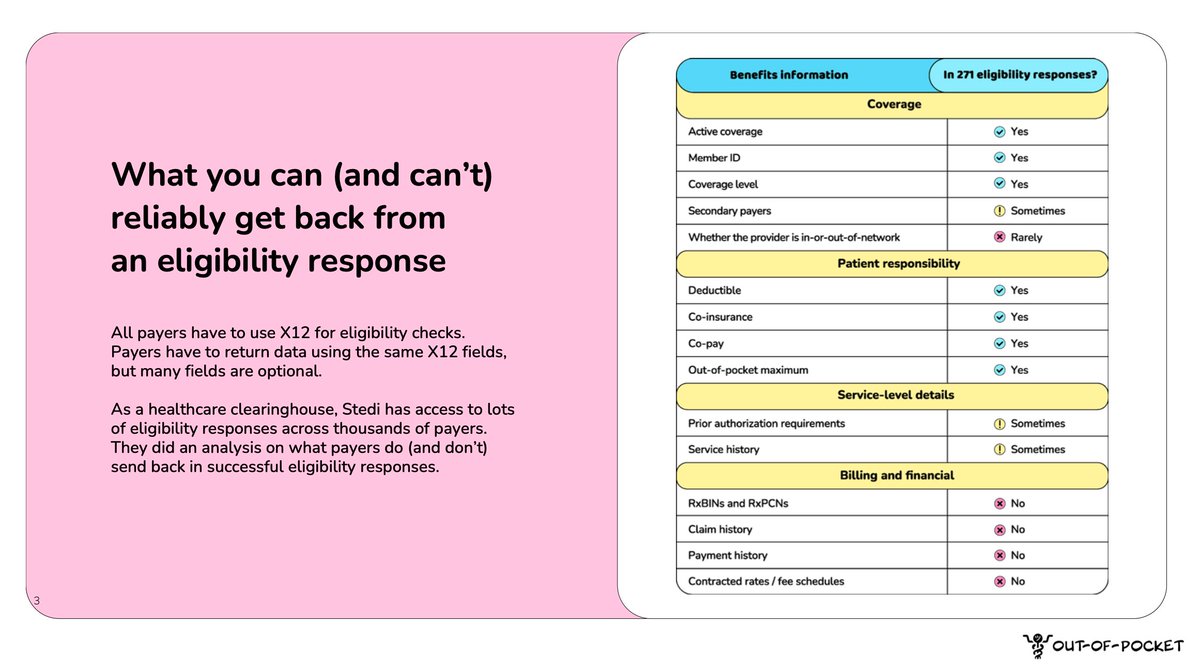
if you're trying to see whether a service is covered, you need to do an eligibility check with the insurance company. This is typically done through something called a 270/271 response.
A lot of people don't know what data is actually included in that transaction + make some common mistakes
We put together a report with @stedi to answer those questions
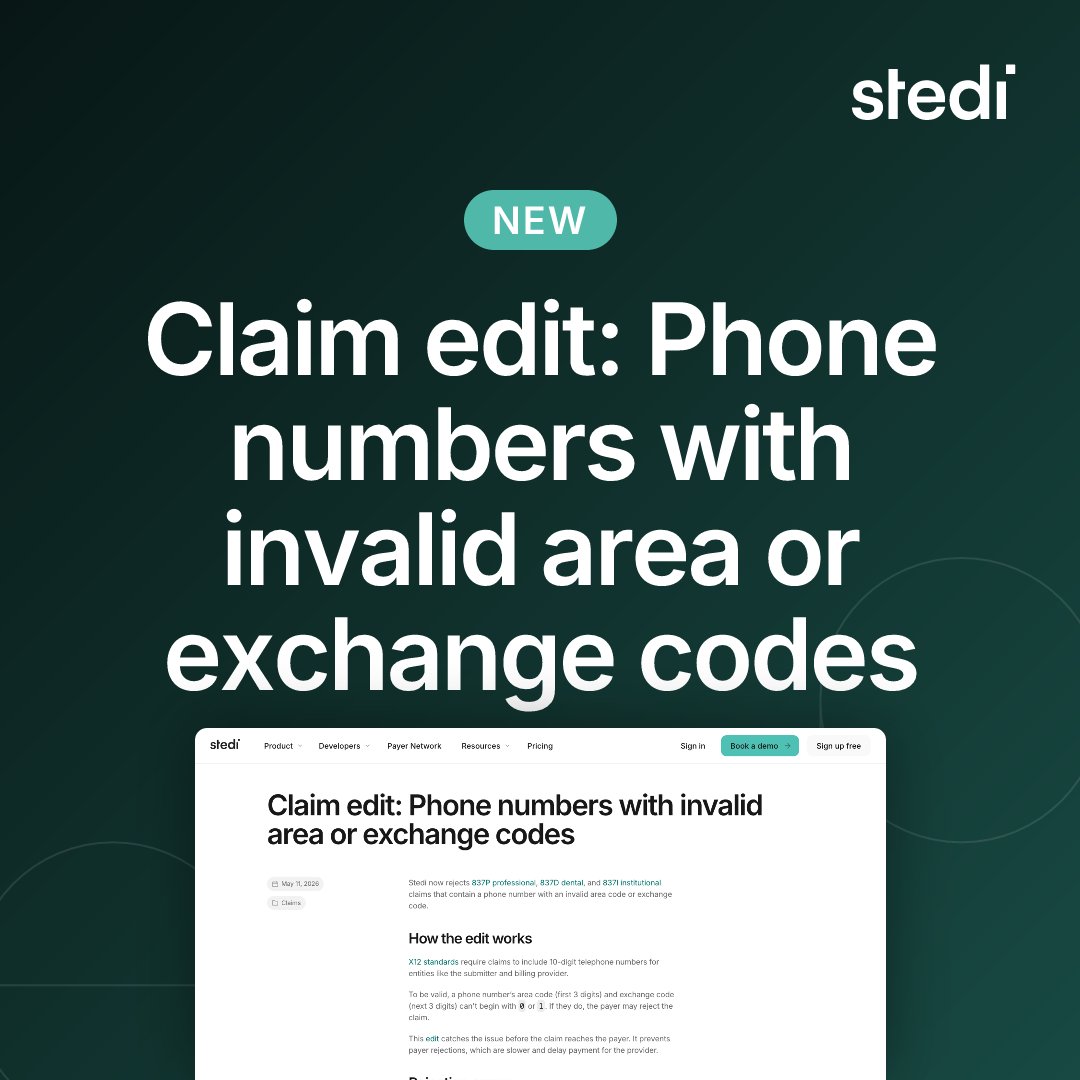
Stedi now has a claim edit for phone numbers with invalid area or exchange codes.
For 10-digit North American phone numbers, the area code is the first 3 digits. The exchange code is the next 3.
To be a valid phone number, neither the area code nor exchange code can begin with '0' or '1'. If you submit a claim that contains a phone number with an invalid area or exchange code, the payer may reject the claim.
This edit catches the issue before the claim reaches the payer. It prevents payer rejections, which take longer to resolve and delay payment for the provider.
More details in our changelog. Link in the replies.