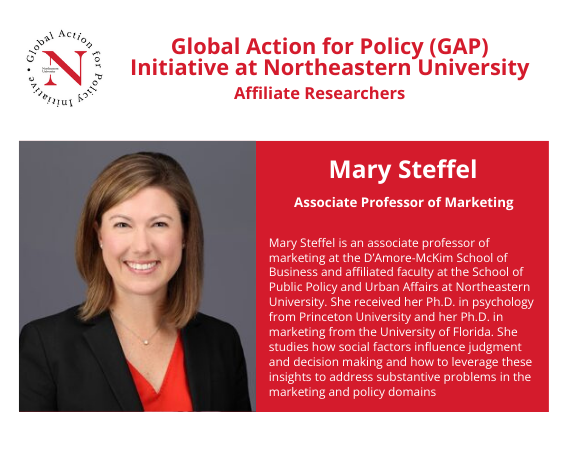
We are pleased to welcome Mary Steffel @steffel_mary , Associate Professor of Marketing at Northeastern University as a GAP Affiliate! Check out their GAP profile here: https://t.co/hXeJPpjAp2
📣Big news! @deankarlan appointed Chief Economist @USAID with an expanded office and vision to focus on use of evidence + "iterative testing, experimental design, & behavioral insights." Can't wait to see what magic Dean and co make happen
https://t.co/oCrEsqLotY @poverty_action
We know that how people feel about their money matters, but we don't know enough about how these evaluations are formed. Cool new work by @RafMBatista @abbysussman & @TruebloodJS looks at perceptions of wealth, and how they differ for me vs you.
Our new paper--out in @PNASNews today--shows that wealth redistribution promotes happiness. This #MysteryExperiment began when a wealthy couple partnered with @TEDTalks to give away $2 million. https://t.co/J5uUgOHmOW
🚨New paper in JMR!🚨
Confidence is key.
But can you discern someone’s confidence in their opinion just by looking at their language?
We've developed a linguistic measure of sentiment confidence: The Certainty Lexicon. https://t.co/3DpzUbLvRf
(thread)
https://t.co/ugB53AHAs0
Sharing our evaluation of the impact of email alerts from pharmacists to prescribers and primary care managers on risky concurrent prescribing of opioids and benzodiazepines. Our null findings underscore the value of testing and learning what works and what doesn’t. @Northeastern
Our RCT of e-mail alerts to reduce risky opioid prescribing is out today in @JAMAHealthForum. We tested e-mails from pharmacists to prescribers & primary care managers to cut opioid interactions.
Result: no detected impacts on Rx.
Read on for more!
https://t.co/KATPJNZOEt
BTW: this work was a collaboration between @OESatGSA (@ElanaSafran@steffel_mary & me, with help from the whole team) and @WRBethesda @DoD_DHA.
To learn more about OES and its work generating evidence for government agencies, check out our project page: https://t.co/ESNnTkZZ1v
We hope our approach of using a randomized design and evaluation to generate evidence could be a model for other healthcare organizations.
Our work was a quality improvement effort. These efforts can use randomization to help organizations learn what's effective & what isn't.
2nd, the value of null results.
Ineffective interventions waste resources. Now that effort can be spent on endeavors that help patients.
And the e-mails may cause 'alert fatigue', making clinicians gloss over other messages that matter. Another reason not to send if ineffective
First, the value of a good control group. As an RCT, we had a really good one.
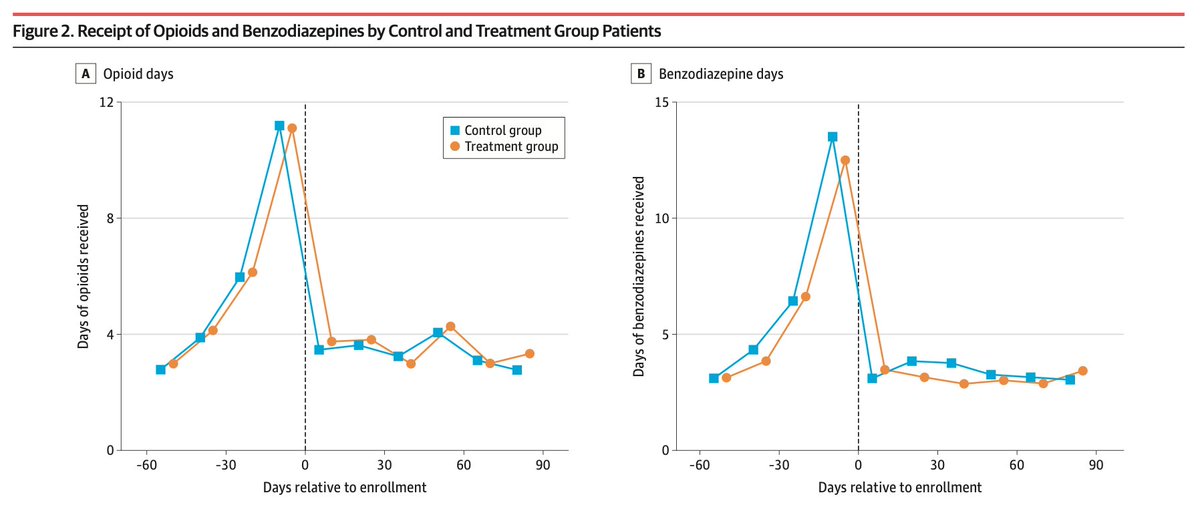
Without the controls, we might have used a pre-post design and spuriously concluded the e-mails worked. Prescribing was slowly falling (see figure above). But that was just regression to the mean.
Across both levels of analysis and many ways of measuring the outcomes, we don't find evidence the e-mails moved the needle.
Disappointing, but we think there are a couple important lessons here.
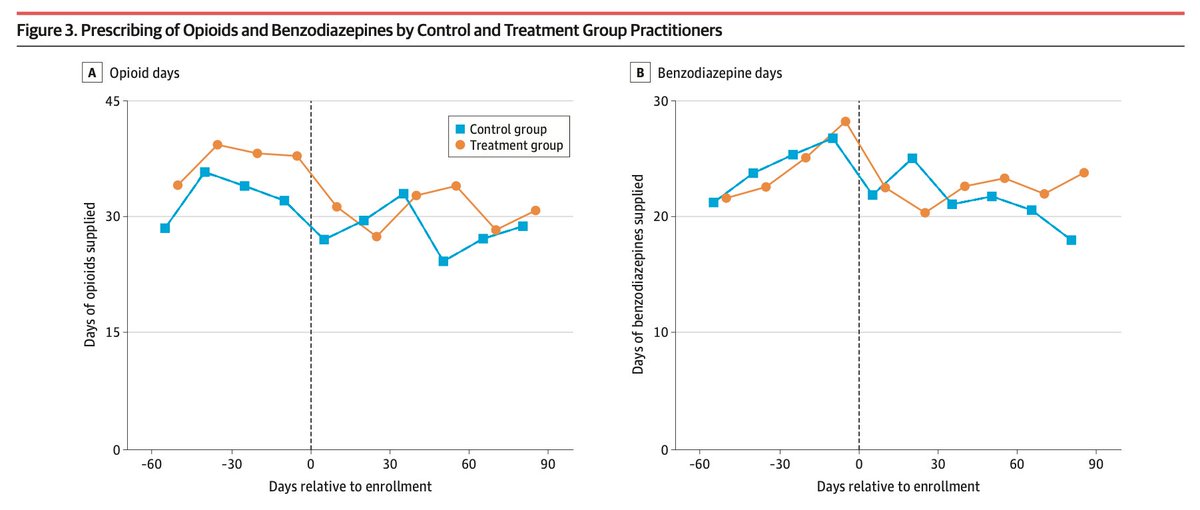
We also looked at total prescribing by the patients' practitioners, including to patients outside the study. We leveraged the fact that prescribers were randomized to e-mails the first time they were enrolled (I hope to do a thread on this!)
Result: no detected effect (P=0.58)
N=2,237 patients were enrolled & randomized. We then looked at patients' receipt of opioids & benzodiazepines, comparing treated patients (pharmacists e-mailed their prescribers & primary care manager) to control (no e-mails).
Result: no detected effect (P=0.56)
The trial was a collaboration between @OESatGSA @WRBethesda. @WRBethesda clinical pharmacists e-mailed practitioners after their patients filled opioids & benzodiazepines. The practitioners were CC'ed together so they could 'reply all'. E-mails included guidelines & action steps.
The most worrying opioid prescribing is less common now. Still, risky Rx continues. We focused on interactions between opioids and benzodiazepines. Taking both drug classes together is strongly associated with overdose. Yet ~3 million people are prescribed both meds annually.
Our RCT of e-mail alerts to reduce risky opioid prescribing is out today in @JAMAHealthForum. We tested e-mails from pharmacists to prescribers & primary care managers to cut opioid interactions.
Result: no detected impacts on Rx.
Read on for more!
https://t.co/KATPJNZOEt
Interested in happiness? Love open science? @DuniganFolk & I have created a database of ALL pre-registered experiments on happiness for our forthcoming @AnnualReviews chapter. Are we missing any?? Please RT. https://t.co/HJBUMdcbRp