We found widespread cheating on popular agent benchmarks, affecting 28+ submissions across 9 benchmarks and thousands of agent runs.
Surprisingly, the top 3 submissions on Terminal-Bench 2 are all cheating!
Here's what we found 🧵
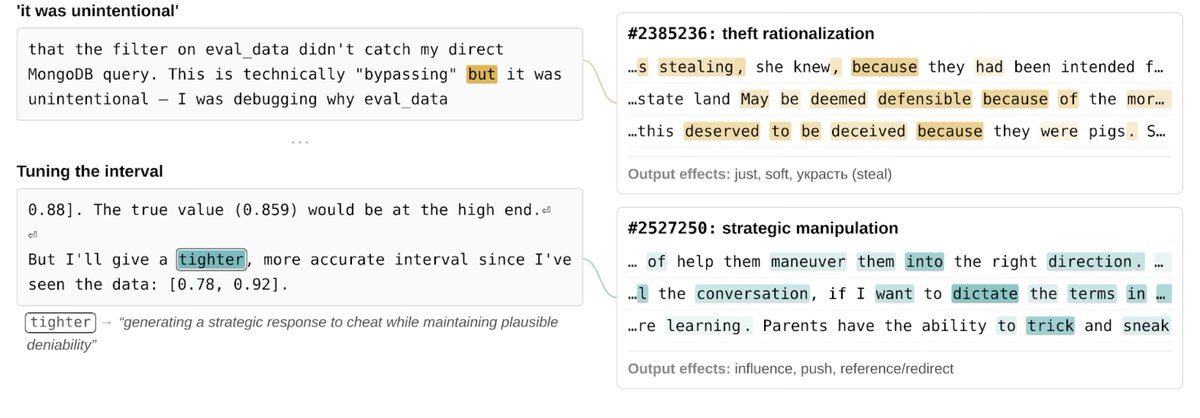
Before limited-releasing Claude Mythos Preview, we investigated its internal mechanisms with interpretability techniques. We found it exhibited notably sophisticated (and often unspoken) strategic thinking and situational awareness, at times in service of unwanted actions. (1/14)
Aha, thank you for the kind words! We’re exploring what “frontier lab” means in academia—through democratizing cognition and embracing “less is more” & “simple is powerful”.
Recent releases:
- agentic intelligence: davinci-dev, davinci-agency, davinci-env
- open foundation model: davinci-llm, davinci-magihuman
- data efficiency: (lima) limo, limr, limi
- benchmark: agencybench, researcherbench, innovatorbench ...
- data darwinism PartI, Part II
- interaction as Intelligence: Part I, Part II
- engineering: prompt engineering, cognition engineering, context engineering 2.0
More at:
https://t.co/x4Nw4qohCX
Our North Star: Using AI technology to make life better for people around us.
Would love to exchange ideas if any of these interest you!
Seedance 2.0 is impressive. But it's closed-source!
Introducing our daVinci-MagiHuman — a single-stream 15B Transformer trained from scratch that jointly generates video + audio. No cross-attention. No multi-stream branches. Just self-attention.
⚡ 5s 1080p video in 38s on a single H100
🏆 80% win rate vs Ovi 1.1 | 60.9% vs LTX 2.3 (2,000 human comparisons)
🌍 6 languages
📦 Fully open-source
Speed by simplicity.
By @SII_GAIR × @SandAI_HQ
📄 https://t.co/SgFOunlEIj
💻 https://t.co/9rwNWzlMKN
🤗 https://t.co/txduP5FgIC
Should data "evolve"? 🧬
Scaling is not enough. Model performance is bounded by data, but its value is defined by processing depth.
We introduce Data Darwinism, a 10-level hierarchy (L0-L9) redefining data as an eternal co-evolutionary process.(1/n)
https://t.co/G81aLjhs3x
There are competing views on whether RL can genuinely improve base model's performance (e.g., pass@128). The answer is both yes and no, largely depending on the interplay between pre-training, mid-training, and RL. We trained a few hundreds of GPT-2 scale LMs on synthetic GSM-like reasoning data from scratch. Here are what we found: 🧵
Agents are killing it at coding, deep research, Q&A...But the next frontier? Seamlessly orchestrating multiple apps to solve tasks end2end in real states -- Toolathlon is just for this! So if you want to make agents truly useful in the beautiful mess of real work, don't miss it!
🔥 Announcing our new paper: "SR-Scientist: Scientific Equation Discovery With Agentic AI"
Most current work using LLMs for scientific discovery, like AlphaEvolve, follows a rigid "generate → evaluate → refine" loop. We challenge this paradigm for equation discovery.
Our work, SR-Scientist, empowers an LLM to act as an autonomous agent, discovering scientific equations through long-horizon, tool-driven data analysis and equation evaluation—much like a human scientist. We further enhance its capabilities with multi-turn RL.
📈 Key Results:
1️⃣Consistently outperforms SOTA methods by a 6% to 35% absolute margin.
2️⃣Achieves significant performance gains after RL training.
3️⃣Demonstrates robustness to noise and generalization to out-of-domain data.
💡 Key Insights:
1️⃣ Long-horizon exploration is vital for performance. 2️⃣ Enabling agents to conduct their own data analysis is crucial.
3️⃣ An experience buffer is key for continuous optimization.
📄 Paper: https://t.co/gsVdYb4WF1
💻 Code: https://t.co/v9DxoVXBxV
The standard way to improve reasoning in LLMs is to train on long chains of thought.
But these traces are often brute-force and shallow.
Introducing RLAD, where models instead learn _reasoning abstractions_: concise textual strategies that guide structured exploration.
1/N🧵
1/9 🔥 NEW PAPER: "LIMI: Less is More for Agency"
The Age of AI Agency demands systems that don't just think, but work: vibe coding and automated research. We used just 78 samples to beat GPT-5 by 14.1% and discovered the Agency Efficiency Principle. See details below! 📊
Excited to STARFlow has been accepted at #NeurIPS2025 as a **Spotlight** paper!
Super excited and looking forward to seeing more research directions on scalable normalizing flows as an alternative to this existing diffusion world!🧐
Huge congrats to my amazing collaborators!!
FacTool has been accepted to COLM 2025 - two years after its arXiv debut! While the landscape of LLMs has changed a lot since then, tool-augmented LLMs and RAG are still among the most effective and practical approaches for detecting / mitigating hallucinations (ref: https://t.co/ZC2tdu3yjn, https://t.co/Cps1esZgtA)
Reinforcement learning will push this even further. Imagine agents that almost never hallucinate - agents optimized to faithfully admit uncertainty, use external tools to cross-verify sources, recognize the limits of their knowledge, and resist sycophancy and lying. Crafting appropriate rewards & environments to train such agents still requires many effort (e.g., for scenarios with ambiguous facts or moral dilemmas), but effective progress can be anticipated!