Super excited that this talked dropped so quickly for everyone else to see it. If you're struggling with #MLOps or #LLMOps I'm happy to chat and see if we can help.
Want higher return on investment #ROI for #MLOps or #LLMOps initiatives? Check out @stefkrawczyk's talk from @MLOpsWorld on some lessons learned building in the space that just dropped.
https://t.co/XogKxl82nf 1/3
User spotlight: SRE Agent, Theodosia mounts a Burr Application as an MCP server — AI agents pick transitions through tool calls, illegal moves are refused with structured errors, and the full Burr observability stack comes free. Clean design by
@msradam 👏
https://t.co/d4uMBqveIY
@ankush_gola11 SDB Is also existential for you to have some IP that isn't easily replicable. It's hard to compete in a commodity space since it's very easy to copy, but it's also hard to copy a database so that gives you some "moat" if done well.
Thought: terminal based coding agents are evolving into the terminal wars of old. Bash vs zsh vs ksh etc. It'll also be one thing you customize as a dev like you customize your shell - look, feel, behaviors, plugins, etc. LLM model will be configurable. UX will be stickier than model provider.
BART spent $90 million on new fare gates. They're recovering about $10 million a year in fares.
That's a 9-year payback on paper. The actual return hit in six months.
Embarcadero station went from 112 hours of corrective maintenance in the six months before installation to 2 hours after. Daly City saved 109. Balboa Park saved 75. Across the system, 961 hours of cleanup work disappeared. Corrective maintenance is the term BART uses for graffiti, heavy soiling, vandalism, the damage that needs a crew not a janitor. At several stations it dropped to zero.
Crime fell 41% year over year. Riders who reported seeing fare evasion on their trip dropped from 22% to 10%. Citations issued by BART police went from 2,200 in January to under 1,000 in July, because there was nothing to cite.
The gates were a filtering project disguised as a revenue project.
Old BART gates were waist-high orange fins designed in the 1970s. You could hop them in under a second. That made the station effectively a public space, and the rider mix reflected that. The new gates are 72 inches of polycarbonate with 3D sensors that detect tailgating. You either pay or you don't enter. Once you don't enter, you also don't smoke on the platform, sleep in the elevator, or harass other riders.
BART tried hiring more police for years. Blitz operations at high-traffic stations. Increased patrols. Dedicated transit cops. None of it moved the numbers the way six feet of polycarbonate did.
The $10 million in recovered fares is the smallest line in the return. Fare revenue used to cover 70% of BART operations. After the pandemic it collapsed to 22%. The gates won't fix that gap directly. They fix the precondition for fixing it: a system that office workers, families, and tourists are willing to use again. Ridership growth at stations with new gates outpaced ungated ones before the rollout finished.
A $400 million annual deficit is heading to voters in November as a sales tax measure. Voters don't approve sales taxes for transit agencies they don't feel safe in. The $90 million on gates is buying BART the right to ask the public for more money.
That's the real return on six feet of polycarbonate.
For once I actually agree with the constructive argument here. There are more approaches that allow you to own your own destiny. Memory is just context after all and you can provide that at many places of the agent while loop. Check out @burr_framework and of course @agentforce
I think there will be a loss of "software layer" vendors if they don't move fast enough. There will be some equilibrium feature point where an internal solution will win if it's good enough, and the only way for a vendor will be either price or moving so fast as to make their product so much better. AI + experienced engineers shifts a lot more to build it...
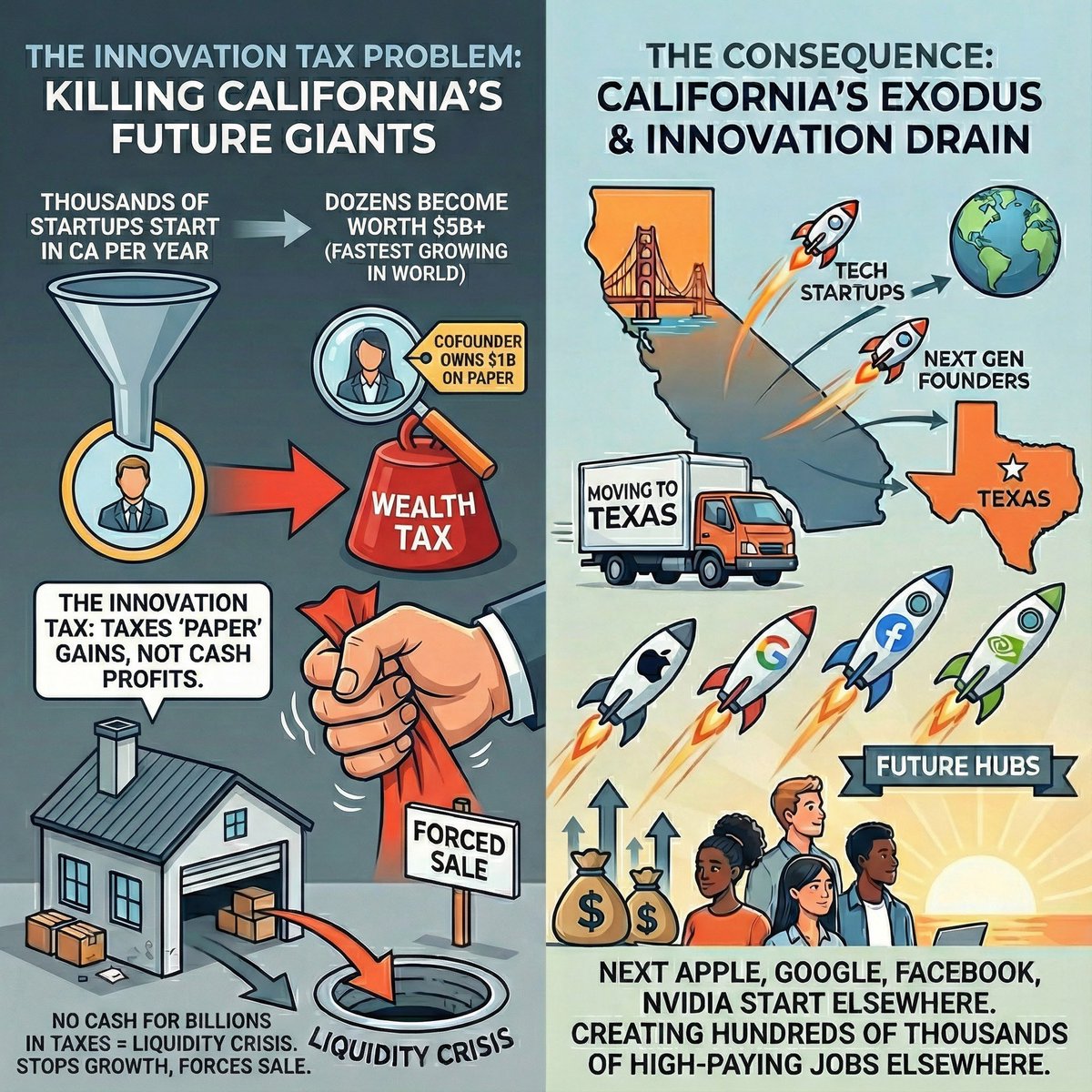
This is the best summary of the personal impact of the California Wealth Tax I've seen. Founders, if you have super voting shares, your tax liability may be substantially higher than your net worth. Private company shareholders, especially those in heavy industries, face a similar risk. Note this tax can apply to founders and shareholders with far less than $1B in net worth as well. As a lifetime Californian, this pains me to say, but founders of any unicorn company or any startup that could become a unicorn this year, really need to start planning a potential move or many will face 30-50%+ wealth taxes and potential bankruptcy. I'm still hopeful that voters will see the serious negative impact on California's tax revenue, services and jobs and will vote this proposition down... but it's so egregiously bad that you need a backup plan.
https://t.co/Y1rpHUDB3J
California started with the Gold Rush and might end with the Golden Exit.
it has been underreported how much wealth has left CA because of the asset seizure tax being proposed.
a private poll was conducted amongst affected individuals a few days ago and 80-90% surveyed said they have already left CA in 2025 or will leave in 2026 if the ballot measure looks likely to pass.
$2-2.5T of assets gone, representing about $20B of annual revenue for the state government. and likely hundreds of thousands of jobs now at risk.
less reported is the bigger exodus underway from folks who are NOT directly affected but worry (as they should) that this law will quickly transition from billionaires to everyone else...
the initiative actually gives CA legislators the right to take anyone's post-tax assets anytime in the future based on a majority vote. this isn't about billionaires. it's a new "tax system" that simply destroys private property rights in America.
all private property is now public property.
even after paying your taxes, it's not legally your property anymore. it's the government's, you're just borrowing it.
legislators will decide what you get to keep and temporarily use each year.
countless founders, CEOs, and other business leaders are actively looking to move their companies out of state. not just tech, not just AI, not just billionaires, but the core engine of California's prosperity since 1847 is unraveling.
and here is how this initiative risks unraveling America:
- ~10 states have explicit or implicit prohibitions against an asset seizure tax...
- individuals affected in CA (and other states trying to do the same) will move to these states that endow private property rights.
- CA already has a $20-30B annual budget deficit, an unfunded ~$1T pension liability for public employees/unions, and $500B of debt outstanding. the state can not afford to borrow much more and will launch more asset seizures to meet its obligations.
- asset seizures will first transition to "millionaires" and eventually to the entire middle class as more asset seizures drive more people to leave the state.
- the deficit, debt, and job loss will spiral. the Golden Exit.
- no US state has ever declared bankruptcy. in addition to CA, dozens of other states face similar fiscal crises - legislators promised future benefits that can't be paid or theft and waste have been allowed to run rampant and unabated for years.
- struggling states will eventually request federal government assistance, as they always have in times of fiscal crisis, effectively "federalizing state debt".
- states not in crisis will declare "enough is enough", individuals in those states will refuse to pay their federal taxes (why pay for other people's mistakes?), some states may try to secede from the Union, and a constitutional and civil crisis will erupt.
this may seem far-fetched but it is the obvious domino effect of selectively deleting private property rights for some people in some states.
i am not a billionaire and this CA bill does not affect me, but i care about the country and the state of CA. i want both to thrive. it's obvious that there are people in CA in desperate need of support and assistance, and inequities may exist that need to be rectified, but eliminating private property rights is the wrong path for everyone.
a few alternatives to consider first:
1) with a $350B annual budget, CA can cut programs that result in theft and little-to-no benefit for citizens. $50B per year is likely recoverable.
2) if more taxes are needed, tax loans against unrealized capital gains (very few objections will arise), eliminate tax-free rollover of certain appreciated assets (real estate industry will fight), create a step up in basis on inheritance (some will fight but most will support). likely $10Bs of incremental revenue can be realized.
3) restructure all public retirement programs from Defined Benefit to Defined Contribution. eliminating the unfunded retirement liabilities ($1T+) will be the release valve on the future the state so desperately needs.
we must address what ails us without dividing and destroying our state, our nation, our home.
ignore the rhetoric, these are the facts.
@AstasiaMyers Maybe. We humans operate largely on paths that worked before.
Where I think things get interesting is if the code and the path are the same thing ala @hamilton_os and @burr_framework . Makes it easier to manipulate, track, and importantly repeat...
Larry and Sergey can’t stay in California since the wealth tax as written would confiscate 50% of their Alphabet shares.
Each own ~3% of Alphabet's stock, worth about $120 billion each at today's ~$4 trillion market cap.
But because their shares have 10x voting power, the SEIU-UHW California billionaire tax would treat them as owning 30% of Alphabet (3% × 10 = 30%). That means each founder's taxable wealth would be $1.2 trillion.
A 5% wealth tax on $1.2 trillion = $60 billion tax bill, each.
That's 50% of their actual Alphabet holdings—wiped out by a "5%" tax.
Section 50303(c)(3)(C) of the 2026 Billionaire Tax Act states: "For any interests that confer voting or other direct control rights, the percentage of the business entity owned by the taxpayer shall be presumed to be not less than the taxpayer's percentage of the overall voting or other direct control rights."
This means if a founder holds shares representing only 3% of economic interest but 30% of voting control (through Class B supervoting shares), the tax would presume their ownership stake is at least 30% for valuation purposes, not 3%.
The wealth tax is poorly defined and designed to drive tech innovation out of California.