Grain prices are down. Fertilizer costs keep climbing. Before you write a smaller check, think twice.
That’s why we’re bringing agronomy to you, so you can learn to cut back with confidence.
6 stops. Find yours>> https://t.co/nS0J3rZrOV
Is your N rate building soil carbon or burning it?
Every N application is a biological decision.
Consider this Iowa State N rate trial (over 14-16 years):
• In continuous corn, no N applied lost about 134# of soil carbon per acre per year
• Soil carbon broke even at about 36% of the rate that maxed out yield and then peaked right at that yield-max rate
• Above that, carbon dipped slightly and yield didn't go up
• Corn after soybeans was about neutral at the optimum rate
So What?
Too little N and the crop runs short. This equates to less residue and less roots= less microbial food. On top of that, microbes short on N may mine OM to get it.
Too much N and the crop doesn't exchange as much carbon with the soil. The extra nitrate is open to leaching and denitrification. A Purdue study also found corn sent less carbon to its roots at the highest N rates.
Adequate N meets the crop's needs and the biology's needs. A well-fed crop harvests more sunlight, CO2, and water. This means it will ultimately push more sugar into the rhizosphere. That builds WEOC which is the food that drives the whole system.
Microbes carry about 8 parts carbon to 1 part N in their bodies and they need roughly a 24:1 C:N diet because most of that carbon gets burned for energy.
N alone doesn't build anything, so it needs carbon with it.
I think the key is knowing what the soil can supply before guessing from a yield goal.
All of this to say, find out what the soil cannot provide and supplement where it cannot.
Same fix, new year isn’t a fertility plan.
BaselineRx asks what your soil can already supply, then covers only the true shortfall.
Spend where it pays.
#BaselineRx#SoilHealth#Agronomy
The fertility is already in your soil. Getting it to cycle is the work.
A soil that functions gives your crop more to work with. So don’t just add more fertility. Make more available.
#agronomy#soilhealth#farmtok#cropcast#biocastmax
This soil doesn’t exist.
Grid sampling blends every zone into one bucket — an average that matches none of them.
Start every decision from what’s really in your ground. Not a guess.
That’s BaselineRx.
#Agriculture#SoilHealth#PrecisionAg#Agronomy#BaselineRx
Dumping more on there isn’t a strategy. Understand the soil, work with Mother Nature, and stop paying for what you don’t need.
#BWFusion#BaselineRx#soilhealth#agronomy
Fertilizer isn't getting cheaper, and buying more isn't the answer.
Sean Nettleton and Blake Hadley are teaming up for a Crop Cast Live webinar on how to get more from your soil and make every pound count.
Oct. 23 · 10 AM ET / 9 AM CT Register now>> https://t.co/MkN8tzNZse
Your plant has a sensor for ethylene, the hormone that drives ripening and stress response. Researchers found that sensor doesn't work without a copper atom sitting in it.
And that's just one of copper's jobs. It helps move energy through photosynthesis, it helps build the lignin that keeps stems standing, and it keeps pollen fertile so you actually set grain.
When copper runs short you see pale plants, twisted dead leaf tips in wheat, and in bad cases heads that don't fill. Copper doesn't move much in the plant, so new growth shows it first.
Where do we see it? Organic soils hold copper tighter than any other micro, so high-OM ground, sands and high-pH spots are the ones to watch.
Here's the catch: this is a nutrient I have seen nearly 0 responses to by applying it on its own. Have you had luck? One exception for me is on wheat.
Next up: molybdenum.
#NextLevelAg #Agronomy365 #The5Percent #copper #agronomy
Building soil P is expensive. The math and the field don’t agree.
Just jumped in the combine helping the family farm . Bean yields around here have been pretty good. Can’t speak for everybody, but overall solid. Quality’s a little off.
I was listening to a video saying phosphorus needs to be 50 ppm, preferably 100. We just finished a field that made over 60. Around here most APHs are 43 to 45. Mother Nature gets the credit. She did the work.
That field tested 3 to 10 ppm phosphorus. Do you really believe another 10, 12, 15 bushel was sitting there just because the soil test number was higher?
I ran the math with Grok on building this ground to 50. 11-52-0 at $1,152 a ton is $1.11 a pound of P₂O₅. University data (Iowa State, Minnesota, SDSU, Tri-State) says it takes about 16 to 20 pounds of P₂O₅ to move a Mehlich-3 test 1 ppm. From 5 ppm to 50, that’s roughly $900 an acre on paper. At pH 7.2, calcium ties a lot of that up. Figure 40 percent fixation and you’re closer to $1,500 an acre before you even count crop removal working against you every year.
Then ask how many bushels that takes to break even. Chasing that ppm, I’d go broke — or I’d be better off buying more land.
We foliar fed this field several times. No check strip, so I can’t prove it paid. I believe it did. Exudation drives phosphorus uptake, stimulation and plant health drives exudation. The more you stimulate the crop, the more phosphorus gets in the plant. - both are important soil P and Uptake. Can’t spend it all just to get it applied to the soil.
I’m not anti-phosphorus. I want P in the field. I’m anti-losing money chasing a magical ppm.
South Dakota cash beans are about $12.40 tonight. At that price, $1,200 an acre is 97 bushels. $2,000 is 161 bushels. Spread over five years, you need an extra 19 to 32 bushel every single year just to get your money back. Not once. Every year.
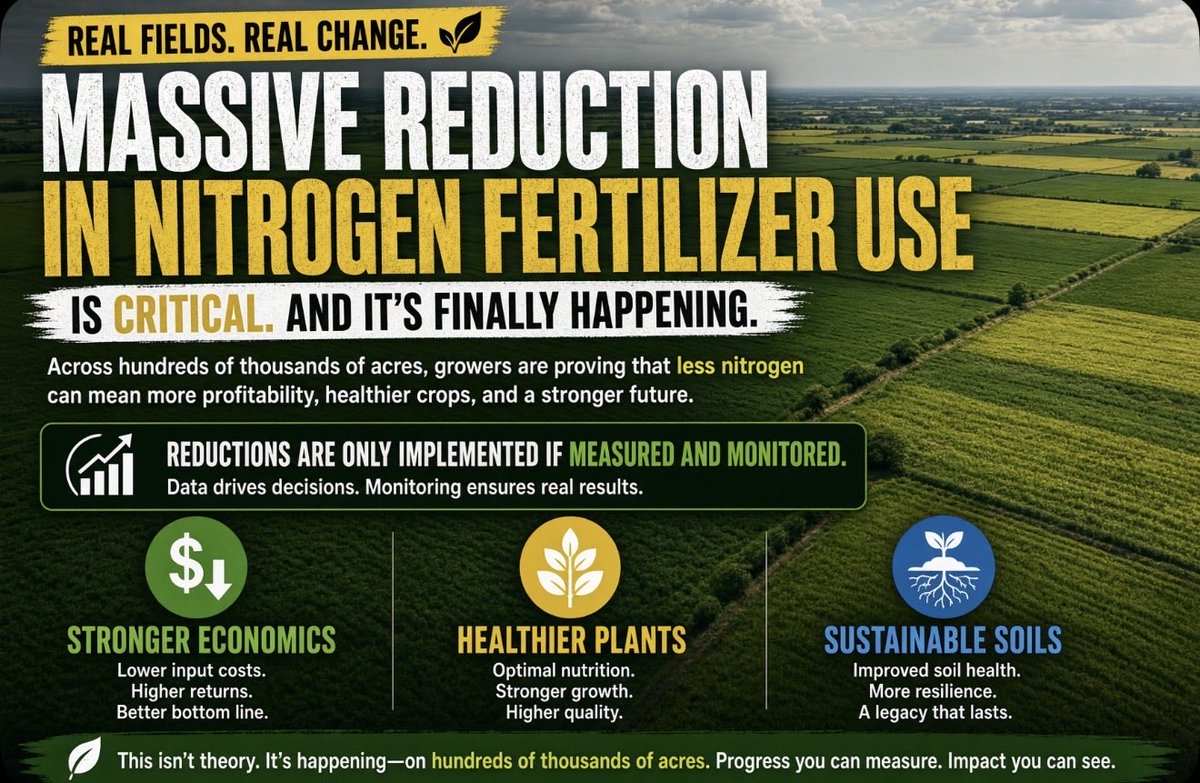
We are now going into year 6 of aggressively cutting back Nitrogen fertilizer on several hundred thousands of acres annually through our recommendations.
Happy to see more people waking up to the opportunities.
Concern- don’t do it blindly and then have a disaster. Measure and monitor and let your fields give you the answers. Success from Nitrogen cutbacks comes from efficiency which is driven by a plan not by accident.
#Baseline RX #agronomy365#nextlevelag
Same field. Five different soils. Why would one average tell you the truth about any of them?
Stop averaging your soil. That's guesswork.
#Agronomy#BaselineRx#SoilHealth#BWFusion
By the late reproductive stages, a lot of your phosphorus is fixed again. Here's why 👇
Every night a healthy plant kicks out 30–50% of its exudates to keep the microbes happy, and the microbes feed the plant. Under stress it saves those sugars for the grain and forgets about the root.
#phosphorus #agronomy #rhizosphere #soilmicrobes #corn #plantHealth
We apply $100 worth of phosphorus. Why can't we get that $100 back into the plant? 🤔
Most growers get between $10 and $30 of it back that year. We think that could be $70–$80, just by maintaining better microbial levels, and allowing the plant to ask for it.
#phosphorus #soilhealth #agronomy #farming #soilbiology #fertilizer
53,000 seeds per bushel.
Grain analysis samples are rolling into the lab, and the spread is eye-opening. One field we just ran came in at 53,000 seeds/bu in one zone and 59,000 in the other. For reference, last year's largest seed we saw was about 57,900.
Other samples are coming in around 90,000.
Same 56 pounds of corn creates that bushel. At 53,000, each kernel carries about 70% more weight than a kernel at 90,000.
So what does that tell us? It tells us how well the back half of the season was managed, did we get rain to finish. Kernel numbers get set early, but kernel weight gets built during grain fill. That comes down to keeping leaves green, holding plant health and nutrition through late summer, and keeping the plant filling until black layer.
That's a lot of yield potential sitting on the backside of the season.
A Grain analysis test shows you where you landed. Send in two ears and get plant nutrition and grain size back. Pair it with a soil test and you can see what to manage differently next year.
#GrainAnalysis #Corn #Agronomy #GrainFill #NextLevelAg