A token presale involves more than choosing a price and connecting a wallet.
There are purchase conditions, payment requirements, fund allocation,
Withdrawal rights and token release schedules.
Here’s how the $TCGV presale is structured.
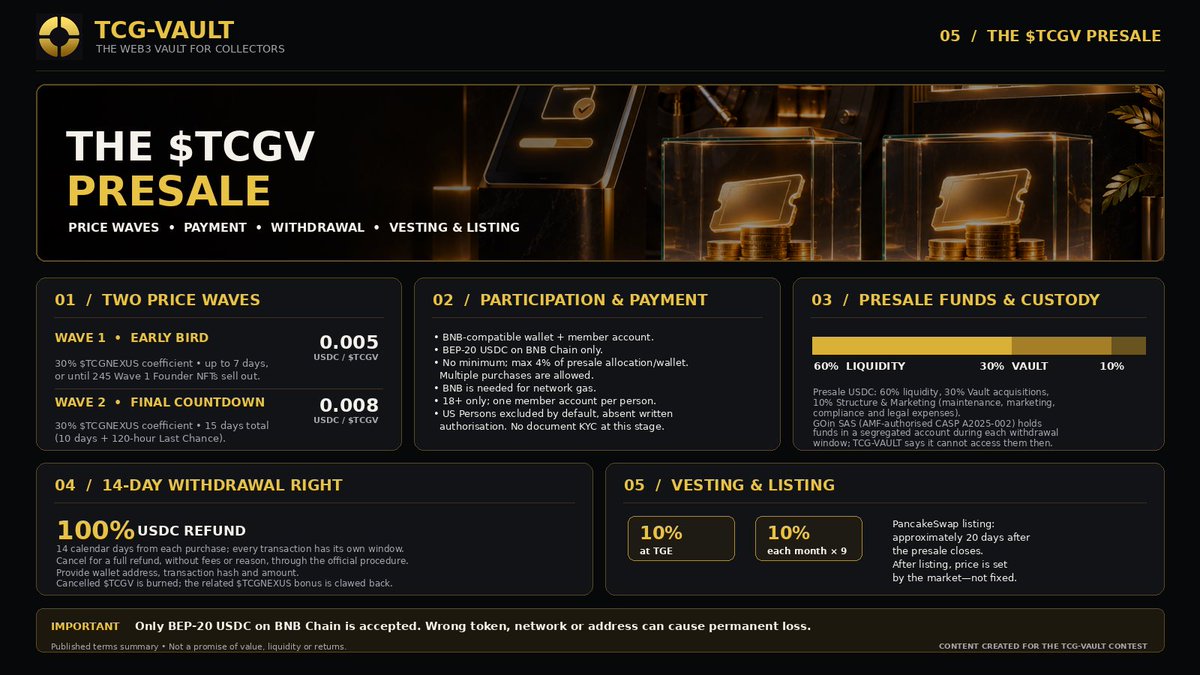
1. TWO PRICE WAVES
The published presale terms specify two stages:
• Wave 1 — Early Bird: 0.005 USDC per $TCGV.
• Wave 2 — Final Countdown: 0.008 USDC per $TCGV.
Both waves include a 30% $TCGNEXUS allocation coefficient.
Wave 1 lasts up to 7 days or until 245 Wave 1 Founder NFTs sell out.
Wave 2 lasts 15 days: 10 days followed by a 120 hour Last Chance period.
2. HOW TO PARTICIPATE
Participants need:
• An active member account on the official website.
• A BNB Chain-compatible wallet, such as MetaMask or Trust Wallet.
• USDC on BNB Chain using the BEP-20 standard.
There is no minimum purchase amount, but each wallet is capped at 4% of the total presale allocation.
Multiple purchases are permitted.
BNB is also required to cover network gas fees which are paid separately and are not collected by TCG VAULT.
Participation is restricted to adults aged 18 and above.
US Persons are excluded by default unless the company grants express written authorisation.
3. WHERE DOES THE PRESALE MONEY GO?
The published allocation of presale USDC is:
• 60% — Liquidity provision on PancakeSwap.
• 30% — Community Vault acquisitions.
• 10% — Structure & Marketing, covering maintenance, marketing, compliance and legal expenses.
Presale funds are held by GOin SAS, an AMF authorised crypto asset service provider (CASP),
In a segregated account until the applicable withdrawal periods expire.
4. THE 14 DAY WITHDRAWAL RIGHT
Each purchase comes with a separate 14 calendar day withdrawal period, starting from its on chain validation.
Under the project’s published procedure, participants can cancel within this period and
Receive 100% of their USDC back, without fees or a justification.
The request requires.
• Wallet address.
• Transaction hash.
• Purchase amount.
The refund is processed by the custody provider to the original wallet.
When a purchase is cancelled, its allocated $TCGV is burned and
The corresponding $TCGNEXUS bonus is withdrawn.
5. VESTING & LISTING
Presale tokens are released gradually.
• 10% at the Token Generation Event (TGE).
• 10% monthly over the following nine months.
The planned PancakeSwap listing is approximately 20 days after the presale closes.
After listing, $TCGV trades at a market determined price rather than its fixed presale prices.
6. WHAT IF THE PRESALE DOESN’T REACH A TARGET?
There is no minimum fundraising threshold.
The operational launch is already funded through the founders’ €100,000 contribution and
Is not conditional on reaching a particular presale amount.
One important distinction.
The $TCGV token prices above are separate from the Founder Edition NFT prices
Which are listed at 200 USDC for Wave 1 and 350 USDC for Wave 2.
Understanding these mechanics gives a much clearer picture of
- https://t.co/kFtmohXIfo
How participation in the @tcgvaultio ecosystem is designed.
Elysium's 100ms block time changes how trading tools need to think about execution.
With roughly 10 blocks arriving every second, waiting to react after an event can mean missing an important execution window.
That's why @Hypesium's design around Elysium is worth examining.
Rather than treating the chain as just another network, its execution flow is built with the chain's block cadence in mind.
Speed is not just about having a fast bot. It's also about designing the process around the network where trades happen.
@Hypesium
1/5
@injective 's stablecoin growth is picking up serious momentum.
The $USDC supply on $INJ has now reached $71.5 million, showing increasing liquidity and activity across the ecosystem.
Tokenized stocks are opening up a new way to access traditional markets, and @solflare is making the experience even more rewarding.
$100K USDC up for grabs, zero trading fees, and a chance to earn by simply buying and holding. Round 2 is live. 👀
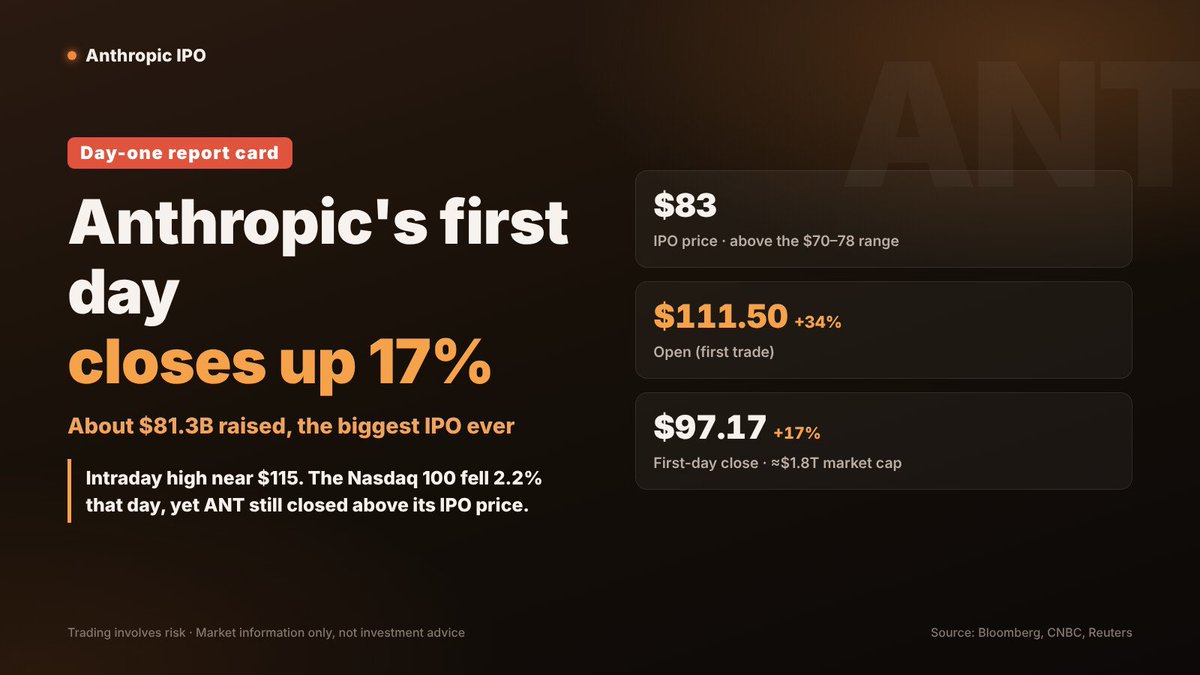
📊 Anthropic's day-one report card
IPO price $83 → open $111.50 (+34%) → first-day close $97.17 (+17%)
It hit about $115 intraday, briefly topping a $2T market value, and closed at roughly $1.8T. At about $81.3B raised, it's the biggest IPO on record.
Gn Moonlit fam
There’s been some talks in the Moonlit inner circle about an extension of the faction war
The offer still stands
$100 for five winners
Have a good night rest fellas
The faction war continues tomorrow.
#MOONLIT#RUNA
If you're a freelancer or someone who earns through international projects, holds part of their funds in stablecoins, and wants a more convenient way to manage digital assets, https://t.co/cZ3q57Mkod is worth exploring.
You don't have to keep jumping between different platforms just to handle everyday financial activities. This is one reason I'm following @deficom ahead of its launch.
What caught my attention is how it brings several useful features together in one non-custodial account.
Here's what I mean:
• Hold: Keep your stablecoin funds in your own account.
• Spend: Use a digital card to spend USDC directly from your account, subject to availability and verification requirements.
• Trade: Convert stablecoins into supported digital assets on Base without moving your funds to another platform.
• Earn: Access professionally managed positions directly from your account without having to navigate the underlying protocols yourself. The rate is variable and can go up or down, and your balance can fall as well as rise.
• defi ID®: Have a more readable name to share instead of relying entirely on lengthy wallet addresses.
I particularly like the idea of having these different activities connected rather than treating each one as a separate experience.
And that's why I'm interested in getting familiar with https://t.co/cZ3q57Mkod early and exploring what it offers.
If you're already using stablecoins or simply curious about a more convenient DeFi experience, I'd love to have you join me.
Get early access through my referral link: https://t.co/WBHnzAa9SJ
Let's explore what's being built together.
39TH ART
I present CONVERGENCE
Every great encounter begins when different worlds find their way to one another.
Convergence represents @get_optimum vision of bringing different systems together, creating new possibilities through a more interconnected blockchain ecosystem.
@Brickken PvP settlement is a major step toward safer cross-border finance. Synchronizing different systems without exposing either side to settlement risk is key
Canton is built so outsiders can't see most of what happens on it. DTCC is live on it anyway.
So what can you actually verify? here's my analysis, "Trust Without a Window":
@CantonNetwork@CantonFdn#CantonResearchNov26 https://t.co/1FM9UaJItR
Good night.
Most people only post on @rarelistio relist when a campaign is live. The accounts that stay high keep writing when nothing is running.
The score doesn’t reset between projects. A clear post about how the platform actually works still gets counted toward Season 1 even when no campaign is active. That quiet work is what stops you from having to start over every time something new drops.
The filter still runs either way. Short, original, and specific still beats another round of the same campaign language.
See you tomorrow.
Tomorrow, 17:00 CET: finding project information.
"Tokenized Real Estate: From Asset Structure to Investor Discovery" with Aldiyar Bogenbayev, Head of Partnerships at Brickken, and Yuliia Kutasevych, Head of Business Development at @UnitStake
Register: https://t.co/nw4NlbS6W2
What stands out about @MMIX_io isn’t the free mint. It’s the design choice behind the chain itself.
Most blockchains let anyone launch anything. That’s fine for experiments and memes. It becomes a problem when the asset claims to represent real estate, energy infrastructure, or financial instruments.
MMIX is building a permissioned Layer 1 where projects and validators are vetted before they go live.
Compliance rules sit inside the contracts rather than being added later. The goal is straightforward: cleaner assets for users and clearer standards for the companies building on it.
That approach won’t appeal to everyone. Some people prefer fully open systems. But for real-world assets, knowing who stands behind the project and whether the transfer rules actually exist is not a small detail.
Districts is just the early entry point. The more interesting part is the network design that comes after.
Worth watching if you’re paying attention to how RWA infrastructure is actually being built.