No but this had me laughing so hard
Q : The name of Sylas passive is....?
Lehends : Hints please?
Staff : Six letters, starts with P
Lehends : Faker
Staff : That's not six letters
Lehends : Faker fighting
????😂😂😂😂😂😂
EXERCISES FOR VISUAL ACUITY
Eye exercises work wonders if done regularly for 10 minutes a day.
1. Blink frequently for two minutes.
2. Slant your eyes to the right and then move your gaze in a straight line. Do the same in the opposite direction.
3. Move your gaze in different directions: right-left, up-down, circle, figure eight.
4. Close your eyes for 3-5 seconds, then open your eyes. Repeat 7 times.
5. Press on the upper eyelids with your fingers, but without much effort, hold in this position for about two seconds. Perform in series - 4-5 times each.
6. Stand near a window, focus on an object located in the immediate vicinity (a point on the glass), and then shift your gaze to a distant object. Repeat 10 times.
7. Close your eyes and slowly move your eyeballs up and down 5-10 times.
8. With open eyes draw in the air first simple geometric figures, and then complex objects and large-scale compositions.
Repetition changes your brain.
Repetition changes your brain.
Repetition changes your brain.
Repetition changes your brain.
Repetition changes your brain.
Repetition changes your brain.
Repetition changes your brain.
That’s why it works.
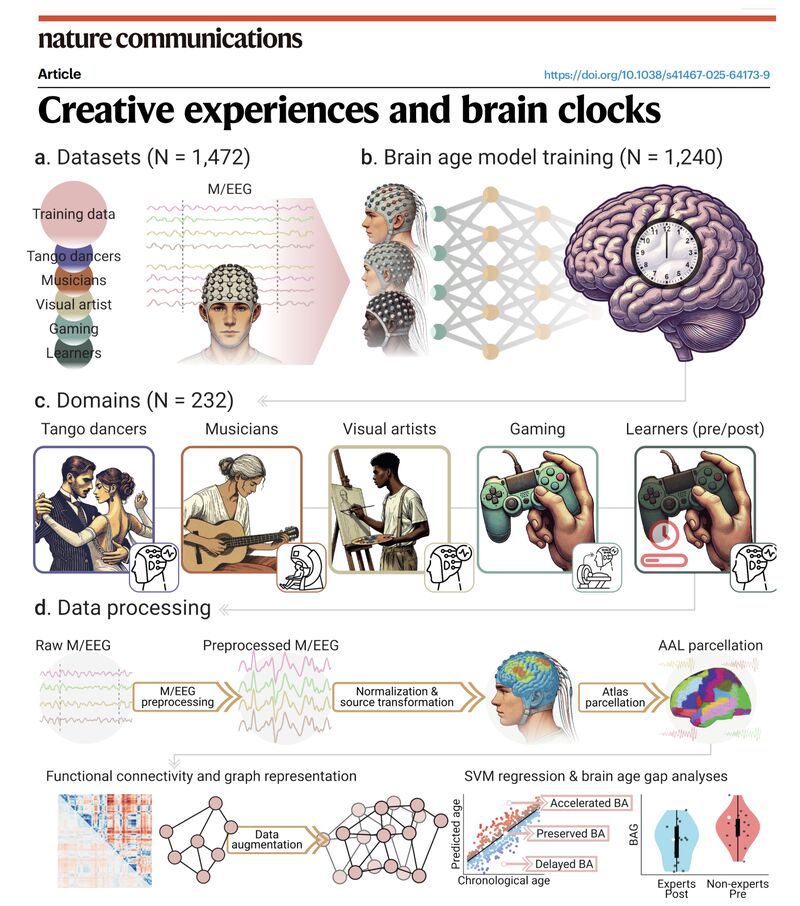
Your brain does not age evenly. Decline starts in frontoparietal networks that run decision-making and strategy.
Creative expertise alters that.
A @NatureComms study using EEG-based brain clocks shows experts in music, dance, visual art, and gaming have lower brain age gaps. Their brains register younger than their actual age.
The mechanism is efficiency.
Creative work increases local efficiency in specialized circuits and strengthens global coupling across networks. Less energy, faster processing, tighter coordination.
This effect scales with expertise. Years of high-level creative demand reinforce the exact regions most vulnerable to aging.
Creativity is not expression.
It is neural preservation.
@bopo_jodhipati Nah kan pantes. Modelan ibu D bukan iri lagi tapi udah dengki. Perlu disombongin balik biar tau batesan. Kalo bisa sekalian biar ngejauh
Banyak orang nggak sadar mereka lagi stress.
Bukan karena nggak ada masalah…
Tapi karena udah terlalu biasa “dipendem”.
Coba cek diri kamu lewat 10 pertanyaan ini, jawab dulu semua baru cek skor diakhir 😁.
Jawab yang jujur yaa
ADHD people screenshotting and bookmarking everything because they're afraid of losing ideas, only to never look at them again because the archive is now its own overwhelming problem.
7 minutes after you finish studying, your brain quietly runs a file-transfer process. Columbia scientists caught it on a brain scan, and repetition is what speeds it up.
In the study, 29 people went into an fMRI machine and saw flashcards pairing words with pictures. Some flashcards appeared once. Others appeared three times. After the flashcards, participants closed their eyes and rested for 7 minutes, still in the scanner, while the researchers watched what their brains did next.
The hippocampus (a seahorse-shaped chunk deep in your brain that handles new memories) replayed the flashcards at the same rate whether people had seen them once or three times. The scan showed no difference between the groups in that region.
Three other brain regions went the other way. All three belong to your brain's long-term storage network, the system that keeps memories around for years. Those regions replayed the repeated flashcards way more than the once-seen ones. One of them also started firing in sync with the hippocampus more often when replaying the repeated cards, like two colleagues confirming a file had been saved.
Textbooks describe memories moving from the hippocampus to long-term storage as a slow process, one that takes weeks, months, or sometimes years. This study caught that process starting within the first 7 minutes after closing your eyes, with repetition speeding it up dramatically.
When a flashcard had been shown three times, the long-term storage regions replayed the most recent viewing. Your brain treats each repetition as an update.
The hippocampus was doing its own kind of work. For the flashcards people saw only once, the more the hippocampus replayed them during that 7-minute rest, the more likely people were to remember them on the test afterward. The hippocampus was picking up the slack for the weaker memories, while the long-term regions took over the stronger ones.
The paper was edited by Robert Bjork at UCLA, the guy who coined "desirable difficulties," the idea that when learning feels harder in the moment, the memory tends to stick longer. This study adds a mechanism. Repetition works by moving a memory, fast, in the minutes right after you stop looking at the thing.
Your brain doesn't age because of time. It ages because of repetition. The more predictable your days become, the faster your neurons quiet down. Your brain builds neural pathways based on experience. New experiences create new connections. Repetition strengthens old ones. But when you repeat the same patterns for years, your brain stops building. That's why time feels faster as you age. Your brain stops encoding new memories. It just references old ones. A year at 40 feels shorter than a year at 10, because at 10, everything was new. At 40, everything is familiar. But neuroplasticity doesn't stop. You can still grow new neurons. You can still learn. You can still change. You just have to break the loop. Your brain will wake up. And time will slow down again.
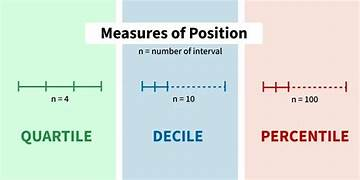
Pengetahuan "Statistika Dasar" ini akan menyelamatkan kehidupanmu.
Ada yang namanya pembagian data, dan data itu bisa dibagi menjadi beberapa bagian dengan sama rata.
Ada yang namanya Median, yang membagi data menjadi 2, 50% atas, 50 persen bawah.
Quartil = Membagi kumpulan data menjadi 4.
25% terbawah, 25% menengah-bawah, 25%menengah-atas, 25% teratas.
Semakin besar bilangan datanya, akan semakin kecil bagian data tersebut.
Ada 2 istilah lain yang sering terpakai.
Desil = Pembagian Data berdasarkan 10 bagian
Ada 9 titik pembagian.
top 10%, top 11-20%, top 21-30%, dan seterusnya...
Ada juga permil, pembagian data berdasarkan 100 bagian. pembagian menjadi per-1%, dan titik pembagiannya ada 99.
Tapi, kalau data mau dibagi /3, /5, /7 atau bahkan /1000 juga tak masalah.
Katakan data ingin dibagi menjadi n bagian...
Bagian dalam persen = 100/n %
Jumlah titik bagian = n-1 titik.