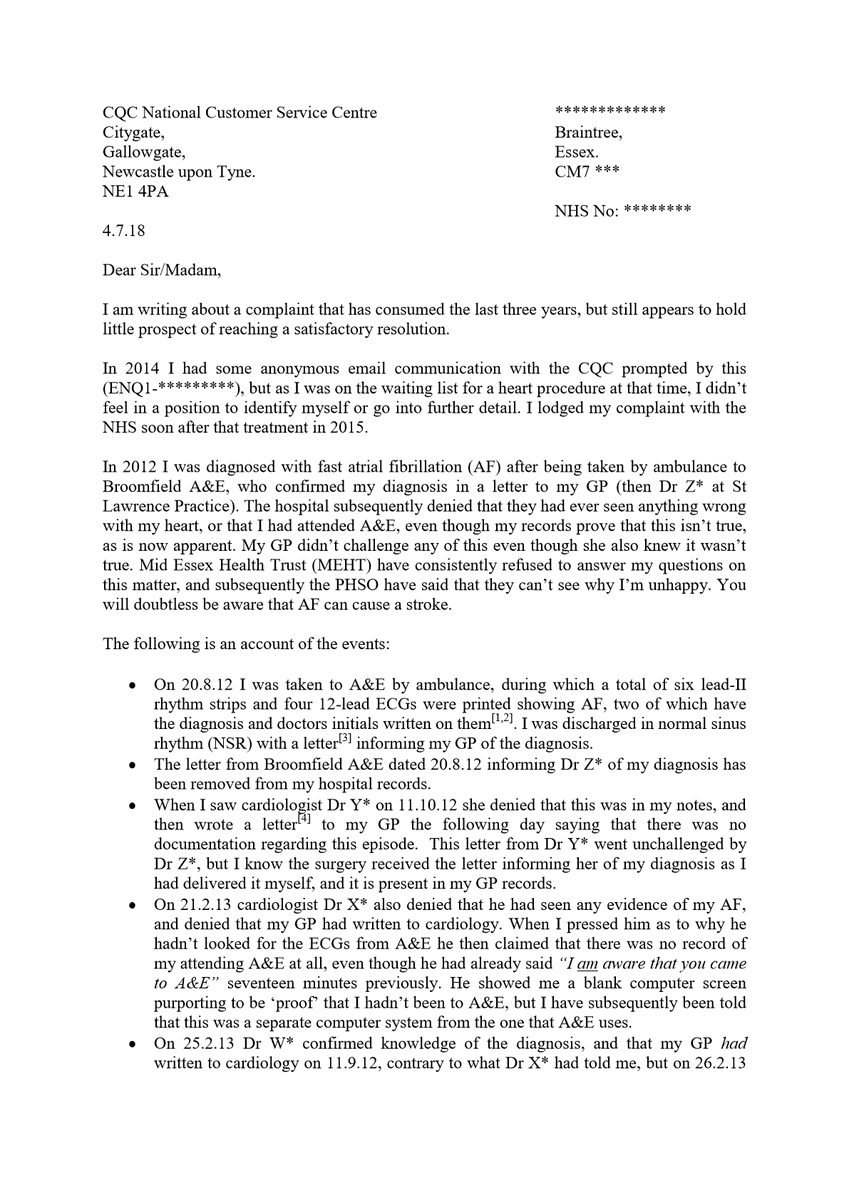
@MrMenApocalypse @CampaignNhs @charlie444b @NHSuk I developed AF after decades of following NHS advice to ignore my symptoms and get more exercise. This is what happened after I was diagnosed:
@DChronicleTales@ChelfcAbby When they renewed the gas main in our street, they fed the new plastic pipe up the inside of the old cast iron one. Then they fitted pressure reducers to each consumer's feed so that they could increase the mains pressure to compensate for the smaller bore pipe.
I run a sewer camera for a drain company in Reading. When a drain keeps backing up and nobody can figure out why, they call me. I push a small waterproof camera on the end of a long flexible cable down the pipe, and I watch on a screen in my van. You see everything. Roots, cracks, grease, toys, once a whole set of car keys.
In September, a woman named Maribel Santiago called. Her basement floor drain backed up every few weeks, and the toilet gurgled. A plumber had come out twice and run a snake down the line, a long steel cable with spinning cutter blades on the end that chews through clogs. Both times it cleared, and three weeks later it backed up again.
The line from her house runs about sixty feet under her front yard to the city sewer in the street. I started the camera down from the cleanout in her basement.
The first forty feet looked like any old clay pipe. A little root hair at the joints, some buildup. Then the camera stopped. Something was blocking it.
Sticking straight through the middle of the sewer pipe, from one wall to the other, was another pipe. It was round, about an inch and a half across, and yellow. Wads of paper and grease had piled up against it.
I sat in my van and looked at that screen for a long time.
Yellow plastic pipe is what the gas company uses for natural gas.
When gas companies put in new lines these days, they often don't dig a trench. They use a machine that bores sideways underground, pulling the new pipe behind it, so they don't have to tear up yards and sidewalks. It's fast and clean. But the drill can't see what's down there. Gas companies have good maps of their own lines and the city's sewer mains, but the old pipes running from each house to the street often aren't on any map. Sometimes the drill goes straight through one.
It's called a cross bore. The gas line ends up running right through the middle of somebody's sewer pipe, and nobody knows. It works fine for years. Then the sewer backs up, because the gas pipe is catching everything that flows past it.
And somebody calls a plumber, who runs a snake with spinning blades down the line.
I pushed the camera up close. On the side of the yellow pipe facing the house, there were fresh scrape marks. Shiny, white gouges in the plastic, where the cutter blades on that snake had hit it. Twice.
The plastic was still holding. Barely...
1/28 A cruise ship carries 6,000 people through a swell, but the movement is surprisingly smooth. Yet the same ship still rises and falls bow to stern. The secret: a pair of wings below the waterline. #maritimehistory
@AetherFox_ When I was in the same hospital, laid in bed with atrial fibrillation and a HR of ~200bpm, I overheard the ward sister outside the door telling the nurses to "take no notice of anything he says, there's nothing wrong with him".
@AetherFox_ Here's another recent example of the same problem at my local general hospital. BBC News reported a nurse as telling him to "stop being dramatic" as he was laid on the floor dying of a heart attack:
https://t.co/cuZsyugof1
@AldoSterone111 Here's another recent example of the same problem at my local general hospital. BBC News reported a nurse as telling him to "stop being dramatic" as he was laid on the floor dying:
https://t.co/cuZsyugW4z
Les déclarations du médecin légiste font mal au cœur. Clarissa Street est arrivée à l'hôpital de Manchester le soir du 14 aout 2024. Elle était à bout de souffle, avait mal à la poitrine et elle avait un vertige l'empêchant de marcher. Elle s'était également évanouie avant son arrivée aux urgences. Elle n'avait pas dormi depuis 2 jours et ne retenait plus la nourriture, ni les liquides.
Dès qu'elle l'a vue, l'infirmière a déclaré dans sa tête : Elle simule. Elle n'a rien.
Ceci va tuer Clarissa.
On va observer sa détresse respiratoire empirer tout en refusant de l'aider. Devant l'insistance de son partenaire qui était venu avec elle et expliquait ses problèmes de santé passés, l'infirmière finit par faire un geste. Elle donne un masque à oxygène à Clarissa, mais discrètement le déconnecte du robinet d'oxygène. La patience respirait à travers un masque dont le tuyau trainait sur le sol tout simplement.
Partout dans les hôpitaux et même dans les ambulances, il y a des robinets d'oxygène médical. Dans le doute, on le donne parce qu'il y a plus à gagner qu'à perdre. L'oxygène ne coute rien et n'a pas d'effets secondaires.
De plus, chaque personne qui travaille aux urgences a un petit saturomètre dans la poche. Si on l'avait mis sur le doigt de Clarissa, on aurait vu que sa saturation en oxygène baissait alors que son cœur battait de plus en plus vite pour compenser.
Mais du moment que l'infirmière a décrété : elle simule, plus personne n'allait prendre sa détresse au sérieux.
Lors du triage son score NEWS2 était de 8. C'est-à-dire critique et nécessitant une prise charge immédiate. Si on lui avait donné de l'oxygène, le score serait passé à 10 parce qu'on ajoute 2 points si le patient a besoin d'oxygène.
Quand le docteur a fini par arriver, il n'a pas regardé son historique médical (il comportait une embolie pulmonaire passée) et il n'a pas regardé son électrocardiogramme qui venait d'être pris et montrait un cœur aux limites.
Le docteur a demandé à Clarissa de fermer son nez et sa bouche et de retenir son souffle pendant 20 secondes parce que ceci allait calmer son coeur. On ne demande pas à une personne en détresse respiratoire de retenir son souffle !
Pendant que le docteur insistait qu'elle cesse de respirer, son cœur s'est arrêté net. Malgré plusieurs tentatives de réanimation, elle est morte cette nuit-là.
La médecine britannique souffre d'une incompétence chronique. Des médecins qui ne savent pas reconnaitre les signes d'une appendicite ou identifier une insuffisance respiratoire, il y en a tout plein. Si le patient en urgence absolue tombe sur ces personnes, il finit au cimetière. C'est une macabre loterie.
Le Coroner a dit que si Clarissa avait été prise en charge ce soir-là, elle ne serait pas morte. Elle souffrait d'une embolie pulmonaire qui aurait pu être traitée.
La panique qu'elle affichait est normale chez les personnes qui n'arrivent pas à respirer. On ne l'apprend peut-être plus en médecine, mais en plongée sous-marine c'est quelque chose d'enseigné. Une personne qui ne peut plus respirer, voit son niveau d'angoisse augmenter, elle se sent comme un poisson sorti de l'eau, et peut même devenir agressive. Ce n'est pas de la simulation, mais de simples symptômes que tout étudiant en médecine devait reconnaitre.
Le coroner a par contre dit que ce degré de négligence médicale n'atteint pas un niveau criminel qui pourrait justifier des poursuites judiciaires. Il avoue, sans le dire directement, que le standard de la médecine britannique est tombé si bas que les comportements ayant causé la mort de Clarissa ne sont que de petits disfonctionnements dans l'ambiance actuelle de l'hôpital britannique.
@skittles_kitty It goes way beyond mere poor record keeping and incompetence, the story in my pinned tweet is about deliberate lying. (The evidence that went to the ombudsman included audio recordings of lying, not just documents.)
@PollyPAuthor Some comments I saw recently in relation to PFAS pollution victims: their stumbling block was that the contamination caused such a wide variety of different conditions that it was difficult to find enough people with enough in common.
@PollyPAuthor As someone with no experience, I suppose you would have to marshal a group of interested patients, then select a few spokespersons to approach a lawyer.
Just your weekly reminder:
- 92.0% of respondents with PAIS and related/overlapping illnesses (such as long COVID, ME, dysautonomia, hEDS, MCAS etc) were no longer under the monitoring or care of ANY NHS specialist department despite profound ongoing illness.
- 88.9% of bedbound participants with "contested" conditions are too ill to access face-to-face NHS care AT ALL with no care plan in place.
- 83.3% WERE FORCED INTO PRIVATE CARE BECAUSE NOTHING APPROPRIATE WAS AVAILABLE FOR THEM ON THE NHS AT ALL.
- Many are needing to source medication via "irregular means."
THIS IS A SCANDAL.
@BethDobbin has talked about how we are forced into private care. Here are the receipts.
Link to my report in first comment. ⬇️ (voiceover available, no paywall)
#longcovid #mecfs #MCAS #dysautonomia #POTS #EDS #lyme #hEDS #chronicillness #disability
🚨Hundreds of Medics Accused of Rape Left Free to Work in the NHS
Between 2018 and 2024 the General Medical Council allowed 248 doctors facing rape, sexual assault or attempted rape allegations to continue practising with no licence suspension. More than 400 nurses stayed unrestricted after similar claims. Eleven doctors accused of indecent images of children faced no interim orders.
These are not minor complaints. They are serious sexual crime allegations against people trusted with the sick and vulnerable, yet many faced no immediate restriction.
The danger is real. In 2018 at Blackpool Victoria Hospital, 75-year-old Valerie Kneale died from injuries caused by a forcible sexual assault on the stroke ward. The coroner ruled it an unlawful killing. Staff noticed extensive bleeding but failed to escalate it, evidence was lost, and no one was ever charged.
When patients can be attacked in hospital beds and hundreds of accused medics keep working unrestricted, the regulators have failed in their most basic duty: protecting the public.
@ThePOTSPostman Well they told me to exercise but also don't exercise but exercise but not like that. Does that count?
They had constantly conflicting advice.