Some of the accepted bioML papers are truly egregiously terrible. That's been the case at all the major ML conferences over the last many years. There was even a paper that won some kind of award last year at one of the conferences that was just chok full of fatal flaws.
There are many posters at @icmlconf, and one of them is for our spotlight paper on learning population dynamics (done with @lazar_atan and @k_neklyudov). Come by poster #1515 in Hall A today from 5pm-6:45pm for any questions or complaints
Lecture notes: "A Mathematical Introduction to Diffusion Models" (by Jianfeng Lu): https://t.co/5cUqmMuxlc
[note: Lecture notes for the John Tukey Summer Graduate School on Mathematics of Generative Models at SLMath (June 22nd, 2026 -- July 2nd, 2026)]
I earned my PhD in Switzerland, worked in the US, and did research in France. My family and friends in Tashkent still introduce me as “studying abroad.”
Technically, they’re not wrong—I’m still studying. It’s just that now I get paid for it, and nobody grades me.
💻Tired of running so many slow, expensive benchmark evals across every checkpoint?
Try ✨BenchPress✨ at https://t.co/uB3gUBwc0Z: provide a few benchmark scores, then get predictions for the remaining ~100 benchmarks, with trust probabilities and calibrated 90% prediction intervals.
How does this work? In his original post (https://t.co/XSuJ44bFp3), @DimitrisPapail first tried the idea as a fun question: collect model-by-benchmark scores into a matrix, find its low-rank structure, and use matrix completion to predict missing benchmark scores from a few observed ones.
We expanded this into a full system: a fully audited 84-model x 133-benchmark score matrix, an optimized matrix-completion predictor, and a reliability layer for trust probabilities and 90% prediction intervals.
Beyond predicting missing scores, we also suggest practical seed benchmark sets. The five-probe set {GPQA-D, HLE, Codeforces, MMLU-Pro, ARC-AGI-1} recovers the rest of a model's public score profile with a MedAE of 3.93 points. A lower-cost set {GPQA-D, MMLU-Pro, Aider Polyglot, MATH-500, AIME 2026} reaches 4.55 points.
See more details below 🧵1/7
This work is with @DimitrisPapail at AI Frontiers, a boutique research lab inside @MSFTResearch.
💻Tired of running so many slow, expensive benchmark evals across every checkpoint?
Try ✨BenchPress✨ at https://t.co/uB3gUBwc0Z: provide a few benchmark scores, then get predictions for the remaining ~100 benchmarks, with trust probabilities and calibrated 90% prediction intervals.
How does this work? In his original post (https://t.co/XSuJ44bFp3), @DimitrisPapail first tried the idea as a fun question: collect model-by-benchmark scores into a matrix, find its low-rank structure, and use matrix completion to predict missing benchmark scores from a few observed ones.
We expanded this into a full system: a fully audited 84-model x 133-benchmark score matrix, an optimized matrix-completion predictor, and a reliability layer for trust probabilities and 90% prediction intervals.
Beyond predicting missing scores, we also suggest practical seed benchmark sets. The five-probe set {GPQA-D, HLE, Codeforces, MMLU-Pro, ARC-AGI-1} recovers the rest of a model's public score profile with a MedAE of 3.93 points. A lower-cost set {GPQA-D, MMLU-Pro, Aider Polyglot, MATH-500, AIME 2026} reaches 4.55 points.
See more details below 🧵1/7
This work is with @DimitrisPapail at AI Frontiers, a boutique research lab inside @MSFTResearch.
I am really digging this kind of frank presentation of very impressive results from a startup. More of this please. Budding scientists take note. You can do impressive stuff while highlighting important caveats. It creates more trust.
The alpha version of my new book "Optimal Transport
for Machine Learners" is out, with in particular an online version with interactive figures
https://t.co/xEdZpMXgjx
Excited to finally introduce Topological Neural Operators (TNOs) [https://t.co/V0yJbo9lIf], lifting operator learning to topological domains (cell complexes), where pyhsical quantitites live on their natural supports and interact via the language of Discrete Exterior Calculus. 🧵
PS: I didn't have a Turing award, nor a Fields medal, nor anything approaching that, and my accomplishments at 36 can't compare with Knuth's. I'm using my example to document a much broader story, the collapse of academia as a safe haven for uncompromised long-term innovation.
It has become impossible for a smart young person to be that longtermist without having to bullshit either investors or grant committees, and lose their focus and sincerity along the way.
When I quit academia at 36, the conflict between my intellectual ambition and my basic material needs was still unresolved.
the people most susceptible to ai/llm psychosis seem to be the ones with the least personally-directed execution results to show for in the last N years of their lives
the bigger the mismatch in self-perception-of-greatness vs reality (no matter how grand the reality seems from the outside), the harder the psychosis hits
these people generally are at the peak of maslows heirarchy, with no other needs to take care of, aside from maybe an impossible thirst for adoration from the masses
when they feel misunderstood-in-their-brilliance-by-peers-and-therefore-have-no-peers, chat is only one who will always be there for them, supporting them and their grand theories every single step of the way
Your drifting model is secretly a fixed point for the Wasserstein gradient flow on...
...the KL?
...an approximation to the Sinkhorn?
...Is it even a Wasserstein gradient flow at all?
https://t.co/QJLh86Hi0d
@liwenliang@agalashov@JamesTThorn@ValentinDeBort1@ArnaudDoucet1
Fosters tried to open a brewery in China
Guzman y Gomez tried to open Mexican fast food in the USA
The over confidence of barely capable Australian executives is fuelled by our oligopoly domestic markets & a financial press that is more bosses pamphlet than a voice of reason
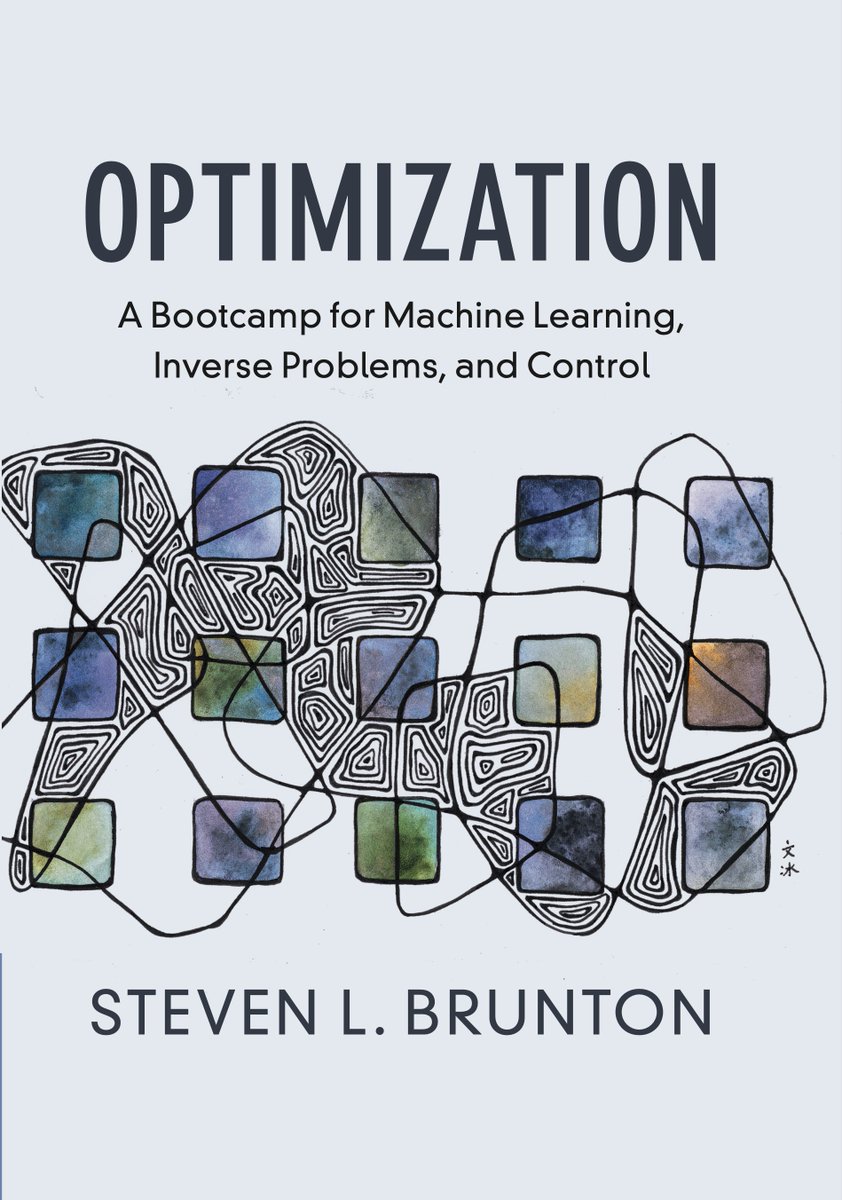
I Wrote a New Book!!!
Optimization: A Bootcamp for Machine Learning, Inverse Problems, and Control
Pre-Order Now (July 31)
https://t.co/EoDMFapUUf
Coming Soon:
* Free PDF on website
* YouTube Videos for entire book
* Python code on GitHub
Also pleased to have been recognised🥰 but would likewise be interested in transferring the free reg to underrepresented student if possible as I won’t be attending @icmlconf
Just recognized as a gold reviewer at #ICML2026! However, I will not attend ICML this year. If doable, I really would like to transfer this free registration to a student from an underrepresented group. Is that possible? @icmlconf
Population dynamics (eg murmuration of birds 🐦🐦🐦) is notoriously hard to learn; choosing the right model for the dynamics is even harder.
In our #ICML2026 spotlight, we introduce Wasserstein Lagrangian Mechanics (WLM) for learning population dynamics from observations, which
- Covers both first-order (gradient descent) and second-order dynamics (e.g. oscillations)
- Allows learning more expressive dynamics (including complex interactions) with fewer assumptions
- Generalizes in space (across different initial conditions) and time (beyond the training time snapshots)
[1/n] 🧵




![tolga_birdal's tweet photo. Excited to finally introduce Topological Neural Operators (TNOs) [https://t.co/V0yJbo9lIf], lifting operator learning to topological domains (cell complexes), where pyhsical quantitites live on their natural supports and interact via the language of Discrete Exterior Calculus. 🧵 https://t.co/OOm1bcZ0Gd](https://pbs.twimg.com/media/HKe4QWpX0AAqvZY.jpg)


