Anglo-Swiss. My blog is still alive. @[email protected] when this ship is done sinking. ADHD, cats, judo, sailing, people, communities. Unfacebooked...
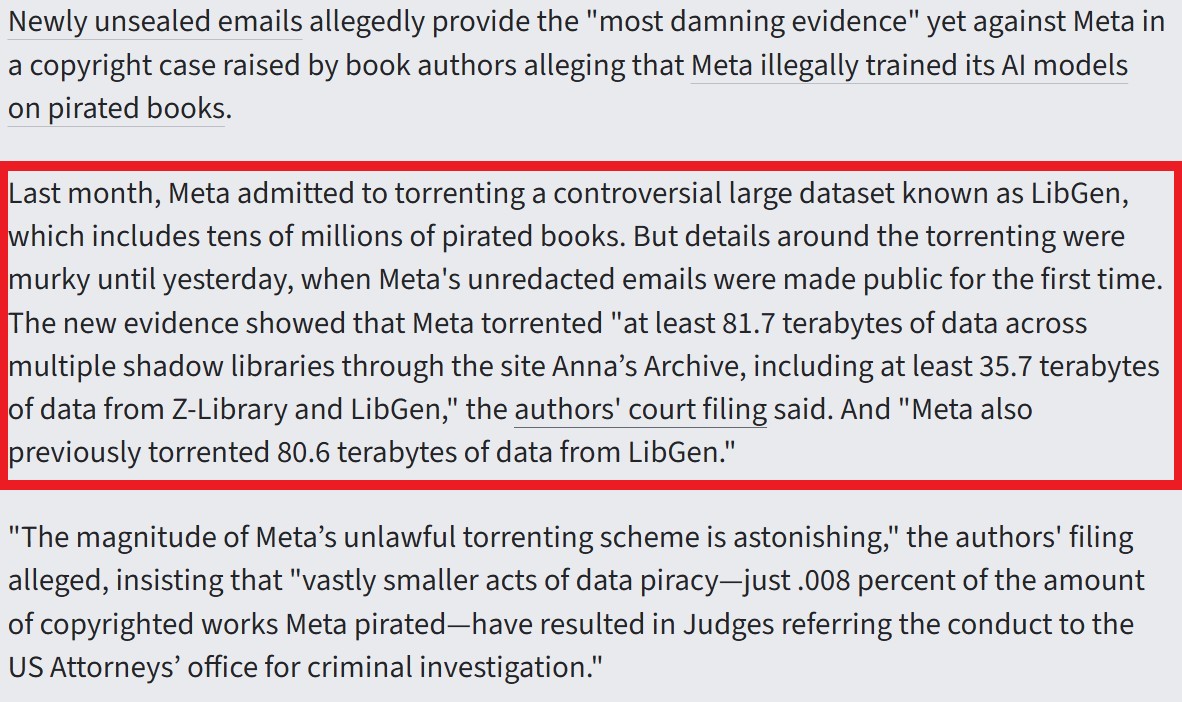
Meta illegaly downloaded 80+ terabytes of books from LibGen, Anna's Archive, and Z-library to train their AI models.
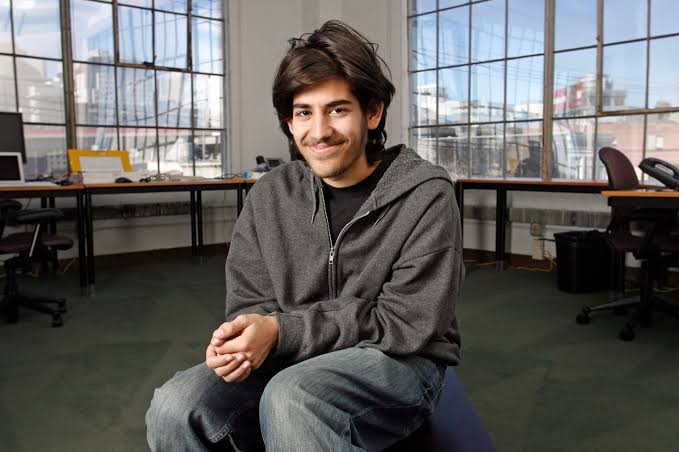
Aaron Swartz downloaded 70 GBs of articles from JSTOR (0.0875% of Meta) in 2010. Faced $1 million in fine and 35 years in jail. Took his own life in 2013.
@AnthropicAI@claudeai you seem to have a billing/payment bug -- 3 different cards declined (that worked less than a month back), dissected transactions with my bank, $0 card checks visible+approved but never see the "real" transaction attempt behind that...
Judging by my tl there is a growing gap in understanding of AI capability.
The first issue I think is around recency and tier of use. I think a lot of people tried the free tier of ChatGPT somewhere last year and allowed it to inform their views on AI a little too much. This is a group of reactions laughing at various quirks of the models, hallucinations, etc. Yes I also saw the viral videos of OpenAI's Advanced Voice mode fumbling simple queries like "should I drive or walk to the carwash". The thing is that these free and old/deprecated models don't reflect the capability in the latest round of state of the art agentic models of this year, especially OpenAI Codex and Claude Code.
But that brings me to the second issue. Even if people paid $200/month to use the state of the art models, a lot of the capabilities are relatively "peaky" in highly technical areas. Typical queries around search, writing, advice, etc. are *not* the domain that has made the most noticeable and dramatic strides in capability. Partly, this is due to the technical details of reinforcement learning and its use of verifiable rewards. But partly, it's also because these use cases are not sufficiently prioritized by the companies in their hillclimbing because they don't lead to as much $$$ value. The goldmines are elsewhere, and the focus comes along.
So that brings me to the second group of people, who *both* 1) pay for and use the state of the art frontier agentic models (OpenAI Codex / Claude Code) and 2) do so professionally in technical domains like programming, math and research. This group of people is subject to the highest amount of "AI Psychosis" because the recent improvements in these domains as of this year have been nothing short of staggering. When you hand a computer terminal to one of these models, you can now watch them melt programming problems that you'd normally expect to take days/weeks of work. It's this second group of people that assigns a much greater gravity to the capabilities, their slope, and various cyber-related repercussions.
TLDR the people in these two groups are speaking past each other. It really is simultaneously the case that OpenAI's free and I think slightly orphaned (?) "Advanced Voice Mode" will fumble the dumbest questions in your Instagram's reels and *at the same time*, OpenAI's highest-tier and paid Codex model will go off for 1 hour to coherently restructure an entire code base, or find and exploit vulnerabilities in computer systems. This part really works and has made dramatic strides because 2 properties: 1) these domains offer explicit reward functions that are verifiable meaning they are easily amenable to reinforcement learning training (e.g. unit tests passed yes or no, in contrast to writing, which is much harder to explicitly judge), but also 2) they are a lot more valuable in b2b settings, meaning that the biggest fraction of the team is focused on improving them. So here we are.
@glitternails2 Oh really? When did it happen? Wonder if they twiddled the algorithms that threw us out just a bit, and all of a sudden we’re all back in?
I got started on a series of essay-like blog posts about where we should try to go with the open web (ie, amongst other things, the blogosphere), to free ourselves from the facebooks of this world. Utopia? Maybe, but it doesn't hurt to try.
https://t.co/N0kbshaw53
🇵🇸 « Nous journalistes à Gaza, sommes des condamnés à mort » explique le journaliste Rami Abu Jamous à Alice Froussard. Depuis le 7 octobre 2023, l'armée israélienne a tué au moins 242 journalistes palestiniens selon le Haut-Commissariat des Nations unies aux droits de l'Homme.
As cybercrime surges around the world, new research increasingly shows that ransomware is evolving as a result of widely available generative AI tools. https://t.co/DDOea0Wmo8
Some operatives from the Department of Government Efficiency (DOGE) are joining Airbnb cofounder and DOGE member Joe Gebbia’s new National Design Studio, sources tell WIRED.
"My directive is to update today’s government services to be as satisfying to use as the Apple Store"
https://t.co/RfIYkL0tIa
Thanks in advance for sharing this in your networks. My hopes are that some way or another, my appeal will be reviewed by a human. If you know anybody I should speak to, or can think of anything useful to do at this stage, do let me know.
https://t.co/PNtqPcLq4p
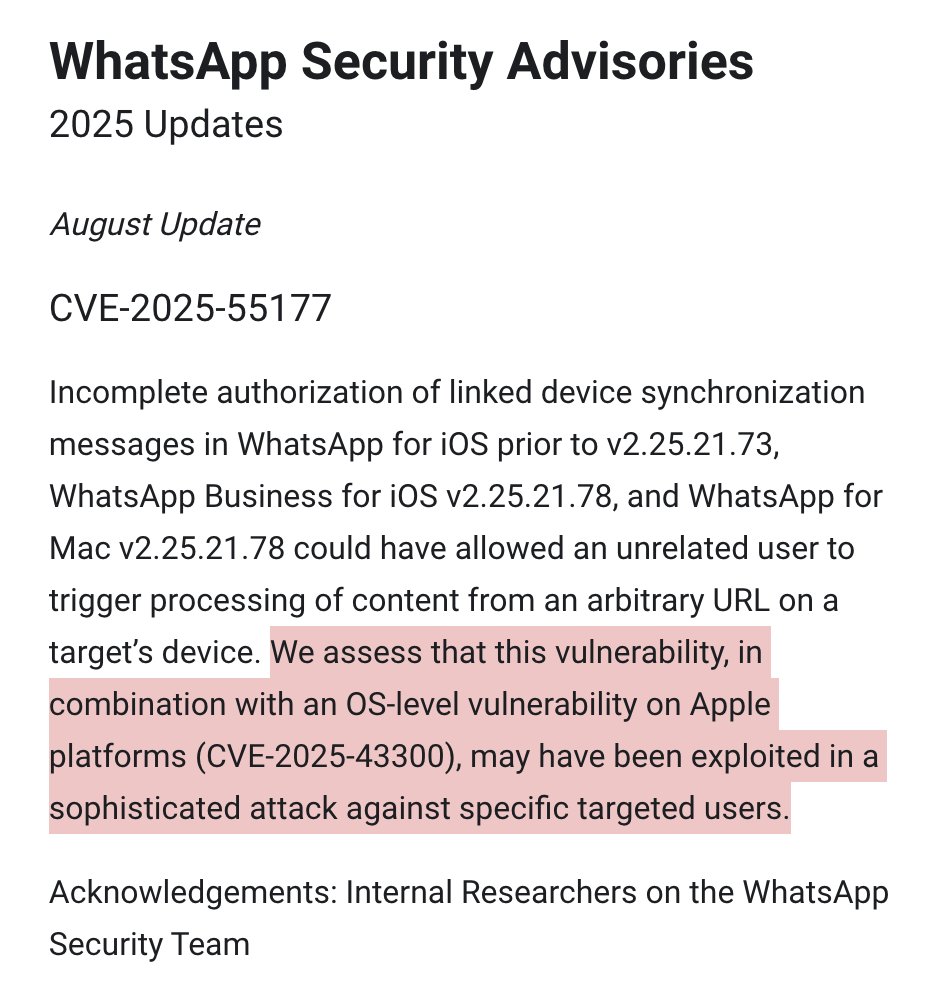
NEW: @WhatsApp caught & fixed a sophisticated zero click attack...
Now they've published an advisory about it.
Say attackers combined the exploit with an @Apple vulnerability to hack a specific group of targets (i.e. this wasn't pointed at everybody)
Quick thoughts 1/