Been a long journey to black belt! 🥋
Through BJJ I’ve been able to meet so many amazing people from around the world, and continue to learn something new every time I step on the mats!
"The most important thing in the next 3-4 years is data centers in space.
In every way, data centers in space, from a first principles perspective, are superior to data centers on earth.
In space, you can keep a satellite in the sun 24 hours a day. The sun is 30% more intense, which results in six times more irradiance than on Earth. So you don't need a battery.
The cooling in these data centers is incredibly complicated. Space cooling is free. You just put a radiator on the dark side of the satellite.
The only thing faster than a laser going through a fiber optic cable is a laser going through absolute vacuum. Link satellites with lasers, and you have a faster and more coherent network than any data center on Earth."
Cathie Wood today: "We have a 2030 price target of $2,600. 90% of that is a function of robotaxis; To the extent that humanoid robots evolve faster than we're expecting, that price target goes up."
A $2,600 stock price would make Tesla an ~$8.7 trillion company.
Great podcast series on Bucky’s work continuing to influence today’s society. Have looked for someone to talk about these topics for a while, glad someone taking the time to record them.
When Buckminster Fuller was asked by a 12 year old boy, How would you suggest solving international problems without violence? He answered:
"I always try to solve problems by some artifact, some tool or invention that makes what people are doing obsolete so that it makes this particular kind of problem no longer relevant.
My answer would be to develop a world energy grid, an electric grid where everybody is on the same grid. All of a sudden, there would be no problems anymore, no international troubles.
Our new economic basis wouldn't be gold or dollars; it would be kilowatt hours."
@WorldGamePod So many Bucky ideas! One of main ones I often consider is Precession, and how it’s leading miners to harness previously wasted or untapped energy sources.
When you have a hammer, everything looks like a nail.
When you’re a VC, everything looks like a capital problem.
In the early days of Valar, a lot of VC’s passed on us because they didn’t believe we could raise the money. In one way, they were totally right. We raised less than a lot of our compatriots.
But in a much more fundamental way, they were very wrong.
You see, capital is not the only advantage a team can have. A team that is moving twice as fast needs half the operating capital per milestone. A team with intimate knowledge of the industry can spend a third of the CAPEX to get to the same place.
Weirdly, I believe that this dynamic is more true in hard tech than software.
A lot of software dollars end up going to sales and advertising, which is a really tough space to innovate on. You may occasionally see breakout successes with teams who know how to work the channels of earned media and vitality, but it rarely ever passes out of a normal band of acquisition cost.
In this lens, the market capture advantage of having an extra $200 million in the bank begins to overshadow everything else: the details of the product, the quality of the team, etc., especially as software gets increasingly easy to build.
I believe this has trained investors to overweight the importance of capital advantage. Particularly in deep tech, there’s a minimum amount of money needed to get to the next lamp post. Adding tens or hundreds of millions on top of this is a marginal benefit, and is generally not enough to offset more fundamental dynamics.
I’m reflecting on this as I think back to some of the early partners I wanted to get on board and could not because of this capital advantage fear. I was a young upstart out of nowhere with very well funded competition.
But in the last two years, the Valar team has made insane progress on 1/10th the capital we were told it would take. Now, because of that, we’re getting to a place where capital is easy to access too. Pretty soon we will have that advantage as well, as well as all the others. (I still don’t think it will be the most important).
I think I feel compelled to write this out because it feels important to the soul of what makes the American tech ecosystem so great to course correct away from this. The argument can be made very selfishly: Valar will be a fund returner for those early believers, and there are others like it just getting started. But more fundamentally, the whole *idea* of tech investing is to find the Davids who are building slings. The fact that the Goliaths are more capitalized is what makes them juicy targets.
VCs are beginning to sound more like bankers and less like pirates. This seems bad. We should figure out how to course correct from that.
My favorite investor consistently reminds me: “There’s a lot of money in the world. You can have as much money as you want. Is that actually what’s blocking you right now?” Usually it’s not.
When you have a hammer, everything looks like a nail.
When you’re a VC, everything looks like a capital problem.
In the early days of Valar, a lot of VC’s passed on us because they didn’t believe we could raise the money. In one way, they were totally right. We raised less than a lot of our compatriots.
But in a much more fundamental way, they were very wrong.
You see, capital is not the only advantage a team can have. A team that is moving twice as fast needs half the operating capital per milestone. A team with intimate knowledge of the industry can spend a third of the CAPEX to get to the same place.
Weirdly, I believe that this dynamic is more true in hard tech than software.
A lot of software dollars end up going to sales and advertising, which is a really tough space to innovate on. You may occasionally see breakout successes with teams who know how to work the channels of earned media and vitality, but it rarely ever passes out of a normal band of acquisition cost.
In this lens, the market capture advantage of having an extra $200 million in the bank begins to overshadow everything else: the details of the product, the quality of the team, etc., especially as software gets increasingly easy to build.
I believe this has trained investors to overweight the importance of capital advantage. Particularly in deep tech, there’s a minimum amount of money needed to get to the next lamp post. Adding tens or hundreds of millions on top of this is a marginal benefit, and is generally not enough to offset more fundamental dynamics.
I’m reflecting on this as I think back to some of the early partners I wanted to get on board and could not because of this capital advantage fear. I was a young upstart out of nowhere with very well funded competition.
But in the last two years, the Valar team has made insane progress on 1/10th the capital we were told it would take. Now, because of that, we’re getting to a place where capital is easy to access too. Pretty soon we will have that advantage as well, as well as all the others. (I still don’t think it will be the most important).
I think I feel compelled to write this out because it feels important to the soul of what makes the American tech ecosystem so great to course correct away from this. The argument can be made very selfishly: Valar will be a fund returner for those early believers, and there are others like it just getting started. But more fundamentally, the whole *idea* of tech investing is to find the Davids who are building slings. The fact that the Goliaths are more capitalized is what makes them juicy targets.
VCs are beginning to sound more like bankers and less like pirates. This seems bad. We should figure out how to course correct from that.
My favorite investor consistently reminds me: “There’s a lot of money in the world. You can have as much money as you want. Is that actually what’s blocking you right now?” Usually it’s not.
A good read & found this part interesting: “In our view, Elon has been engineering Optimus robots and Boring Company machines to build infrastructure for challenging extraterrestrial environments to support the colonization of Mars”!
Hotz on AI safety “If you give it to a small number of people, there’s a chance you gave it to good people, but there’s a chance you also gave it to bad people. If you give it to everybody, we’ll if good outnumbers bad, then you definitely gave it to more good people than bad.”
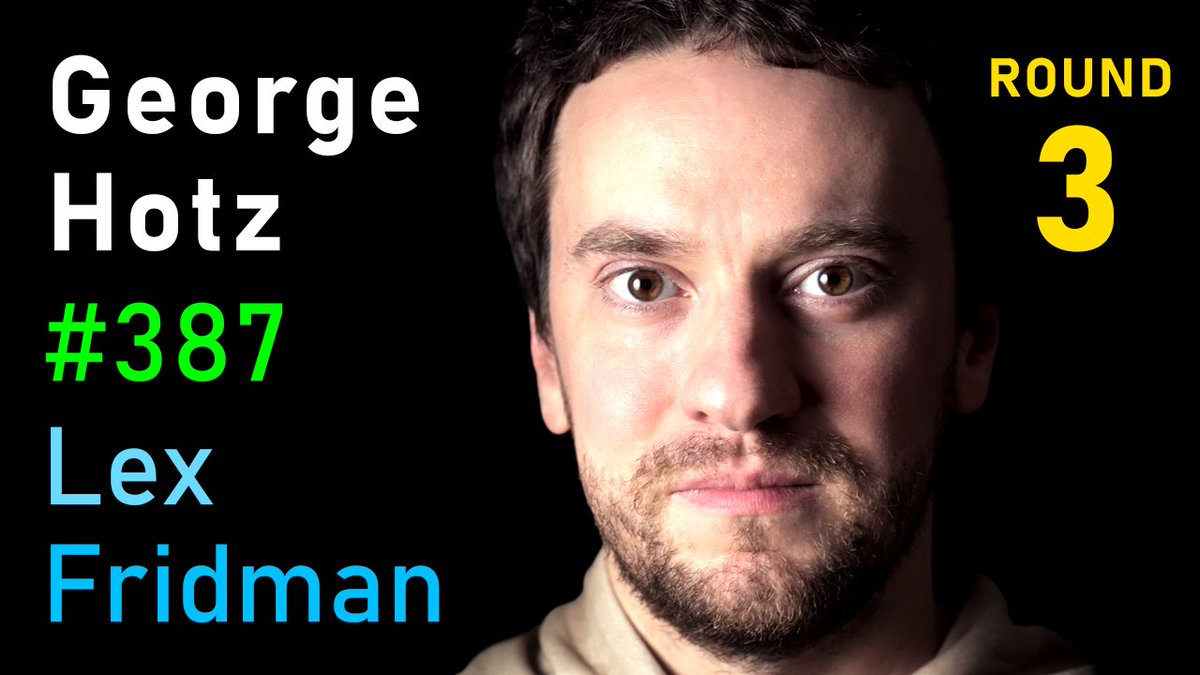
Here's my conversation with @realGeorgeHotz, his 3rd time on the podcast. We discuss everything from the nature of time & reality to the future of ML, programming, self-driving & his time at Twitter. George is always fascinating and super fun to talk to! https://t.co/sOpEzqLXY8
Finishing up a great wide ranging talk by @tferriss & @balajis …Many new concepts for me, but one of the few I did know was Tensegrity by Bucky Fuller…recommended to check out! https://t.co/T8GnMzXare
@GerberKawasaki Been reading their annual Big Ideas for last few years and try to watch their economic updates too. A smart lady with a good team of analysts too 👍🏼
You have been told that the odds are ever in your favor.
More and more, you suspect this was a lie.
Over the past weeks you've been told that by acting together, you can "democratize" the stock market.
Today, you suspect this was a lie, too.
What now?
https://t.co/PQUWXwAT3X
@AndrewRangeley@BoyarValue Thoughts on IAC acquiring stake in MGM, or whether there’s likely more acquisition opportunities in online gaming or gambling area for them?
@lexfridman@comma_ai@elonmusk Really enjoyed this interview! Been thinking about the ‘lossless compression as intelligence’ framework further which led me to your Marcus Hutter episode.