This is a highly ideological selection. Nothing bad per se, as some students may look for an overview of heterodox economics. However, others (less expert) may pick the course expecting to learn development economics. But this is not what they will learn, neither it is what they need to get a job
Thailand sets B1.16bn budget for 2026 World Bank–IMF meetings
The Cabinet has approved a 1.162-billion-baht central budget to prepare Thailand for hosting the 2026 annual meetings of the International Monetary Fund and World Bank, with more than 15,000 participants from 191 countries expected to attend.
Government spokeswoman Rachada Dhnadirek said the funding will come from the FY2026 central emergency budget and be allocated to the Fiscal Policy Office, the lead agency overseeing preparations. The budget will cover venues, registration systems, IT infrastructure and equipment to meet IMF and World Bank standards, with inspections scheduled for September–October 2026 ahead of the meetings on Oct 12–18, 2026.
The event will bring together finance ministers, central bank governors, financial executives, academics and civil society representatives to discuss global economic challenges, including growth, fiscal sustainability and financial stability. Thailand will host the meetings under the theme “Thailand’s New Horizons: Empowering People, Building Resilience.” Authorities say the event is expected to boost tourism and services in the short term while showcasing the country’s infrastructure and readiness to host major international forums.
#Thailand #Bangkok #IMFWBG #IMFWBG2026
@seftonhanley I don’t treat numbers from politicians as evidence unless they’re backed by data or proper analysis. Otherwise it’s closer to storytelling and rhetoric than public finance, not something you can compare with VAT revenue.
They know a VAT hike is necessary, but it is so unpopular and politically costly that they constantly deny it (it also happened with the previous administration)
Government denies VAT hike, clarifies 500bn baht borrowing plan under consideration
The government is not planning to raise value-added tax (VAT) from 7% to 10%, government spokesperson Rachada Dhnadirek said.
She also clarified remarks by Deputy Prime Minister Pakorn Nilprapunt regarding a proposed 500 billion baht emergency borrowing framework, saying his comments were legal and policy explanations rather than final decisions. The proposal is being considered under constitutional provisions for urgent economic or security situations, amid limited fiscal space, low treasury reserves, and external risks including geopolitical tensions and extreme weather linked to a Super El Niño.
The plan has been linked to discussions on potentially raising Thailand’s public debt ceiling from 70% to 75% of GDP. While the Prime Minister has signalled support for the adjustment, Finance Ministry officials have said they have not yet received formal instructions on the borrowing package.
Separate proposals, including a 150 billion baht government guarantee for the Oil Fuel Fund, remain under review as part of broader fiscal management discussions.
Rachada stressed that government and civil servants continue to work in coordination, rejecting claims that officials had been bypassed in the decision-making process.
#Thailand #VAT #ภาษีมูลค่าเพิ่ม #กู้เงิน5แสนล้าน
@seftonhanley The 3-year VAT phase-in is a political choice, not a constraint on fiscal effectiveness. “Immediate” spending cuts etc. are not equivalent in impact, they are politically and institutionally constrained and often one-off. They do not substitute for increasing VAT.
@seftonhanley Again, I don’t disagree. Some of that may be valid but it’s structural with uncertain timing and one-off gains. You can’t fund a current budget gap on that. Still you haven’t given a valid short-term alternative to increasing VAT. This is the issue unfortunately.
@seftonhanley I don’t disagree with your proposals but some are governance reforms and others are structural, not solutions to the immediate fiscal constraint (savings outcome is uncertain too). They don’t provide a concrete short-term alternative to VAT, which is the core issue here.
@seftonhanley I didn’t and don’t deny your point but you still haven’t proposed a short-term alternative. Even if we assume all “rich people” start paying taxes tomorrow, it still doesn’t solve the current fiscal problem. Hence, VAT increases.
@seftonhanley Tax evasion exists, agreed but it’s not unique to Thailand. The issue is structural. If you have a realistic short-term alternative for raising revenue or another alternative on the expenditures side (spoiler - hard to decrease them), I’m open to hearing it.
@seftonhanley “It can’t be proven” isn’t an argument; we do have evidence: low PIT coverage and widespread informality point to a narrow tax base, not just “the rich don’t pay”. That’s exactly why VAT is used: it’s one of the few taxes that actually captures activity in this system.
@seftonhanley Corruption and waste matter but do not replace structural revenue. Thailand’s issue is a narrow tax base, which is why VAT is used it’s efficient and enforceable. At 7%, it’s also low by international standards (~15%+ in many countries).
@seftonhanley It necessary because it is a fiscal constraint: if revenue declines or remain constant while expenditures rise, the gap
has to be closed somewhere.
@seftonhanley There's no solid evidence showing that wealthy Thais as a group systematically "don't pay income tax": some pay fully, some optimize and some other underreport just like in most countries. The problem is low PIT coverage and compliance. Hiking VAT is just textbook policy
Thank you to our members for a very constructive Spring Meetings, and to IMF staff for once again rising to the challenge. The countdown to Bangkok begins—see you in Thailand for the Annual Meetings.
New technologies can be really disruptive to the labor market, but eventually new jobs emerge and things come back into balance. But could it be different this time with the rise of AI?
@alexolegimas joins @tracyalloway and @TheStalwart on the Odd Lots podcast to discuss why the sheer speed of AI development could make it different from new technologies that came before it https://t.co/qoGXjc1GMM
@apinions_ You assume assimilation is something the native population must uniformly “want” in a complete sense. In practice, societies coordinate under varying degrees of cultural similarity, not on full convergence of identity or norms.
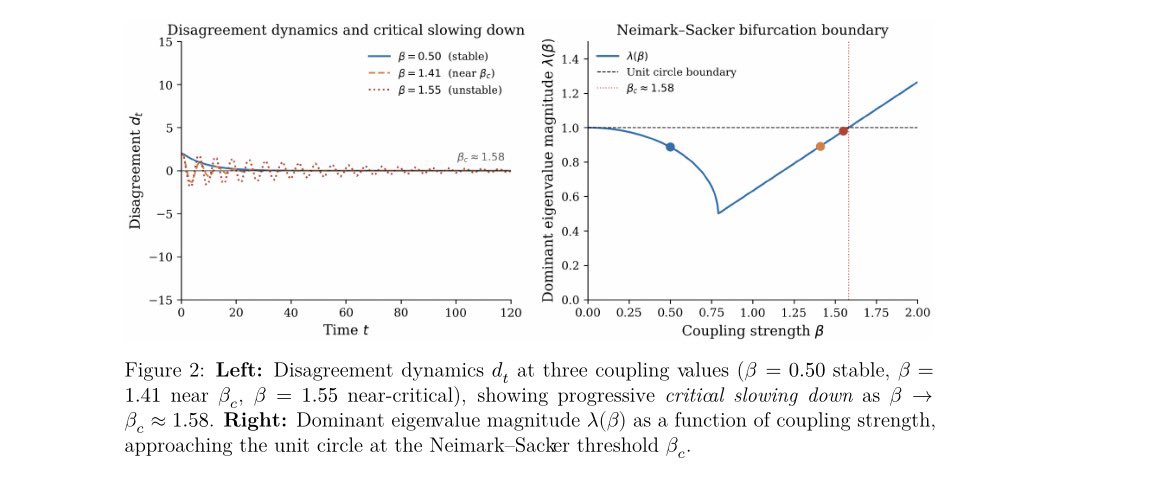
@apinions_ Fig. 2 in my paper shows this (parameters are illustrative). At low coupling (β≈0.5), incentives and env. align → assimilation converges.
Near the threshold (β≈1.4), convergence is slow and fragile.
Beyond it (β≈1.5+), the system becomes unstable → ass. oscillates or fails.