@andyyy 100% the future of crypto will be boring and people will not know they’re using crypto. The crypto that wins will solve operational efficiency for banks.
AI replacement of engineers affects non-technical folks, because the best engineers I’ve known are better at business than business folks. You’re about to have some difficult competition :)
Two years ago, Sei v2 arrived as a bet that the EVM could be the home for high-performance ecosystems.
One hundred million EVM wallets later, the call was right.
Next, Sei Giga will prove that the EVM can be the home for global finance.
One thing I’m learning is that AI tooling makes everyone feel like an expert at how to use it. Always prioritize learning from those who make a real impact. Often impact isn’t caused by their process/tools as much as values/priorities.
To improve node cold starts, v6.3 introduced:
- Sequential snapshot prefetch to replace random I/O
- Smart MADV hints to guide the kernel
- Selective preload of only the big trees (evm, bank, acc)
- Skipping the huge sparse KV file
- Skipping prefetch entirely if >80% of pages are already cached
This is a huge reliability and performance win for Sei's node operators.
Shoutout to the Labs engineering team.
You can view the changelogs for v6.3 here: https://t.co/JMVDTSyd00
AI is doing to code what the cloud did for infra. Just as we destroy and create environments, it will be easier to rewrite the whole codebase. Ephemeral code will change how everything is built.
A multi-proposer network offers interesting properties for MEV. As volume increases, extractable value will be key in keeping transactions affordable for all. Sei is laying the groundwork for the first sustainable low-cost network now.
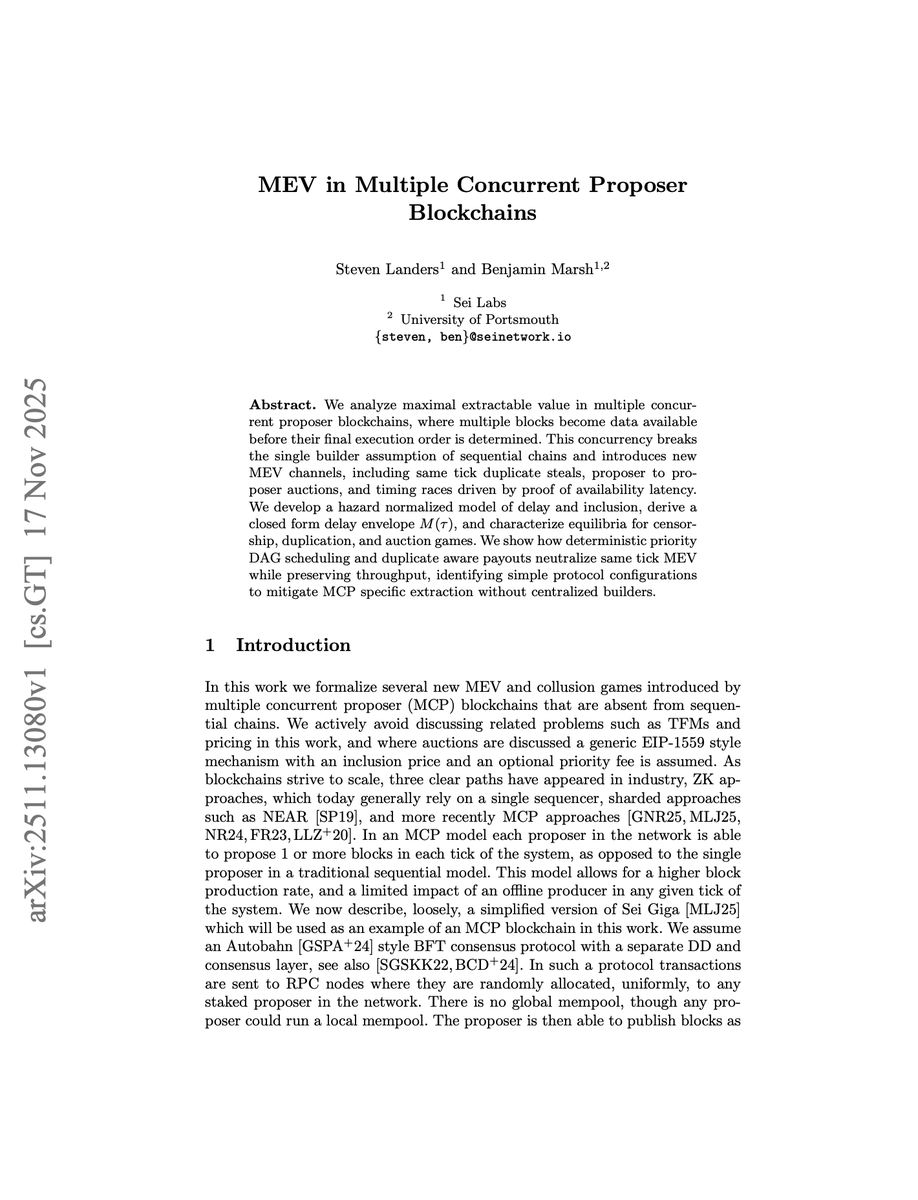
Next generation blockchains like Sei Giga will create types of MEV that are completely new, and poorly understood.
Today, we share the first ever paper exploring MEV in next-generation blockchains.
With this we can protect users from this MEV, before they can be affected.
JUST IN: a16z report confirms Sei flipped Sui, Polygon and Aptos in active addresses for September 2025.
Building on a strong Q3, growth on Sei has accelerated — DEX volume exceeding $10B LTM, 3 ETF filings, and tokenized funds from BlackRock, Apollo, and more now live on Sei.
@royalarp@jayendra_jog@Sei_Labs@MetaMask@Rabby_io Wallet don’t really struggle with speeds, because users generally operate in seconds kind of UX and poll tx updates. Explorers will need to evolve. We’re about 50 blocks per second here so the UX of “per block” will need to change - and be more user-focused.
@royalarp@jayendra_jog@Sei_Labs@MetaMask@Rabby_io Wallets generally don’t have an issue at the moment - it basically just polls for the receipt (we’re running the demo with MM) - but just like how browsers got better with bandwidth, we know wallets will take advantage of the experience eventually
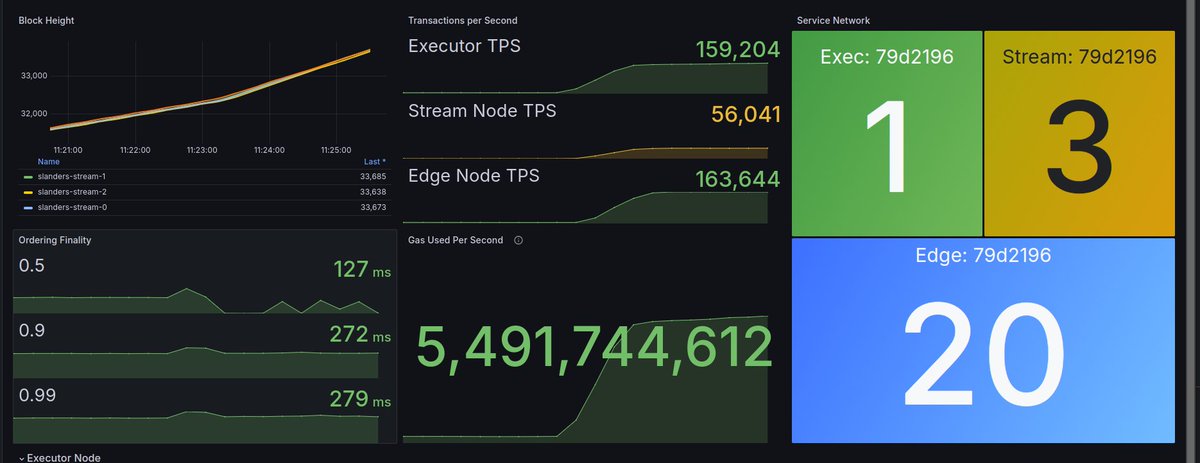
Each block is emitted by producers in parallel, and they zipper seamlessly into a canonical block order in 100-250ms (we measure 99th percentile). And at >5 ggas/sec, there’s plenty of room.
HUGE news - the @Sei_Labs team was able to get a live demo in a Sei Giga internal devnet.
Each bar on the left hand side of visual represents a block being proposed by a validator, showing Sei's multi proposer architecture in action.
This milestone required building out support for many operational components, including RPC APIs, receipts support, and gas support.
@megaeth Could you explain how you calculate 10 GGas and 100k TPS? On Sei's new L1 prototype, 200k tps (with ERC20 transfers) come out to 5.9 GGas. Are you benchmarking with 100k gas txs?
Happy to share that the @Sei_Labs team was able to get 5 gigagas with a DECENTRALIZED validator set in an internal devnet.
Internal goal was to achieve this by March 31, 2025. The team ended up getting it done by Feb 11.
Absolutely insane 🤯 🤯 🤯
These tests were performed with 40 validator nodes spread out equally across Singapore, Germany, Oregon, and Ohio.
Next milestone is to finish all of the remaining productionization work (archive nodes, RPCs, state sync, etc) before getting ready for a public devnet.
2024 has been the best year ever for @Sei_Labs
Highlight of the year was shipping Sei v2 - the first parallelized EVM
For 2025, I'm looking forward to 5 gigagas per second
Here are some metrics from a barebones internal devnet 👀