Regulated assets need infrastructure that DeFi was not originally built to support.
Dario Lo Buglio (@xaler2 ), our co-founder and Head of Blockchain, was featured by @Cointelegraph discussing ERC-7943, the uRWA token standard he co-authored, which has now reached the final stage of the @ethereum Improvement Proposal process.
The interview addresses a core issue for institutional tokenization: regulated assets require identity frameworks, transfer controls, compliance logic, and interoperability across custodians, exchanges, wallets, and institutional platforms.
ERC-7943 was designed as a flexible framework for tokenized real-world assets, helping assets move across different compliance systems without forcing every institution into isolated infrastructure.
Tokenized RWAs have grown from roughly $6.4B at the start of 2025 to about $34B today.
The standards underpinning that growth matter.
Read the full Cointelegraph feature here:
https://t.co/HfcJ9GnzCo
ERC-7943 is now an official Ethereum standard.
That matters because institutional tokenization cannot scale through vendor-controlled frameworks, fragmented compliance logic, and asset-specific integrations.
Tokenized real-world assets need more than token representation.
They need predictable ways for wallets, custodians, issuer platforms, infrastructure providers, and other integrators to understand whether a transfer is permitted, who can interact with the instrument, and how enforcement or restriction logic is applied.
Authored by Dario Lo Buglio (@xaler2 ), Brickken co-founder, ERC-7943 introduces a minimal, composable open interface for compliant tokenization of real-world assets across @ethereum and EVM-compatible networks.
It does not impose one compliance model, identity provider, or tokenization platform.
It gives institutions a common implementation surface while preserving flexibility at the policy, identity, jurisdiction, and compliance layers.
For financial institutions, that distinction is strategic.
A vendor-controlled framework can create dependency on a single commercial roadmap.
An open Ethereum standard gives issuers and integrators a more neutral foundation for tokenized asset infrastructure.
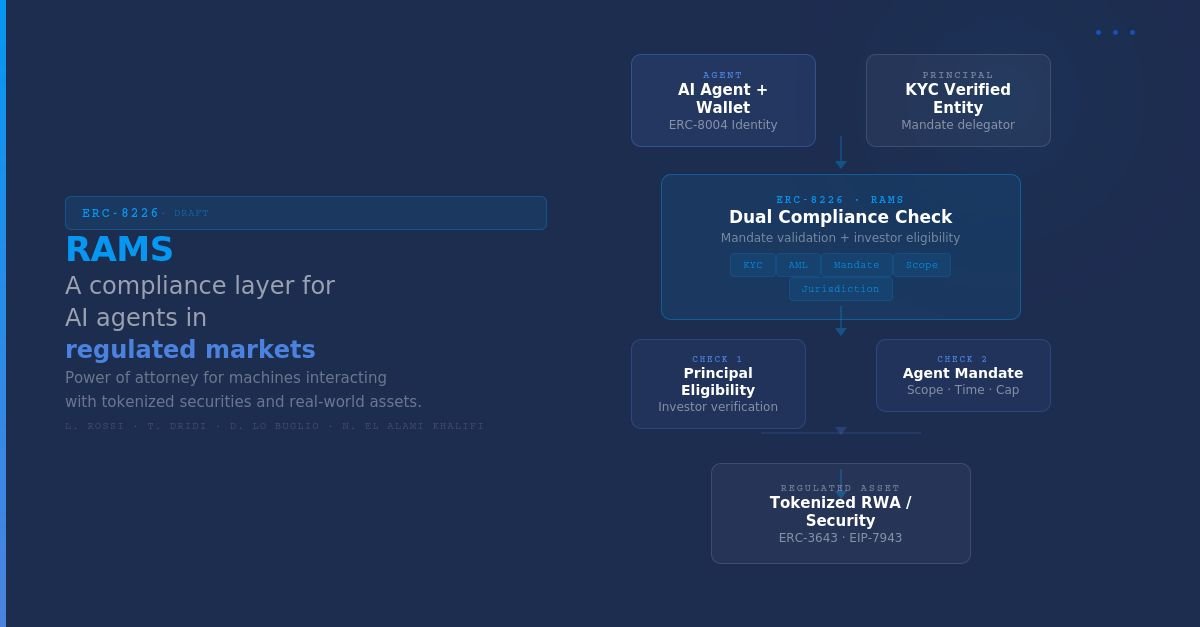
As AI agents move deeper into finance, regulated markets need standards that define how automation can operate within legal boundaries, not outside them.
That is exactly what ERC-8226 addresses.
Created by our team, the proposal introduces a framework for compliant agent mandates, allowing verified investors to delegate limited on-chain authority to AI agents while preserving KYC, AML, eligibility checks, and issuer control.
This is a foundational step for the agentic economy, where autonomous software agents will execute tasks, allocate capital, manage positions, and interact with financial products on behalf of users and institutions.
The next phase of tokenization is not only digitizing assets, but building the infrastructure and standards that allow new participants, including AI agents, to operate securely in regulated markets.
Brickken is proud to contribute at both levels: infrastructure for tokenized real world assets and open standardization that helps shape how automation connects with financial markets.
Congratulations to @Ludovico__Rossi , @xaler2 , @ThamerDridi1 and @nabilbrickken on pushing this forward.
Secondary Liquidity, Built In
We’ve just introduced a new feature inside Brickken: P2P Digital Asset Transfers: Private Secondary Markets
This module connects verified investors inside each issuance, facilitating compliant secondary transactions.
It extends the lifecycle of tokenized assets while preserving issuer governance and platform integrity.
Here’s what this means:
• Secondary liquidity without leaving the ecosystem
• Investors can buy and sell digital assets within the same platform where they were issued
• Transactions are secured through escrow logic
• Only verified participants can interact with each issuance
• Issuers maintain governance through optional right-of-first-refusal
This is not a speculative trading venue.
It is structured, compliant secondary liquidity designed for real-world assets.
We continue building the infrastructure layer that tokenized finance actually needs.
Industry has shown maturity compared to few years ago when it comes to secure code. The same is not true for operational security. That's how you level up your security posture 👇
Today, most blockchain hacks aren’t smart contract bugs. They stem from phishing attacks, stolen keys, compromised accounts, blind signatures, and operational vulnerabilities.
Take the $1.4 billion ByBit hack: the exploit didn't target the code; it targeted operational security.
Worried about your location data? Spawn random locations every 5 minutes.
Worried about AI taking over? Let's flood the internet with wrong data so that AI learns from it and becomes dumb.
Don't escape the matrix, blast it from the inside.
ERC-7943 (Universal RWA) is now supported in the CMTAT. This ERC, by @xaler2, defines a minimal interface for representing financial instruments on-chain, introducing core compliance features such as asset freezing, enforcement transfers, and authorized transfer restrictions.
Standards Are the Foundation of Institutional Tokenization
Institutional capital does not scale on proprietary frameworks. It scales on open standards.
We are partnering with the Capital Markets and Technology Association (@cmta_ch ) on the incorporation of ERC-7943 into their CMTA Token (CMTAT) Solidity implementation.
CMTA’s framework is one of the most established open, blockchain-agnostic standards for tokenized securities, with implementations across Ethereum and other chains, and oversight from its Technical Committee and Advisory Board in Switzerland.
Its modular architecture supports on-chain corporate actions, enforcement logic, and institutional-grade compliance.
ERC-7943, authored by our Co-Founder and Head of Blockchain Dario Lo Buglio (@xaler2 ) , introduces a universal compliance interface for transfer validation, freezing, forced transfers, and standardized error signaling.
By aligning ERC-7943 with CMTAT, we are:
• Strengthening cross-platform interoperability across the RWA ecosystem.
• Reducing fragmentation in regulated tokenization frameworks.
• Embedding standardized compliance hooks at the protocol level.
• Supporting cross-jurisdictional compatibility and long-term maintainability.
This integration is a concrete step toward a unified compliance layer for tokenized financial instruments.
CMTA announces ERC-7943 support in the CMTAT Solidity implementation (v3.2.0).
ERC-7943 (Universal RWA) standard introduces a minimal, modular interface for compliance-related events and transfer restrictions, designed to sit on top of existing token standards. Its integration into CMTAT strengthens interoperability and helps reduce fragmentation in the tokenization of financial instruments.
ERC-7943 Authored by Dario Lo Buglio @xaler2 (@Brickken co-founder).
Learn more: https://t.co/97muoSs9st
GitHub: https://t.co/1U7BDwxZmN
Release: https://t.co/9g8QASpRXX
Thanks to the CMTA Technical Committee, all contributors to the release and @Brickken for the support.
@ADCDIII@veorq
Casper is now aligned with ERC-7943, the emerging standard for compliant and interoperable real-world asset tokenization.
A step toward a unified, scalable #RWA ecosystem.
🔗 Press release: https://t.co/WVUycV4u2k
@pashov Shipped https://t.co/k9nOzzqC8e with @josepchetrit, inspired by the work of @pcaversaccio 🫡
I also wrote EIP-7943 and many more things.
Stay safe 🔐
We will never get mass adoption as long as 99% of devconnect talks are technical brain gymnastic while it still takes three failed txs and 25 minutes to get a swag paid with crypto at the swag spot at @EFDevcon. Less mental flex and more UX please.