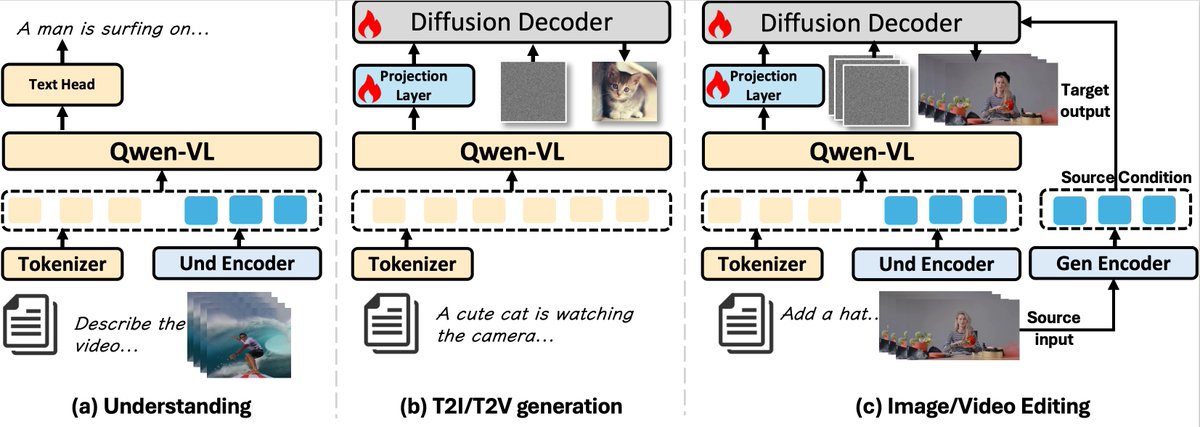
Omni-Video2: unified video generation + understanding, optimized for editing.
FiVe 73 (+20 over #2). Best open-source so far—practical success rate, near closed-source level (and better in some cases).
Links in replies. #GenAI
We removed ~80% of the Claude Code system prompt for our newest models, this is what we've learned about writing system prompts, skills and Claude.MDs for them. https://t.co/6DZwSrZjE9
Anthropic engineer:
"Don't just prompt Claude. Build a system that can prompt itself."
In this 45-minute session, she explains how Anthropic builds AI agents that can remember past work, learn from mistakes, and improve with every run.
It's one of the best free resources for learning how AI agents work.
Watch the session, then read How Browser Agents Automate Online Workflows
Reverse experiment: instead of making AI video look impressive, I tested if it could be unrecognizable as AI.
BTS(behind-the-scenes) feel of a hanfu shoot — no VFX, just an old tree, backlight, mist, one girl. Strip every variable, keep only realism.
Fewer tells = more real.
#AIvideo #GenAI #hanfu #Seedance
This works really well btw, at the end of your query ask your LLM to "structure your response as HTML", then view the generated file in your browser. I've also had some success asking the LLM to present its output as slideshows, etc.
More generally, imo audio is the human-preferred input to AIs but vision (images/animations/video) is the preferred output from them. Around a ~third of our brains are a massively parallel processor dedicated to vision, it is the 10-lane superhighway of information into brain. As AI improves, I think we'll see a progression that takes advantage:
1) raw text (hard/effortful to read)
2) markdown (bold, italic, headings, tables, a bit easier on the eyes) <-- current default
3) HTML (still procedural with underlying code, but a lot more flexibility on the graphics, layout, even interactivity) <-- early but forming new good default
...4,5,6,...
n) interactive neural videos/simulations
Imo the extrapolation (though the technology doesn't exist just yet) ends in some kind of interactive videos generated directly by a diffusion neural net. Many open questions as to how exact/procedural "Software 1.0" artifacts (e.g. interactive simulations) may be woven together with neural artifacts (diffusion grids), but generally something in the direction of the recently viral https://t.co/z21CP5iQfu
There are also improvements necessary and pending at the input. Audio nor text nor video alone are not enough, e.g. I feel a need to point/gesture to things on the screen, similar to all the things you would do with a person physically next to you and your computer screen.
TLDR The input/output mind meld between humans and AIs is ongoing and there is a lot of work to do and significant progress to be made, way before jumping all the way into neuralink-esque BCIs and all that. For what's worth exploring at the current stage, hot tip try ask for HTML.
How Anthropic’s product team moves faster than anyone else
I sat down with @_catwu, Head of Product for Claude Code at @AnthropicAI, to get a peek into their unprecedented shipping pace, how AI is changing the PM role, and how to be the right amount of AGI-pilled.
We discuss:
🔸 How Anthropic’s shipping cadence went from months to weeks to days
🔸 The emerging skills PMs need to develop right now
🔸 Why you should build products that don't work yet—then wait for the model to catch up
🔸 Why a 95% automation isn't really an automation
🔸 Cat’s most underrated AI skill (introspection)
🔸 What Cat actually looks for when hiring PMs now (hint: it's not traditional PM skills)
Listen now 👇
https://t.co/uymmT55Nq6
@Muiz_Musk@broodsugar Thanks, very happy to connect. I’d love to exchange ideas.
Right now, I mainly work on unified generative models for both understanding and generation.
Looking forward to the conversation.
In fact, Japanese companies are pulling out because Japanese automakers are no longer competitive in the Chinese market. Let’s look at the numbers: In 2024, the numbers made the competitive shift hard to deny. In China, Toyota, Honda, and Nissan together sold about 3.32 million vehicles, whereas Chinese domestic brands sold 17.97 million passenger vehicles and took a record 65.2% share of the market. In Japan, by contrast, Chinese brands still had only a minimal presence: Japan’s total new-vehicle market was 4.42 million units, while BYD sold just over 2,200 vehicles there in 2024. And globally, China has already overtaken Japan in exports: China exported 5.859 million vehicles in 2024, compared with Japan’s 4.22 million.
I spoke at length with @OpenAI President @gdb about the company's double-down bet on text models, AI takeoff, Codex, infrastructure scaling, and plenty more.
Full episode below:
0:00 Introduction
4:06 Why OpenAI Pulled Back From Sora
11:24 The OpenAI Super App Plan
22:59 OpenAI's Forthcoming “Spud” Model
28:13 OpenAI’s Automated AI Researcher Plan
31:12 AI Risk, Safety, and Takeoff
55:15 The Logic Behind OpenAI’s Compute Spending
1:03:24 Why So Many People Still Distrust AI
We want to speak directly to the concern many of you have expressed, and we owe you a clear explanation of what happened, why it happened, and where we stand now. We understand this situation caused genuine alarm and we take that seriously.
In preparing the NeurIPS 2026 handbook, we included a link to a US government sanctions tool that covers a significantly broader set of restrictions than those NeurIPS is actually required to follow. This error was due to miscommunication between the NeurIPS Foundation and our legal team; there was never an intention to restrict participation beyond our mandatory compliance obligations. The responsibility for that error is ours as an organization, and we deeply apologize for the alarm and impact this miscommunication had on our community.
We have updated the link and clarified the text of our policy, which is consistent with that of ACM and IEEE, as well as other international conferences and NeurIPS in the past. As in previous years, NeurIPS welcomes submissions from all compliant institutions and individuals.
We want to reiterate that NeurIPS is a community-driven event, created by and for the community, and strives to be inclusive. The NeurIPS 2026 organizing committee was particularly saddened to learn of this institutional miscommunication. The organizing committee has taken on the responsibility of running the conference this year with the goal of fostering open communication, knowledge sharing, and global scientific discourse.
We thank the community for bringing this issue to our attention and working with us through this situation.
My information consumption is now 1/4 X, 1/4 podcast interviews of the smartest practitioners, 1/4 talking to the leading AI models, and 1/4 reading old books. The opportunity cost of anything else is far too high, and rising daily.