The OoenRISC glibc hardware floating point support is getting some love again. I finally have a few brain cycles to spend on this and finished the kernel docs in a blog post.
https://t.co/Go1Q8UTOtn
I finally finished the second installment in my series on the OpenRISC FPU port. Here we discuss updating hardware and simulators.
https://t.co/Ovj6ctpsit
Someone ask me for some docker images to make it easy to setup the OpenRISC toolchain and simulator environment. Here they are; I have both or1ksim (or1k-sim-env) and fusesoc (or1k-verilog-env) environments.
I hope its useful.
https://t.co/qKUDbUuHoX
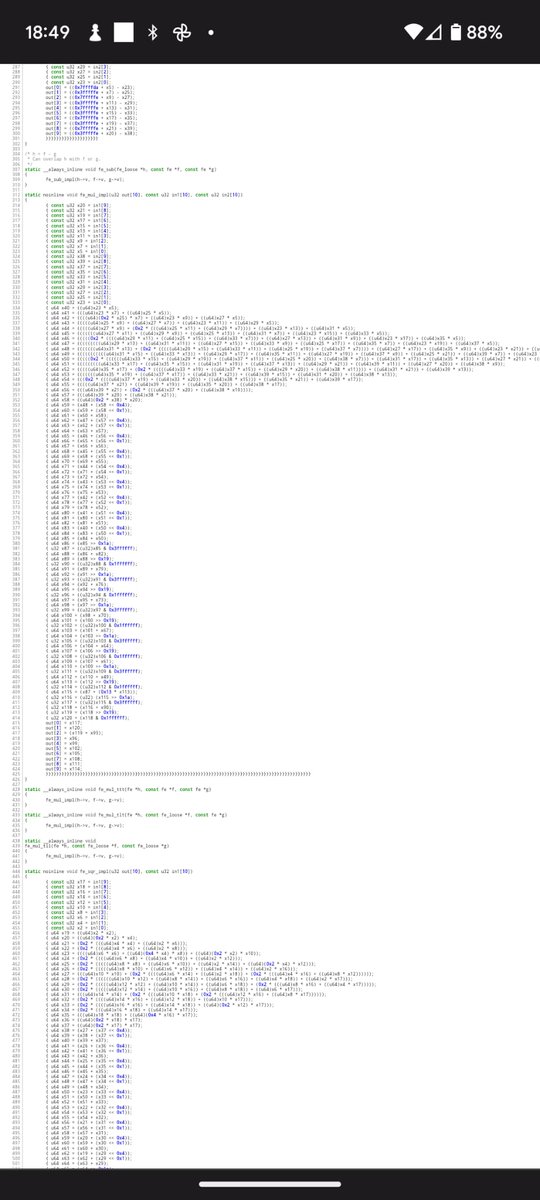
In the Linux kernel crypto libraries there are several machine generated constant time math algorithms. I find these fascinating.
Talk about walls of code.
https://t.co/JXuZ4RaJZk
@redhog_org There is a different implementation in signal too originally written by Google.
https://t.co/A2M8KCv6vC
However, it looks like that was replaced by a rust rewrite.
https://t.co/D347YpQ6FZ
@muwlgr @minut_e This board looks like a beast so I was hopeful it might have a PCI bus. But yes, it could be all memory mapped devices, so maybe just look under /sys/devices/platform.
I have been working on getting the OpenRISC FPU supported in linux and now all GLIBC math tests PASS! This required adding support and fixing bugs in QEMU, Linux, GCC and glibc. The last fix took the the longest, and is right here can you spot it:
https://t.co/HUEO2l3Cv5
@mxshift Don't give up on kids, I'm sure it will mean something to them in the long run even if your don't talk. Maybe change it to a weekly call on Saturday/Sunday?
@Lord_Arse I tried to organize, I have a big bag of little bags each labeled. i.e. 1.35mm audio, USB micro, USB mini, pro audio, and my favorite USB obsolete.