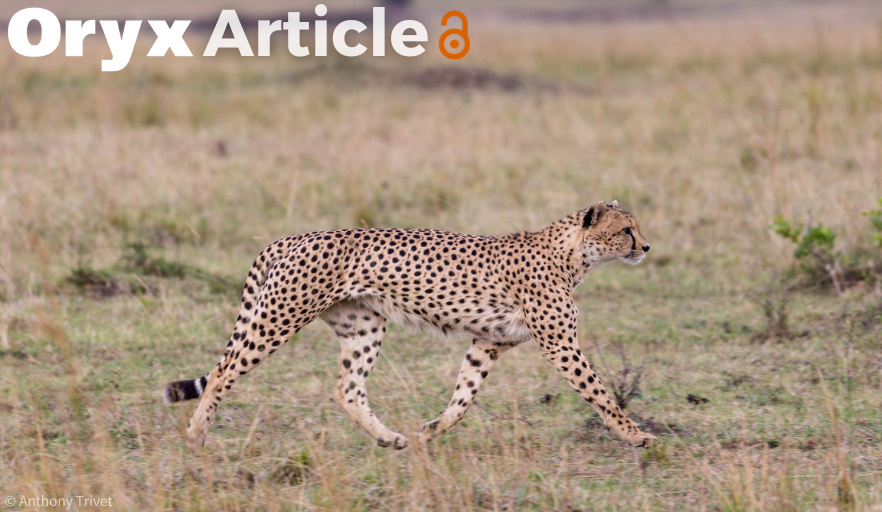
Combining detection dogs with smart camera trap placement enhances cheetah monitoring, offering rapid and efficient survey opportunities for remote and understudied parts of their range 🐆
Read more 👉 https://t.co/FAUK6jy2aY
@stijn_versch@CCFCheetah
Monitoring cheetahs is imperative for conservation planning, but challenging due to the species' wide range and low detection rates.
Combining detection dog surveys and camera traps reduced the effort required to accurately survey the cheetah population.
https://t.co/5rEXpxF81u
Verschueren et al.'s camera-trap research in Ondjou Conservancy, Namibia, reveals a surprising array of predators despite human encroachment and prey depletion in the region. Discover the hidden diversity of Namibia's carnivores in @stijn_versch's blog🐾📸
https://t.co/B4rR5iJqRb
A new paper coauthored by @stijn_versch and Hans Bauer assessed carnivore richness at the periphery of the Kavango–Zambezi Transfrontier Conservation Area, finding that this area could act as an important buffer for the larger conservation network.
👉 https://t.co/dy82GoV7DU
Verschueren et al. conducted a mammal survey in the Ondjou Conservancy in Namibia, an understudied area in the KAZA TCA. Analysing 317,758 camera-trap images, they identified 18 carnivore species, finding occurrence increased further from the main village: https://t.co/0z1QwIwOCy
Central-eastern #Namibia is notably understudied. Results from large-scale camera trapping showed dominant predators like #lions & spotted hyenas were largely missing, while subordinate species like wild dogs, brown hyenas, cheetahs & leopards persist.
See https://t.co/wVt9omjFaq
New paper led by @stijn_versch explores the potential of #cheetah as a flagship species for biodiversity conservation outside current protected areas – highlighting benefits of combining species-centric & area-based approaches to research & #conservation. https://t.co/xJNoPJ4PM8
"Most cubs are taken from the Horn of Africa - Ethiopia, Somalia, and Somaliland - and sold to wealthy exotic pet collectors and private zoos across the Arabian Peninsula." The new feature from @undarkmag highlights the impact of the #illegalwildlifetrade.
https://t.co/jzTCtmWUPQ
"We found that leopard social units within our study area consisted of up to five individuals and that same-sex and opposite-sex interactions were equally likely to occur."
A study by @stijn_versch et al
#populationdynamics#Pantherapardus#population
https://t.co/tKh3VzTeQE
Out now!🐆 Marker et al. carried out surveys in villages across Somaliland, receiving multiple reports of cheetah sightings as well as finding cheetah tracks, scrapes and 3 carcasses. These findings confirm the presence of wild cheetahs in Somaliland👉 https://t.co/2wJesfq6yL
🚨Hot off the press: Our exciting new report of a small canid and small mustelid pairing up to hunt ground-dwelling prey in the Kalahari!😲
Great observation and follow-up Wendy Panaino (@WendZ_222) and Alexander Sliwa!
Link to the article ➡️https://t.co/YGZxLkHqHm
Photo-identification of individuals is the baseline of many population estimations, but is often prone to human errors. Taking the example of Namibian carnivores, @stijn_versch et al. show how #AI can assist this process to make results more reliable: https://t.co/jOadANNtp5 🇳🇦🐆
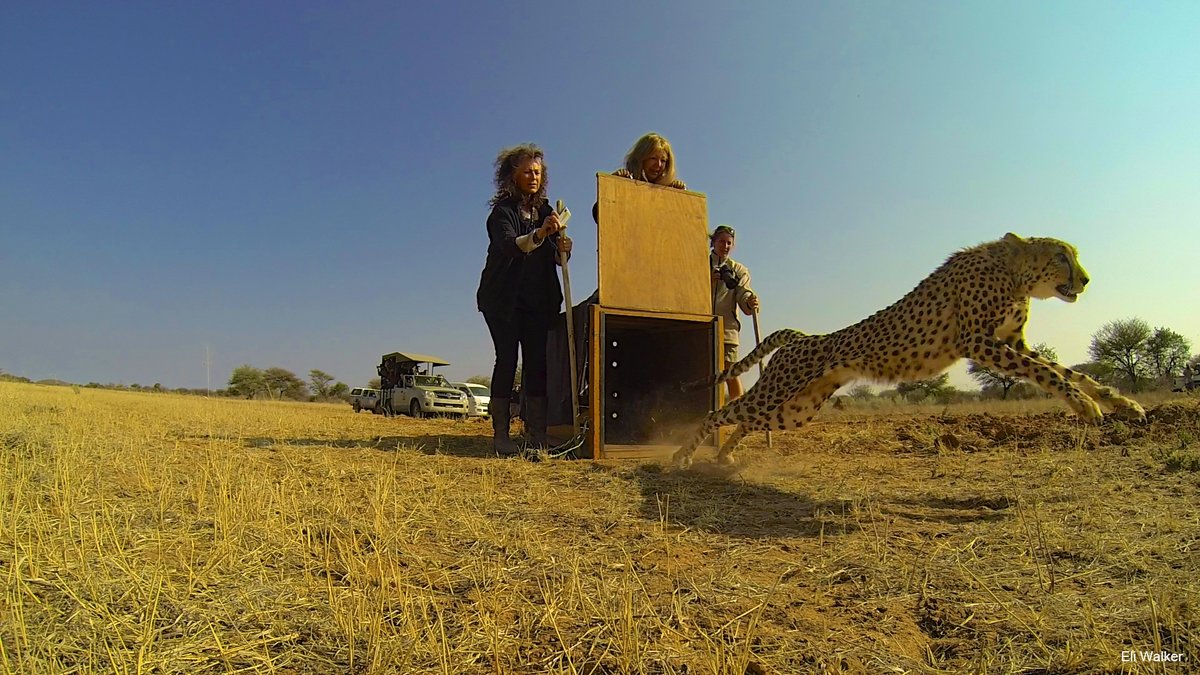
Our July issue's lead article and cover feature by Walker et al. highlights the importance of pre- and post-release management for optimizing survival of rehabilitated and released wild-born, captive-raised #cheetahs.
Take a closer look: https://t.co/0iQmeYbIJT
A long-running @CCFCheetah program in Namibia has shown how orphaned cheetahs can be successfully rewilded, presenting a rehabilitation template for wild-born, captive-bred individuals of other species, @Sean_Mow reports. https://t.co/3mc8lmmMiS
Out now! Recommendations for the rehabilitation and release of wild-born, captive-raised #cheetahs: the importance of pre- and post-release management for optimizing survival🐆
Learn more about Walker et al.'s research: https://t.co/0iQmeYbIJT
Read about new research from Namibia that shows how flashing lights can work as an effective visual deterrent to protect livestock in kraals at night against wild carnivores https://t.co/NCPh6sGadE @stijn_versch@fleurygs@Bound2Wild@Chewbaaka@CCFCheetah https://t.co/h8JpfGuiHu
New paper out on the patterns of #carnivore#occupancy and #diversity in a semiarid farming system: Namibian multiple use rangeland supports a diverse carnivore guild
https://t.co/bUC9bQHSi6
EXPLAINED: Why more international collaboration is needed to protect leopards🐆
On #InternationalLeopardDay, we're sharing this film from @WildCRU_Ox & partners highlighting the importance of transboundary collaboration for safeguarding the fragile populations of Asian leopards.