I’ll be giving a tutorial on diffusion language models at AACL-IJCNLP 2026 on Nov. 10
w/ @Bollegala
🔗 https://t.co/zTumLwYrBa
(Slides coming soon!)
#aacl2026@aaclmeeting
💭Grateful for the opportunity to organize my perspective on this fast-moving field and share it with the NLP community. This will be my first tutorial, so it’s a bit of a personal challenge for me as well. Looking forward to the discussions :)
Which DLM is least biased? Depends on how you sample.
We systematically show that sampling configs like remasking strategy can easily shift the bias scores of DLMs, reshuffling their ranking, even after debiasing.
📄 https://t.co/RSAR4RdXd2
w/ @dai0NLP@Bollegala@chokkanorg
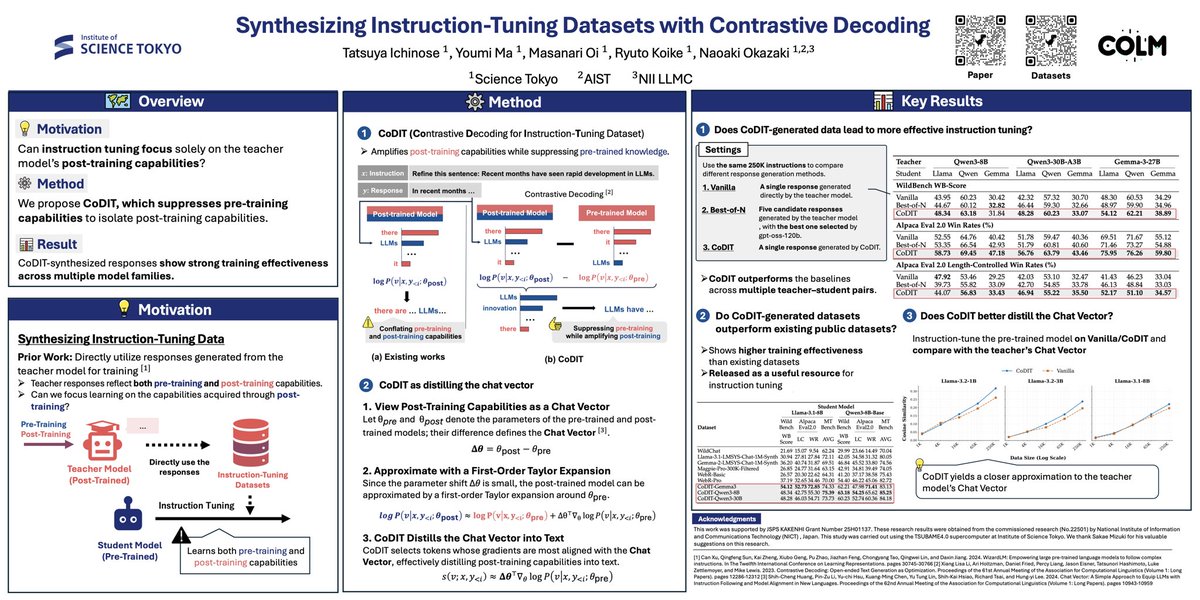
I'll be presenting CoDIT at #COLM2026, bour approach to building better instruction-tuning datasets.
If you're attending, stop by our poster and say hi! 👋
Synthesizing Instruction-Tuning Datasets with Contrastive Decoding
📍 Poster session: Tue, Oct 6 · 11 AM #93
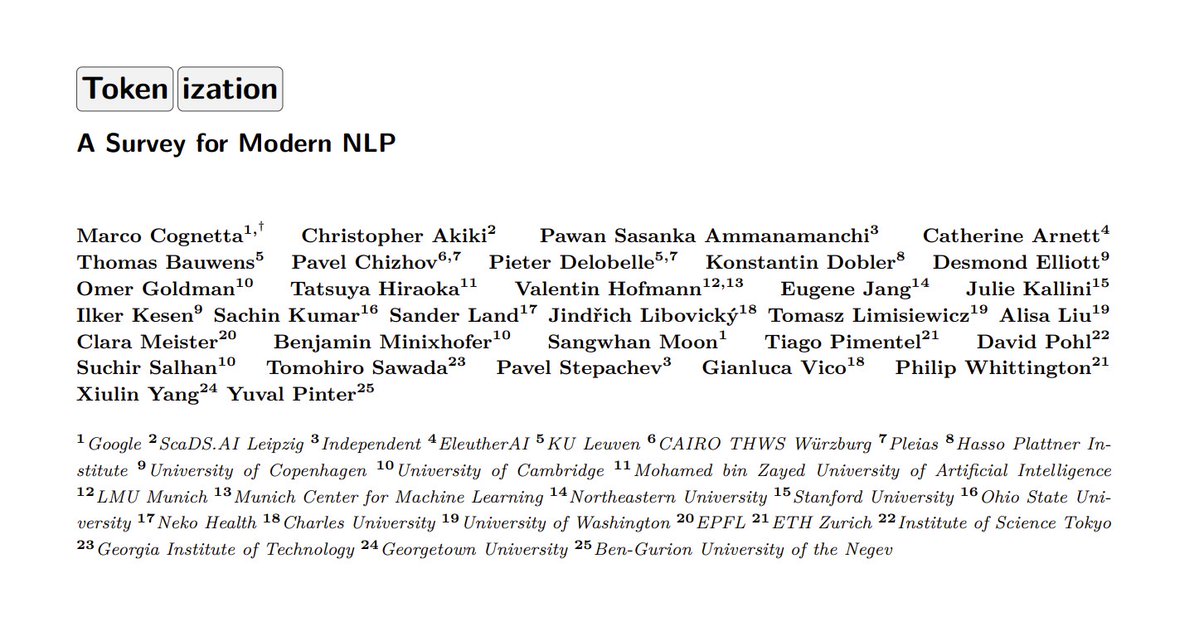
🚨 [Token][ization] Paper Alert 🚨
Tokenization is a wildly understudied area of language modeling despite it having effects across all of NLP. Over the past ~8 months, 32 (!) tokenizer researchers put together the most comprehensive survey of the field. Check it out!
SpatialClaw, our work at @NVIDIAAI, was accepted to NeurIPS 2026! 🎊
Even GPT-6 Astra gets better with SpatialClaw. 71.3 → 77.4 (+6.1%p), averaged across 20 spatial reasoning benchmarks. Opus 5 gained +15.0 points, and GPT-6 Sol gained +11.7.
With one shared SpatialClaw harness, we saw improvements across open-source and proprietary models, without any model- or dataset-specific tuning.
WAON, the largest Japanese image-text dataset, and HakushoBench, a challenging Japanese chart and table VQA benchmark, have been accepted to #AACL-IJCNLP2026 Findings! 🎉
We hope you’ll find them useful for training and evaluating VLMs.
See you in Hengqin! 🇨🇳✈️