🎤 Excited to speak at EthCC [9] this year.
I’ll be introducing:
CryptoCPU — a solution for Ethereum’s cost-effective, post-quantum-secure ZK future.
🗓 April 2, 10:20 AM
Burton Stage#EthCC
#Ethereum#ZK#PostQuantum#RiscV#CryptoHardware#Web3
🎤 Excited to speak at EthCC [9] this year.
I’ll be introducing:
CryptoCPU — a solution for Ethereum’s cost-effective, post-quantum-secure ZK future.
🗓 April 2, 10:20 AM
Burton Stage#EthCC
#Ethereum#ZK#PostQuantum#RiscV#CryptoHardware#Web3
@BasBeekenkamp@jurgen_nauditt Lol, says a Nazi Dutchman. The good thing is that you are irrelevant Nazi. You have zero real power, you can just bark as a small dog ;).
🚀 Meet CryptoCPU — a high-performance platform built to accelerate end-to-end ZK proving & blockchain validation.
With custom RISC-V vector extensions & co-processors, it delivers top-tier throughput, low latency, & power efficiency.
https://t.co/AwE7Pxdu5m
#ZKProofs#RISCV
@Niall_Emmart No reason why ZK ASIC can't have more cache, HBM access and most importantly much faster specialized prime field operations baked in, instead of high-latency massively parallel INT32s that GPUs only support.
@Niall_Emmart Buses on ASIC are not that expensive. What is really expensive is having a lot of cache memory on chip and access to fast external memory (HBM). There is a lot of work done in that direction in AI and NVIDIA is not dominating because of great architecture but because of CUDA.
@Niall_Emmart This is a very well known paradigm, demonstrated in running modern AI models, that eventual bottleneck doesn't come from computation but from data movement. To mitigate this, there is a lot of effort (specially in AI) to perform so-called in-memory (near-memory) computing.
Big thanks to @Aleo for sponsoring and @Cysic for organizing this year’s #Zprize 1b Track! Honored to be part of today’s announcement and discussion. Huge congratulations to the @PonosTechnology team for achieving the top place in the FPGA category!
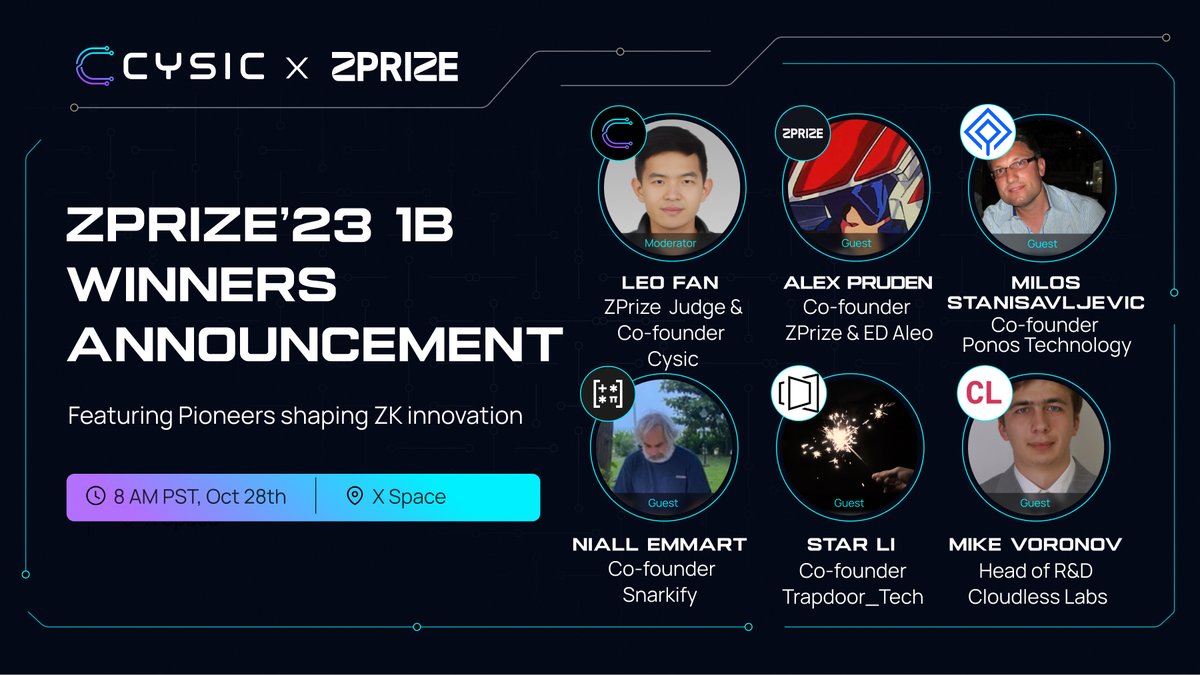
🎉In just 10 hours, join us for the ZPrize'23 1B Winners Announcement!
@leofanxiong, Cysic cofounder and judge of the 1B track @z_prize, will reveal the winners live on our Twitter Space! Featuring ZPrize cofounder @apruden08 and participants shaping ZK innovation @Niall_Emmart, @stmilosh, @StarLi53910273, and @VMS11.
🗓️Oct 28, 8PM PST
Set a reminder: https://t.co/4wJKdJm2a7
Our project Mandala final report, press release, and videos are finally out. If you happen to be at the Singapore Fintech Festival next week, come visit us at the BIS booth to chat more about it or come to the technical showcase on 6 November at 3PM at the Regulation Stage.
Boundless is breaking barriers. We've partnered with @ponostechnology to unleash the power of hardware-optimized STARK proving in our zkVM.
Get ready for a new era of speed and scalability.
@lisb68 @nexta_tv@POTUS@SecBlinken@Keir_Starmer@OlafScholz@EmmanuelMacron They'd love to help, but they can't because they know NATO is nothing but a paper tiger, that used to be great at bombing sandal-wearers with AK47s on pickup trucks, but now even Houthis are making joke of them.
@desperation84@BohuslavskaKate@JoeBiden @SecDef There is virtually no system in usage or even development by any NATO country that can down Iskander missiles. So your question is the same as where is Captain America and Ironman when one needs them.
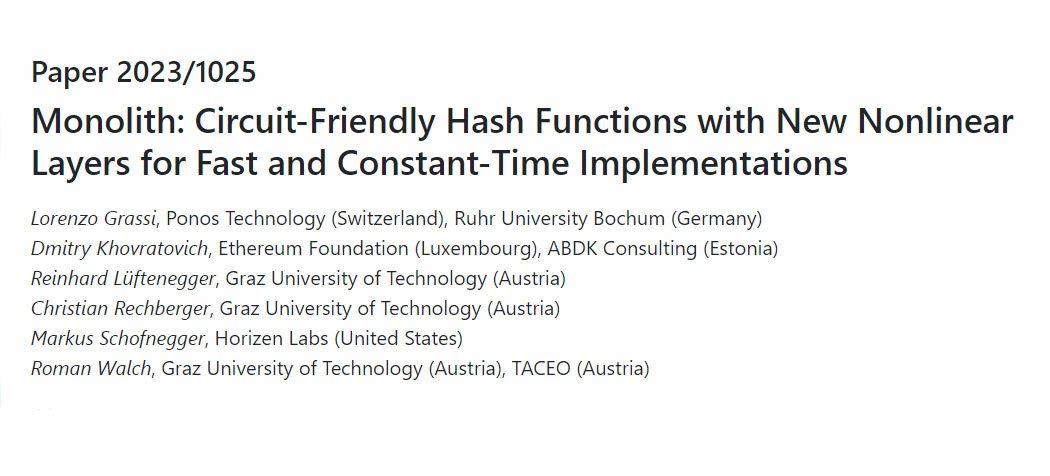
Hash functions are a crucial component in incrementally verifiable computation (IVC) protocols and applications. Among those, recursive SNARKs and folding schemes require hash functions to be both fast in native CPU computations and compact in algebraic descriptions (constraints). However, neither SHA-2/3 nor newer algebraic constructions, such as Poseidon, achieve both requirements.
Read how this problem is overcome in the following paper:
Lorenzo Grassi, @PonosTechnology, Ruhr University Bochum
Dmitry Khovratovich (@Khovr), @ethereum, ABDK Consulting
Reinhard Lüftenegger, Graz University of Technology (@tugraz)
Christian Rechberger, Graz University of Technology (@tugraz)
Markus Schofnegger (@mschofnegger), @HorizenLabs
Roman Walch (@rw0x0), Graz University of Technology, @TACEO_IO
https://t.co/OOmz5tprfj
We validated @RiscZero's benchmarks and can confirm that R0's zkVM 1.0 improvements are fully aligned with their release notes. Our benchmark runs:
https://t.co/fe30SQKsz0


![lukovics's tweet photo. 🎤 Excited to speak at EthCC [9] this year.
I’ll be introducing:
CryptoCPU — a solution for Ethereum’s cost-effective, post-quantum-secure ZK future.
🗓 April 2, 10:20 AM
Burton Stage#EthCC
#Ethereum #ZK #PostQuantum #RiscV #CryptoHardware #Web3 https://t.co/JEFMxJxggT](https://pbs.twimg.com/media/HDj70UkWsAACnGE.jpg)