💎 The Primitive Mind in the Modern Market: An Evolutionary Psychology Perspective on Investment
To truly understand human behavior, we must consider evolutionary psychology.
All the intense emotions we feel today when investing or speculating—fear, greed, impatience, and so on—are simply echoes of survival instincts that were refined in a primitive environment over hundreds of thousands of years.
While we operate in the modern financial market, the psychological operating system we use to interpret it is still running on a 'Stone Age version.'
Let me quickly explain evolutionary psychology. For countless generations, our ancestors lived day-to-day as hunters and gatherers. The image of the early human represents the vast majority of our species' existence.
The emotional patterns and survival strategies forged in that long, harsh environment have been passed down directly to us.
This happened because the people who had the instincts and psychology most advantageous for survival in that primitive world became our ancestors—and, ultimately, us.
This ratio—99% to 1%—is the fundamental reason why our minds are stuck on the 'primitive version.'
Humankind spent hundreds of thousands of years in a primitive setting, yet the 'modern society' we know has only existed for roughly the last two thousand years.
As a result, we still live with this disconnect:
Our Mind is running on the Stone Age version.
Our Life is running on the Modern version.
This gap explains the many mistakes and emotional struggles we face in investing, relationships, and decision-making. The conflict between these two versions can manifest in modern life as depression, anxiety, and impulsive trading.
Speculation: A Survival Instinct That Becomes a 'Kluge'
Speculation is driven by the "impulsive urge to acquire wealth more quickly and in greater amounts." In primitive times, securing resources faster and more abundantly directly boosted one's chance of survival. Therefore, our desire to speculate is a natural product of instinct.
We are born with a deep-seated drive to accumulate resources (like food), and in the modern world, this resource is replaced by 'money.'
We also possess a psychological bias called temporal discounting, where we place a much higher value on a 'reward now' than a 'reward later.' Why?
Because in the primitive world, tomorrow was always uncertain. Famine, disease, predators, and the cold meant that tomorrow might never come. Getting "the food right in front of you" was the safest survival plan.
This hardwired psychology automatically triggers the modern impulse to "want to get rich quickly." This is not a character flaw; it is a natural evolutionary consequence.
However, the problem is that we no longer live in the Stone Age. These instincts are no longer helpful. The urge to speculate will not lead to victory in the modern stock market, which is designed to prevent impulsive gambling from winning.
The 'Kluge'
In today's environment, those same instincts that were beneficial for past survival now function as a maladaptive response—a 'psychological kluge.' A kluge is an inelegant, yet functional, solution that is ultimately flawed.
The speculative impulse to acquire resources quickly was certainly helpful for survival in the Stone Age. Being quick to secure immediate food boosted survival odds. However, this instinct was formed in an environment completely different from the modern stock market.
Thus, in today's financial markets, speculation acts as a deeply unsuitable psychology—a kluge.
To become a successful investor, we must first understand how our inherent primitive mind works. Only then can we build conscious strategies and long-term thinking on top of that awareness.
We must ask ourselves: Is the emotion I feel while watching the stock market ticker simply a 'kluge'—a maladaptive leftover from a different environment?
Ultimately, the power to succeed in modern finance does not come from following instinctive impulses, but from being able to build strategies that rise above instinct.
How the New Executive Team Strengthens $IREN's Commercial Positioning
At this stage of its development, I think it is finally possible to define IREN's business model and operational boundaries more clearly. This is extremely important. The founders and core leadership of IREN truly reflect the training of Europe's top business schools. Many of the company's decisions demonstrate a deep understanding of the critical factors behind long-term corporate success. That matters enormously because it ultimately determines whether a company deserves to remain a long-term investment.
Among the outstanding companies I have studied, one common characteristic stands out: clearly defining strategic boundaries and then relentlessly deepening them. The most important thing is to focus resources on strengthening existing advantages, building a competitive moat from the very beginning, and ensuring that every subsequent decision further reinforces that moat.
IREN's real strategy is to become the ultimate neutral AI infrastructure provider. Its goal is to build an operating model that is independent of any particular AI model. Whether the eventual winners are Claude, GPT, Gemini, Kimi, Llama, or future open-source models that have yet to emerge, IREN always provides the same core capabilities: power, liquid cooling, GPU racks, networking, data center operations, orchestration, and secure isolation.
IREN is monetizing the efficiency created by the combination of this hardware and software infrastructure—not Token Revenue. It serves every model developer. Its mission is to maximize the efficiency of token production regardless of whose model generates those tokens. From my perspective, this is the core of IREN's commercial positioning.
Its partnership with NVIDIA to build the DSX ecosystem further demonstrates that IREN has chosen not to align itself with any specific model developer. Sweetwater being selected as NVIDIA's flagship DSX deployment is itself a powerful signal. DSX is not a platform for any single model; it is NVIDIA's definition of the next-generation AI Factory standard.
Within this ecosystem, NVIDIA provides the architecture, IREN operates the physical infrastructure, Mirantis delivers the open orchestration layer, and customers run their own models on top of the platform.
At no point does this architecture require IREN to own its own AI model. In fact, remaining neutral becomes its greatest competitive advantage and differentiator. No model developer wants to deploy its most valuable models on a platform that also competes directly with it in the Token business. That is true for Anthropic, OpenAI, and it will also be true for future companies such as Moonshot, DeepSeek, Kimi, and others. DSX strengthens the strategic boundary IREN has established—it does not blur it.
The acquisition of Mirantis was never about acquiring model capabilities. Instead, it was about improving hardware utilization and workload isolation. Many people immediately associate Mirantis with OpenStack or Kubernetes, but the truly important point is that it gives IREN a complete open orchestration capability. GPU resources are no longer tied to a single model; Kubernetes, OpenStack, and k0rdent can orchestrate heterogeneous GPU clusters through one unified control layer, ultimately creating a genuinely model-agnostic AI infrastructure.
Claude can run on it. GPT can run on it. Llama can run on it. Kimi can run on it.
IREN does not need to care which model wins. Its job is simply to maximize GPU utilization and optimize infrastructure efficiency.
Events like today's release of the open-source K3 model are actually positive for IREN. K3 reinforces the idea that the future will not be dominated by just two or three closed-source models. Instead, the model layer is likely to become increasingly diverse, fragmented, and open.
As a result, more enterprises will choose not to depend entirely on Azure, AWS, or Google Cloud. Instead, they will need neutral infrastructure capable of hosting many different models. Third-party GPU operators, enterprise private clouds, sovereign regional clouds, and independent AI data centers will all become important sources of demand.
The real beneficiary is not any single model. The more models that exist, the greater the need for neutral infrastructure. Therefore, K3 is not fundamentally bullish because it is open source—it is bullish because it reinforces the need for Model-Agnostic Infrastructure, which has been IREN's direction from the very beginning.
NVIDIA's philosophy has always been to "sell shovels to every gold miner." Every future model company is a potential customer.
IREN occupies exactly the same position.
The flagship DSX AI Factory that NVIDIA and IREN are building together is designed specifically for this long-term industry trend.
Over the past month, three senior executives have joined IREN. Their appointments have attracted considerable attention. They left globally recognized companies to join a startup valued at roughly $10 billion because they saw something unique that few other companies can offer—a distinctive operating environment and capabilities that are difficult to replicate.
What roles will they actually play?
Based on the positioning outlined above, each of these executives strengthens the same overarching narrative. Together, they make IREN's neutrality not just a marketing message, but a verifiable engineering capability.
Here is how I interpret their roles.
The first is Kambiz Aghili, formerly of Oracle OCI.
His most valuable experience comes from Oracle's Dedicated Region business—building cloud environments that give customers an experience nearly identical to owning their own data center while still preserving the advantages of a cloud platform.
Within IREN, this translates into turning GPU infrastructure into a true enterprise product. The company is no longer simply selling GPUs—it is selling Enterprise AI Infrastructure.
The second is Michael Nudelman, formerly with Google and CyrusOne.
He represents hyperscale data center development and execution.
His value lies in standardizing and rapidly replicating large-scale AI infrastructure, enabling campuses such as Sweetwater, Horizon, and future AI Factories to be deployed faster and more consistently.
The third is Eric Hammersley, formerly with Nutanix and NVIDIA HPC Security.
His greatest contribution is not his government background, but his expertise in security.
In the future, IREN may simultaneously serve Anthropic, OpenAI, Microsoft, NVIDIA, and many other competing AI companies. Every customer must have confidence that its model weights, proprietary data, and inference workloads cannot leak to any other tenant.
That requires verifiable physical isolation, network isolation, security auditing, and compliance systems.
Eric Hammersley completes the final missing piece of a neutral infrastructure platform.
Together, these three executives transform neutrality into an actual product.
Many companies claim to be neutral.
Customers, however, do not buy promises.
They buy systems that are verifiable, auditable, and certifiable.
Together, the three executives form a complete operating loop:
Kambiz Aghili defines the product.
Michael Nudelman delivers the engineering execution.
Eric Hammersley secures the trust boundary.
Collectively, they solve the challenge of transforming "neutral infrastructure" from a business slogan into a platform that customers can purchase, trust, and deploy over the long term.
This is a critical step toward differentiating IREN's business model.
It is also where future pricing power will originate.
Viewed through this framework, Enterprise Sovereign AI deserves more attention than Government Sovereign AI.
There has been considerable discussion about whether IREN will eventually support U.S. government AI initiatives.
At present, however, the publicly available evidence does not support that conclusion.
There is no FedRAMP authorization, no IL5 certification, no federal contract, and no government procurement announcement.
The more reasonable conclusion is that government AI remains a long-term strategic option rather than an existing business.
What already exists today—and represents a significantly larger addressable market—is the Enterprise Sovereign Cloud.
Financial institutions, healthcare providers, energy companies, and large enterprises increasingly require dedicated GPUs, dedicated networks, dedicated data environments, and dedicated security.
This market does not depend on government procurement cycles and aligns far more closely with IREN's current organizational structure, executive hires, and product roadmap.
Against the backdrop of building a neutral AI infrastructure platform, the addition of liquid-cooling expert John Gross earlier this year takes on much deeper strategic significance.
Most likely, IREN intends to make liquid cooling and high-density rack infrastructure into rapidly deployable foundational capabilities. Regardless of how the external landscape evolves, the company aims to remain hardware-agnostic.
In the future, even NVIDIA itself will inevitably face increasing competition from alternative hardware vendors.
A neutral infrastructure platform with robust isolation capabilities, however, can remain relevant for twenty or even thirty years.
This is entirely consistent with IREN's long-standing management philosophy: every capability that determines long-term competitiveness should, whenever possible, be owned internally.
Liquid cooling is therefore not viewed as an outsourced engineering service. Instead, by recruiting industry-leading talent, IREN is turning it into a core in-house capability.
This follows exactly the same path the company has already taken with land ownership, power infrastructure, substations, fiber networks, data center design, and, through the acquisition of Mirantis, software orchestration.
To summarize, this year's key executive appointments all serve one strategic objective.
Under the broader goal of building long-term neutral and isolated AI infrastructure, IREN's organizational capability has become increasingly complete:
John Gross strengthens in-house liquid cooling, high-density rack architecture, and the physical foundation of AI Factories.
Kambiz Aghili strengthens the productization of Enterprise AI Infrastructure.
Michael Nudelman strengthens hyperscale AI data center construction and replication.
Eric Hammersley strengthens security boundaries and workload isolation.
Mirantis strengthens open orchestration capabilities through Kubernetes, OpenStack, and k0rdent.
Together, these capabilities cover virtually every critical component required to build a modern AI Factory.
Compared with IREN, the strategic differences between CoreWeave and Nebius have become increasingly obvious.
Over the past six months, CoreWeave has primarily strengthened its sales organization, financial operations, and post-IPO management.
Nebius has continued expanding horizontally across multiple products while simultaneously pursuing acquisitions related to model capabilities.
Within the field of neutral AI infrastructure, however, neither company possesses the foundational characteristics required to compete.
CoreWeave's fragmented infrastructure, built largely on leased data centers, cannot realistically provide true neutrality.
Nebius aims to generate revenue directly from token services, which inherently conflicts with the concept of neutrality.
Moreover, during the past six months, neither company has announced executive hires comparable to IREN's strategic talent acquisitions.
By contrast, IREN's recent executive appointments are all concentrated on strengthening one clearly defined objective: building a neutral AI infrastructure platform.
Its strategic positioning could hardly be clearer.
IREN is reinforcing the deepest, most neutral, and least replaceable layer of the AI value chain.
As long as the AI ecosystem continues to evolve, models continue to improve, and demand for compute continues to expand, every model will ultimately need to run on infrastructure.
That is the layer IREN aspires to own: the most trusted, the most specialized, and the most neutral AI infrastructure operator.
For companies operating in emerging industries, defining a durable position within the value chain as early as possible is one of the most important strategic decisions they can make.
Although IREN has not explicitly articulated this vision to the market over the past six months, I believe the evidence increasingly points to this becoming its long-term strategic identity.
More importantly, it is becoming increasingly difficult to imagine another company replicating the entire strategy.
Once this positioning becomes widely recognized, Government Sovereign AI could become a major future opportunity as well, because there are likely to be very few companies with both the capability and the scale to deliver it.
These are the concentrated expression of IREN’s principles of optionality and flexible commercial strategy.
The management team and the Board of Directors at IREN deserve high marks.
@brianfry01@FransBakker9812@jiahanjimliu
Reflecting on $IREN
Over the last couple of days I spoke with multiple people in close contact with $IREN's management team, including investors who attended the RAISE Summit this week.
Given the insights I've gathered, I think it's an appropriate time to reflect on $IREN and share my latest thoughts.
It's no secret that $IREN has been somewhat slow on the commercial side, at least relative to the likes of $NBIS and $CRWV. I for one thought we'd have seen a Sweetwater deal by now, let alone substantial parts of the remaining Childress capacity pre-contracted.
So what's stopping $IREN from signing these multi-hundred MW deals?
In short, nothing is really "stopping" them. It comes down more to a few factors shaping their decision to hold off where other cloud providers perhaps wouldn't.
Based on management's comments both on and off camera, I can confidently say demand truly isn't the issue. Cloud capacity in this market is sparse and supply can't keep up. In fact, I've heard $IREN could easily sell out 100% of its 2027 capacity today if it wanted to.
The catch is that selling capacity which won't come online for another 6, 9, or 12 months yields significantly less than capacity arriving sooner. Customers want capacity today, and they're willing to pay a substantial premium for it.
So while selling far into the future might prop up the stock, commercially it may not be the most prudent strategy in this environment. That dynamic can obviously shift over time, but given how far supply sits behind demand, it won't change overnight, and as it stands, holding off as long as possible yields better long-term returns.
Not only do returns shrink the further out you pre-contract, but the available buyer pool shrinks with it. Selling capacity well into the future means gatekeeping much of the smaller, higher-margin clientele while mostly attracting the lower-paying hyperscalers.
As we know, $IREN is increasingly moving up the stack, effectively cutting out the middle-man that hyperscalers represent, as evident in their recent Mirantis acquisition. On that note, $IREN apparently has multiple LOIs and customer commitments for high-margin managed cloud services set to take effect once the Mirantis deal closes over the coming weeks.
I've now also heard several times that $IREN takes customer selection and contract structure extremely seriously. Creditworthiness matters, but management also wants clients that can scale their compute demand substantially as $IREN ramps capacity. The only near-term downside is that this due diligence takes time, yet the longer-term advantages of the approach are obvious.
Beyond contract timing and customer selection, I believe some of it also comes down to operational reasons.
We know the 1.4 GW Sweetwater campus is earmarked for the upcoming VR200 (Rubin) capacity, whose supply won't ramp until late this year into early next. That partly explains why the site isn't up and running already, since all they could lease out right now would be current Blackwell generation.
The flip side is that $IREN could simply build "Horizon-style" capacity at Sweetwater, the same style they're currently developing at Childress, since those facilities are fully capable of housing next-gen Rubins, and have them ready by early next year, right as NVIDIA fully ramps Rubin production.
And while $IREN is already doing foundation work at Sweetwater, it could still easily take another 3-4 quarters before we see operational capacity there.
So what's the holdup?
I believe a major reason for the slow ramp at Sweetwater is that they want to implement lessons learned from their Horizon build-outs at Childress, making the Sweetwater process more efficient, less costly, and thus more economical.
Here I want to give a big shoutout to my friend @FransBakker9812, who found that $IREN has recently developed proprietary methods to make elements of the construction process significantly more streamlined, saving time and cost across all future liquid-cooled builds.
He shared more specifics on that with his "Research” and “Founding” subscription tiers, which I recommend checking out.
I firmly believe what some might see as a relatively slow ramp, given $IREN's starting position, is management's way of doing things right. Start with the first liquid-cooled buildouts in Horizons 1-4, implement lessons from one Horizon batch to the next, then apply the full set of process and workflow improvements at Sweetwater.
This closely mirrors what $IREN has always done since its mining era, when it started small and progressively scaled its construction operations in both size and speed. A true construction flywheel.
Interestingly, I've just heard that $IREN plans to develop Sweetwater 1, Sweetwater 2, and the 1.6 GW Oklahoma site in parallel over the coming years. That shows just how exponential their construction ramp really is.
In short, I believe holding out on the next wave of contracts comes down to a few factors:
1) Signing well ahead of commissioning means giving up pricing upside and attracting only a small subset of clients.
2) Customer selection and contract structure are a big part of $IREN's long-term strategy. It takes more time than simply selling to the highest bidder, but should build stronger customer relationships over the long run.
3) Scaling construction in a controlled manner, carrying critical lessons from current builds into the next. Slow start, exponential growth curve.
None of this means we won't see any deals this year, but it does add color on why commercial progress on closing deals has been slower than many of us expected.
As for deal activity and my current expectations there, it helps to step back and consider how $IREN's near-term capacity is structured.
We should expect the 50k B300 units $IREN procured back in March to be fully contracted and installed by year-end, roughly 33k at Mackenzie and another ~17k at Childress. Apparently first deliveries for Mackenzie have already arrived and are being installed.
Given this progress, I'd expect $IREN to announce having contracted substantial parts of these air-cooled Blackwells by August earnings at the latest. This is the low-hanging fruit.
And worth noting, since $IREN first gave ARR guidance for that capacity, GPU rates across the board have moved up substantially. If they sign anything close to what they landed with the 60 MW NVIDIA deal, their year-end guidance of $3.7B should climb to at least $3.9-$4.1B.
Beyond this, there's plenty of 2027 capacity that could get contracted later this year, including 190 MW of air-cooled capacity at Childress, 30 MW at Canal Flats, 150 MW of liquid-cooled Horizon 5-6, and 300 MW of liquid-cooled capacity at Sweetwater 1.
We don't have guidance on when this capacity comes online next year or what the ramp schedule looks like, but since liquid-cooled greenfield development takes longer than retrofitting existing air-cooled buildings (currently mining BTC), I'd expect the remaining 220 MW of air-cooled capacity to come online within the first couple of quarters of 2027.
For that reason, I think the odds those few hundred MW get pre-contracted later this year are relatively high.
The trickier part is the 150 MW of Horizons 5-6 and the 300 MW of liquid-cooled Sweetwater capacity. I think there's a decent shot at least one of the two gets pre-contracted in 2026, especially if it's for a hyperscaler or a frontier lab, which are far more inclined to sign a few quarters ahead.
Either way, it's just a matter of time until contracts start flowing. It's clear to me that $IREN is playing the long game and isn't compromising long-term upside for short-term euphoria in the share price. As a long-term investor, I fully support that.
I do wish, however, that $IREN were a bit more open about strategy and roadmap. It's obvious they're holding their cards close to the chest, but I find management has been overly vague on strategy.
It takes investors like me piecing the puzzle together to make sense of how $IREN plans to scale into the next hyperscaler. Ironically, management does share a fair bit of interesting and useful information if you get the chance to meet them in person, yet on earnings calls they come across as overly reserved.
That said, the future looks bright, and I have no reason to get overly concerned about disappointing price action. With a bit of luck we're in for a string of positive catalysts, starting with the Horizon 1 handoff in a couple of weeks.
I also want to take a moment to thank @OMCapitalGroup, who did an excellent job gathering information and insights while attending RAISE this week.
If it weren't for his work, I wouldn't be nearly as informed, so big props to him for taking the time to travel all the way to Paris for $IREN due diligence and then going out of his way to keep me updated with everything he picked up, even putting some of my own questions to management directly.
He's relatively new to X, but he told me he's going to start posting shortly and jump into Frans' spaces more often. Do me a favor and give this fella a follow.
Have a good one, cheers! ✌️
Thumbnail Credit (enhanced version): @AndyDTrades
$IREN's Executive Compensation
My full take on $IREN's controversial RSU package is now live on Substack for FREE.
While this topic has been discussed to death already, I believe my piece brings some unique perspectives to the table and might shift a few opinions.
I'm genuinely curious to hear your feedback in the comments!
If you don't already have a Substack account, it just takes about 2 minutes to set up. Very user-friendly platform.
Cheers!
https://t.co/OeyqAFTf1F
$IREN lost a core pillar of its retail culture today and I do think that is a signal.
What I will say is that it doesn’t matter. Never did and never will. Why?
Because this is not a sports team trying to sell you tickets to a game. This is a business. It doesn’t need your applause. It doesn’t need your cheerleading. It doesn’t care about your commercial opinion.
Your job is not to feel included. Your only job is to decide whether the facts still support the thesis.
If they do, great. If they don’t, also great.
Everything else is noise.
NVIDIA independently validated our B300 training performance across their benchmark suite, a status only a few achieve. Design, networking, software and operations tuned as one system. Owning the data centers, not renting them, helps keep cloud performance repeatable at scale.
So overnight is a slaughterfest, and my tiny $PRIM position is looking extra rough.
Most of my plays from last week are not looking well, but so be it.
Last week I made a very nice return on a combination of closing $EOSE and $UAMY puts, as well as closing my previous $PRIM position at a nice gain.
If I would close out my new $PRIM position on this drawdown, I would erase my entire last week's gains, so I will probably hold on to it for a while, as the expiration for my synthetics is in September, the volume is marginal, and the CEO seems to have frontloaded all the negatives, while providing himself with plenty of time to do better going into the second half of this year.
What I learned from this event, is that execution is more important than just good earnings.
Derisking a business model or project, is in some cases more important than actually seeing the revenue recognized, even though in reality, it's a combination that mostly works in sync.
What it also showed, is that being transparant, upfront, and honest about your progress, is not being rewarded by the market for that fact alone.
$PRIM announced $2B of new business, which would be significant on a $4B market cap, would it not be that the market doesn't believe they will deliver it, until the current stalled projects are being delivered.
I could draw parallels with $NBIS in terms of being completely not transparant, or with $IREN in terms of not being believed that they can deliver on their projects.
It's obvious that Nebius is not granted the current valuation for just being vague about their unit economics. The real reason they are up this much, comes from the fact that they have shown to be able to deliver compute from mostly existing data centers, while simultaneously being able to monetize future projects, with hyperscaler deals.
Their earnings showed growth more than profitability, and the market loved it.
$IREN has not yet delivered meaningful AI revenue to date. And the slow ramp in 2026, paired with the delivery of Horizon 1 in Q3, has made the market weary of their ability to execute.
In this environment, striking new deals, would be received to a similar degree, as $PRIM trying to calm the markets with announcing a $2B deal.
The truth is, delivering deals, leads to pricing out execution risk, which in turn helps to lower financing risk.
-> Everything comes back to execution.
-> Profitability is nice to have, but not key in this part of the buildout.
I understand that this is a simplified approach, and the truth will most likely be somewhere in the middle.
I am convinced however, that $IREN will be delivering Horizon 1 next month, which will be the first in a series of events that will show that they can in fact execute, deliver, and subsequently recognize these revenues.
But where this may be reason for the market to start pricing out execution and financing risk, I think this is a turning point in profitability as well, and I strongly believe that that's exactly what the company is working on in the background.
Let's assume that the delivery of Horizon 1 is a milestone for the market, to believe that $IREN is able to deliver liquid-cooled, next generation, infrastructure and compute, to a hyperscaler customer.
What is going to happen when that milestone is met, and the company is immediately, subsequently, able to:
1. Show their AI revenue has a higher margin profile than their peers.
2. Demonstrate that their capex is being funded with a lower cost of capital than their peers.
3. And then signs a new deal with a hyperscaler or frontier lab.
This is the order where in I want IREN to deliver.
-> Deliver Horizon 1 to Microsoft.
-> Bring healthy operating income to the August earnings.
-> Showcase a low interest profile, paired with a prudent mix of equity and debt.
-> Sign Horizon 5-6.
Now of course, the deal for Horizon 5-6 could come at the same day as earnings. And I think that will not lead to the same correction we saw at last earnings.
The entire point I am trying to make, is the same point that I called a breaking point for my investment thesis for $IREN, and that is the delivery of the Microsoft deal, and delivering Horizon 1 is the milestone both me, and the market will need to see.
Everything else will be valued more accurately, as long as the main overhang of the Microsoft deal is gone.
$IREN did not have the luxury of a 75MW fully operational data center during their last 2 earnings, and sure enough the Prince George revenue will still not be even close to $NBIS in their last earnings.
But if we deliver Horizon 1, we will add 50MW of operational AI MWs to our portfolio, and that's a big milestone.
Make no mistake, the operational MWs are lagging the contracted MWs, and at the same token, the AI revenue is lagging the operational MWs.
But the gap is closing, and we are in the darkest night before the dawn.
I have the exact date of the completion of the 50MW supercluster of Horizon 1, and I AM BULLISH AF.
Nobody is going to tell me that IREN is not moving forward, because if you don't look at what's really happening, you either stay completely in the dark, or even worse: YOU MAY CONFUSE THE ORDER OF BUSINESS
I am just as much looking forward to the next deal as anyone, but signing a deal now will not yield the same results as doing it after Horizon 1 is delivered.
Get this in your head, and stop crying in the casino while the hedgefunds are playing ping-pong with your life savings.
IREN is being derisked EVERY SINGLE DAY, and I am here to report on that.
Fade the noise, and do your own research.
We are just getting started.
𝐓𝐡𝐫𝐞𝐞 𝐋𝐚𝐲𝐞𝐫𝐬. 𝐎𝐧𝐞 𝐂𝐨𝐦𝐩𝐨𝐮𝐧𝐝𝐢𝐧𝐠 𝐀𝐝𝐯𝐚𝐧𝐭𝐚𝐠𝐞. 𝐓𝐡𝐞 𝐈𝐑𝐄𝐍 𝐓𝐡𝐞𝐬𝐢𝐬.
There's been a lot happening at IREN recently.
Expansion across North America, Europe and Asia-Pacific.
The NVIDIA partnership.
The Mirantis acquisition.
New GPU deployments.
New customer discussions.
A growing global footprint.
Underneath all of it is a fairly simple view of where the world is heading, and a deliberate strategy for how we position IREN within it.
That strategy is built on three layers. Together, they compound into a structural advantage that gets harder to replicate every quarter we execute.
Layer 1: Physical infrastructure. Power, land, substations, data centers, cooling. The foundation that everything else sits on.
Layer 2: Compute infrastructure. The GPUs, servers and networking that go inside those buildings. Deployed at scale. Generating revenue. Building execution track record.
Layer 3: Software and operational capability. The orchestration, deployment tooling and enterprise expertise that makes the first two layers work harder for customers, and opens the door to a broader, higher-value market over time.
Layers 1 and 2 are where the overwhelming majority of IREN's value is being created today. Layer 3 is where that advantage compounds further over time, but only because Layers 1 and 2 are built, owned and controlled at scale by IREN, not subscale nor contracted from a third party.
Think of Amazon. They didn't win e-commerce by building a great website. They won it by controlling the fulfilment infrastructure at a scale nobody else could replicate. The foundation you don't control becomes the ceiling on your business.
That is exactly how we think about IREN. The physical infrastructure - the land, the power, the substations, the data centers - is owned and controlled by us. The compute deployed into it generates the revenue and execution track record. And the software, orchestration and enterprise capability we are more methodically building on top is what turns the total product into a vertically integrated AI Cloud platform that compounds over time and deepens into a competitive moat.
AI is still early. The bottleneck is increasingly physical. And we have spent eight years building the foundations.
NVIDIA가 해결한 건 "계약 체결"이고, Awaken이 해결할 건 "고객 유입"이라고 생각합니다.
NVIDIA 파트너십은 계약 테이블에서의 신뢰 문제를 해결해줍니다. 고객이 IREN과 계약을 검토할 때 NVIDIA의 보증은 강력한 클로징 도구가 되죠.
다만 NVIDIA가 고객을 테이블로 직접 데려오진 않습니다.
그 역할을 Awaken이 맡게 됩니다. 브랜드 인지도를 높이고, 콘텐츠로 잠재 고객을 유입시키며, "AI 인프라 기업 IREN"을 시장에 각인시키는 것, 이게 이번 인수의 본질이 아닐까 싶습니다.
NVIDIA가 클로징을 쉽게 만들수록, Awaken이 더 많은 고객을 테이블로 데려올수록, 두 기능의 레버리지는 곱으로 커질 것 같습니다.
$IREN is making all the right moves…
I'm pleasantly surprised by $IREN's acquisition of @MirantisIT. Previously I thought $IREN would eventually move up the stack through M&A, but I anticipated this to happen in 1-2 years, not today.
I interpret this as things genuinely moving VERY fast at $IREN behind the scenes and all of us just underestimating the pace this company is on.
Remember, two years ago everybody saw $IREN as "just another BTC miner".
Six months later (late 2024) it became the most formidable competitor in the space, breaking growth records and being the only profitable entity in the industry.
Then, last year, the story evolved to $IREN having genuine potential in the AI/HPC colocation space with its gigawatt scale power portfolio.
Not long after, this company surprised everybody with its first hyperscaler deal consisting of leasing out cloud capacity, moving up the value chain and skipping the lower-yielding colocation segment.
Today, $IREN's product portfolio is evolving once again.
Previously they were widely regarded as a pure-play "bare metal" compute provider, yet with the acquisition of Mirantis, the company moved up to a full-stack AI cloud, now covering everything from the metal up through the managed AI services that enterprise and sovereign customers actually plug their workloads into.
Contrary to what most analysts interpret this as, I don't see this as a pivot, but rather a hedge. A hedge against customer concentration.
There are fewer than 10 companies in the world that can rent hundreds of megawatts of compute. Think hyperscalers and frontier AI labs like OpenAI and Anthropic.
Even if $IREN managed to establish relationships with >50% of these tier-1 customers, that would still result in an incredibly concentrated client composition.
This sort of reliance on a handful of customers just adds more risks, which in turn leads to lower valuations, higher cost of capital, and arguably most importantly, a weaker hand at the negotiating table.
All that said, I still think bare metal will continue to be the majority of $IREN's contracted cloud capacity going forward.
The big players' appetite for compute is just insatiable and $IREN is in a prime position to become THE "plug" for high-quality, low-cost compute, given its fully vertically integrated infrastructure portfolio and massive power pipeline.
Yet with this acquisition $IREN now has a solid shot at also taking meaningful market share in the smaller subsets of the AI compute market, namely the enterprise & sovereign AI (governmental) sectors.
The end result could be a much more diverse and thus more robust client mix.
If I had to take an educated guess at the reason why $IREN acquired Mirantis at this point, I believe it could very well be related to the multi-billion-dollar deal Co-CEO @danroberts0101 referenced in last quarter's earnings call:
"One of the contracts we are negotiating at the moment is a multi-billion dollar contract where we would have to bring a software solution".
I believe the counterparty in question isn't a hyperscaler or a frontier AI lab. These are exactly the kind of customers who DON'T need the software layer, as they develop it in-house and retain full control.
Likewise, I don't think there are many enterprise clients requiring cloud compute in the "multi-billion" dollar range.
Thus, by process of elimination I think the most likely fit is a sovereign entity, i.e., a state or government. Mirantis just happens to be one of the few companies validated by NVIDIA as part of its sovereign AI reference architecture.
As for which sovereign entity it might be, there are many possible candidates, but there is none more obvious than the Australian government itself, be it federal or stae-level, given $IREN's roots in the ‘land down under' (founded and headquartered in Sydney).
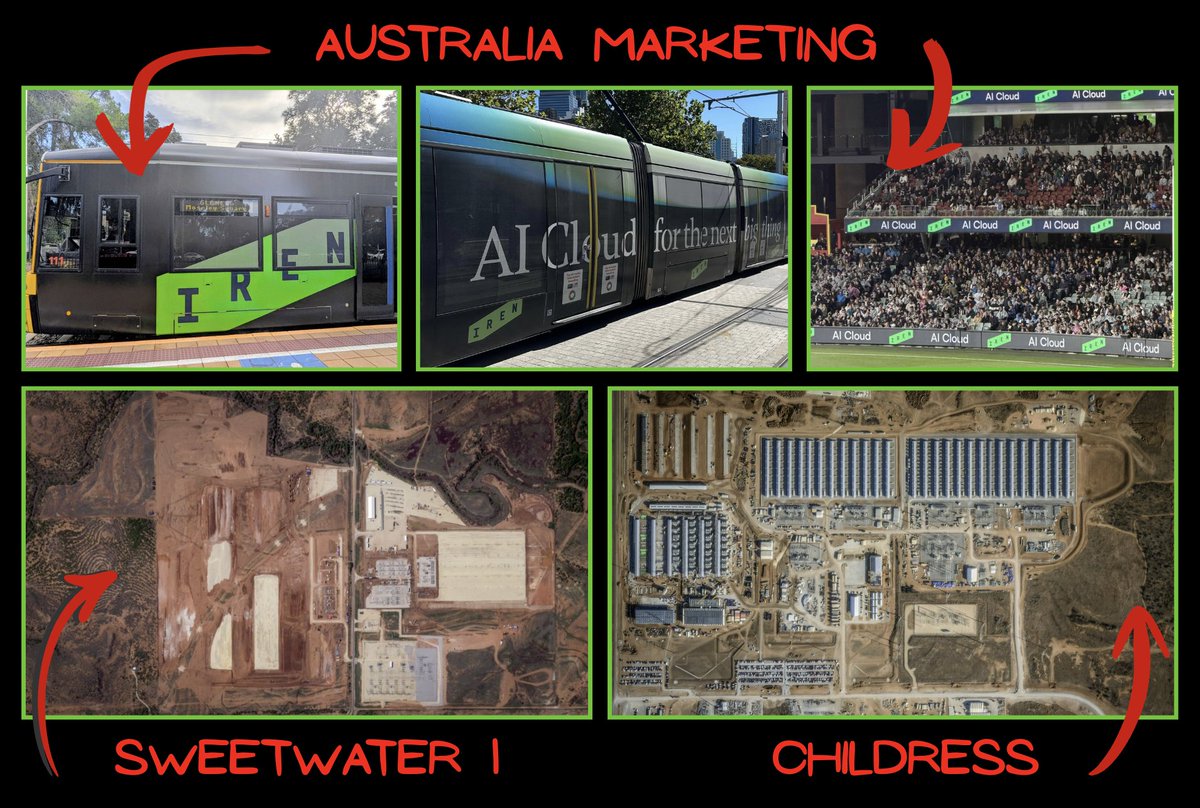
This would also explain the company's recent advertising push in several regions across Australia, perhaps to attract the necessary local tenant to successfully pull off a venture of this magnitude.
I'm just thinking out loud here, and much of this is nothing more than speculation at this point, but in any case, this acquisition appears highly strategic in multiple ways.
I'm very much looking forward to tomorrow's earnings call, in anticipation of getting more insights into the motivation behind taking Mirantis on board.
Over the coming days post-earnings I'll publish a very extensive earnings breakdown on Substack, of which the acquisition of Mirantis will be a substantial focal point.
I'll lay out everything there is to know about this tech company & provide you with my unfiltered opinion in an easy-to-digest manner.
Stepping back one more time, it's incredible to see just how far $IREN has come since I started covering it. It's truly a generational unicorn company. Something you don't come across very often.
The growth trajectory has been unprecedented. The company is firing on all cylinders, and I think we stand right before some major commercial victories.
Another piece of data pointing in that direction is the company's recent hiring spree. $IREN now has 142 job openings across a wide range of departments and geographies.
This company is not standing still!
Cheers, guys ✌️
S/O to my friend @_Sgr_A_Star for providing the job listings pics
3 Imminent $IREN Catalysts
Not many companies have as much going for them right now as $IREN does.
While management has been relatively quiet since the last earnings call, I believe we're standing right before a wave of major, thesis defining announcements.
1) Australia Expansion
Given that Australia is where $IREN was incorporated, one might expect the company to already be operational there. Yet as of today, Australia remains merely the home of its HQ.
That will likely change very soon...
Just a couple of months ago, $IREN announced a sponsorship of the Sydney Swans, a prominent AFL team. As an isolated event, I wouldn't have thought much of it. The company's CEO is an Australian Football coach himself, so it could have simply been management paying homage to the company's roots.
However, this sponsorship was accompanied by a sweeping marketing campaign across Australia.
$IREN has seemingly gone all out on visual ad spend, plastering full trams with the company's logo and tagline across multiple Australian states, while also putting up new billboards outside Sydney's airport and other notables places.
Knowing how cost disciplined management is, I seriously doubt they're burning all this money on nothing. I strongly believe the company is close to unveiling a major expansion into Australia.
Currently, there are rumors that $IREN has at least two new data center sites lined up: one in South Australia, and one in New South Wales.
With how aggressive the regional ad spend has been, I'd expect any new site announcement to be accompanied by large-scale customer contracts.
If I had to speculate on who $IREN's first major customer in Australia might be, I'd wager on Anthropic, who recently announced plans to open an office in Sydney.
2) Sweetwater 1 Energization + Deal
$IREN is likely just days or weeks away from energizing its largest site to date; the massive 1.4 GW Sweetwater 1 campus.
With data center projects across the industry missing delivery timelines, largely due to an inability to secure reliable power, Sweetwater 1 stands out as a true unicorn.
Having this much grid connected power concentrated at a single site is virtually unheard of, and positions Sweetwater as one of the most valuable assets in the sector.
Successful energization will undoubtedly elevate $IREN's standing among operators industry wide, putting its execution capabilities on full display while competitors face severe delays and outright project cancellations.
Management is also aggressively hiring for the Sweetwater campus, including night shift positions, a strong signal that the company is gearing up to develop new data centers at rapid speed around the clock, 24/7.
This tells me we're likely nearing the signing of a new large-scale anchor client deal, possibly with another hyperscaler or frontier AI lab.
My expectation is that the first tranche of the Sweetwater build-out will be designed entirely for liquid-cooled Rubins, with commissioning likely sometime in H1 2027.
3) Childress Expansion
While Sweetwater is currently getting all the attention, we shouldn't overlook $IREN's first Texas campus; the 750 MW large Childress site.
So far, $IREN has contracted 40% of the site's total capacity to Microsoft, 300 MW gross across 4 tranches (Horizon 1 to 4).
That leaves 450 MW still up for grabs.
With management clearly signaling its intention to fully convert the remainder of Childress into an air-cooled AI cloud campus, the runway potential remains enormous.
Over the coming weeks, I'm expecting one of two things: either $IREN announces a new multi-hundred MW cloud contract for Childress, or management lays out a concrete plan to convert the remaining 450 MW into a large-scale cloud hub for multiple enterprise clients.
Either way, the conversion of Childress's remaining capacity is likely to begin very soon.
As with Sweetwater, the company is also actively hiring night shift HSE advisors for Childress construction, once again signaling an intent to scale development rapidly (night shift = 24/7 construction).
On a side note, I'm also expecting the successful delivery of Horizon 1 this quarter to act as a meaningful catalyst for the company's competitive standing in the market.
General Thoughts
While I've covered each of these topics in depth in previous Substack reports, I believe the time has now come for this wave of catalysts to materialize.
It's also worth pointing out that most Wall Street analysts fail to see around the corner when it comes to $IREN's cloud expansion. For the most part, they simply react to what's directly in front of them.
That means $IREN is one of the rare stocks where retail investors can front run institutional capital, getting positioned before the catalysts materialize and before Wall Street prices them in accordingly.
The irony is that over the past few weeks, retail has been doing the exact opposite: panic selling right before what I expect to be a major re-rate of the stock.
Earlier this month I also heard many investors claim that $IREN couldn't move up before new large-scale deals or other catalysts materialized…
That's a very dangerous way to think.
Markets are inherently illogical. Trying to rationalize them is a mistake not only retail investors, but institutional ones too tend to make.
Last year, $IREN's share price increased by over 1,000% from its April lows, purely on the expectation of a deal being close. If you'd waited for the actual announcement, you would have entered around $70…
In any case, with these 3 major catalysts in front of us, I'm very much looking forward to the weeks ahead and especially to the Q1 earnings call.
NFA, but I wouldn't be surprised if the stock cracks $100 in May.
Images S/O: @FransBakker9812, @tempocap2
$IREN: Putting things into perspective
There is really no other way to put it. $IREN's recent price action has been severely disappointing. The stock is now down over 20% YTD and nearly 60% from its all time highs.
I honestly feel for people who first started investing in $IREN over the past ~6 months. $IREN hasn’t been the easiest stock to hold in recent months. There is no doubt about that.
These days, I’m getting messages left and right from friends and family who are positioned in the stock. Most of them are baffled by the price action and are trying to make sense of it, and I think many investors find themselves in a similar situation.
In this post, I’ll lay out my perspective on the matter, providing you with some valuable context on the current situation.
First of all, it’s clear that much of the current sell-off over the past couple of weeks can be attributed to the macro backdrop. Virtually every stock is getting hit hard by a situation outside of management’s control.
Clearly, however, some stocks are getting hit harder, and $IREN finds itself in that bucket.
I see many investors attributing this volatility to the fact that $IREN's market cap is relatively small, but I wouldn’t say that’s the primary reason. After all, the company’s market cap has increased tenfold over the past year, and the stock still pretty much trades the same, with lots of volatility in both directions.
Just consider that $TSLA is a company with a trillion dollar market cap, yet it still trades like many small and mid caps.
The real reason for heightened volatility in some stocks is the gap between diverging opinions around the investment story, not just the market cap itself.
Public companies that have a wide range of differing views will naturally trade with more volatility than something that is more established and has a stronger consensus among market participants.
A great case study is Apple.
Nowadays, $AAPL's price action is far less extreme than it was in the early 2000s.
What changed is that, back then, Apple was still far less established than it is today, and its long-term positioning was much less clear to the market. The company’s moat was nowhere near as obvious as it is now.
Many market participants feared fierce competition from the Windows ecosystem, with some even arguing for the inevitable commoditization of the PC itself.
Then, on the other end of the spectrum, you had $AAPL bulls who saw the company as much more than just a PC vendor after the first iPod launch in 2001 and later the release of the iPhone in 2007. I’m sure some bulls, who were ultimately proven right, argued for 50 to 100x upside in the stock.
So, on the one hand, you had investors arguing for deteriorating financials and eventual bankruptcy, while on the other you had investors calling for a 100x in the stock.
These vastly different ranges of opinion created heightened investor uncertainty, i.e., fear, while at the same time fueling greed among investors looking for the next multibagger.
Greed and fear are the most prevalent emotions in financial markets. More of both always creates more volatility.
Nowadays, Apple is widely viewed as a slower growing but robust company with very predictable earnings and cash flows, so the spread of consensus is much narrower.
There are not many investors who believe $AAPL will pull 10x move any time soon, but at the same time, pretty much no one thinks the company could go bankrupt in the coming years.
$IREN, on the other hand, is still early in its growth story and is operating in a rapidly evolving market that is not yet widely understood.
The volatile price action is largely a reflection of how uncertain the broader investor base still is about the company, with many investors not having done the necessary work to truly understand the business from the inside out.
The only real way to stomach this kind of price action is to have very high conviction in both the company and the investment thesis, and that conviction can only be built through proper due diligence.
The main takeaway here is hyper-growth stocks such as $IREN tend to suffer from stronger sell offs than most other companies, often even for factors unrelated to the company’s underlying fundamentals.
As a reminder, $AAPL crashed by over 60% from its all time highs in the years following a very successful iPhone release because of unrelated macro events. The company even grew its revenue and earnings during the 2008 recession, yet the stock kept falling.
Just let that sink in...
In retrospect, buying $AAPL at $3 during that time, or simply holding the stock through the crash, was the most obvious play.
But that required investors to see through the macro noise and focus purely on the company’s fundamentals.
Just imagine how many good sounding bear arguments were flying around in the midst of what, at the time, seemed like a complete collapse of the financial system.
Today, companies like $IREN are getting punished hard by broader market turbulence, even when the factors driving that volatility have little impact on current business operations or runway.
Nothing has changed for $IREN.
The market is still severely compute constrained, and $IREN is one of the few players with the technical expertise and resources to help fill that void.
Even if the economy were to deteriorate as a result of rising oil prices, demand for AI is one of the last things I would expect to wane. Just like demand for the iPhone in 2008 only accelerated despite a horrible macro backdrop.
I’d recommend everyone revisit their thesis for why they invested in $IREN in the first place. If nothing has changed, then there is no reason to panic.
While my thesis on the stock has materially evolved over the past years, the core essence of the story has not changed one bit and, if anything, has only gotten stronger:
$IREN is one of the best positioned companies for what is shaping up to be the most disruptive technological paradigm shift of our lifetimes, the rise of AI.
As a final note, be aware of stock pumpers hopping from one theme to another.
$IREN is not a trade. At least it is not for me.
Would you have traded out of $AAPL at $3?
만약 당신의 아이가 독서하는 아이가 된다면, 교육의 약 80%는 이미 끝난 것이나 다름없다는 것. 이것이 30년 넘게 교육 현장에서 일한 뒤 내린 솔직한 평가임.
나머지는 부차적인 것에 불과함. 대부분의 부모는 과학교육이 중요하다고 생각함. 물론 중요함. 그러나 생물 교과서를 읽지 못하면 생물을 배울 수 없는 것임.
독서는 모든 다른 기술을 가능하게 하는 메타 기술임. 역사는 읽기를 필요로 함. 과학도 읽기를 필요로 함. 수학조차도 점점 더 고도화될수록 읽기를 요구함. 탐독하는 아이는 결국 다른 것들도 스스로 터득하게 됨.
반대로 읽지 않는 아이는 거의 모든 영역에서 어려움을 겪게 됨.
Vertical integration sets $IREN’s AI Cloud platform apart.
Construction discipline is what makes it possible.
In British Columbia, Texas, and soon Oklahoma, we’re building the future of AI infrastructure end-to-end: from grid-connected power to data centers to compute.
AI is driving unprecedented demand for compute.
The ability to rapidly design and construct data centers at scale is the critical bottleneck.
$IREN ’s 1,000+ site team at Childress is meeting that challenge head on, and momentum is building for our AI Cloud deployment for @Microsoft.
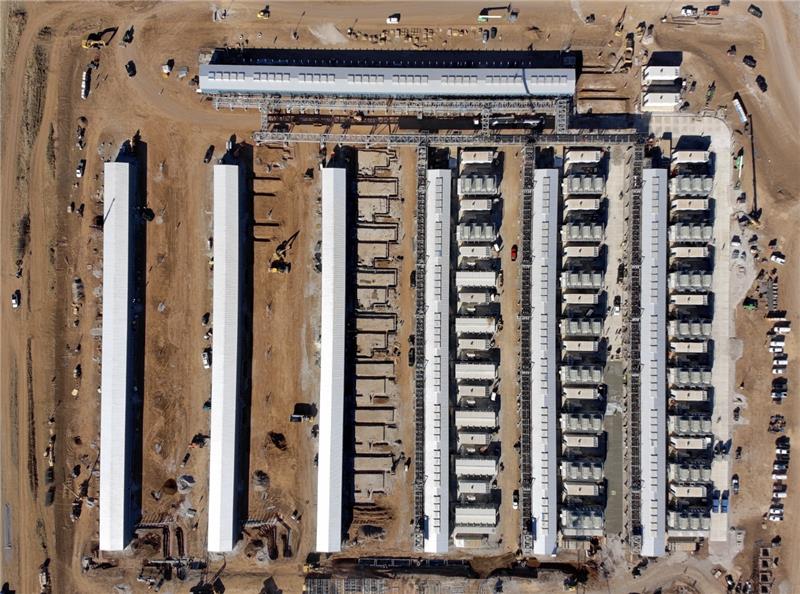
Construction is well advanced across Horizon 1 and 2 data halls and supercluster infrastructure, with internal electrical and mechanical works progressing to plan and generator and UPS load banking in progress. Horizons 3 and 4 are also on schedule, with civil works and grading well underway.
Execution is the differentiator.
Why a Life Focused Only on Gains Leaves Us Empty
We often tell ourselves:
“If I just make a profit, I’ll be happy.”
Of course, profits are good. Everyone enjoys them.
Watching the numbers in your account climb is exciting, and the moment that reward arrives is undeniably thrilling.
But one question still lingers:
“And then what?”
A profitable day feels wonderful, but if the road leading to that day was empty, the joy disappears far sooner than we expect. We end up treating all the time before the result as nothing more than a hostage to a future that has not yet come.
The Long Wait We Erase So Easily
Imagine investing in a company for three years and finally seeing a major gain.
Most people say, “Finally, the payoff has arrived.”
But in truth, out of those three years, the profit occurred on just one day. During the other 1,094 days, your account barely moved, the graph wavered, and the news simply rose and fell.
If profit is all we value, those 1,094 days become waiting, anxiety, impatience, comparison, and doubt. Time erased simply because the money had not entered yet.
When we treat living time as “unfinished time,” the emptiness lasts far longer than we expect.
How a Profit-Centered Lens Devours Our Days
Think about it.
You open your eyes in the morning, and your stock has not risen yet. The day begins with the quiet thought, “I have not achieved anything today.”
At lunch, you check the price and nothing has changed. “Nothing special today either.”
You work hard, return home, and the market remains indifferent. “Another meaningless day.”
Days accumulate. A month passes. A year passes. Then one day the stock jumps and you say, “Now I can finally breathe.”
But the moment you say that, you have already labeled the hundreds of days before it as meaningless, days spent waiting instead of living. Discarding most of one’s life this way is perhaps the greatest emptiness of all.
Those Who Love the Process Live a Completely Different Life
For someone who finds joy in the process, life looks entirely different.
A single sentence in a filing feels like a discovery. Seeing the company’s product selling well brings pride. Understanding today what confused you yesterday fills the day with meaning.
They lived the same 1,094 days, but each day is recorded like this:
“I learned something today.”
“I understand the business a little better.”
“My thesis still holds.”
“I became a better investor today.”
Even before the result arrives, every day has already gained value. This is why the day profits come feels like nothing more than a bonus. The days before it were already alive.
If You Do Not Feel This Joy Yet, Nothing Is Wrong With You
It is not a lack of talent. It is not weak analytical ability.
You simply have not found your reason yet.
The joy of long-term investing is not something others give you. It awakens only when you ask, “Why am I studying this company? Why am I walking this path?”
Once motivation appears, the scenery changes. And once the scenery changes, the meaning of each day changes as well.
The Core Truth
A life focused solely on profit inevitably turns most of our time into incomplete time, time we deem not yet meaningful.
But those who find joy in the process live complete days, even without any result.
Long-term investing is easier not because the gains are large but because the process itself fills each day.
Those who judge a day by profit live in constant insufficiency. Those who find meaning in the process are already fulfilled, profit or not.
In the end, long-term investing is not a technique for making money. It is a choice between emptiness and fullness, a decision about what kind of day and what kind of life you choose to live.