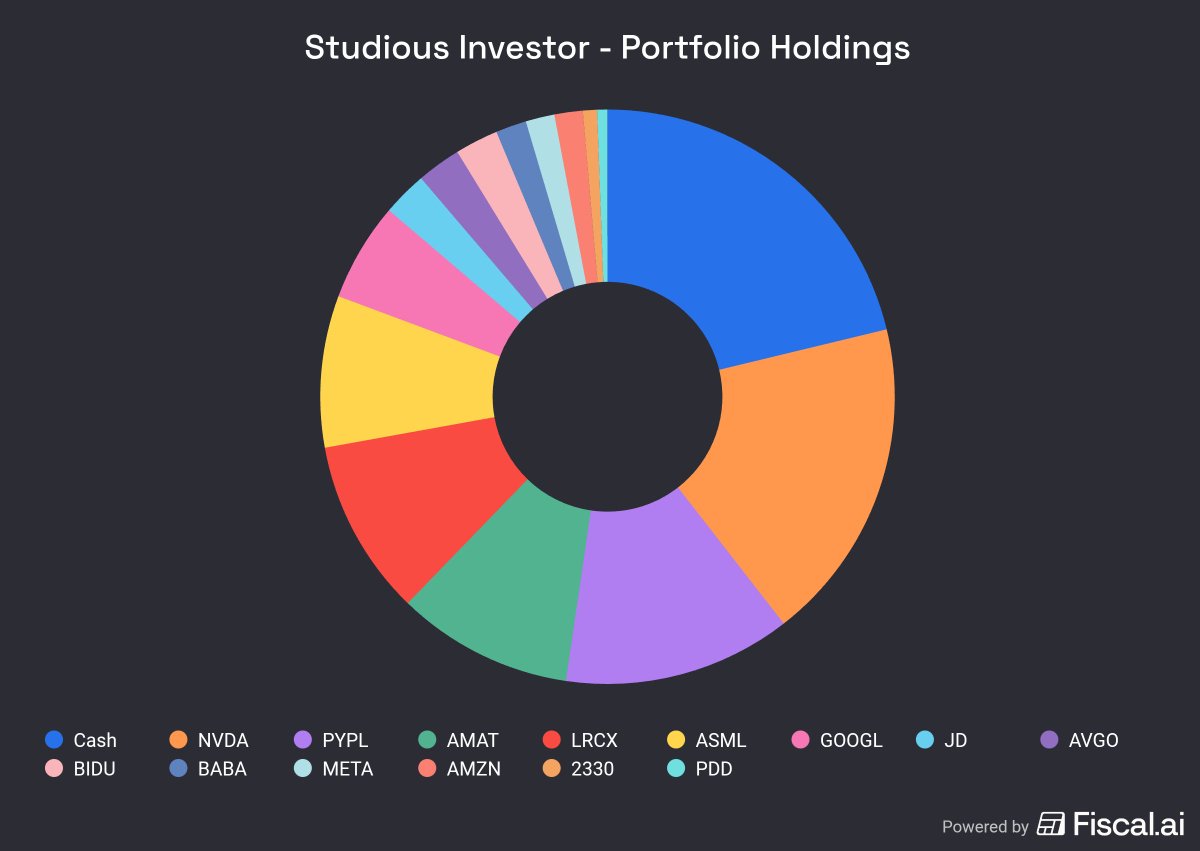
@TheGeordiePig Yes, I’m holding my shares. My only regret is not having a larger cash position to keep adding. The lesson I’ve learned is to always enter a new position gradually through a DCA approach, rather than making a large one-time purchase.
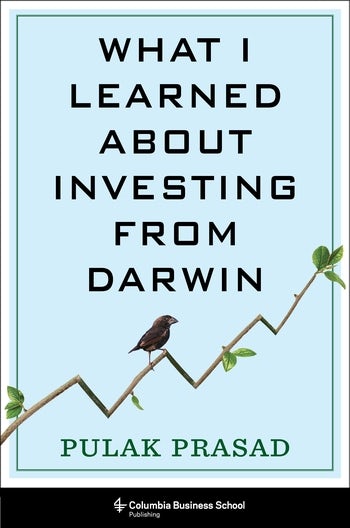
One of the books that taught me the most and shaped my investment philosophy is What I Learned About Investing from Darwin by Pulak Prasad.
The book devotes an entire chapter to the optimal behavior an investor should adopt in order to achieve long term success.
It describes inactivity over extended periods of time as a key tool. For this very reason, Paul Samuelson’s quote is so accurate:
“Investing should be more like watching paint dry or watching grass grow. If you want excitement, take your money and go to Las Vegas.”
Inactivity has an underlying prerequisite: extreme patience.
However, it must also be accompanied by a constant state of alertness in order to capitalize on exceptional opportunities.
Ultimately, the chapter emphasizes buying only when fear, crisis, or extreme uncertainty dominate capital markets.
Nalanda Capital, the fund managed by Pulak Prasad, deployed most of its capital during the 2008 Global Financial Crisis, the 2020 COVID-19 crisis, and the 2022 market crash. Since then, it has largely remained inactive.
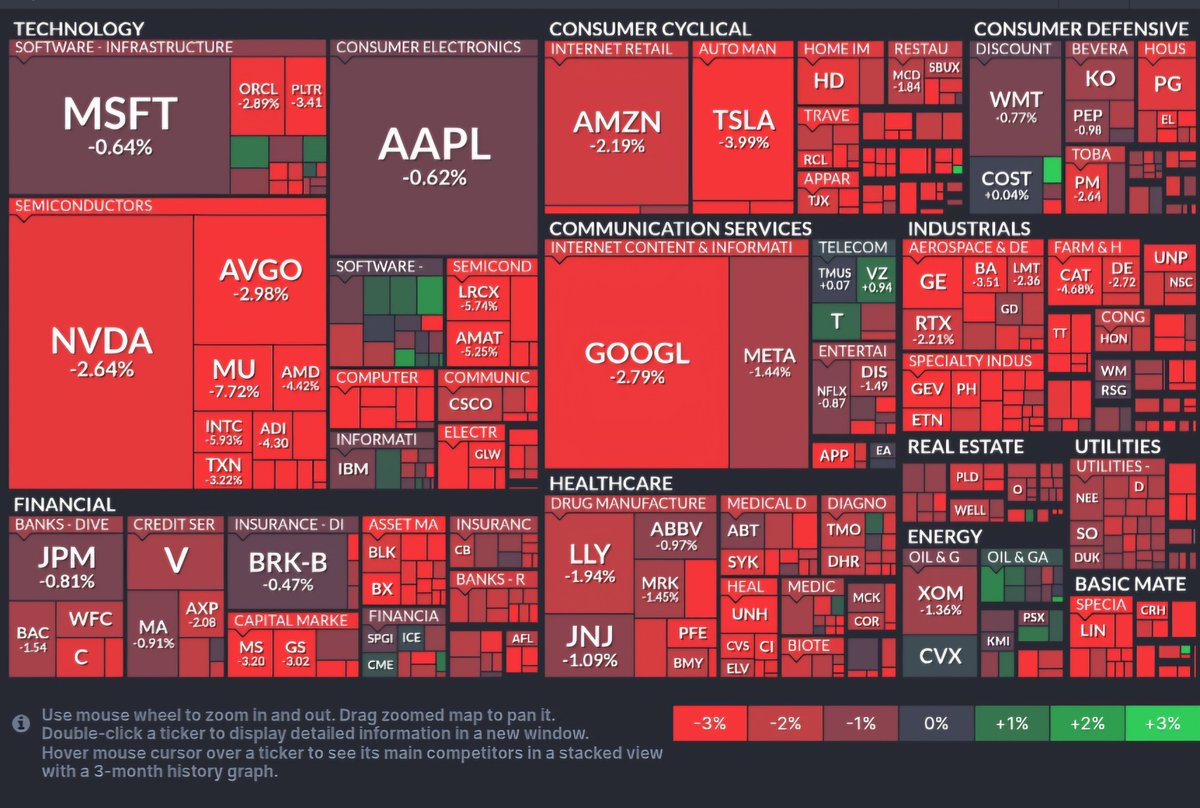
Days like today should be viewed within a broader context. While they may present attractive opportunities in the short term, they may not necessarily be compelling from a long term perspective.
$PYPL
The stock price already seems to discount a scenario in which all of its operating results turn out poorly.
Therefore, it is at a point where virtually any news about the company would be perceived as positive and could drive the share price up +5%.
Honestly, I believe we are at or near the bottom, and the margin of safety is substantial.
🧠 In markets, you often look wrong before you’re proven right.
"You have to be willing to look stupid to make money in stocks. If you buy a stock that’s down 50% and it keeps going down, people will say you’re crazy. But if the fundamentals are still sound and the price is now absurdly low relative to its earning power, you have a huge margin of safety. That’s exactly when the best opportunities appear, when almost everyone else is running away."
- Peter Lynch 💬
This particularly reminds me of something… any guesses?
🧠 Looking at the relationship between P/E & PEG is only the tip of the iceberg.
- 📊 Analyze the company’s beat rate across at least 8 of the most recent quarterly earnings reports.
If the beat rate exceeds 80%, this would suggest that the effective PEG ratio should be lower than the consensus estimate.
Conversely, if the beat rate is below 50%, this would suggest that the effective PEG ratio should be higher than the estimated one.
- 🔮 The higher the growth rate, the greater the forecasting uncertainty embedded in forward projections.
- 📈 At the same time, the higher the growth rate, the faster intrinsic value compounds for shareholders.
- 📉 Pay special attention to the spread between ROIC and WACC.
If the spread turns negative, incremental growth destroys shareholder value.
In such cases, growth operates in the opposite direction, eroding rather than creating value.
- 📚 More broadly, the P/E multiple often functions as a proxy for business quality.
When the fundamental analysis across all financial statements (income statement, balance sheet, and cash flow) is robust, the P/E multiple tends to remain structurally elevated.
Always look at PEG, when you analyse PE.
PE in isolation conveys nothing. A 10 PE can be expensive if PEG is 3. A 40 PE can be cheap if PEG is 0.75.
The crux is PE multiples should always be seen along with potential earnings growth.
🧵 The single most important factor in investing is PRICE.
- Not capital efficiency
- Not growth projections
- Not company quality
- Not a wide moat
🧠 Price is what ultimately determines RISK and long-term RETURNS.
"No asset is worth paying any price for, no matter how good it is. Even the finest business becomes a poor investment at an excessive price. The higher the price, the more flawless the future must be to deliver returns.
Overpaying embeds high expectations; any shortfall produces disappointment. The prudent investor always asks: is the price low enough to provide protection? If not, he passes - no exceptions."
- Howard Marks
Another great one to add to the list:
"The great lesson of investing is that the future is uncertain, and therefore the entry price is everything. You can be right about the business, you can be right about the management, you can be right about the industry, and if you pay too much you’re going to have a bad result.
We’ve seen it a million times. People fall in love with a business, they fall in love with a story, they fall in love with growth rates, and they pay any price. And then when the growth slows a little bit, or something doesn’t go exactly right, the stock falls 70%."
- Charlie Munger
🚨 If you think $PYPL is a bad investment because of the price drop after the latest earnings report, let me tell you I think exactly the opposite.
🧠 It was attractive at $60, and now in the $40 range it is even more so, with a larger margin of safety.