The most striking takeaway from Solana Breakpoint was that 90% of all presentations were products as opposed to the endless infrastructure echo chamber that’s typical on the conference circuit.
At this point, the Solana bull case isn’t about the tech — it’s all about the apps.
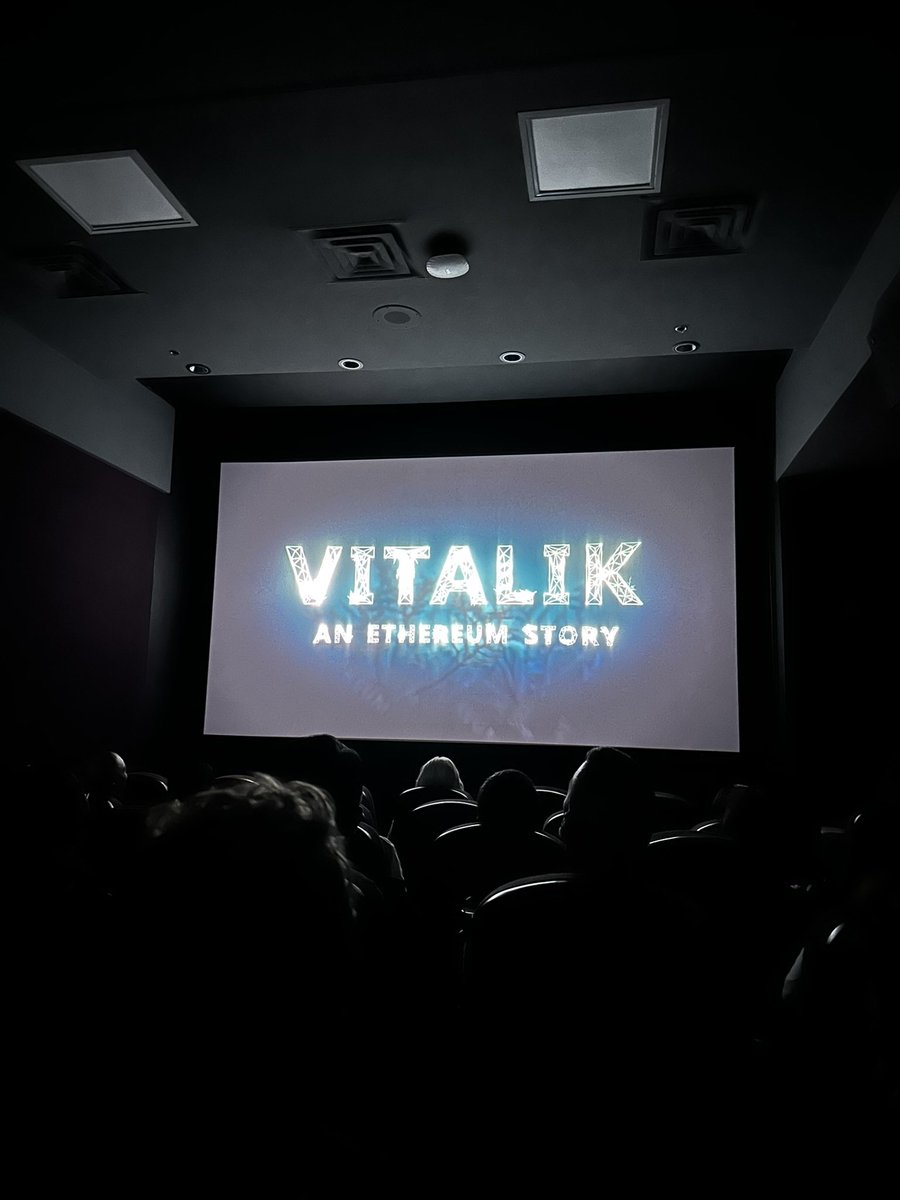
Really enjoyed watching "Vitalik: An Ethereum story" documentary by @EthereumFilm with a bunch of other Buterins here in Toronto.
Big kudos to the creators for capturing Vitaliks personality and sincerety - as well as the spirit of the Ethereum vibrant international community.
Lots of ground covered:
- Vitaliks encyclopedia of bunnies
- the origins of the Ethereum idea
- vision and hopes for Ethereum and our society
- his support of Ukraine against Russian invasion
- Ethereums transition to Proof of Stake that cut down it's energy usage by 99.95%
- Crypto usage by Argentinians to combat inflation
- The rise of NFTs and speculative bubble
- Beautiful visual depiction of Ethereum network and concepts
- Lots of awesome Ethereum people captured on the screen
(reposting since i accidentally tagged a scam in the original post. What a beautiful reminder of all the noise and weeds around us here in crypto)
Wall Street traders have a unique challenge in placing bets on the stock market now that the Fed has started cutting interest rates: History is no longer a guide https://t.co/A3jHMtu8Sk
Crypto asset manager Grayscale Investments said it has begun to offer the Grayscale XRP Trust, helping to send the price of the seventh-largest digital asset up by almost 10% https://t.co/RAoODraLRK
Imagine bitcoin doing another 100x from here. Bitcoiners could renew and revitalize institutions everywhere. This is a multi-generational opportunity. If we get our values right, we can really change the world for the better.
💼 Proof of Work: How We Show Up for Founders
As a crypto VC for 10+ years, we’ve been lucky to work with 200+ of the best & brightest founders in the world at @PanteraCapital.
But how do we earn our opportunity for the next 10 years?
A simple answer: Show Your Work.
Remember this past June, when a call-driven gamma squeeze in GME was extinguished by the company suddenly issuing 75 million additional shares of stock, causing a complete halt to the upward squeeze?
Right. There is no way to ‘issue additional shares’ of #Bitcoin. There will be no halting gamma squeezes. Buckle in for Bitcoin options.
1/ 🚅 Introducing @bulletxyz: the first real-time, ultra-low latency layer 2 on @Solana. Built for speed, with @zetamarkets (Zeta X) as the DeFi super-app live on day 1. Testnet lands in Q4! 🧵
The long-term quarterly chart suggests that oil may be establishing a historical support level after breaking through a major resistance in 2021.
This development is significant and could set the stage for oil prices to find a bottom, despite concerns about elections.
Moreover, investors are currently holding one of the lowest long positions in WTI contracts in the past decade.
This suggests that positioning is skewed, potentially paving the way for a notable reversal in the recent decline in energy prices.
Finally, the Fed’s recent decision to further ease monetary conditions, despite financial conditions already being at two-year lows, could intensify inflationary pressures in my view.
As a reminder:
It’s worth noting that oil prices and the breakeven rate are closely aligned, which is logical given that energy prices significantly influence inflation expectations over time.
Disclosure:
Crescat may or may not hold positions at any given time in the securities herein. This is not a recommendation or endorsement to buy or sell any security or other financial instrument. West Texas Intermediate (WTI - Cushing) represents a crude stream produced in Texas and southern Oklahoma which serves as a reference or "marker" for pricing a number of other crude streams and which is traded in the domestic spot market at Cushing, Oklahoma.
The S&P 500 has added nearly $1 TRILLION of market cap today after the Fed cut rates by 50 basis points.
Since the September 6th low, the index has now added over $3 TRILLION of market cap.
Here's how we bought BEFORE the move and predicted it in our analysis.
(a thread)
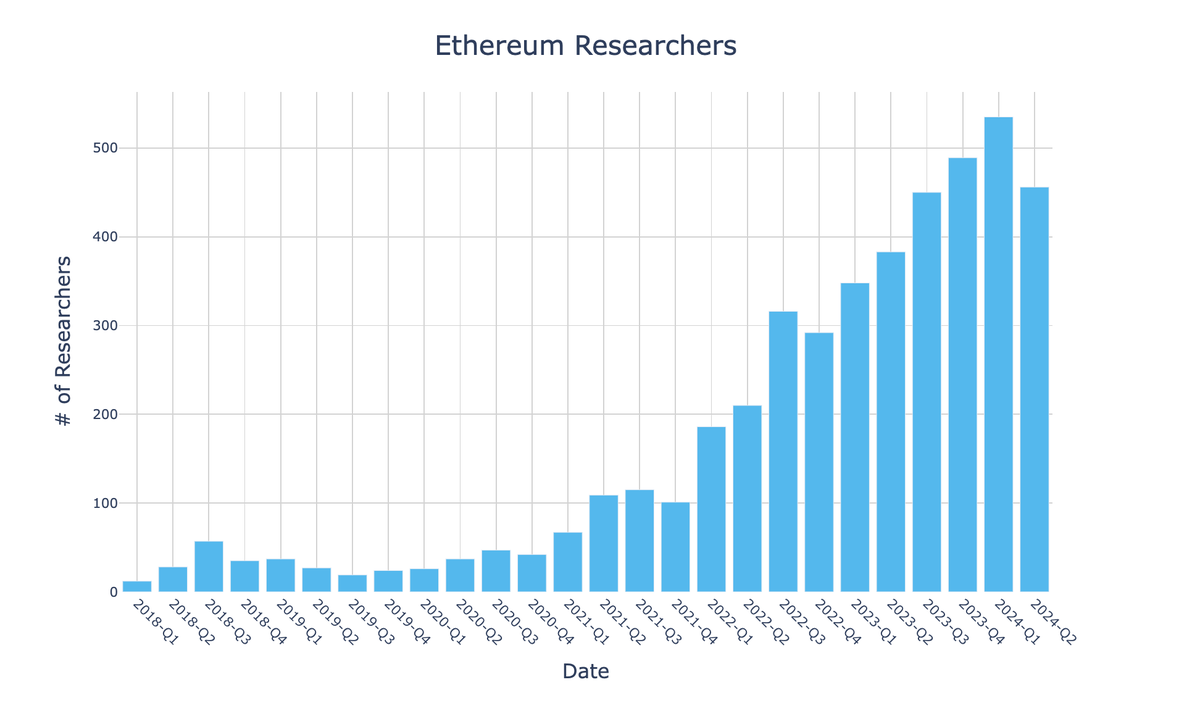
The real Ethereum bull run isn't price - it's brainpower. 1500% growth in researchers since 2019.
Hard to bet against the collective brainpower of this ecosystem.
The important point is that Bitcoin’s narrative is tied to the broader concept of a “store of value,” with gold simply serving as a familiar example
BTC represents ownership over verifiable digital scarcity, making it a strong contender as a valuable & limited asset
The issue with ETH is that the world has simply never seen anything like it before.
When something doesn’t fit someone’s narrative or frameworks, their brains tend to short circuit.
This is why we see such desperation in trying to label ETH as “digital oil” or “tech equity” or “programmable money.”
Ppl need frameworks they’ve been conditioned into accepting. “If it’s really money why does the price go up and down!?” Is a common gotcha.
Any junior analyst can track the 30day fees generated by ethereum and slap together an extrapolated thesis based on a p/e benchmarks that they find palatable. And indeed, we’ve seen many of these folks pop up over the past year.
That’s why they feel so secure with their Btc narratives, it fits so well within the models they’ve adjusted to. “Digital Gold” is so easy to lazily reason about that ppl just accept it. They look at the all-time gold chart and want Bitcoin to follow the same path.
Key thing there is to “follow” because Bitcoin doesn’t own its own narrative, it’s a narrative that is tethered to gold being valuable in the first place.
Trying to assign value to Eth is much more difficult, you can’t just mindlessly point to the chart of silver and Oil in expectation of future value because those assets are not out performers on long time frames, and thus not attractive for modelling.
Seeing the value in ETH requires a certain social awareness, a sense of understanding in the underlying mission of this industry, an appreciation for network effects, a heathy scepticism towards fiat money, a belief in internet native societies that can compete at the highest levels of innovation.
Seeing the value in ETH requires the vision to see the endless possibilities that can be achieved without the frictions of being subject to intermediaries and regulatory monopolies.
Seeing the value prop of ETH requires the ability to envision patterns and trends that have not yet formed. It requires an intuition for the abstract.
Seeing the value prop of ETH is in seeing a world where a sovereign economy exists on the internet unbounded by the constraints and norms of (politically captured) legacy systems.
Seeing the value in ETH, is simply seeing the value of humanity when you give ppl maximum expressive freedom.
The value of ETH cannot be defined in a single line.
In the short term, that may be troubling for analysts in search of an elevator pitch, but in the long term, the benefit is that ETH will define its own narrative, one that did not exist before it.
Eth owns its own narrative. Do not look to historical references in search of a premonition of its price action. Look to the future, beyond what you think is possible.
For the destiny of Ethereum is a road not yet travelled.
Long live Ethereum ✌️
Too many startups/investors are exploring the b2b opportunities with LLMs and not enough are exploring the consumer opportunities. This is the moment consumer founders have been waiting for.
AI apps are set to be the next big revolution after mobile and social media, and the infrastructure is already in place for crypto to make a significant impact in this space
It's very interesting to see the first major players in this market
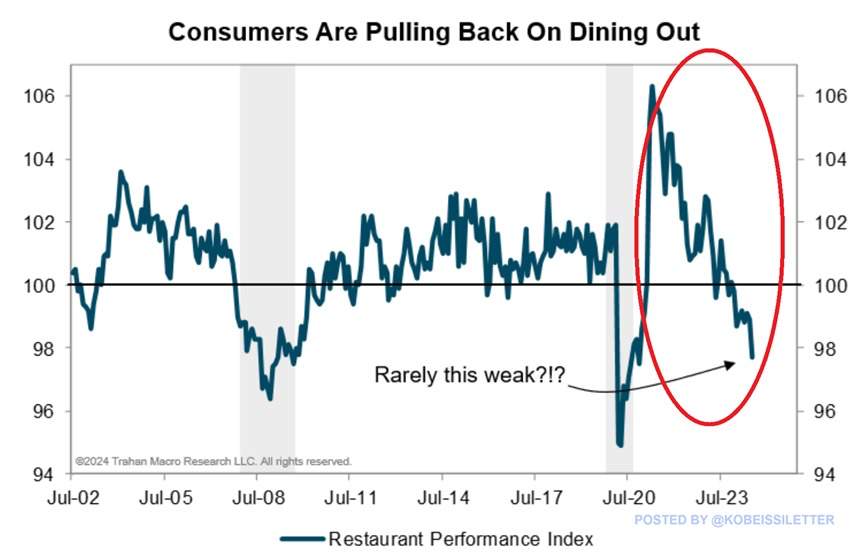
BREAKING: The Restaurant Performance Index (RPI) fell -1.3% in July to 97.7 points, the lowest level since the 2020 lockdowns.
This index tracks the health of the restaurant industry in the US by measuring sales, customer traffic, labor, and overall business conditions.
Since 2021, this metric has fallen by ~8.0%, marking the largest drop since it was launched in 2002.
Such a low level in the index has only been seen during recessions.
Americans are pulling back on dining out as prices have been sharply rising and recently hit new all-time highs.
Since 2020, food prices away from home have increased by 27.0%, and fast food prices have jumped by 31.0%.
Eating out is officially a luxury.
Overall, it seems like biotech innovation has really picked up speed in the last 5 years, but I wish there were more high-risk, high-reward opportunities
GLP1s have added $1T in market cap to Eli and Novo over the last 5 years. That's 3x+ the market cap created by all biopharma startups over the last 30 years combined. This is a bit of an indicment of the biotech startup ecosystem. There are many $1T and even $10T drugs to be invented, we just don't fund them. Through no one persons fault, the biotech industry is stuck in a local performance maxima. Faced with lower multiples than tech, biotech funds have to pitch something other than straight multiple to LPs and the only other level is faster liquidity. Biotech has been good at this, with the average age of biotech companies at IPO being 2 years younger than tech companies at IPO (~5.5 years vs 7.5 years). This means biotech funds need to back companies that can get to IPO within a few years. This requirement constrains the types of companies funded by bio funds to 'linear bet' plays (where you buy at some reasonable multiple based on current performance, etc). As any experienced venture fund manager will tell you, a portfolio of linear bets underperforms a portfolio of asymmetric bets. Double unfortunately, no one firm can break this model because no one firm is the sole backer of a company to profitability. You must rely on an ecosystem of capital partners. So if you are the one firm that strikes out and funds asymmetric companies, no one will show up to fund the company downstream and your whole portfolio will fail. For this reason, I think the biggest plays in bio over the coming decade will be mostly backed by generalist funds rather than bio funds.
*Note this will perpetuate the trend of sector specific funds underperforming generalist funds (by industry and geo!).
Even though the 10-year rate is higher than the 2-year today, the yield curve looks pretty similar to last year but has shifted down due to increased Treasury demand from recession fears, outpacing the effects of more issuance and the Fed’s ongoing quantitative tightening
The US Treasury yield curve has officially turned positive, but what does it mean for the job market?
The yield curve just turned positive after 565 consecutive sessions of inversion, ending the longest streak in history.
Over the last 45 years, each time the yield curve un-inverted, the number of jobs within the economy materially dropped within the next 12 months, except for in 1998.
In 2000, the 3-month average job decline reached a whopping ~280,000 within a year of the yield curve turned positive.
In 2007, job declines hit ~190,000 in 12 months after the yield curve turned positive.
If history is any guide, we expect more labor market weakness.
Good point that modularity has definitely become a buzzword lately, but the real focus should be on maximizing efficiency. While this modular trend might catch some investor attention, it could also be complicating the development process more than necessary
Folks - I'm all for modularity when it technically makes sense, but we have turned it into a "narrative-hungry" obsession to say something is "modular."
Allowing developers to choose their storage, compute, and security parameters rarely makes sense. It usually only applies to larger projects that have found product-market fit and are looking to reduce gas fees, capture parts of it, or offer better experiences. They can afford it.
Outside of that, sticking with "choose your own infra" is nonsense. For v0 of their products, I don't see dApp developers asking for these choices. They don't care - they need things to run, be cheap, and compose. But they're confused - they spend countless hours learning before they can write a single line of code. We're doing them a disservice by offering too many choices.
Finally, it will be impossible to capture a single new developer from outside of the existing group if the first thing they have to do is navigate thousands of chains, hundreds of layers, and dozens of components to choose from while still trying to understand the core value proposition of the space. We still have fewer than 10k full-time developers in the space. Unless we learn how to grow the pie with simple value propositions, we'll be stuck.
Stop the narrative-seeking games. Build for the true value.