From today's '24 Hrs in Crypto:'
With gold continuing to reach new all-time highs, in this AM’s note we review the precious metal’s performance from the perspective of ardent, long-term holders of BTC
Subscribe & read the full note: https://t.co/3YiFK8tljT
Gold’s rally signals the conditions that many BTC proponents envisioned when first purchasing the asset: Bitcoin’s 2009 genesis block, mined by the asset’s pseudonymous creator Satoshi Nakamoto, featured the message, ‘The Times 03/Jan/2009 Chancellor on brink of second bailout for banks.’ The message served as an allusion to the economic turmoil of the era and the alternative monetary system the asset was designed to represent. In this regard, the broad anxiety related to global macro dynamics dynamics that is driving demand for gold, from the perspective of long-time BTC proponents, is also conducive to the asset’s adoption.
Gold’s rally increases BTC’s addressable market: BTC proponents have often pointed to BTC’s relatively small market cap to other macro assets to underscore its earliness and upside. The expansion of gold signals growing demand for neutral, global, assets that offer insulation from worrying macro dynamics. BTC proponents are confident that the asset’s qualities that allow it to serve as a safe haven asset will receive increased attention under these circumstances. BTC proponents will also be quick to highlight the asset’s advantages over gold. For instance, in June 2025 we wrote that an FT headline, ‘Germany and Italy pressed to bring $245bn of gold home from US,’ underscores a key advantage of BTC over gold: BTC custody is infinitely scalable and offers key advantages over physical bullion. We wrote that, ‘[u]nlike physical gold, BTC custody is infinitely scalable. What this means in practice is that custodying one BTC is not more difficult compared to custodying 100,000 BTC.’
Gold’s growing role in the crypto space: In a broad interview with Bloomberg with Tether CEO Paolo Ardoino, the news outlet placed the firm’s gold holding at 140 tons, worth USD ~25B. Considering that a portion of this gold backs Tether tokenized gold product XAUt, the remaining USD ~22.4B represents 12% of USDt’s market cap. As of Tether’s Q3 2025 attestation report, 7.41% of USDt’s market cap market cap was backed by gold. According to Bloomberg, Tether is now ‘the world’s largest known hoard of bullion outside of banks and nation states.’ Besides gold’s growing backing of the largest stablecoin, Ardoino told Bloomberg that he believes countries currently ‘buying a lot of gold…will soon launch tokenized version of gold as a competitive currency to the US dollar.’ As we pointed out yesterday, this is already taking place: In December, Bhutan and Kyrgyzstan launched tokenized gold products. Crypto proponents believe that tokenized gold can endow the precious metals with new capacities, such as peer-to-peer transferability or access to crypto native financial services. For example, holders from emerging markets where financial services may be deficient will be able to borrow against tokenized gold in a manner not possible with physical precious metal. Ardoino told Bloomberg he foresees there is a ‘good chance’ that XAUt can end 2026 with a market cap from USD 5B to 10B; XAUt’s current market cap is USD 2.6B.
In the US, Google searches for ‘gold price’ surpassed those for ‘bitcoin price’ in April 2025 for the first time since June 2020.
From this AM's '24 Hrs in Crypto:'
BTC traded to as low as USD ~86,000 last night while gold reached a new record high - We review select dynamics & market narratives in this AM’s note
Read more & subscribe to the full note:
Gold in the crypto space: The combined market cap of the two leading tokenized gold products, Tether’s XAUt and Paxos’ PAXG, currently stands at USD 4.28B. These two tokens are the largest examples of tokenized gold though we’ve previously characterized their market caps as relatively small for crypto standards. Despite the small size of the market, according to FT reporting from November, Tether’s ramped up acquisition of gold in 2025 has been partly motivated by the stablecoin issuer ‘betting on tokenised physical gold finally catching on.’ With 116 tonnes of gold as of November 2025, Tether is now the largest holder of the precious metal outside of central banks. In 2025, gold also emerged as a more pronounced portion of the reserves backing the USD 186B USDt stablecoin. According to Tether’s Q3 2025 attestation, Tether’s gold and BTC represented 7.13% and 5.44% of USDt’s reserves, respectively. The Q3 2024 attestation report indicated that gold and BTC represented 3.95% and 3.81% of the stablecoin’s reserves.
BTC and gold are ‘assets of fear:’ Speaking at the Global Financial Leaders’ Investment Summit in Hong Kong in November, BlackRock (NYSE: BLK) CEO Larry Fink described gold and BTC as ‘assets of fear.’ According to Fink, ‘you own these instruments if you are frightened of the debasement of your currency, you own it if you have financial insecurity…’ While for long-time BTC adopters the asset’s safe haven qualities have been evident since its earliest days, this view is now receiving mainstream attention. In this context, for many ardent BTC proponents, the ongoing global backdrop is likely close to what they imagined when first purchasing the asset. Against these conditions, that many see as highly conducive for BTC adoption, some market participants have been disappointed by the performance of crypto over the past year.
BTC’s ‘delayed reaction’ in 2020: In March 2020, the Fed’s emergency rate cut, induced by the COVID-19 crisis, came following the crypto space’s sell-off, along with broader risk assets. That sell-off saw BTC fall from USD ~8,000 to USD ~4,000. Following the emergency cut, despite the extreme crypto sell-off, we pointed out that ‘the Western environment is quickly becoming one that crypto was designed to serve.’ We also wrote, ‘[i]f Bitcoin was born of any concern, it was an abuse of Central Bank balance sheets and financial censorship from governments.’ However, following those emergency rate cuts, ultimately, it took BTC ~10 months to break out above its 2017 record high of USD ~20,000. BTC’s ‘delayed reaction’ to macro dynamics in 2020 is an important context for those disappointed by the asset’s performance over the past year.
The chances of a US Government shutdown have increased to 82% on Polygon-based prediction market Polymarket.
From this morning's '24 Hrs in Crypto:'
Subpoenas served to the US Fed will serve as an opportunity for BTC proponents to highlight the asset’s a prior set & immutable monetary characteristics - We discuss the development as it relates to BTC in this AM’s note
Read and subscribe to the full note: https://t.co/YN2zZ09ToO
In March 2024, as BTC neared its 2021 record high, FRNT CEO Stephane Ouellette told Bloomberg columnist John Authers that ‘there’s generally a distrust for establishment organizations and a slow realization that Bitcoin provides some insulation to these forces.’ FRNT’s CEO gave the examples of regional banking troubles in 2023 and an ‘extreme amount of currency crises globally.’ Fast forward to 2026, and this dynamic of uncertainty, economic anxiety, and geopolitical turmoil has continued.
For early BTC proponents, the asset’s ability to offer insulation from both local and global challenges has been evident from the asset’s inception. Bitcoin’s 2009 genesis block, mined by the asset’s pseudonymous creator Satoshi Nakamoto, featured the message, ‘The Times 03/Jan/2009 Chancellor on brink of second bailout for banks.’ In this regard, for BTC proponents, many of the global dynamics taking place today represent the dynamics they likely envisioned when first acquiring the asset.
Unlike BTC’s earlier history, when it was viewed with scepticism by many traditional market practitioners, in 2026 the asset core thesis as a safe haven asset is no longer outside of mainstream discourse. For example, speaking at the Global Financial Leaders’ Investment Summit in Hong Kong in November, hosted by the city’s Monetary Authority, BlackRock (NYSE: BLK) CEO Larry Fink described gold and BTC as ‘assets of fear.’ According to Fink, ‘you own these instruments if you are frightened of the debasement of your currency, you own it if you have financial insecurity…’
Takeaway: For BTC’s cult-like followers, this rift will likely harden their commitment to ‘HODLing.’ This investment strategy, characterized by strong confidence in BTC’s uptake as a global safe haven asset and its long-term appreciation, is reflected in the fact that 42.63% of BTC’s supply remains un-moved for three or more years, according to data from Glassnode. This metric has seen a relatively small decline from its all-time high of 46.77% in May 2024, despite the asset’s appreciation of ~82% between then and October’s record high. In this regard, BTC proponents remain committed to HODLing and confident in the asset’s long-term outlook. At the same time, the ability of new investors to access the asset has been significantly built-out over the past several years but also continues to expand. In parallel, BTC’s qualities as a ‘safe haven’ asset are increasingly being pitched to a wider audience than ever before in the asset’s history.
From today's '24 Hrs in Crypto:'
Morgan Stanley (NYSE: MS) revealed plans to launch a crypto wallet in the second half of the year, among a slate of other crypto-focused efforts being developed
Subscribe and read the full note: https://t.co/gNSCFdK5od
According to Jed Finn, head of Morgan Stanley Wealth Management, the bank has significant plans for digital assets, its workplace business, and private-market investing. These plans include the launch of a crypto wallet in the second half of the year. This wallet would support a variety of tokenized assets, ‘including private companies’ equity.’ Via a partnership revealed with Zerohash, Morgan Stanley also plans to provide trading in BTC, ETH and SOL via the bank’s E*Trade platform, which according to Finn, will go live in the first half of 2026. This initiative was initially revealed last year in September. This week, Morgan Stanley also filed to launch BTC, SOL and ETH ETFs. According to Barron’s, ‘[t]he company envisions its in-house offering as a platform for eventually handling transactions involving not just coins, but all manner of tokenized assets.’
According to Finn, these plans fit ‘together in a broader strategy of adapting to the change in the industry and in some cases driving the change in the industry.’ Finn told Barron’s that, ‘[o]ver time as our infrastructure develops, we’ll be able to do more with the blending of the traditional finance, or tradfi, and decentralized finance, or defi, ecosystems.’ Barron’s writes, ‘[t]hat could mean borrowing against crypto holdings to buy equities, or vice versa, for example, or making loans against crypto from cold storage…’
The vision shared by Finn closely resembles that described by BlackRock (NYSE: BLK) CEO Larry Fink in October. Fink described envisioning ‘a future where investors never need to leave a digital wallet to allocate efficiently across crypto, stablecoin and exposures to long-term stocks and bonds.’ In an earnings call, Fink discussed ‘commercial opportunities in using tokenization to further bridge the gap between traditional capital markets and the growing digital asset space.’
According to tokenization data platform https://t.co/k3yNE0R1OX, the value of real-world tokenized assets, excluding stablecoins, began 2025 with a value of USD 5.93B. The value currently stands at USD 19.29B, representing a 225% increase.
Takeaway: The institutional embrace of BTC and the broader digital asset space has been a well-covered theme in this note. However, Morgan Stanley’s crypto ambitions underscore that Fink’s vision of blurring the previously well-defined divide between traditional markets and crypto is not in isolation. Furthermore, it should be noted that Morgan Stanley’s decision to launch crypto ETFs comes two years following the launch of spot BTC ETF that have to date accumulated 7% of the asset’s supply. The planned ETFs highlights the view Morgan Stanley expects demand for crypto via ETFs to continue into the future.
From today's '24 Hrs in Crypto:'
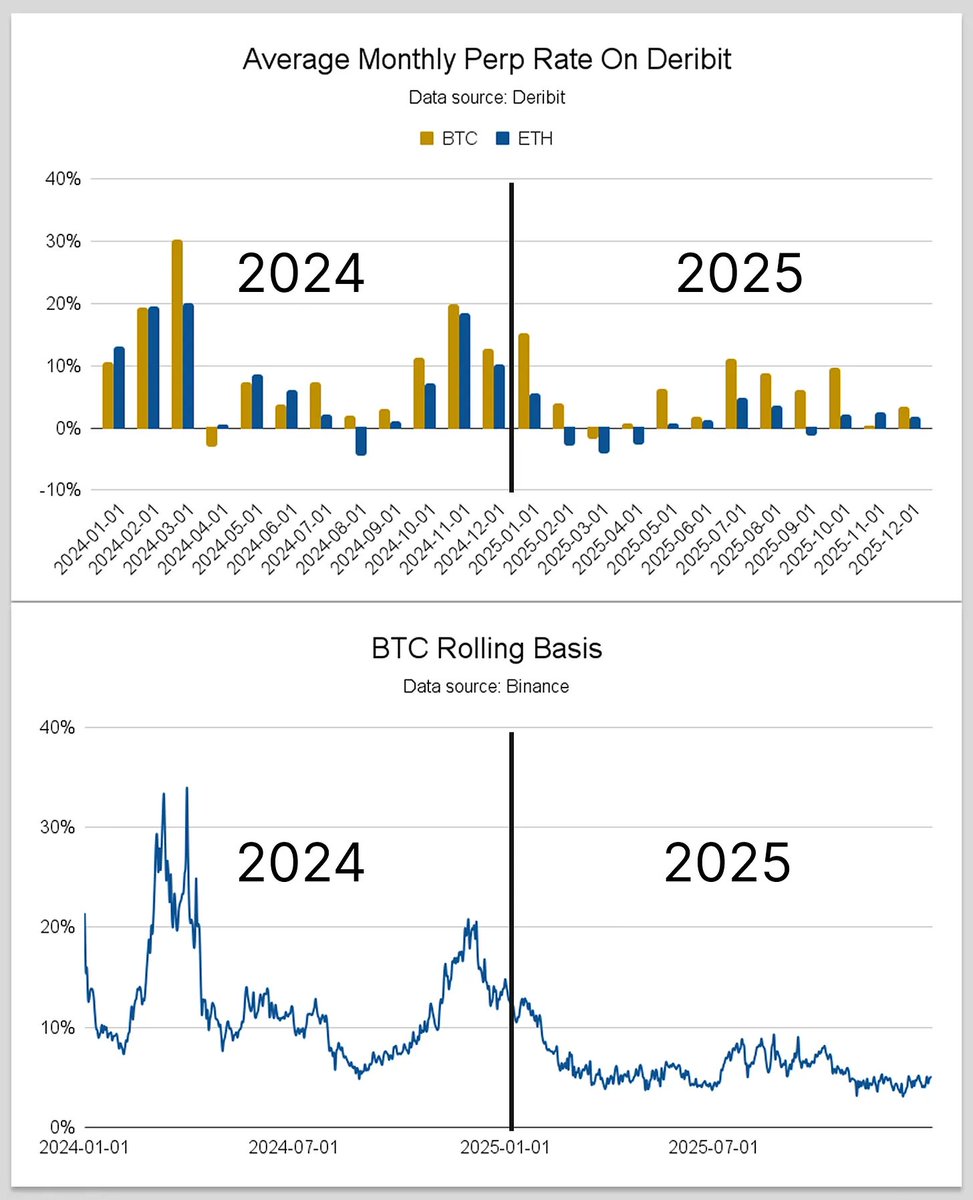
In this AM’s note we compare leverage & risk appetite in the crypto space between 2024 & 2025
Subscribe & read the full note: https://t.co/B92TUIi00z
Core leverage metrics indicate benign dynamics in 2025 compared to 2024: During the two years, the highest average daily BTC perp rate on Deribit was 71.73%, recorded in March 2024. This level was achieved on the back of strong US BTC ETF inflows, which had surprised many market commentators in their magnitude, and the asset breaking above its 2021 record high. BTC perp rates spiked again at the end of 2024, reaching 68.20% in December when BTC broke the psychologically significant price of USD 100,000 on the back of President Trump’s election win. Overall, BTC perp rates on Deribit averaged 10.24% in 2024, compared to 5.38% in 2025. Last year, the metric peaked early in the year, reaching 61.49% in January 2025. However, this January peak was more a spill-over from the year prior given that leverage dynamics in 2025 largely failed to materialize in the manner they did in 2024; outside of January, BTC perp rates on Deribit peaked in August, reaching 36.09%. Rolling BTC basis corroborates this view, with the metric reaching 33.94% in March 2024 and remaining below 10% for most of 2025. ETH perp rates on Deribit followed a relatively similar pattern, averaging 8.20% in 2024 and just 0.85% last year. It is also worth noting that perp rates in 2024 remained well below levels seen in 2021, when BTC and ETH rates on Deribit reached 190.25% and 184.88%, respectively.
Memecoins reached a record high market cap of 127.26B in December 2024: Memecoins emerged as the most retail-driven and speculative subsector of the crypto space in 2024. While estimates vary from source to source, https://t.co/lwQsbNN0MF shows the aggregate memecoin market cap reaching a record high in December 2024. Since then, the aggregate memecoin market cap has seen a decline of ~65%, reaching a current USD 44.19B. In December 2024, we described memecoins as ‘as an early candidate for this cycle’s ‘craze,’ similar to NFTs in 2021.’ However, memecoins in 2024 never reached the same magnitude of ‘craze’ as compared to NFTs. Google searches for ‘NFT’ in 2021 were magnitudes greater than recent all-time high searches for ‘memecoin’ or ‘memecoins.’ The fizzling out of memecoins in late 2024 corroborates the limited demand for retail-driven risk and excess in 2025.
Google searches for key crypto terms show mixed results when compared 2024 to 2025, but remain significantly below levels seen in 2021: Google search volumes for crypto key words are often cited as a proxy for retail interest in digital assets. In turn, retail trading is often associated with the demand for leverage. In 2024, global Google searches for ‘bitcoin’ reached a record high in November. In 2025, searches peaked in November as well, corresponding to BTC’s sell-off to USD ~80,000. Google searches for ‘crypto’ reached their highest level in 2024 and 2025 in August of last year. This spike corresponds to the SEC announcing ‘Project Crypto,’ a widespread regulatory effort to ‘enable America’s financial markets to move on-chain.’ While search volumes for ‘crypto’ and ‘bitcoin’ varied in timing in 2024 and 2025, both remained below levels seen in 2021. Google searches for BTC in November 2021, for instance, were 65% of levels seen in 2021.
Пре и после рестаурације породичног портрета мајке глумца Владимира Петровића, са легендарном улогом Бобе из Жикине династије 🎭
Владимир тренутно тумачи одраслог Бобу у новом филму Повратак Жикине династије, а ја сам имала част д�� вратим сјај овом предивном портрету његове маме.
From this AM's '24 Hrs in Crypto:'
$ETH is down ~8% year-over-year during a period in which the network & asset have enjoyed numerous tailwinds, including a significant reduction in regulatory overhang - We review select ETH narratives & market dynamics in this AM’s note
Subscribe and read the full note: https://t.co/0DpZ41zxlo
ETH is the undisputed leader in on-chain markets: At the moment, there is USD 124.16B worth of crypto (total value locked, TVL) deployed across multiple networks’ DeFi markets. Ethereum accounts for USD 72.22B worth of the total TVL, or 62%. The remaining TVL is fragmented across numerous other blockchain networks, such as Solana, which hosts just 7% or BNB Chain with 6%. Ethereum also hosts the majority of the USD 308B stablecoin market, with 54% of all blockchain-based dollars. Similarly to DeFi TVL, the remaining stablecoins are fragmented across numerous networks. TRON is a distant second, hosting 26% of stablecoins.
Less than two years ago Ethereum was being investigated by the SEC, now the network is aligned with US national interests: In March 2024 CoinDesk and Fortune revealed that the SEC was ‘waging an energetic legal campaign to classify Ethereum… as a security.’ Fast forward to 2025, the SEC under the Trump Administration has implemented a ‘Commission-wide initiative to modernize the securities rules and regulations to enable America’s financial markets to move on-chain.’ Moreover, the US Government has begun to see stablecoins as a new, crucial, source of demand for US debt. Given Ethereum’s outsized role as the dominant infrastructure hosting this debt, the network is now highly aligned with US economic interests. It’s difficult to overstate the regulatory turn-around that the entire Ethereum ecosystem has enjoyed in 2025.
The number of digital assets tracked by https://t.co/lwQsbNN0MF has grown 4x since Trump took office: The day following Trump’s inauguration in January the number of digital assets tracked by https://t.co/lwQsbNN0MF stood at just over 7M. This number has since ballooned to 28.16M. This trend has largely been driven by the aforementioned regulatory reprieve. High profile crypto projects have confirmed plans to launch tokens, such as MetaMask, one of the most popular crypto wallets. Coinbase’s (NASDAQ: COIN) Ethereum layer-2 Base may also receive a native token, according to Jesse Pollak, who leads the network’s development. The practical effect of this dynamic is the expansion of the universe of investable digital assets that offer exposure to many of the defining narratives of 2025, such as stablecoins, tokenization, etc.
The Ethereum Foundation plans to ‘roll out hard forks on an accelerated twice-a-year cadence:’ Last week the Ethereum network successfully underwent a hard fork upgrade, dubbed Fusaka. The upgrade aims to better facilitate interaction between Ethereum and its growing layer-2 ecosystem. The Ethereum foundation plans to implement two upgrades per year. While frequent upgrades help Ethereum achieve goals such as increasing throughput capacity, they introduce the risk of passing critical bugs into the network’s code. Ethereum’s growing complexity vis-a-vis its layer-2 ecosystem additionally heightens the risk of technical issues associated with upgrades.
Today's top headlines:
• President Donald Trump’s branded memecoin, down 87% since launch, will be used in a new mobile game as a revival effort by promoter Bill Zanker.
• The Bitwise 10 Crypto Index Fund (NYSE Arca: BITW) began trading yesterday, becoming the second US-listed multi-asset crypto index fund.
• KindlyMD (NASDAQ: NAKA) agreed to borrow USD 210M from Kraken to repay an Antalpha Digital loan originally used to repay a Two Prime Lending credit line
• Toronto-based Pineapple Financial (NYSEAMERICAN: PAPL) launched a mortgage tokenization platform, converting over 1,200 mortgage files worth approximately USD 412M on-chain using the Injective blockchain.
From this AM's '24 Hrs in Crypto:'
A Tuesday article from the FT describes @tether as a ‘gold whale’ due to the stablecoin issuer becoming ‘the largest holder of gold outside central banks’ - We provide key highlights from Tether’s strategy as it relates to the precious metal
Read the full note: https://t.co/IIq78Md1r7
Tether is ‘the largest holder of gold outside central banks’, Jefferies writes: According to Tether’s Q3 ‘Attestation Report,’ the company holds USD 12.9B worth of gold. FT points out that, according to Jeffries, with 116 tonnes of gold, Tether is now the largest holder of the precious metal outside of central banks. FT points out that ‘[m]ore important than the size of the hoard to the gold price is the pace of recent buying.’ Tether purchased 50 tonnes of gold, more than half of its total holdings, in Q2 and Q3 of 2025. According to Jeffries, Tether’s gold purchases are likely to have ‘tightened supply in the short-term and influenced sentiment, which in turn may have driven speculative flows.’ According to Jeffries, citing ‘conversations with investors,’ Tether intends to acquire 100 tonnes of gold in 2025.
‘Jefferies’ team thinks Tether is betting on tokenised physical gold finally catching on:’ To-date, Tether’s Ethereum-based tokenized gold product, XAUt, with a market cap of USD 1.56B, has seen limited traction for crypto standards. Data from Etherscan indicates the token’s supply increased from 375,572 in October to a current 522,089, with each token representing 1 oz of gold vaulted in Switzerland. The issuance of the tokens resulted in a record 9,400 XAUt transfers on the Ethereum blockchain, with blockchain data indicating 16,001 distinct addresses holding the token. Relative to its market cap, XAUt spot trading against USDt has seen reasonable volumes; XAUt’s most active spot market over the past 24 hours was Bybit, where XAUT/USDt saw a trading volume of 39.92M USDt. However, XAUt trading against USD is virtually non-existent (Kraken’s XAUT/USD pair saw a trading volume of USD 86,200 over the past 24 hours). The token’s uptake in DeFi is also scant; only 9.53M XAUt is deposited on DeFi lending platform Aave.
Tether has made several investments in gold companies: In September, the FT reported that Tether is considering investments in the gold supply chain, including refining and trading. That month, Tether increased its USD 105M stake in Elemental Altus (TSXV: ELE) by USD 100M, in conjunction with the latter firm’s merger with EMX Royalty Corporation (NYSEAMERICAN | TSXV: EMX). Juan Sartori, head of business initiatives at Tether, told the FT the investment was part of the group’s strategy to increase its ‘gold exposure.’
Gold & BTC represent 7.13% & 5.44% of USDt’s reserves, respectively: According to Tether’s latest attestation, USDt’s 174.44B market cap, as of September 30, was backed by 77.23% in ‘Cash & Cash Equivalents & Other Short-Term Deposits.’ Of these, 93.10% were held in US treasuries and overnight reverse repurchase agreements. The proportion of USDt reserves allocated to gold is 7.13%, which is separate from the bullion backing XAUt. Tether’s total assets, USD 181.22B, exceed total liabilities by USD 6.78B. Over the past year, the stablecoin’s market cap has expanded by USD ~51B to a current record high of USD 184B.
Today's top headlines:
• Nasdaq has requested approval from the SEC to raise the daily trading limit for options on BlackRock’s iShares Bitcoin Trust ETF (NASDAQ: IBIT) from 250,000 to 1M contracts
• S&P Global Ratings issued a warning that Tether’s USDt could become undercollateralized and lose its US dollar peg due to reserve asset declines and transparency concerns.
• A report from House Judiciary Committee Democrats claims President Donald Trump and his family gained hundreds of millions from crypto ventures, alleging exploitation of political power.
• Ripple’s dollar stablecoin RLUSD has been recognized as an Accepted Fiat-Referenced Token by Abu Dhabi’s FSRA, allowing use in the ADGM.
From this AM's '24 Hrs in Crypto:'
According to BTC mining data platform Hashrate Index, Chinese miners account for 14% of the global hash rate, ranking third behind the US & Russia - The BTC hash rate, a measure of the computing power devoted to mining, recorded a new record high in late October
Subscribe to the full note: https://t.co/NOZ700jUKu
Between May and July 2021, the hash rate fell by ~65% as the Chinese government placed further restrictions on crypto-related activities, including mining (the drop in hash rate was likely exacerbated by a ~40% decline in the price of BTC during this period.) However, reporting on Hashrate Index’s data showing China as third-ranked in contribution to the hash rate, Reuters writes: ‘[BTC] mining is quietly staging a comeback in China despite being banned four years ago, as individual and corporate miners exploit cheap electricity and a data center boom in some energy-rich provinces, according to miners and industry data.’ According to a ‘private miner’ interviewed by Reuters, cheap energy cannot be transmitted out of the region of Xinjiang, ‘so you consume it in the form of crypto mining.’ According to the miner, ‘[n]ew mining projects are under construction.’ Reuters also points out that according to company filings, mining hardware producer Canaan (NASDAQ: CAN) ‘generated 30.3% of its global revenues in China last year, compared with 2.8% in 2022 in the aftermath of the crackdown…’
Hashrate Index data shows US miners leading global hash rate with a 38% share, followed by Russia at 16%. Other notable jurisdictions include Paraguay (4%), Canada (3%), Kazakhstan (2%), UAE (3%), Oman (3%), Ethiopia (2%) and Indonesia (2%).
The BTC hash rate has expanded by ~2,318% since the start of 2018 and ~16% since the start of the year. At the beginning of October, we noted that ‘BTC’s growing hash rate has increased the asset’s safe haven attributes.’ BTC’s hash rate is spread across an increasingly diverse set of jurisdictions, geographies. Miners themselves are an increasingly diverse group of actors, relying on a wide array of energy sources, ensuring that local disruptions cannot affect the global function of the BTC network. BTC’s distribution among politically unaligned nations also ensures that efforts to collude to censor the network remain exceedingly difficult. This fundamental expansion of BTC’s ability to act as a global safe haven asset comes with increasing mainstream recognition of this attribute. BlackRock (NYSE: BLK) CEO Larry Fink has emerged as a notable advocate of BTC’s safe haven attributes. Most recently, speaking at the Global Financial Leaders’ Investment Summit in Hong Kong this month, hosted by the city’s Monetary Authority, Fink described gold and BTC as ‘assets of fear.’ According to Fink, ‘you own these instruments if you are frightened of the debasement of your currency, you own it if you have financial insecurity…’
Takeaway: For BTC proponents, the emergence of mining in China underscores the difficulty of censoring or banning the network. In addition to this interpretation, the growing hash rate underscores that the asset’s ability to act as a safe haven asset is not just gaining broader mainstream recognition, but is also fundamentally expanding.
Today's top headlines:
• The European Central Bank (ECB) released a report warning that significant stablecoin growth could create ‘spillover risk.’
• The first DOGE ETF under the 1933 Act, issued by Grayscale, is set to debut today.
• Enlivex Therapeutics (NASDAQ: ENLV) plans to raise USD 212M through a PIPE to build a Rain token digital asset treasury.
• Revolut achieved a USD 75B valuation through a secondary share sale led by Coatue, Fidelity, Dragoneer and Greenoaks.
From this AM's '24 Hrs in Crypto:'
Last week, the Czech National Bank revealed a ‘test portfolio’ holding BTC, the Harvard Endowment revealed an increase its BTC position while Finance Minister Gilles Roth proclaimed ‘Luxembourg HODLs’ - The placements, along with Roth’s statement, underscore a new investor type embracing the asset
Read the full note & subscribe: https://t.co/rJrYlHVMW9
According to filings made with the SEC last week, Harvard University’s endowment holds USD 443M in BlackRock’s BTC ETF (NASDAQ: IBIT). In August, filings with the SEC revealed the endowment held a USD 116M BTC position via the ETF. CoinDesk notes that the position now represents 20% of the endowment’s publicly disclosed equity holdings, making it its single largest public-equity allocation. The endowment manages USD 55B, making the IBIT allocation relatively small overall. On Thursday, the CNB revealed investing USD 1M in a ‘test portfolio’ of blockchain-based digital assets, including BTC, a USD stablecoin, and a tokenised deposit. Governor Aleš Michl explained the portfolio ‘does not form part of the international reserves’ and that it would allow the CNB to ‘gain knowledge and practical experience’ in regards to digital assets. In addition to revealing the ‘test portfolio,’ the CNB published a comprehensive report on BTC and digital assets. The report explored topics such as BTC’s scarcity, resistance to ‘seizure and freezing’ and its ‘intrinsic value.’
Last month, Luxembourg sovereign wealth fund Intergenerational Sovereign Wealth Fund (FSIL) revealed a USD 7.31M allocation to BTC via an unspecified ETF. A subsequent LinkedIn post from Bob Kieffer, Director of the nation’s Treasury, featured the infamous Satoshi Nakamoto quote, ‘[i]t might make sense just to get some in case it catches on.’ Discussing the location at a BTC conference in Amsterdam, Finance Minister Roth explained Luxembourg ‘is in it for the long haul’ and proclaimed the country ‘HODLs.’ Roth shared his remarks on X adding that ‘Bitcoin will help shape the future of finance: secure, open and competitive.’
Takeaway: Long-time BTC proponents have expected the asset’s gradual adoption by traditional financial institutions such as university endowments, central banks, and sovereign wealth funds. While these predictions may have seemed far-fetched to some traditional market practitioners previously, in 2025 they have proven correct. Having said that, the relatively small size of these positions suggest early, exploratory allocations rather than full-fledged BTC strategies. In this context, the institutional adoption of BTC remains in its early innings.
It is also noteworthy that Luxembourg and Czechia have adopted BTC strategies despite the European Central Bank’s continued hardline stance on the asset. Just last month, Christine Lagarde repeated the view that BTC has no ‘underlying value.’ BTC’s adoption by the actors described in this note underscores a global shift in attitude towards BTC as an investable asset.
Today's top headlines:
• The EU is proposing to give the European Securities and Markets Authority (ESMA) direct oversight of all cryptoasset service providers operating in the bloc.
• Tether is considering a USD 1.15B investment in German robotics firm Neura, according to sources cited by FT.
• Alibaba is planning to use tokenized deposits backed by fiat currencies to facilitate cross-border payments, partnering with JPMorgan on a blockchain-based settlement system
• American Bitcoin Corp. (NASDAQ: ABTC) reported third-quarter revenue of USD 64.2M, net income of USD 3.5M, and expanding BTC reserves after a merger with Gryphon Digital Mining
From today's '24 Hrs in Crypto:'
On Friday, US Treasury Secretary Scott Bessent wrote on X that ‘17 years after the white paper, the Bitcoin network remains operational and more resilient than ever. Bitcoin never shuts down.’ - The post underscores the turn-around in the US government’s approach to BTC & digital assets during Trump’s second term in office
Subscribe to the full note: https://t.co/r1PZqq8tUf
Prior US Treasury Secretaries had expressed scepticism towards crypto. Under the presidency of Joe Biden, Jannet Yellen had emerged as a notable critic of BTC and the crypto space at large. In 2021, for instance, Yellen said she doesn’t believe BTC ‘is widely used as a transaction mechanism’ and that ‘[t]o the extent it is used I fear it’s often for illicit finance.’ Yellen also claimed that BTC is an ‘inefficient way of conducting transactions, and the amount of energy that’s consumed in processing those transactions is staggering.’ Under President Trump’s first term, Treasury Secretary Steve Mnuchin often framed BTC and the crypto space as posing national security concerns due to alleged money laundering and other alleged illicit activity. In broad terms, both the first Trump term and the Biden presidency can be described as being sceptical towards BTC and digital assets.
In a weekend interview with 60 Minutes, asked about pardons of prominent crypto figures such as Changpeng Zhao, President Trump described the moves as part of his support for the digital asset space. Trump explained that ‘[c]rypto’s turned out to be a massive industry’ and that not supporting space would have allowed ‘China [to] be number one in the world in crypto.’
Under President Trump, 2025 has seen a growing list of headlines highlighting the growing integration of BTC with traditional financial markets. These include the Federal Housing Finance Agency ordering Fannie Mae and Freddie Mac to propose how to consider cryptocurrencies as assets in mortgage risk assessments.
The US’ embrace of BTC under Trump’s second term has been accompanied by a global warming to the asset. The Czech National Bank, for example, began considering an allocation to BTC in January. Earlier this month, Luxembourg’s Intergenerational Sovereign Wealth Fund (FSIL) revealed a 1% allocation to BTC ETFs. According to Bob Kieffer, Director of the nation’s Treasury, the decision recognized the ‘growing maturity of this new asset class.’ Kieffer’s LinkedIn post about the allocation featured the infamous Satoshi Nakamoto, ‘[i]t might make sense just to get some in case it catches on.’
Takeaway: For much of its history, BTC has been perceived as a taboo asset among many traditional market practitioners. The Trump Administration has taken unprecedented steps to alleviate this perception and green light the engagement of mainstay financial institutions with digital assets. Bessent’s X post underscores the extent of the turn-around BTC and crypto have enjoyed under Trump’s second term.
Today's top headlines:
• Coinbase (NASDAQ: COIN) is in late-stage talks to acquire stablecoin infrastructure startup BVNK for approximately USD 2B, according to Bloomberg.
• Hong Kong’s Securities and Futures Commission will allow licensed crypto trading platforms to connect local entities with global order books.
• The European Commission is preparing proposals to expand the European Securities and Markets Authority’s (Esma) powers to supervise major financial infrastructure, such as stock and crypto exchanges.
• IREN Limited (NASDAQ: IREN) has signed a five-year GPU cloud services contract with Microsoft, valued at approximately USD 9.7B.
From today's '24 Hrs in Crypto:'
Circle (NASDAQ: CRCL) has launched the ‘public testnet’ for Arc, ‘an open Layer-1 blockchain network designed to meet the needs of developers and companies bringing more economic activity onchain’
Subscribe to the full note: https://t.co/pEszylEiJe
Yesterday, Circle revealed Arc ‘is now available for developers and enterprises to deploy, test and build…’ The stablecoin issuer describes Arc as ‘the new Economic Operating System (“OS”) for the internet.’ The blockchain is pitched as going beyond just hosting stablecoins, enabling ‘a wide range of use cases across lending, capital markets, foreign exchange (FX), and global payments.’ Circle aims to ‘evolve’ Arc ‘into a distributed, community-driven system’ which would eventually be ‘operated and governed by a broad, globally distributed set of participants.’ Circle envisions Arc becoming a ‘neutral layer of economic infrastructure for the internet.’
Arc enters public testing with a diverse coalition of early participants. These include Intercontinental Exchange Inc (ICE:NYSE), State Street (STT:NYSE), Société Générale (GLE:EPA) and Standard Chartered (STAN:LSE), among traditional banks, asset managers and capital markets firms. Stablecoin issuers Australia, Brazil, Canada, Japan, Mexico, the Philippines, and South Korea, including Stablecorp (QCAP), Forte Securities (AUDF) among others are participating in the testing as well. Crypto native firms participating in the testing include Coinbase (COIN:NASDAQ), Kraken Uniswap Labs, Aave, and BitGo.
Arc’s testing comes on the back of numerous high-profile stablecoin-focused networks being announced and launched. In September, the Plasma network, which included Bitfinex and Tether CEO Paolo Ardoino among investors, launched its mainnet. The network currently hosts USD 4.26B worth of stablecoins, according to data from DeFiLlama. In September, Stripe and Paradigm released details of their new jointly ‘incubated’ stablecoin blockchain, Tempo. The network is pitched as a ‘purpose-built for stablecoins and real-world payments, born from Stripe’s experience in global payments and Paradigm’s expertise in crypto.’
According to a report from blockchain data firm Artemis, stablecoin usage for payments has increased by 70% since the GENIUS Act was signed into law in July.
Takeaway: Stablecoins have emerged as one of crypto’s most enduring products. However, as have repeatedly noted, since the election of US President Donald Trump, blockchain-based dollars have enjoyed a strategic significance for the US government as a new source of demand for the country’s debt. Under this strategic alignment, stablecoins have emerged as a focal point of innovation in the crypto space and have attracted participation from numerous traditional financial institutions.
Today's top headlines:
• The European Central Bank is targeting 2029 for the potential launch of its digital Euro.
• Western Union (NYSE: WU) plans to launch USDPT, a stablecoin built on Solana and issued by Anchorage Digital Bank.
• Polymarket is reportedly ‘preparing to return to the US in the coming weeks with a focus on sports betting,’ according to bloomberg.
• Visa is expanding support for four stablecoins on four different blockchains, aiming to increase its crypto services and cross-border transaction capabilities.
TZERO aims for a public listing to expand its regulated platform, capitalizing on the growing mainstream adoption of tokenization in securities, real estate, and digital assets.
https://t.co/SpUJcWe0ih
From today's '24 Hrs in Crypto:'
@binance co-founder @cz_binance, Changpeng Zhao, has been pardoned by US President Donald Trump - We review key elements of Binance’s legacy in the crypto space
Subscribe to the full note: https://t.co/2ZEtSRNS6h
Binance has served a key role in the proliferation of stablecoins: Binance’s proof of reserves indicate the exchange holds USD ~40.62B worth of USDt and USDC, representing ~16% of the two stablecoin’s combined market cap. Binance remains the largest spot and derivatives market, settling the vast majority of trading against USDt. Binance also holds ¾ of all outstanding FSUSD, the fourth largest stablecoin, with a market cap of USD 1B. Over the last 24 hours, Binance’s BTC/USDt market recorded USDt 1.75B in volume, compared to USD 771.21M in BTC/USD volume on Coinbase (NASDAQ: COIN). Over the past year, across 434 pairs trading against USDt, Binance recorded a cumulative trading volume of USDt 5.10T.
Binance is a key source of USDt denominated financial services in emerging markets: Although Binance does not accept USD deposits and denominates the vast majority of its trading in USDt, the exchange does support trading against numerous emerging market fiat currencies. These include the Brazilian rial, Argentine peso and Turkish lira, countries characterized by acute currency debasement. For users in emerging markets, Binance offers a reliable access point to USDt-denominated financial services such as lending or tokenized gold, PAXG. We have previously pointed out that USDt trading against the Turkish lira (TRY) far outpaces BTC trading against the currency. In March, we wrote: ‘Over the past year, USDt/TRY saw a cumulative trading volume of USDt 40.94B, compared to USD 3.80B for BTC/TRY.’
Binance was the first exchange to launch its own blockchain network & token: In 2017, Binance launched the BNB token via a USD 15M ICO. The initial focus of the token was to act as ‘an internal currency on the Binance platform,’ used by traders to ‘pay trading fees and services on Binance.’ Initially launched as an Ethereum-based token, in 2019 BNB was migrated to a stand-alone network, Binance Chain, later rebranded to BNB Chain. According to data from DeFiLlama, the network now hosts USD 13.95B worth of stablecoins, the fourth largest total across all networks. The value of crypto deployed in the network’s DeFi markets (total value locked, TVL) stands at USD 8.78B. For comparison, Coinbase’s Ethereum layer-2 network Base, hosts USD 4.55B in stablecoins and has a TVL of USD 5.09B. Numerous crypto exchanges, such as Coinbase via Base, have sought to emulate Binance’s strategy of deploying an exchange token and/or blockchain. These also include Kraken’s INK token and Ethereum layer-2 network Ink. According to https://t.co/4wSc5FxEuj, the aggregate market cap of all centralized exchange tokens stands at USD 181.19B; BNB accounts for 87% of this market cap.
Today top headlines:
• JPMorgan (NYSE: JPM) is expected to allow institutional clients to use BTC and ETH as collateral for loans by year-end, according to sources cited by Bloomberg.
• Polymarket CMO Matthew Modabber confirmed the Polygon-based prediction market plans to launch a native POLY token.
• Spark, a DeFi lending protocol in the Sky ecosystem, allocated USD 100M of stablecoin reserves to Superstate’s USCC fund for diversification beyond government securities.
• Stable announced that its Phase 1 pre-deposit campaign reached the USD 825M cap
From today's '24 Hrs in Crypto:'
$DOGE saw a ~67% peak-to-trough drawdown during the October 10 crypto sell-off - We review DOGE’s performance & discuss efforts to give DOGE real-world utility
Read the full note: https://t.co/qfILoAJP3b
DOGE is often considered the largest and original memecoin. The token was launched as a satire of the existing crypto space in 2013, making it also one of the oldest digital assets. It began 2021 with a market cap of 1.35B. The token rallied, virtually overnight, to a record high market cap of USD 82.36B by the middle of the year as the broader crypto bull market gathered pace. DOGE’s rally came on the back of significant attention towards the asset in 2021, fueled by Elon Musk’s fixation with the asset. DOGE reached its all-time high in May 2021 ahead of Musk appearing on Saturday Night Live where he was widely expected to promote the asset. That year also saw Musk considering using the DOGE blockchain to counter spam on X, although that initiative ultimately failed to materialize.
In December 2024 DOGE rallied to a market cap of USD 66.78B on the back of the formation of the Department of Government Efficiency (DoGE). Musk repeatedly associated DoGE with the memecoin while the Trump Campaign began selling merchandise featuring the shiba inu dog bread, the token’s mascot, following Musk accepting of leading the department in November.
The trend of digital asset treasuries, or DATs, has also included DOGE. For example, CleanCore Solutions (NYSEAMERICAN: ZONE) holds 710M DOGE, worth USD 137.24M. According to CEO Clayton Adams, the company’s approach ‘goes beyond a simple NAV play…. We are working closely with House of Doge to jointly advance the Dogecoin ecosystem through professional treasury governance, building the foundation for future yield-bearing opportunities, and supporting the long-term stability and utility of DOGE.’ According to its website, the House of DOGE is the ‘the official corporate partners of the Dogecoin Foundation, committed to transforming Dogecoin into a fully integrated and accessible global payment platform and currency.’
According to crypto data site https://t.co/UZyswqDWf6, DOGE accounts for ~52% of the aggregate USD 56.41B memecoin market cap. The second largest token in this cohort is essentially a DOGE copy, the Ethereum-based Shiba Inu token with a market cap of USD 5.86B.
Takeaway: Musk has floated the idea of using DOGE for practical purposes, and has been in contact with developers working on the asset. The House of DOGE aims to ‘advance the mainstream adoption of Dogecoin by enhancing its utility through real-world application.’ However, DOGE’s use-case at the moment remains limited to speculation within the crypto space. While the broader crypto space has seen a significant uptake in adoption for real-world applications, from stablecoin payments to BTC’s growing recognition as a hedge against uncertainty. DOGE, on the other hand, has not yet participated in this trend. The purely speculative purpose of DOGE contributes to the asset’s volatility during episodes such as October 10, where investors, beyond price performance, have virtually no reason to hold the asset.
Today's top crypto headlines:
• Citadel founder and CEO Ken Griffin disclosed a 4.5% stake in SOL treasury company DeFi Development Corp. (NASDAQ: DFDV).
• Hyperliquid Strategies, resulting from Sonnet BioTherapeutics and Rorschach I LLC’s pending merger, filed to raise up to USD 1B via a Nasdaq public offering.
• Kraken reported USD 648M in revenue and USD 178.6M in adjusted earnings for Q3 2024, as it prepares for a US IPO next year.
• Crypto custody tech provider Fireblocks acquired Dynamic Labs Inc., a company providing software tools for integrating digital-asset services into applications.
From today's '24 Hrs in Crypto:'
The aggregate stablecoin market cap on Solana has seen the largest relative expansion, 33%, among major blockchains since the GENIUS Act was signed into law on July 18 - Ethereum continues to host the majority of blockchain-based dollars, accounting for 54% of the aggregate stablecoin market
Subscribe to read the full note: https://t.co/YjxSHaD1oq
The aggregate stablecoin market surpassed USD 300B on October 9: According to data from DeFiLlama, on July 19, the day after the GENIUS Act was signed into law, the aggregate stablecoin market cap stood at USD 257.97B. This metric has since expanded to USD 303.62B. DeFiLlama includes algorithmic stablecoins in this metric, like USDe, which has a market cap of 11.11B, making it the third token in this category. Since the GENIUS Act became law, USDt has expanded by USD 20.80B, i.e. 13%. USDC has grown from USD 76.68B to 64.47B, a 19% increase.
Solana sees the largest relative increase in deployed stablecoins: Compared to leading networks in terms of hosting stablecoins (Ethereum, Solana, BNB Chain, and TRON), Solana saw the largest relative increase in blockchain-based dollar market cap. On July 19, the network hosted USD 11.23B worth of stablecoins; since this metric has increased by 33% to USD 14.88B. Binance’s BNB Chain and Ethereum have both seen increases of ~27%. Among the networks analyzed, TRON was the only blockchain to lose stablecoins, dropping from USD 80.95B to 77.66B.
Ethereum continues to host the majority of the stablecoin market: Ethereum remains the leading network for stablecoins, accounting for 53.9% of total market capitalization. At the moment, the network hosts USD 163.66B in stablecoin value. While Ethereum continues to dominate in this regard, proponents of other networks such as Solana or TRON, point out that transaction fees on Ethereum are too expensive to support day-to-day payments in stablecoins. Average daily transaction fees on Ethereum are a function of demand for using the network and are relatively volatile. This metric spiked to USD 199.45 in May 2022. Transaction fees on the network averaged USD 8.44 during the October 10 crypto sell-off.
Plasma hosts USD 5.38B worth of stablecoins after launching mainnet in September: Stablecoin-focused blockchain plasma launched in September. The network describes itself as ‘purpose-built for stablecoin payments, not general-purpose computation’ and includes features such as zero-fee USDt transfers and ‘confidential but compliant transactions.’ Additionally, Plasma ‘integrates a native Bitcoin bridge, enabling users to move their BTC onto the network in a trust-minimized manner…’ Plasma is the first blockchain to launch among a new cohort of stablecoin-focused networks that have emerged over previous months. These include Circle’s (NYSE: CRCL) Arc and Stripe and Paradigm’s Tempo. Commenting on Plasma in July, we wrote that the network’s launch underscores that incumbent networks, like the ones covered in this analysis, are likely to see further competition from new networks, including those focused on stablecoins.
Today's top headlines:
• BlackRock (NYSE: BLK) has facilitated USD 3B worth of in-kind share creations for their BTC ETF (NASDAQ: IBIT) since regulators allowed such transactions in July.
• Federal Reserve Governor Christopher Waller stated that the Fed will study providing a ‘skinny’ master account to eligible institutions primarily offering payment services through third parties
• Hong Kong’s Securities and Futures Commission has approved the first spot SOL ETF, ChinaAMC Solana ETF.
• FalconX agreed to acquire crypto exchange traded product issuer 21shares, according to sources cited by WSJ.
From today's '24 Hrs in Crypto:'
Read the full note & subscribe: https://t.co/QiebpkArMB
@Ripple Labs is reportedly seeking to raise at least USD 1B for an $XRP-focused digital-asset treasury, using a SPAC and contributing tokens from its own holdings - We revisit the #XRP bull thesis in this AM’s note
At the start of the year we noted that XRP entered the new year with minimal regulatory overhang. Ripple’s website now explains that ‘XRP is one of the only cryptocurrencies determined not to be a security in the [US] and with a foundation of regulatory clarity in several other countries.’ We wrote that the asset’s issuer, Ripple, is ‘now positioned to focus on the growth and adoption of digital asset solutions for payments and other traditional services.’
XRP, created in 2012, is described as ‘as a bridge currency to facilitate faster, more affordable cross-border payments around the world.’ Ripple’s website notes the token was ‘built to be a better Bitcoin—faster, cheaper and greener than any other digital asset.’ Besides its intended role in payments, XRP is also the native currency of the XRP Ledger (XRPL), used to pay for transactions on the network.
In this context, XRP’s 2025 bull thesis centers on the uptake of XRP for its original purpose, i.e. facilitating crossboarder payments, along with the adoption of XRPL for the development of financial applications similar to Ethereum or Solana. The following points outline how this bull thesis has played out in 2025:
• XRP has seen limited adoption for payments; the asset’s bulls have long expected XRP to become a mainstay feature of cross border payments. This, however, has not panned out.
• In January, Ondo Finance announced plans to deploy its tokenized US Treasury fund, OUSG, on XRPL. According to real-world asset (RWA) tokenization data platform https://t.co/2aawbMveK1, USD 40.45M worth of OUSG’s total USD 792.12M market cap has been deployed on XRPL. https://t.co/2aawbMveK1 indicates that USD 365.29M worth of RWAs have been deployed on XRPL to-date. According to https://t.co/2aawbMveK1, a total of USD 34.19B of RWAs have been tokenized.
• Ripple’s USD (RLSUD), launched in December 2024, has a market cap of USD 874.09M. According to DeFiLlama, XRPL hosts USD 182.01M worth of stablecoins, with RLSUD accounting for half of this total. The aggregate stablecoin market cap is currently USD 265.62B.
• Аccording to DeFiLlama, the value of crypto (total value locked, TVL) deployed in XRPL-based DeFi stands at USD 84.2M. XRPL began the year with TVL standing at USD 55.17M. Aggregate DeFi TVL is currently USD 154.29B.
Takeaway: The XRP bull thesis centered on the adoption of the asset for payments has not panned out thus far in 2025. On the other hand, the XRPL has seen uptake for the development of financial applications. However, XRPL’s share in these activities remains scant.
Today's top headlines:
• Japan’s Financial Services Agency is considering policy reforms that may allow domestic banks to trade and hold cryptocurrencies, according to local news outlet Yomiuri Shimbun.
• Arthur Hayes’ Maelstrom is seeking to raise USD 250M for its first private equity fund targeting mid-sized crypto firms, according to sources cited by Bloomberg.
• MicroStrategy (NASDAQ: MSTR) acquired 168 BTC at an average price of USD 112,051, financed by raising USD 18.8M through share issuance
• HM Revenue & Customs issued 65,000 letters to UK individuals suspected of owing tax on crypto holdings in the 2024-25 tax year.
From today's '24 Hrs in Crypto:'
BTC’s market cap has receded by USD ~290B since reaching a record high earlier this month - We review select BTC market dynamics & narratives amid the ongoing volatility
Read the full note: https://t.co/ofrvSzOlFh
Gold pushing to new highs is seen as increasing BTC’s addressable market: Earlier this month, in a Global Investment Committee report to advisors, Morgan Stanley (NYSE: MS) described BTC as a ‘scarce asset, akin to digital gold.’ As a result of BTC’s pitch as a ‘digital gold,’ many of the asset’s proponents see the precious metal’s record-setting performance in 2025 as increasing the its addressable market. For many of the asset’s proponents, Gold’s performance also contributes to the macro economic anxieties that are in turn also contributing to demand for BTC. Earlier in the month, JPMorgan (NYSE: JPM)described demand for gold and BTC as the ‘debasement trade,’ the result of growing concerns over themes such as currency debasement, political tensions, geopolitical risk.
‘I believe it is an instrument you invest in when you’re frightened…:’ BTC has been pitched as a ‘safe haven’ asset to an increasingly wide audience over the past ~18 months. Last year, BlackRock (NYSE: BLK) CEO Larry Fink, for instance,explainedthat BTC is ‘an instrument that you invest in when you’re more frightened… when you believe that countries are debasing their currency.’ For BTC proponents, the ongoing macro backdrop of gold’s rally, fiat debasement, geopolitical anxieties, have been long-time motivators for owning the asset. In this context, the ongoing global economic dynamics are likely the type of circumstances they imagined when first purchasing the asset. In 2025, BTC’s role as an emergent safe haven, however, is being introduced to a broader audience.
BTC adoption as a safe haven asset is in its early innings:Last week, Luxembourg’s Intergenerational Sovereign Wealth Fund (FSIL) revealeda 1% allocation to BTC via an ETF. A LinkedIn post from Bob Kieffer, Director of the nation’s Treasury, discussing the allocation featured an image of Luxembourg City, the BTC logo, and the infamous Satoshi Nakamoto quote, ‘[i]t might make sense just to get some in case it catches on.’ The relatively small allocation, which was described by Keifer as ‘[striking] the right balance, while sending a clear message about Bitcoin��s long-term potential,’ underscores that exposure to the asset by actors such as FSIL represent only initial explorations of the asset vs a full-throttled BTC strategy. In February, Abu Dhabi sovereign wealth fund Mubadala Investments revealed a USD 436.9M investment in BlackRock's iShares Bitcoin ETF (NASDAQ: IBIT); Mubadala manages USD 330B in assets/
BTC has seen a 25% reduction in BTC perp open interest on Binance: Over the past seven days, BTC perp open interest has fallen from USD 11.37B to a current USD 8.51B. The metric is now at levels previously seen in July. In 2025, BTC has seen several drawdowns which have resulted in significant retracements in leverage and open interest. For instance, between February and April, BTC sold off from USD ~106,000 to USD ~75,000, culminating with tariff-related anxieties following ‘Liberation Day.’ During the period, open interest declined by ~30%, serving as a reset in leverage metrics. Following this reset in April, BTC has rallied by ~41% to-date.
Today's top crypto headlines:
Newsmax (NYSE: NMAX) announced a plan to purchase up to USD 5M in BTC and Trump Coin over 12 months, subject to market conditions.
A shareholder lawsuit is challenging Strive’s (NASDAQ: ASST) proposed merger with Semler Scientific (NASDAQ: SMLR), alleging that Semler’s board provided misleading financial information to investors.
Ripple Labs is seeking to raise at least USD 1B for an XRP-focused digital-asset treasury, using a SPAC and contributing some of its own XRP.
Paxos, the blockchain partner for PayPal (NASDAQ: PYPL), mistakenly minted USD 300T in PYUSD stablecoin during an internal transfer yesterday.
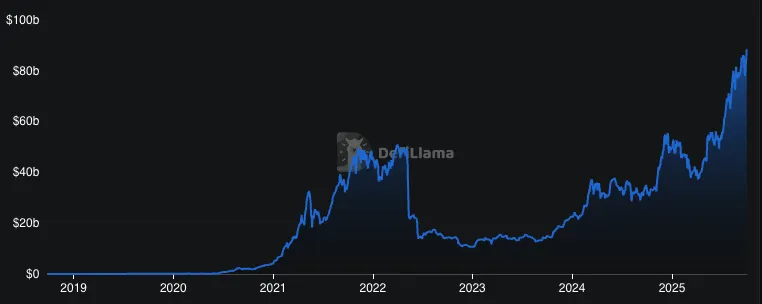
The TVL of DeFi lending venues are reached a new record high, according to data from @DefiLlama. In this AM's '24 Hrs in Crypto,' we discuss how DeFi has gone from being scrutinized by regulators to enjoying strategic importance for the US Government.
https://t.co/Jicex8KIzF


![FRNT_Financial's tweet photo. From today's '24 Hrs in Crypto:'
With gold continuing to reach new all-time highs, in this AM’s note we review the precious metal’s performance from the perspective of ardent, long-term holders of BTC
Subscribe & read the full note: https://t.co/3YiFK8tljT
Gold’s rally signals the conditions that many BTC proponents envisioned when first purchasing the asset: Bitcoin’s 2009 genesis block, mined by the asset’s pseudonymous creator Satoshi Nakamoto, featured the message, ‘The Times 03/Jan/2009 Chancellor on brink of second bailout for banks.’ The message served as an allusion to the economic turmoil of the era and the alternative monetary system the asset was designed to represent. In this regard, the broad anxiety related to global macro dynamics dynamics that is driving demand for gold, from the perspective of long-time BTC proponents, is also conducive to the asset’s adoption.
Gold’s rally increases BTC’s addressable market: BTC proponents have often pointed to BTC’s relatively small market cap to other macro assets to underscore its earliness and upside. The expansion of gold signals growing demand for neutral, global, assets that offer insulation from worrying macro dynamics. BTC proponents are confident that the asset’s qualities that allow it to serve as a safe haven asset will receive increased attention under these circumstances. BTC proponents will also be quick to highlight the asset’s advantages over gold. For instance, in June 2025 we wrote that an FT headline, ‘Germany and Italy pressed to bring $245bn of gold home from US,’ underscores a key advantage of BTC over gold: BTC custody is infinitely scalable and offers key advantages over physical bullion. We wrote that, ‘[u]nlike physical gold, BTC custody is infinitely scalable. What this means in practice is that custodying one BTC is not more difficult compared to custodying 100,000 BTC.’
Gold’s growing role in the crypto space: In a broad interview with Bloomberg with Tether CEO Paolo Ardoino, the news outlet placed the firm’s gold holding at 140 tons, worth USD ~25B. Considering that a portion of this gold backs Tether tokenized gold product XAUt, the remaining USD ~22.4B represents 12% of USDt’s market cap. As of Tether’s Q3 2025 attestation report, 7.41% of USDt’s market cap market cap was backed by gold. According to Bloomberg, Tether is now ‘the world’s largest known hoard of bullion outside of banks and nation states.’ Besides gold’s growing backing of the largest stablecoin, Ardoino told Bloomberg that he believes countries currently ‘buying a lot of gold…will soon launch tokenized version of gold as a competitive currency to the US dollar.’ As we pointed out yesterday, this is already taking place: In December, Bhutan and Kyrgyzstan launched tokenized gold products. Crypto proponents believe that tokenized gold can endow the precious metals with new capacities, such as peer-to-peer transferability or access to crypto native financial services. For example, holders from emerging markets where financial services may be deficient will be able to borrow against tokenized gold in a manner not possible with physical precious metal. Ardoino told Bloomberg he foresees there is a ‘good chance’ that XAUt can end 2026 with a market cap from USD 5B to 10B; XAUt’s current market cap is USD 2.6B.
In the US, Google searches for ‘gold price’ surpassed those for ‘bitcoin price’ in April 2025 for the first time since June 2020.](https://pbs.twimg.com/media/G_2g-v7WcAEscRc.jpg)
![FRNT_Financial's tweet photo. From this AM's '24 Hrs in Crypto:'
BTC traded to as low as USD ~86,000 last night while gold reached a new record high - We review select dynamics & market narratives in this AM’s note
Read more & subscribe to the full note:
Gold in the crypto space: The combined market cap of the two leading tokenized gold products, Tether’s XAUt and Paxos’ PAXG, currently stands at USD 4.28B. These two tokens are the largest examples of tokenized gold though we’ve previously characterized their market caps as relatively small for crypto standards. Despite the small size of the market, according to FT reporting from November, Tether’s ramped up acquisition of gold in 2025 has been partly motivated by the stablecoin issuer ‘betting on tokenised physical gold finally catching on.’ With 116 tonnes of gold as of November 2025, Tether is now the largest holder of the precious metal outside of central banks. In 2025, gold also emerged as a more pronounced portion of the reserves backing the USD 186B USDt stablecoin. According to Tether’s Q3 2025 attestation, Tether’s gold and BTC represented 7.13% and 5.44% of USDt’s reserves, respectively. The Q3 2024 attestation report indicated that gold and BTC represented 3.95% and 3.81% of the stablecoin’s reserves.
BTC and gold are ‘assets of fear:’ Speaking at the Global Financial Leaders’ Investment Summit in Hong Kong in November, BlackRock (NYSE: BLK) CEO Larry Fink described gold and BTC as ‘assets of fear.’ According to Fink, ‘you own these instruments if you are frightened of the debasement of your currency, you own it if you have financial insecurity…’ While for long-time BTC adopters the asset’s safe haven qualities have been evident since its earliest days, this view is now receiving mainstream attention. In this context, for many ardent BTC proponents, the ongoing global backdrop is likely close to what they imagined when first purchasing the asset. Against these conditions, that many see as highly conducive for BTC adoption, some market participants have been disappointed by the performance of crypto over the past year.
BTC’s ‘delayed reaction’ in 2020: In March 2020, the Fed’s emergency rate cut, induced by the COVID-19 crisis, came following the crypto space’s sell-off, along with broader risk assets. That sell-off saw BTC fall from USD ~8,000 to USD ~4,000. Following the emergency cut, despite the extreme crypto sell-off, we pointed out that ‘the Western environment is quickly becoming one that crypto was designed to serve.’ We also wrote, ‘[i]f Bitcoin was born of any concern, it was an abuse of Central Bank balance sheets and financial censorship from governments.’ However, following those emergency rate cuts, ultimately, it took BTC ~10 months to break out above its 2017 record high of USD ~20,000. BTC’s ‘delayed reaction’ to macro dynamics in 2020 is an important context for those disappointed by the asset’s performance over the past year.
The chances of a US Government shutdown have increased to 82% on Polygon-based prediction market Polymarket.](https://pbs.twimg.com/media/G_mREAOXYAA_430.jpg)