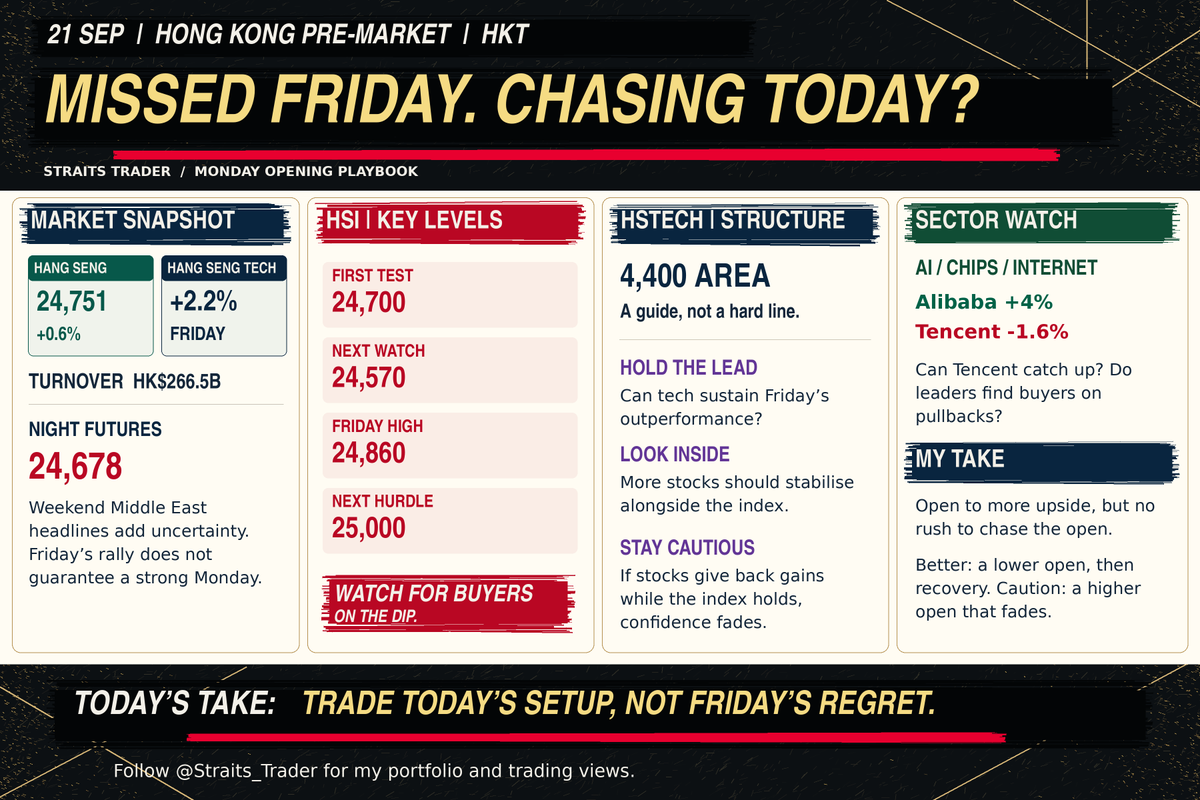
21 September | Hong Kong Pre-Market
Market Overview:
Last Friday, the HSI rose 0.6% to 24,751, while the Hang Seng Tech Index gained 2.2%. Turnover reached around HK$266.5 billion. Finally, some improvement. But night futures closed at 24,678, and there were fresh developments in the Middle East over the weekend. Don’t assume Friday’s rally will carry straight into today.
HSI: Key Levels
I’m watching the 24,700 area first. A lower open isn’t the main concern. What matters is whether buyers step in when prices fall. If that level doesn’t hold, I’ll look at 24,570 next. On the upside, Friday’s high near 24,860 comes first. Clear that, then we can talk about 25,000.
Hang Seng Tech: What to Watch
Tech outperformed the HSI on Friday. Today, let’s see if it can hold those gains. The 4,400 area is worth watching, but don’t get too fixated on one number. If the index holds up while more of its stocks start giving back their gains, I wouldn’t be too optimistic either.
Sector Watch:
AI, chips and internet stocks remain on my radar. Still, Alibaba rose 4% on Friday while Tencent fell 1.6%. Even within the same sector, your experience can be very different depending on what you hold.
My Take:
🔴 I’m open to the rebound continuing. I’m still holding Alibaba (https://t.co/F9ynLpJWAz) and Tencent (https://t.co/vq6WA2nTvs).
If we open lower and gradually recover, with tech stocks stabilising together, I’ll be more interested. An opening bounce that keeps fading as the session goes on would make me more cautious.
Today’s Key Point:
Whether a trade is worth taking depends on today’s price and price action. Don’t place a trade just to make up for an opportunity you missed.
Follow 👉 @Straits_Trader for updates on my portfolio and trading ideas.
20 September | Weekend Market Wrap
🔴 Hong Kong tech is recovering and Bitcoin is bouncing. Is money starting to flow back into risk assets across the board?
① Hong Kong Stocks
On Friday, the HSI rose 0.60% to 24,750.78, while the Hang Seng Tech Index gained 2.20% to 4,405.50. Total turnover reached around HK$266.5 billion, up 43.6% from the previous session.
Tech led the rebound, but Alibaba gained 4% while Tencent fell 1.6%, showing that the sector is still split. The HSI also finished slightly lower for the week. One strong session on higher turnover isn’t enough to confirm a trend reversal.
② ETFs
Southbound investors recorded net purchases of around HK$1.193 billion on Friday. Yet they net sold roughly HK$2.26 billion of the Tracker Fund of Hong Kong, while buying heavily into Baidu.
My take: Investors are making different calls on individual stocks and the broader market. Southbound inflows don’t automatically mean investors are bullish across the board. Likewise, southbound selling of an ETF doesn’t necessarily mean the fund itself saw net redemptions.
③ Crypto and Derivatives
Bitcoin moved back above US$80,000 on Friday morning, US Eastern time. US Bitcoin ETFs recorded around US$160 million in inflows on Thursday, suggesting some recovery in risk appetite.
However, HSI night futures closed at 24,678, around 73 points below the cash index, without showing the same strength. Crypto and Hong Kong stocks are still moving differently. A Bitcoin rally alone doesn’t tell us that Hong Kong will open higher on Monday.
④ My Take
🔴 For now, money appears to be moving selectively, rather than lifting every asset together.
Tech stocks, index ETFs and crypto are telling different stories. Instead of rushing into the hottest theme, I’m watching whether the rebound lasts and whether buyers step in on pullbacks. If your holdings aren’t moving, first check whether your reasons for buying still hold. Don’t let FOMO make the decision for you.
⑤ What I’m Watching Next
Can the HSI reclaim and hold the 24,800–25,000 area? Will more tech stocks join the rally? Will ETF flows continue in the same direction? Can Bitcoin hold US$80,000? I’m also watching whether developments in the Middle East push oil prices higher again.
🔴 Next week, will you chase the rally or wait for a pullback to see if buyers are still there?
Follow 👉 @Straits_Trader for updates on my portfolio and trading ideas.
solana:3aSu9uuDLiWkBQGycJDDSubZEPb6YJjDzULPWZkJn8ic #HongKongETF #Crypto #OptionsTrading
The Bank of Japan has raised rates to 1.25%, the highest since 1995. It’s also the sixth hike since Japan ended its negative interest rate policy in March 2024. So why did the yen fall?
① The hike was already priced in. The decision met expectations. Without an extra surprise, there may be little reason for fresh buying.
② The outlook for further hikes fell short of some investors’ expectations. The vote was split, leaving the market concerned that the BOJ would remain cautious about raising rates further.
③ The US is raising rates too. Higher rates in Japan don’t necessarily mean the gap with US rates will narrow quickly. Dollar assets still offer attractive interest returns.
It’s like a company reporting higher profits, only for its share price to fall. If the market was expecting more, even good news can trigger a sell-off.
https://t.co/IFQgpCyNFD, which I recommended earlier, continues to rise on higher volume. Congrats to everyone who profited from the move!
🎯Follow me and learn a little about finance every day
$0100.HK
My question is how much of the appeal comes from Chinese bonds, and how much comes from a stronger yuan. Annualising recent currency gains and adding the coupon can make FX returns look like steady income. For a dollar-based investor, does the trade still work if the yuan stops rising—or reverses?