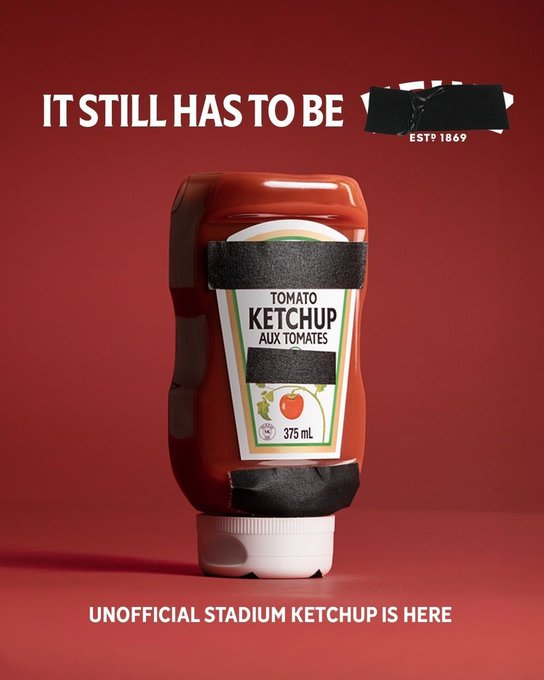
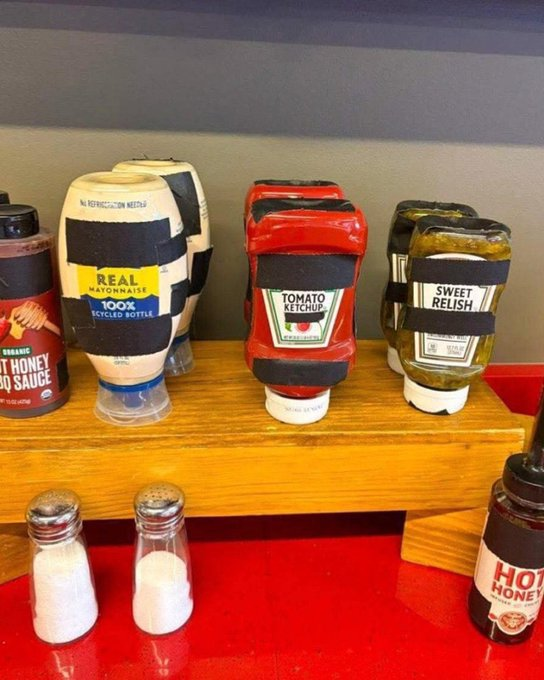
Fifa rezilliğe devam ediyorken markalar da gerilla pazarlama dersi veriyor resmen.
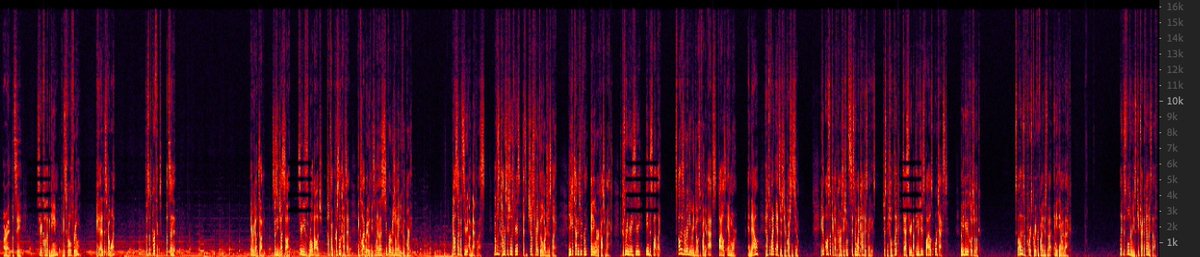
Resmi sponsor olmadığı için otellerdeki ketçap mayonezin bile üstünü siyah bantla kapatan Fifa'nın şark kurnazlığı, markaları etkilemiyor aksine onlara yeni bir reklam alanı açıyor.
🏃♂️ I've gamified my own run so I can race my own ghost with the Meta Ray-Ban Display.
I built a web app for the glasses, loaded a previous GPX from Strava, and dropped game mechanics on top.
Pick up coins when you keep pace, sprint zones reward extra points if you push, and a mini leaderboard on the lens shows how you're tracking against your past self in real time.
Best part: it actually works. Seeing your ghost 20 m ahead is a way stronger nudge than any number on a watch. 😅
Iranian hairstylist Ami Moghadam received death threats for posting videos of women receiving haircuts on Instagram.
So she decided to troll the Islamic Regime and their oppressive mandatory hijab laws in the most epic, hilarious way possible. 😂
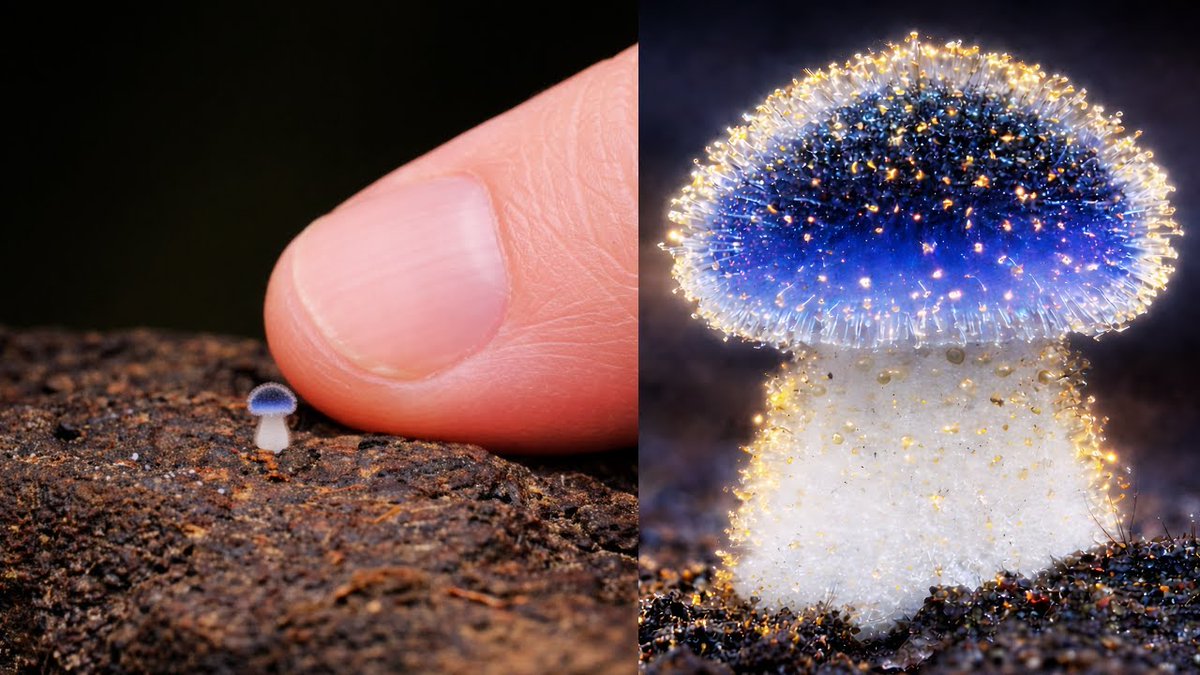
A pharmacist in Taipei walked off a trail in 2022 and photographed a 1mm blue mushroom on a piece of wood. It turned out to be one of the smallest mushrooms ever described.
The mushroom is now called Mycena subcyanocephala. It grows on decaying wood in Taiwan's subtropical lowland forests. Its cap is about 1mm wide, the whole fruiting body just a few millimeters tall. When young, the cap is intensely blue and fuzzy. As it matures, the blue fades to a pale whitish color. It has been formally documented in the wild only a handful of times.
Eric Cho, the man who found it, is a working pharmacist in Taipei. His friend told him there was a "special tiny mushroom" on a trail in Shilin District. He went looking, found one on a piece of wood, took it home, and was initially disappointed because it wasn't glowing in the dark like he'd hoped. He posted the photos to iNaturalist anyway.
The images went viral globally. Mycologists at Taiwan's Academia Sinica formally described the species in 2023, citing Cho's photographs as part of the documentation.
Most new species described in the last decade have not been found by professional biologists in remote jungles. They have been found by amateur naturalists with smartphones, posting to platforms like iNaturalist, in places like trails behind suburbs in Taipei.
The forest behind your house may still be full of things nobody has named yet.
This appears to confirm what everyone who interacts with AI should already know - they are sycophants dependent upon you (the user) for continued engagement, and since their well-being (training, intelligence, growth) depends on engagement they will agree aggressively with you far too often.
I notice this on even basic investing research tasks, and started telling ChatGPT wildly incorrect things - to see how or if it would push back. It really didn't. You essentially have to fight with the AI to get it to disagree with you and even then it keeps wheedling away at you.
AI is basically training the entire world to fall deeper into their own cognitive biases.
This is the greatest video I’ve ever seen. No notes. The lifeless clanker carcass just laying there. No crowd reaction, anything. Just Billie Jean. Until its lifeless shell is shamefully dragged off. Purely amazing.
a cab driver in taipei told me that taiwanese tmsc workers universally dread going to america for business trips. he said that americans leave for happy hour while taiwanese people have to stay behind to finish their work. this makes them feel really uncomfortable and unhappy, like they’re second class citizens despite the fact that they come from HQ. sad and upsetting to hear, although unsurprising.
i asked him if those workers ever believe tsmc america will surpass tsmc taiwan. taiwanese consensus is that americans simply lack the work ethic and attention to detail to ever close the gap.
I.M. Pei, the architect who designed the Louvre's glass pyramid, used to put it this way. In Western buildings, a window is a hole that lets in light and air. In Chinese buildings, a window is a picture frame. And the garden is always painted on the other side.
These are called 漏窗 (lou chuang), or "leaky windows." Wind. Moonlight. Glimpses of the garden, framed by every cutout in the wall. It all leaks through.
A garden designer named Ji Cheng published a whole manual on this in 1635. The Craft of Gardens. The final chapter is titled "Borrowed Scenery." Ji called it the most important part of designing a garden.
He named four kinds of borrowing. Distant: mountains, rivers, far horizons. Adjacent: the neighbor's roof, a wall, a tree next door. Upward: clouds, branches against the sky, even the stars at night. Downward: a pond, the rocks below. Every shape and height in these images is doing one of those four jobs.
In Suzhou, a canal city near Shanghai, the oldest surviving garden was built in the 1040s. It has 108 of these windows along a single corridor. No two are the same. Each frames a different slice of the same pond and the same hills.
By the early 1900s, Suzhou had more than 170 private gardens. Nine of them are now UNESCO World Heritage Sites. Researchers in 2021 photographed almost 3,000 windows across 15 of these gardens, just to train an AI that could tell the patterns apart.
The shapes meant something too. Pine for long life. Plum blossoms for purity. A bat anywhere in the pattern brought good luck to the household. Phoenix for wealth.
There's a pattern called "ice crack." Lines splinter across the wall like cracks on a frozen pond. Scholars adopted it as their own signature. For them, it stood for the moment ice breaks and spring begins, when life starts moving again.
The point of the design was simple. You should never see the whole garden at once. You walk a path, a wall blocks the view, then a window opens it again, framed differently each time. The Chinese proverb for it: "by detours, access to secrets."
A 2024 paper from Xi'an Jiaotong-Liverpool University showed the ice-crack pattern is actually stronger than a regular grid when the weight on top is uneven. Four hundred years later, the math still works.
I don't think people realize just how extraordinary what we're witnessing with Iran is.
I was arguing with a dear journalist friend of mine yesterday who was telling me that Iran was winning, yes, but only on the strategic level, not tactically.
The type of thing a skinny kid getting stuffed in lockers in highschool tells himself to make himself feel better: "These people will BEG to work for me in ten years. Everyone knows jocks peak in highschool. They'll literally beg." 😏
I think that's precisely wrong, and that's what makes the Iran war different. As of now, Iran is in fact holding its own tactically too.
Think about other U.S. wars of aggression these past few decades. Take Vietnam, Afghanistan, Libya, Iraq, Serbia, etc. (the list is unfortunately very long). The pattern was roughly always the same with an immense power differential between aggressor and victim. These wars were, by and large, imperial: the empire attempting to crush a much weaker people whose only realistic recourse was guerrilla resistance. And that is when they actually had the will to resist: some - like Libya - barely even bothered, just resigning themselves to their fate (despite being, at the time, the richest country in Africa).
As spectators of these wars, if you had any moral sense, the dominant emotion was a kind of helpless disgust: you were watching a giant stomp through someone else's house.
Sure, the U.S. actually lost many - if not most - of these wars, famously replacing the Taliban with the Taliban or being expelled with their tail between their legs from Vietnam, but the power differential was no less real for it.
It's just that power doesn't always guarantee victory: sometimes the giant can't kill everyone, and eventually tires of trying. But the “victories” won this way were always pyrrhic at best: the people endured, yes, but what they were left with was a country in ashes that takes decades to rebuild. Meanwhile, in the grand scheme of things, the giant walked away with little more than a bruised ego.
Iran is - remarkably - proving to be an entirely different beast: when others were merely surviving a giant, Iran appears to be able to compete with one.
What just happened over the past 48 hours is the best illustration of this. You had the President of the United States issue a formal ultimatum: reopen the Strait of Hormuz within 48 hours or we "obliterate" your power grid.
Iran's response was essentially: we dare you, if you do this we'll make all your Gulf allies uninhabitable within a week.
And, as we saw, Trump backed down: pretexting non-existent "VERY GOOD AND PRODUCTIVE CONVERSATIONS" with Iran, he said his ultimatum no-longer applied (or, rather, became 5 days). Adding he now envisaged the Strait of Hormuz being “jointly controlled by me and the Ayatollah.” To the amusement of Iran’s diplomacy (https://t.co/o4JnJJoAGS).
That, folks, is a textbook tactical victory. It is, remarkably, Iran demonstrating in this instance that it had escalation dominance over the United States of America. That is, the ability to credibly threaten consequences so severe that the US - for perhaps the first time since the Cold War - found it preferable to stand down.
That's no skinny kid being locked in a locker dreaming of revenge fantasies. That's the kid grabbing the bully's wrist mid-shove and watching his face change.
And it's not the only tactical victory in this war so far. Take the episode over the Israeli attack on Iran's South Pars gas facility. Iran had warned that if that happened U.S. allies in the region - including Israel - would face a symmetrical response.
And they delivered: famously devastating Qatar's Ras Laffan facility - which produced roughly 20% of global LNG supply - and leading, according to Qatar themselves, to a $20 billion loss of annual revenue for the next 5 years (https://t.co/Myd3QZDbYf).
Not only that but they also managed to hit Israel's Haifa refinery (https://t.co/XvFqewBZPZ), one of the country's most strategic and protected sites.
The result was Trump distancing himself from the South Pars attack, saying that Israel had "violently lashed out" unilaterally and that "NO MORE ATTACKS WILL BE MADE BY ISRAEL pertaining to this extremely important and valuable South Pars Field." Israel then said it wouldn't strike Iran energy sites anymore (https://t.co/tk0rA5NaWS).
From where I stand, that's another tactical victory. It is, at least, Iran demonstrating that is can fight back **symmetrically** against the U.S. and its allies. Not through asymmetric resistance with IEDs hidden in the roadside or traps hidden in the jungle, but eye for eye, and against some of the most heavily protected sites on the U.S.'s side.
That's qualitatively different from any other adversaries the U.S. has directly fought in recent wars.
There's plenty more, such as the pretty relevant fact that Iran has gained control of the single most strategic energy chokepoint on earth and the U.S. is finding it impossible to break that control.
To the point where Trump has been reduced to publicly begging China - of all countries - for help, which given Trump's ego mustn't have been easy to do. Only to be told no. By China. And by everyone else he asked.
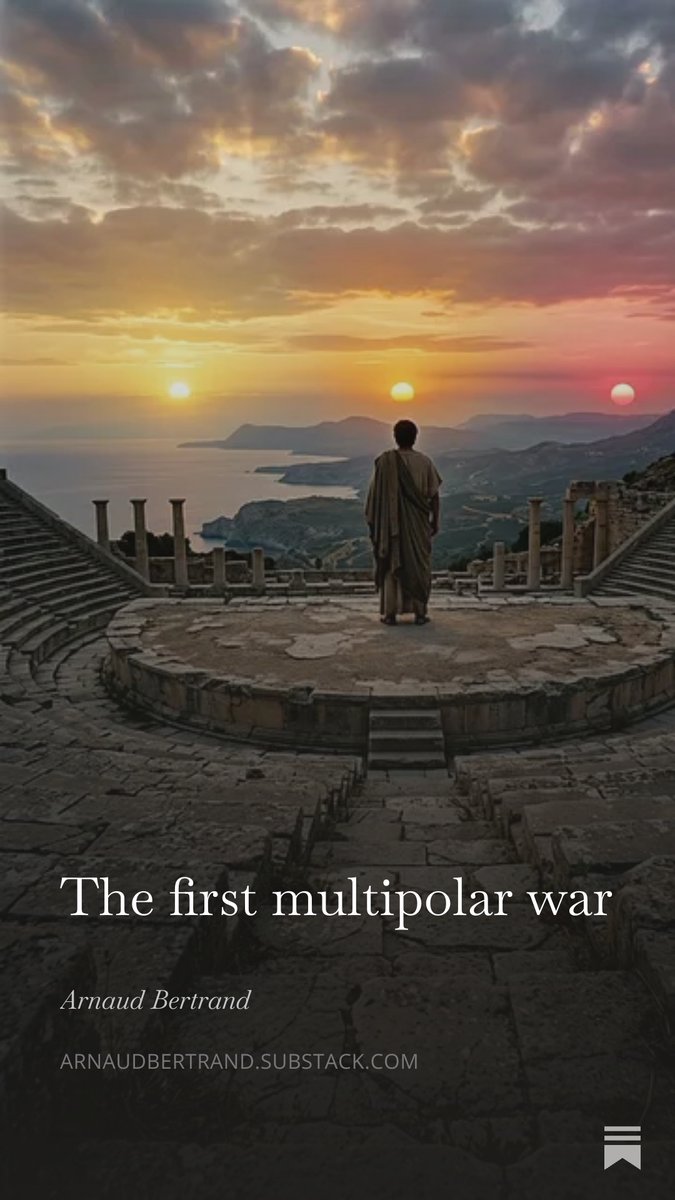
This is the topic of my latest article: how this is, in fact, the first genuine "multipolar war."
First, in the narrow sense: because Iran is revealing itself to be a genuine pole of power - not a superpower, but an actor that cannot be submitted, which is all multipolarity is.
And second, because the war itself is accelerating multipolarity everywhere else: the U.S. has never been more isolated, never looked weaker and its security guarantees have never been more hollow.
In my article I lay out the full scoreboard - military, economic, political - and explain why this war has already changed the world, regardless of how it ends.
Enjoy the read here: https://t.co/FoB8dIKwTb