@NickHintonn buddhism doesnt say that it says attachment is the root of all suffering. craving and aversion. if a desire arises, the problem is attachment to said desire.
clavicular is exactly the type of guy socrates would have gone out of his way to single out in the agora with some “what IS beauty” bullshit utterly ἔλεγχοςmogging him
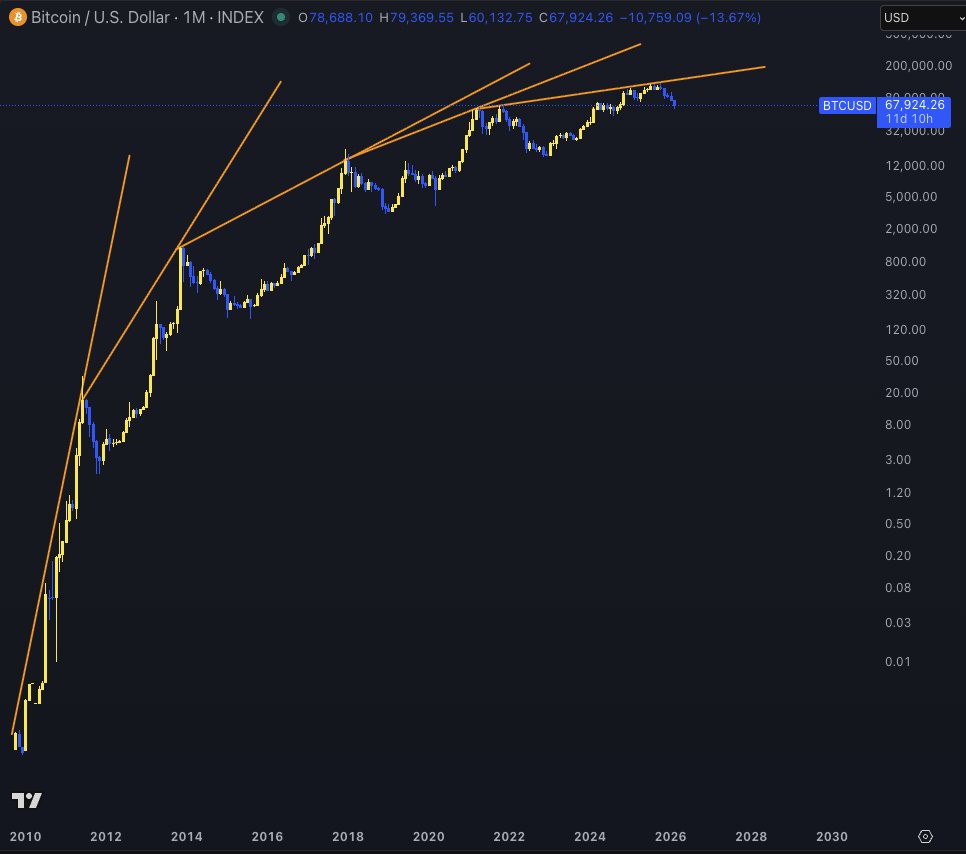
Cycles are a normal part of the crypto industry, what is important is what those cycles reveal about how far the industry has progressed and what next stage/trends of adoption/value creation will go on to define the industry.
So far this cycle reveals two key things for me:
Firstly, there have been no large risk management failures leading to large institutional failures or widespread systemic risks. In the previous cycle you had FTX and multiple lenders cleaned out through large price drops, this time around I am pleasantly surprised to see none of that or at least none of it at any system wide scale. If the crypto industry and its systems are able to successfully weather large drawdowns in price and liquidity issues then it is a more reliable place to put both retail/client capital and institutional capital. This time has been much better managed than last time.
Secondly, real world asset migration on-chain continues to accelerate regardless of Bitcoin/Cryptocurrency prices, signaling that having real world assets on-chain is not tightly coupled to crpytocurrency prices but provides its own unique value that can grow irrespective of market pricing of Bitcoin or other crypto assets. We have seen RWA issuance continue to grow and we've seen leading on-chain perp markets rival tradfi perp markets for very traditional commodities like silver, especially in periods when trading in permissioned traditional markets became harder or more risky vs trading in on-chain permissionless markets. As more and more RWA data goes on-chain to make perps work correctly for more asset types and as more on-chain value is generated as RWAs themselves, I expect these dynamics to only increase regardless of crypto prices.
These are both very positive signals for the assumptions I have been making about three key trends I am expecting to work together to reshape our industry in the next stage of its growth into mainstream adoption.
Firstly, on-chain perps about real world assets and tokenization of the assets on-chain has unique and durable long-term value which is growing regardless of any other dynamics. It is the value of 24/7/365 markets, on-chain collateral management and on-chain data.
Secondly, institutional adoption of our industry will be driven by the fundamental/technology value it provides, accelerated by access to permissionless/always on markets in DeFi, which will grow massively as a result.
Thirdly, the infrastructure that will make RWAs possible will be experiencing much more demand as more of the real world finds itself on-chain. As more RWAs have to go on-chain as perps via on-chan data or tokenization itself and as those RWAs are increasingly complex in how they need to work on-chain, more systems will need to interface with chains to enable those RWAs.
The first two trends are inevitable market forces that are now accelerating regardless of cryptocurrency prices, that is the real insight I see from this part of the cycle. The third trend is where Chainlink is providing the key global standards/protocols/infrastructure that is needed for providing the data, connectivity and orchestration that accelerates the first two trends.
Data is what allows most RWAs to exist on-chain at all. Market data for on-chain perps e.g. on-chain silver markets, Proof of Reserves for Stablecoins, NAV for Tokenized Funds to operate on-chain and many other examples touching every category of RWAs. Chainlink is the largest provider of data to the leading blockchains by far and is successfully servicing the vast majority of DeFi for all their data needs with 70%+ market share. Our new launches with leading institutional data providers like S&P, ICE and many others put Chainlink in a similar position in the growing institutional RWA world.
Connectivity to both other chains and existing backend/accounting/risk management systems is key for liquidity. The ability to connect to the other chains as a system of record/source of liquidity and to the existing centralized systems of record/sources of liquidity are key for scaling RWA adoption globally. Chainlink is the leading provider of these capabilities to institutions and has been chosen by the leading security teams in Web3 to be their official bridging provider due to a superior reliability/security track record. Chainlink is also the only system that successfully pulls TradFi payments into on-chain transactions across multiple chains, integrating existing sources of liquidity and new sources of liquidity into one interoperability layer.
Orchestration is the process of coordinating multiple systems into one workflow/transaction that defines the core value an application is providing to its users. Coordinating between multiple chains, multiple off-chain systems, multiple market data sources and now multiple AIs is a key function that some system needs to play for the more advanced RWAs to function properly. The Chainlink Runtime Environment seems to be the only environment in which you can currently run a workflow that can coordinate all of these key systems into a single application, already in use by enterprises and with advanced integrations into many key systems. Orchestration has an additional critical component of creating privacy, which there are now new and exciting solutions for being built on CRE. More to come on truly useful privacy as a key feature of CRE's orchestration.
If these trends continue I believe what I have been saying for years will happen; on-chain RWAs will surpass cryptocurrency in the total value in our industry and what our industry is about will fundamentally change. This shift will also lead to cryptocurrency's growth as an asset class that benefits from more capital on-chain, but RWAs is how all of this goes mainstream.
I have never been more excited about our industry's potential to become the way a better version of the global financial system works to benefit all of us.
At this point the most radical thing we can do is love people and enjoy the simple things. The demons hate when we have joy. They hate when we forget they don’t exist. They want our attention. They want us angry and in despair. Don’t let them take away your peace!
@krommufc@TheOtherParker_ if the third party didn't care about sanctions, and binance's due diligence team is retarded. because with trades of enough size to fuck the market they would be heavily vetted.
This was the highest volume day on $IBIT, ever, by a factor of nearly 2x, trading $10.7B today. Additionally, roughly $900M in options premiums were traded today, also the highest ever for IBIT. Given these facts and the way $BTC and $SOL traded down in lockstep today (normally SOL trades with beta) + the relatively lower liquidations on CeFi exchanges, this leads me to believe that the nexus of the problem lies with a large IBIT holder. IBIT has become the #1 venue for BTC options trading, so my guess is that a hedge fund trading IBIT options is the culprit.
If you look at the 13F filings for IBIT (I like whalewisdom dot com), you'll find a number of interesting names that have the majority of their fund in IBIT. In fact, there are a few in there (not naming names) that have 100% of their fund in IBIT, which likely means no cross margin. In fact, the biggest reason to set up a fund to hold a single asset would be to isolate margin, so that if the trade blew up, the brokers wouldn't have claim to any other assets.
Interestingly, most of these giant, single asset funds are based in HK.
We know that Asian traders, particularly in China, have been deeply involved in the Silver and Gold trade. Silver was down 20% today, which was the 2nd largest 1 day move in a very long time (largest on Jan 30). We also know that the JPY carry trade has been unwinding at an increasingly rapid pace.
This leads me to think that the culprit for the IBIT blowup today was 1 or more HK-based non-crypto hedge funds. As @FranklinBi pointed out, the fund(s) being non-crypto would explain why no one sniffed them out. They would likely have few/no crypto counterparties, meaning complete isolation from CT.
The last small piece of evidence I have is that I personally know a number of HK-based hedge funds that are holders of $DFDV, which had the worst single down day ever, with a meaningful mNAV decline. The mNAV had been holding steady surprisingly well throughout this pull back until today. One of these fund(s) could have been connected to the IBIT culprit, as I highly doubt a fund taking that large of a position in IBIT and using a single entity structure would only have the one fund.
Now, I could easily see how the fund(s) could have been running a levered options trade on IBIT (think way OTM calls = ultra high gamma) with borrowed capital in JPY. Oct 10th could very well have blown a hole in their balance sheet, that they tried to win back by adding leverage waiting for the "obvious" rebound. As that led to increased losses, coupled with increased funding costs in JPY, I could see how the fund(s) would have gotten more desperate and hopped on the Silver trade. When that blew up, things got dire and this last push in BTC finished them off.
I have no hard evidence here, just some hunches and bread crumbs, but it does seem very plausible. Let's see if some more concrete evidence floats to the surface here soon. The smoking gun will be a large fund fitting this profile filing a 13F showing a giant IBIT holding going to zero. Unfortunately, if a fund had their IBIT position liquidated today, they wouldn't have to disclose the position change until 45 days after the quarter end, so we'd be looking at mid May for the smoking gun from 13F filings most likely.
Hopefully some of you out there with too much time on your hands this weekend can snoop around more. My guess is that word will start to get out, because something of this size is just too hard to hide. Additionally, if the broker was not able to liquidate the fund in time, the broker may have a hole in their balance sheet, which would be even more difficult to hide.
You can be so intelligent that people know they can't spar with you brain-for-brain. They turn to AI for help in building a response that could simulate your intelligence. This is the height you should all strive for, and more reason why you must not outsource your thinking!