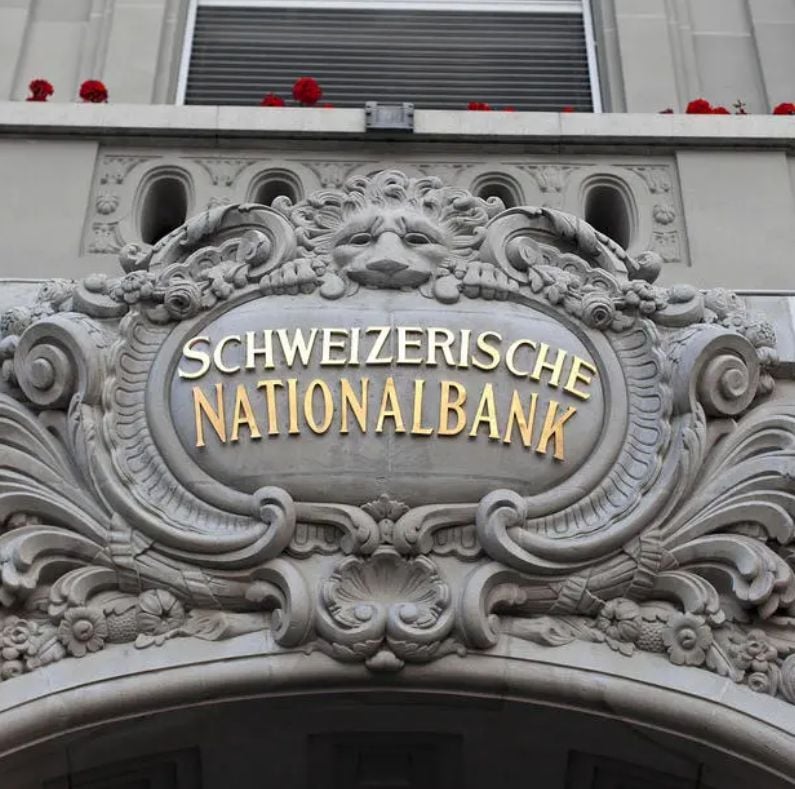
🚨BREAKING: SWISS CENTRAL BANK, UBS AND SIX JOIN FORCES TO EXPLORE BLOCKCHAIN SETTLEMENT!
The initiative aims to connect central bank money, bank deposits and tokenised securities on shared infrastructure!
Interestingly, UBS last week announced a @chainlink solution targeting the $2T structured products market! $LINK
🚨HUGE: STELLAR SEES $207.2 MILLION FLOW INTO TOKENISED FUNDS IN JUST ONE WEEK!
That's over $200 MILLION in fresh capital entering blockchain based investment funds on $XLM in just seven days!
As major financial institutions increasingly embrace tokenisation, @StellarOrg is positioning itself as a leading home for real world assets!
Soon, $XRP will power the banking system like SWIFT has done for decades.
THE GREAT RESET IS COMING ‼️
Watch this interview with Brad Garlinghouse on Bloomberg, and I'll break down how big I believe $XRP will become through everything Ripple is building.
This will be a long read, but trust me, there is a much bigger story unfolding here.
I've spent a considerable amount of time studying Ripple's acquisitions, institutional partnerships, and developments on the XRP Ledger.
The deeper I look into these developments, the more I understand why Ripple has been expanding into different areas of the financial industry.
Everything is starting to come together.
During his November 19, 2026, Bloomberg Television interview with Haslinda Amin, Brad Garlinghouse explained Ripple's ambition to become an infrastructure provider for banks.
Think about the significance of that statement.
Ripple wants to provide financial institutions with the technology and services they need to conduct their everyday business more efficiently.
Moving money, managing liquidity, financing investments, trading assets, securing collateral, and settling financial transactions are all essential parts of the global financial system.
Ripple is building businesses around these activities.
Brad also explained how blockchain technology brings faster settlement and lower costs to financial transactions, including payments, insurance, and tokenized assets.
He pointed toward prime brokerage as an area where traditional banks have reduced their involvement, opening opportunities for companies capable of providing those services.
And Ripple has already made a billion-dollar move into that industry.
THE $1.25 BILLION ACQUISITION THAT CHANGED EVERYTHING
On April 8, 2025, Ripple announced its acquisition of Hidden Road for $1.25 billion. The acquisition was completed in October 2025, and Hidden Road became Ripple Prime.
I believe this acquisition deserves far more attention from the XRP community.
Most everyday investors hear the words prime brokerage and immediately assume it is something complicated that has little relevance to their crypto holdings.
Let me simplify it.
Imagine managing an investment fund with billions of dollars. Your business involves trading currencies, government bonds, digital assets, derivatives, and other financial instruments.
You need access to different markets.
You need financing to support your positions.
You need somewhere to pledge assets as collateral.
You need financial services that help manage risk, clear transactions, and complete settlement.
A prime broker brings these services together, making it easier to conduct business across multiple financial markets.
Ripple now owns one of these businesses.
When the acquisition was announced, Hidden Road was clearing approximately $3 trillion annually across multiple asset classes and serving more than 300 institutional customers.
Three trillion dollars in annual financial activity.
Those figures represent Hidden Road's historical clearing business. They give us an idea of the institutional market Ripple entered through this acquisition.
Instead of spending years building hundreds of institutional relationships individually, Ripple acquired a business with an established customer base and experience handling financial transactions on an enormous scale.
Now consider what happens when blockchain infrastructure becomes part of that business.
RIPPLE PRIME AND THE XRP LEDGER
When Ripple announced the acquisition, the company explicitly outlined its intention to migrate Hidden Road's post-trade activity onto the XRP Ledger to improve efficiency and reduce operational costs.
I want every XRP holder to understand what post-trade activity means.
When two institutions agree to exchange financial assets, their responsibilities extend beyond agreeing on the transaction.
The trade needs to be recorded, matched, processed, cleared, and eventually settled.
Depending on the financial product, several different systems and intermediaries participate in completing those responsibilities.
Ripple intends to bring aspects of that process onto XRPL.
Imagine two institutional customers executing a financial transaction through Ripple Prime.
Ripple Prime provides the clearing, financing, collateral, and risk management services surrounding the transaction.
The XRP Ledger then offers blockchain infrastructure capable of supporting relevant post-trade processing and settlement activities.
Within that developing environment, XRP has potential roles in network reserves, transaction fees, liquidity, asset conversion, and collateral.
The connection between Ripple's brokerage business and XRPL is especially exciting because financial institutions perform these operations regularly.
They have businesses to run, customers to serve, transactions to complete, and financial obligations to manage.
Every successful integration brings blockchain technology closer to those everyday responsibilities.
Let's put the opportunity into perspective using Hidden Road's historical $3 trillion annual clearing volume.
Imagine the following hypothetical adoption scenarios:
1% of that historical activity represents $30 billion annually.
5% represents $150 billion annually.
10% represents $300 billion annually.
These are illustrative scenarios showing the scale of financial activity that an XRPL integration opens up. They are separate from forecasts of direct XRP purchases.
Even examining a small percentage of Hidden Road's historical business helps explain the importance of Ripple's post-trade migration plans.
Institutional activity brings opportunities involving recurring transactions, digital assets, collateral management, and liquidity.
Each represents another area where the XRP Ledger and its native asset can become increasingly useful.
I will be paying particular attention to future announcements detailing how much Ripple Prime activity has moved onto XRPL and how XRP participates in those operations.
XRP IS ALREADY ENTERING PROFESSIONAL FINANCIAL MARKETS
In November 2025, Ripple announced that institutional customers in the United States were able to trade XRP and RLUSD through Ripple Prime's over-the-counter spot brokerage services.
Ripple Prime also identifies XRP, RLUSD, tokenized real-world assets, and traditional assets as potential collateral within supported financing arrangements.
This introduces a fascinating opportunity.
An institutional investor accessing XRP through Ripple Prime has more ways to interact with the asset.
Market makers require trading inventory to support their operations. Financial institutions need liquidity to complete transactions. Investment funds need assets that support their financing arrangements.
XRP has an opportunity to participate in all three activities.
Consider a market maker holding XRP inventory.
That inventory supports trading operations and provides liquidity to customers. As institutional trading activity develops, the market maker has additional business reasons to maintain access to XRP.
Now consider collateral.
An investment fund often holds valuable assets that it can pledge to obtain financing. By pledging eligible assets, the fund gains access to capital that supports its other financial activities.
Ripple Prime's support for eligible XRP collateral brings the asset into that conversation.
Then there is XRP's role as a bridge currency.
As institutions transact with different currencies, stablecoins, and tokenized assets, efficient conversion becomes increasingly important.
The XRP Ledger has built-in functionality that allows XRP to serve as an intermediary when it provides a competitive liquidity route.
Combine institutional trading inventory, collateral, bridge liquidity, and developing credit applications, and you begin to understand my long-term thesis.
I see XRP developing into an asset with multiple financial responsibilities.
LOOK AT WHO RIPPLE IS ALREADY WORKING WITH
The institutional names behind Ripple's expansion deserve serious attention.
Brevan Howard.
On October 6, 2026, Ripple announced an expanded relationship with Brevan Howard, covering multi-asset prime brokerage, clearing, and financing services through Ripple Prime.
Brevan Howard reported approximately $35 billion in assets under management.
An investment manager operating at this scale requires sophisticated infrastructure to conduct business across financial markets.
Ripple is positioning itself within those operations.
Then we have Robinhood and Bitstamp.
Ripple Prime provides lending and margin financing to Bitstamp by Robinhood across approximately 20 digital assets.
Robinhood also plans to use RLUSD on the XRP Ledger for institutional settlement.
I find this combination particularly interesting because it connects institutional financing, digital asset brokerage, stablecoins, and blockchain settlement within the same broader financial relationship.
DriveWealth is another important name.
Its relationship with Ripple includes RLUSD settlement on XRPL, digital asset custody, cross-border payments, and potential equity financing through Ripple Prime.
DriveWealth provides investment infrastructure to more than 100 partners globally.
Think about the distribution opportunity associated with a company already connecting numerous financial businesses.
Next is Virtu Financial.
On October 15, 2026, Ripple announced that institutional clients, including Virtu, were trading real-world-asset perpetual swaps through Ripple Prime.
These products provide exposure to equities, commodities, currencies, and other traditional financial markets.
Ripple's institutional services are reaching financial activities that extend well beyond cryptocurrency trading.
And finally, BNY.
BNY has a custody relationship with Ripple Prime and supports XRP and RLUSD through its institutional digital asset custody platform.
Ripple and BNY are also exploring tokenized trade finance on the XRP Ledger.
Custody, financing, settlement, traditional market exposure, and tokenization are gradually coming together through these commercial relationships.
Each institution introduces a different opportunity to integrate Ripple's technology into existing financial activities.
For me, the collective significance of these relationships is much greater than any individual partnership announcement.
FOLLOW THE ACQUISITIONS AND THE STRATEGY BECOMES CLEARER
Look at the different businesses Ripple has assembled.
Ripple Payments provides cross-border payments and international money movement.
Ripple Prime, previously Hidden Road, provides institutional trading, financing, clearing, and collateral services.
Ripple Custody, supported by acquisitions including Metaco and Palisade, provides digital asset custody and wallet infrastructure.
Ripple Treasury, through GTreasury, provides corporate cash management, liquidity management, and treasury services.
Rail provides stablecoin-powered payments and virtual accounts.
RLUSD provides dollar-denominated digital settlement infrastructure.
The XRP Ledger provides blockchain infrastructure for issuing, exchanging, and settling assets.
And XRP serves as the native asset of that network, with opportunities involving bridge liquidity and institutional collateral.
Now imagine yourself running a financial institution preparing to integrate digital assets into its business.
You need somewhere to secure those assets. You need access to financial markets. You need to manage cash, move money internationally, obtain financing, and settle transactions.
Ripple has been acquiring and developing businesses capable of addressing these requirements.
An institution that initially approaches Ripple seeking custody services also has access to a broader ecosystem of financial products.
Its next requirement might involve treasury management. Another might involve institutional financing or stablecoin settlement.
The business relationship grows as additional services become relevant.
And every expansion creates another opportunity for XRPL and XRP to participate.
This is one of the reasons I pay so much attention to Ripple's acquisition strategy. It provides a clearer understanding of the financial environment Ripple intends to build.
THE NUMBERS ARE GETTING SERIOUS
Ripple's October 28, 2026, company-wide announcement provided several figures worth remembering:
More than 1,700 institutional and enterprise users.
More than 85 regulatory licenses.
Approximately $900 million in expected annual product revenue run rate for 2026.
More than $16 trillion in transactions enabled across its products during 2025.
These figures describe the scale of Ripple's overall business operations.
Behind those numbers are relationships with banks, payment providers, corporations, asset managers, exchanges, and other businesses.
Ripple has an opportunity to expand those existing relationships by introducing additional products.
A payment customer can explore custody.
A custody customer can explore financing.
A corporate treasury customer can explore stablecoin payments and liquidity services.
Institutional customers can gain access to XRP and RLUSD through services that connect with their existing business requirements.
I keep coming back to the importance of distribution.
Ripple already has a commercial foundation through which it can introduce new financial capabilities to customers.
Building useful blockchain technology is an important achievement. Establishing relationships with institutions capable of integrating that technology into their everyday operations is another significant achievement.
Ripple is pursuing both.
THE NEXT CHAPTER: MAKING XRP A PRODUCTIVE FINANCIAL ASSET
In February 2026, Ripple outlined its institutional DeFi roadmap for the XRP Ledger.
Three areas of XRP utility stood out:
Payments and foreign exchange.
Collateral and liquidity.
Credit and financing.
The roadmap also discussed Multi-Purpose Tokens, permissioned trading, token escrow, and the proposed native XRPL lending protocol.
I believe the credit and financing component deserves particular attention following the Hidden Road acquisition.
Prime brokers already provide financing and collateral management services.
An institution holding digital assets may need access to additional capital to support its business. A market maker maintaining a large XRP inventory may require financing to continue serving customers and managing trading activity.
Institutional lending infrastructure introduces ways to put those assets to work.
Ripple's research into the proposed XRPL Lending Protocol discusses inventory financing, underwritten loans, and short-term institutional liquidity.
These are practical financial activities that already exist within the brokerage industry.
Subject to validator approval, native lending infrastructure brings the prospect of supporting these activities directly on-chain.
Ripple Prime brings institutional relationships and experience in financing.
XRPL brings developing blockchain-based credit infrastructure.
XRP brings an asset that can participate in eligible financial arrangements.
And there is another development involving Soil.
Ripple's November 2026 Swell recap revealed that Soil has been working with Ripple to explore XRP's use in institutional credit and collateral within Ripple Payments.
Notice how naturally this connects with the broader strategy.
Ripple is exploring ways for XRP to participate in financing arrangements alongside its established payments utility.
The financial world needs capital to remain productive. Businesses borrow, lend, pledge collateral, and manage liquidity every day.
An asset that participates in these activities gains additional economic relevance.
That is the future I am interested in researching.
IMAGINE XRP BECOMING PART OF A FINANCIAL INSTITUTION'S WORKING CAPITAL
When I think about XRP's future, I imagine an institution using several Ripple products simultaneously.
It holds digital assets through Ripple Custody.
It accesses financial markets and financing through Ripple Prime.
It manages cash and liquidity through Ripple Treasury.
It transfers dollar-denominated value using RLUSD.
It uses XRP when bridge liquidity offers an efficient way to exchange currencies and assets.
As institutional lending infrastructure develops, eligible XRP holdings also become useful within collateral and credit arrangements.
An institution operating in this environment has business reasons to maintain access to XRP.
That distinction matters enormously to me as a long-term holder.
Retail investors often buy crypto because they expect its price to appreciate.
Financial institutions maintain assets because those assets serve specific operational purposes.
Trading inventory helps market makers conduct business.
Collateral helps institutions access financing.
Liquidity helps businesses complete transactions.
Settlement assets help counterparties fulfill financial obligations.
The more XRP becomes useful within these responsibilities, the deeper its economic relevance becomes.
Imagine the conversations that follow as institutional customers explore how XRP fits into their capital management, trading, and financing strategies.
Those decisions are connected to the actual needs of businesses.
I believe recurring institutional utility is one of the most interesting long-term opportunities in crypto.
And Ripple is assembling the commercial relationships, technological infrastructure, and financial services necessary to pursue that opportunity.
WHAT I AM WATCHING NEXT
There are seven developments I will be following closely.
First, confirmation of substantial Ripple Prime post-trade activity operating on the XRP Ledger.
Second, more institutional customers using XRP as eligible collateral.
Third, banks establishing recurring XRP-based foreign exchange liquidity arrangements.
Fourth, activation of the proposed native XRPL lending protocol.
Fifth, growth in measurable institutional XRP lending activity.
Sixth, deeper liquidity between RLUSD and XRP, supporting asset conversions and settlement.
Seventh, additional brokers integrating Ripple Prime's financial services and expanding access to its institutional infrastructure.
These announcements will help us understand how Ripple's growing business translates into measurable economic activity involving XRP.
I want to see the institutional numbers, the integrations, the recurring transactions, and the expanding financial responsibilities of the asset.
Those developments are what make this journey so fascinating to follow.
MY FINAL TAKE
After studying Brad Garlinghouse's Bloomberg interview and connecting it with Ripple's acquisitions, I believe the company's direction is becoming increasingly clear.
Ripple wants to become part of the infrastructure that financial institutions depend on to conduct business.
The $1.25 billion Hidden Road acquisition gives Ripple an established institutional brokerage operation.
Brevan Howard, Robinhood, Bitstamp, DriveWealth, Virtu Financial, and BNY demonstrate the different markets and financial activities its services are reaching.
Metaco, Palisade, GTreasury, and Rail expand the capabilities surrounding those institutional relationships.
RLUSD introduces digital-dollar infrastructure.
XRPL provides a blockchain environment for financial activities.
And XRP has opportunities across trading, collateral, foreign exchange, liquidity, settlement, and institutional credit.
This is why my long-term conviction goes far deeper than watching the price move on a chart.
I am watching a company assemble financial infrastructure piece by piece, with an explicit strategy to bring institutional activity onto the XRP Ledger.
My vision for XRP is an asset that financial institutions increasingly hold and use because it helps them conduct their everyday business.
Imagine looking back years from now and remembering when we were studying prime brokerage, institutional collateral, blockchain settlement, and native lending before these services reached broader adoption.
We are watching the building process unfold in real time.
And personally, I believe the most exciting chapter of XRP's institutional utility is still ahead of us.
The opportunity extends across the very financial operations that keep the world's money moving.
That is the scale of the future I see for $XRP.
“Nothing will run unless you have the tokens.” — Gilbert Verdian, 2019.
$QNT has a documented role in Overledger licensing. Customers can pay in USD or QNT, and Quant described how its treasury could handle tokens for them.
How much QNT does a bank need to lock? Still undisclosed.
Most people look at $QNT and ask, “How high can the price go?”
I start with a completely different question: what happens if banks in different countries start issuing tokenized money on different systems and all of those systems need to talk to each other?
Warning: this one is LONG.
Probably one of my deepest $QNT posts yet. Give me a few minutes and read the whole thing. It’ll be worth it.
That question led me straight back to The Clearing House.
And once you understand the architecture The Clearing House is building, the entire Quant thesis starts making a lot more sense.
The Clearing House is one of the most important pieces of U.S. banking infrastructure.
It is owned by 25 banks.
Its CHIPS network has 43 direct participants.
CHIPS settles more than $2T in average value each business day.
During 2025 it processed around $2.014T in average daily payments.
Its liquidity efficiency was around 26:1.
So when I talk about The Clearing House moving toward tokenized deposits, understand the scale.
This is not a crypto company trying to get banks interested.
These are banking rails banks already use.
Now they are preparing those rails for tokenized commercial bank money.
On August 24, 2026, The Clearing House published a discussion with Chief Strategy Officer Sal Karakaplan.
The message was simple but extremely important.
Banks using CHIPS and RTP already have their settlement infrastructure.
They already maintain funds.
They already have liquidity processes.
They already have payment connectivity.
So tokenized deposits should not force them to rebuild everything.
Instead, tokenized transactions can be tightly connected with the systems they already use.
That one idea is massive.
Because the biggest obstacle to institutional blockchain adoption has always been disruption.
Banks do not want to throw away working infrastructure.
They want new capability without destroying the old system.
Now fast-forward one month.
September 24, 2026.
The Clearing House selects Quant.
Quant becomes the announced technology provider for:
Interoperability.
Orchestration.
Transaction management.
Quant also brings Tokenized Deposits-as-a-Service.
So imagine the future banking system.
Bank A issues tokenized dollars on one ledger.
Bank B uses another private network.
Bank C wants programmable deposits but has not built its own blockchain system.
A tokenized-securities platform needs cash settlement.
A treasury platform needs programmable payments.
A public blockchain contains tokenized assets.
CHIPS remains the regulated high-value dollar settlement network.
RTP handles real-time payments.
These systems are different.
But the money still needs to move between them.
Quant’s job is to coordinate that complexity.
I think this is much bigger than “blockchain interoperability.”
This is financial-system interoperability.
And the banks around The Clearing House initiative show how serious it is.
JPMorgan Chase.
Citi.
Bank of America.
HSBC.
BNY.
Wells Fargo.
Santander.
TD Bank.
Then:
BMO.
Citizens.
Fifth Third.
Huntington.
KeyBank.
PNC.
Regions.
Truist.
The comments from these institutions focused on exactly the problems Quant wants to solve.
Tokenized-deposit clearing.
Interbank connectivity.
Trusted financial infrastructure.
Interoperability.
Programmable payments.
Connecting blockchain capability with existing payment rails.
The Clearing House subsequently chose Quant.
That gives Quant a completely different distribution opportunity.
Instead of selling software one bank at a time, Quant is now inside an initiative connected to an institution already serving major banks.
That can shorten the path to institutional adoption dramatically.
Then look at what Quant has already done in Britain.
The Great British Tokenised Deposit initiative gives us a preview.
Quant was selected in September 2025.
One year later, seven banks had completed live customer transactions.
The names:
Barclays
HSBC UK
Lloyds Banking Group
Monzo
Nationwide
NatWest
Santander
These transactions involved real money.
Mortgage completions.
A marketplace purchase.
Funds could be reserved and released when conditions were met.
This is programmable commercial bank money doing actual work.
Now compare the timeline.
UK Quant selection: September 2025.
UK live customer transactions: September 2026.
U.S. Quant selection by The Clearing House: September 2026.
U.S. network targeted for availability: H1 2027.
I see a pattern.
Quant builds.
Banks test.
Transactions go live.
Then the model expands to another market.
Now layer international interoperability on top.
In October 2026, Quant participated directly in the UK Finance Tokenised Markets and Money Conference.
The discussion involved how tokenized-deposit initiatives from countries including the UK, Japan, the U.S. and Germany could connect.
The industry is talking about:
Standards.
Rulebooks.
Overlapping bank participation.
Commercial corridors.
Synchronized settlement.
Payment-versus-payment.
That is the future Quant has been preparing for.
People sometimes think tokenization will simplify finance because everything moves onto one blockchain.
I think the opposite can happen.
Tokenization can create even more systems.
Every major bank may have its own approach.
Countries may build national frameworks.
Central banks may support separate settlement infrastructure.
Private asset ledgers will exist.
Public blockchains will exist.
Commercial bank deposit tokens will exist.
Stablecoins will exist.
Digital securities will exist.
The technology becomes more diverse.
The need for coordination becomes bigger.
That is where a “network of networks” becomes valuable.
Think about U.S.-UK payments.
The U.S. bank has tokenized dollars.
The UK bank has tokenized sterling.
Both have domestic rules.
Both have their own settlement rails.
Both need foreign exchange.
Both need confirmation.
Both need compliance.
Both need the cash and asset legs synchronized.
Quant already has technology connected to both banking environments.
I think that gives it an incredibly interesting strategic position.
And I am not stopping at deposits.
Look at Murex.
Murex runs MX.3, widely used in institutional trading, risk management and post-trade operations.
In March 2026, Murex and Quant announced an integration.
Quant’s programmable money infrastructure can work alongside MX.3.
Now banks can potentially handle tokenized deposits and digital bonds without changing the core institutional workflow they already use.
This matters because tokenized assets need money.
A digital bond cannot settle itself.
A tokenized fund still needs subscriptions and redemptions.
Tokenized collateral still needs financing.
Tokenized securities still need delivery-versus-payment.
If the asset moves but the cash cannot move with it, the system is incomplete.
Quant is working across both sides.
Asset systems.
Money systems.
Institutional software.
Interoperability.
That creates more commercial opportunities.
Now I want to talk about token utility because this is where a lot of crypto research gets lazy.
The Clearing House settling $2T does not mean $2T buys QNT.
I care about a different mechanism.
QNT is documented as an access and licensing token.
Overledger subscribers can pay platform fees in USD or QNT.
Historical licensing models used QNT for annual mainnet licensing.
The 2026 MiCA disclosure also describes QNT utilization and locking in licensing arrangements.
So institutional growth can potentially create token demand through access rather than through the gross dollar value of payments.
That model makes more sense to me.
If one bank moves $100B using Quant infrastructure, QNT does not need to absorb $100B.
Quant needs commercial contracts.
Licensing.
Platform access.
Network services.
Potential token commitments.
If the number of institutions keeps increasing, those commitments can compound.
I care even more about locking.
One-time purchases can come back to market.
Locked tokens cannot.
If enterprise arrangements require QNT to remain committed for periods of time, liquid supply can tighten.
Then incoming demand has fewer freely available tokens to compete for.
And QNT supply is already small.
Roughly 14.56M circulating.
Around 14.61M total supply in the data used for this research.
That scarcity matters.
Then add Fusion.
Fusion launched on mainnet in June 2026.
It initially connected 74 networks.
Its Trusted Node Program gives institutions more control around who processes transactions.
QNT has a documented staking role.
So now I can see a second demand channel.
Overledger and enterprise licensing create one path.
Fusion execution and staking create another.
If both scale together, QNT becomes much more interesting.
Think of the potential progression.
Bank joins Quant infrastructure.
Bank or service provider needs platform access.
Access creates licensing economics.
Some licensing arrangements involve QNT usage or locking.
Meanwhile, institutional networks connect through Fusion.
Trusted nodes stake QNT.
Network execution grows.
More QNT becomes tied to productive use.
Supply stays around 14.6M.
That is the flywheel I want.
We are not fully there yet.
The exact QNT economics attached to The Clearing House contract have not been publicly disclosed.
But the general utility already exists.
That makes public confirmation of recurring institutional QNT demand one of the biggest catalysts I am waiting for.
Now do the valuation math.
Using about 14.61M tokens:
$5B valuation = ~$342 QNT
$10B = ~$684
$20B = ~$1,369
$30B = ~$2,053
$50B = ~$3,422
Again, these are valuation scenarios.
They are useful because they show what QNT’s scarcity does when the market cap expands.
The question becomes:
What valuation would investors assign to a token if Quant becomes recurring infrastructure for bank-issued digital money?
I think $10B becomes much easier to discuss if we see meaningful commercial bank onboarding, recurring QNT-linked revenue, rising activity and token commitments.
Higher scenarios need even more.
International usage.
Multiple national banking systems.
Cross-border network connectivity.
Large-scale Fusion adoption.
Material staking.
Recurring institutional contracts.
That is what I want to watch.
And the catalysts are already lined up.
1. The Clearing House network opening in H1 2027.
The partnership moves closer to real commercial usage.
2. U.S. bank onboarding.
More institutions can mean more Quant products being used.
3. Tokenized Deposits-as-a-Service.
Banks that do not want to build token infrastructure themselves can still participate.
4. QNT-linked enterprise licensing.
This is where institutional adoption can begin translating more directly into token demand.
5. Great British Tokenised Deposit expansion.
The UK already has live transactions.
More banks and more use cases would strengthen the proof.
6. U.S.-UK interoperability.
Both national banking environments already have Quant technology involved.
7. Fusion trusted-node adoption.
More nodes can mean more staking.
8. Fusion transaction growth.
More execution can increase ongoing QNT utility.
9. Murex MX.3 integration.
Tokenized bonds and institutional settlement open another market.
10. Delivery-versus-payment.
Tokenized cash and tokenized securities can move together.
11. Corporate treasury automation.
Conditional payments and programmable liquidity become real business use cases.
12. International network-of-networks development.
This is the monster opportunity.
Multiple national financial systems using Quant to coordinate transactions.
Now zoom out globally.
Britain already has live tokenized-deposit customer transactions.
The United States has The Clearing House preparing its initiative with Quant.
Europe has launched the first phase of Pontes for wholesale tokenized-asset settlement using central bank money.
And international banking discussions are focusing on cross-border connectivity.
Pontes is not currently an announced Quant project.
I am not claiming it is.
But Europe moving in the same broad direction matters.
Because every new financial network increases the need for interoperability.
The future is not going to be one giant blockchain.
It will probably look more like the internet.
Different networks.
Different systems.
Different protocols.
Different organizations.
Still able to communicate.
Quant wants to become part of the layer making that possible for financial institutions.
And the thing I like most is that Quant is approaching banks without asking them to abandon what already works.
That is a huge advantage.
Banks already have CHIPS.
They already have RTP.
They already have Murex.
They already have internal ledgers.
They already have compliance systems.
Quant can sit between those systems.
That is a much easier institutional pitch than saying:
“Throw away your current infrastructure and put everything on our chain.”
This is why I think Quant has a chance to scale differently from many crypto networks.
It is not competing to be the one ledger every bank uses.
It is monetizing the fact that banks will use many ledgers.
More fragmentation can actually increase the value of Quant.
Think about that.
If JPMorgan has one system.
Citi has another.
HSBC has another.
A public blockchain hosts an asset.
A central bank runs the final settlement layer.
Murex manages trading.
The Clearing House manages interbank payment infrastructure.
Every connection between those pieces becomes an interoperability problem.
Quant sells the solution to that problem.
That is the business.
Now think about $QNT.
If those commercial connections increasingly require QNT for access, licensing, locking, execution or staking, the token begins reflecting that business growth.
That is the bridge between the technology thesis and the investment thesis.
And because QNT supply is small, the potential asymmetry is what keeps me interested.
A lot of people saw QNT at $60.
Then $100.
Then $200.
Then over $300.
They only started asking questions after price moved.
I prefer studying the infrastructure before the crowd starts chasing the chart.
Right now I’m watching the next phase.
Can The Clearing House deliver the H1 2027 network?
How many banks participate?
How much transaction activity appears?
Does TDaaS expand the customer base?
Does the UK system grow?
Does cross-border interoperability become commercial?
Does Murex bring Quant deeper into digital bonds and securities?
Does Fusion gain institutional trusted nodes?
Does QNT staking grow?
Do enterprise licenses create recurring QNT demand?
Those are the questions that matter.
And if several of those answers become “yes,” the QNT story gets much bigger.
I see Quant’s future in three steps.
First:
Become infrastructure banks trust.
The UK and U.S. partnerships are doing that.
Second:
Become infrastructure banks repeatedly use.
Commercial tokenized deposits, settlement, securities and treasury activity can do that.
Third:
Convert that usage into measurable QNT economics.
Licensing.
Locking.
Execution.
Staking.
That final step is where I think the market could dramatically reprice QNT.
I am bullish today because stage one is no longer imaginary.
Quant has already delivered the UK banking infrastructure.
The Clearing House already selected Quant.
Murex already partnered with Quant.
Fusion is already live.
QNT utility is already documented.
The banking industry is already talking about a network of networks.
Everything does not need to happen tomorrow.
I am looking years ahead.
I want Quant sitting in the middle as more commercial bank money becomes digital.
I want Quant helping banks move between networks.
I want Quant coordinating tokenized cash and tokenized securities.
I want recurring licensing.
I want more QNT locked.
I want institutional Fusion activity.
I want trusted nodes staking QNT.
Those are the things that can turn institutional adoption into sustainable token demand.
And if Quant gets there, I think the upside could be much larger than people expect today.
The Clearing House already moves trillions. Britain already has live tokenized-deposit transactions. The banks are already building programmable money. Quant is already inside the infrastructure.
Now I’m watching how much of that institutional growth eventually reaches $QNT itself.
That’s the part that could make the next QNT cycle very different from the last one.
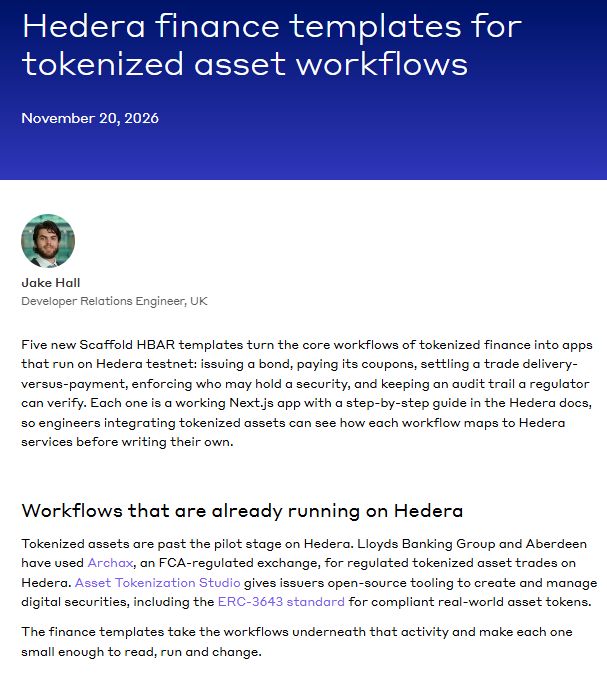
🚨HEDERA IS MAKING IT EASIER FOR BANKS TO BRING FINANCIAL ASSETS ONCHAIN!
Five new $HBAR developer templates cover bond issuance, automatic interest payments, instant trade settlement, regulatory compliance and audit trails!
With Lloyds and Aberdeen already using @hedera for tokenised assets, the infrastructure keeps advancing!
Imagine being able to connect your $XRP wallet directly to your BANK ACCOUNT without handing over your crypto. 👀
Banks have always wanted customers to TRUST them with their money.
Now we’re seeing a bank trying to build a system where customers DON'T have to GIVE UP control of their crypto in the first place. ✅
Bell (Protocol 30) is designed to make smart accounts ready for businesses at scale and begin work on quantum-safe signatures and faster ledgers.
And it's now live on Mainnet 🎉
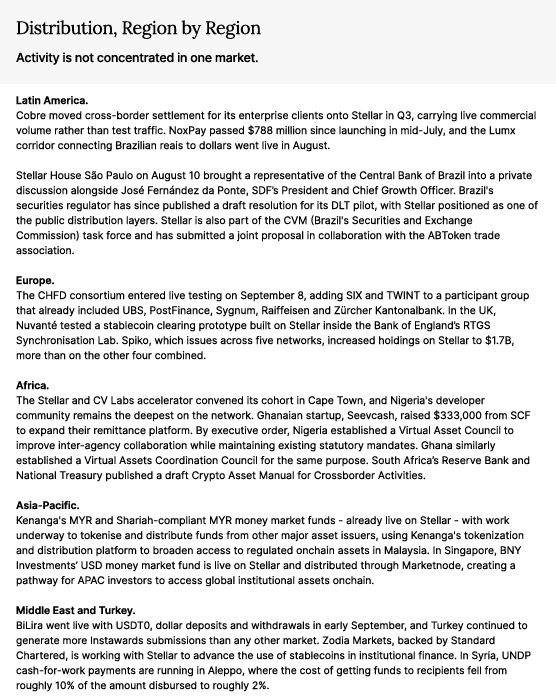
🚨STELLAR'S GLOBAL ADOPTION IS INCREDIBLE!
From banks in Europe and payments across Latin America to tokenised funds in Asia, stablecoins in Turkey and humanitarian aid in Africa and Syria!
@StellarOrg is establishing a presence across EVERY major region.
This isn't adoption in one country, $XLM is becoming GLOBAL financial infrastructure!
👁️Watch the DLTs that are closely connected w Hyperledger
$QNT
LACChain on Besu
BoE Rosalind used Fabric
Cacti SATP Compliance
hedera-hashgraph:native
Hiero built on Hedera code
Hedera LFDT Founding Member
HCS compatible with Hyperledger
stellar:native
Cacti for Stellar connector
BIS used Stellar & Besu in Genesis
IBM Worldwire used Stellar & Fabric
$XRP
Codeveloped Quilt for Hyperledger
Ripple Custody native Besu support
Ripple member of Mojaloop by LF
$CC
Digital Asset is founding Hyperledger member
Canton DAML native transfers w HL products
Digital Asset launched Splice w Linux Foundation
There's been a LOT of news around NVIDIA lately
But one piece has stayed under the radar amidst all the Jensen related noise
NVIDIA has handed it's Open Secure AI Alliance over to the Linux Foundation
And $HBAR is seemingly in the middle of it all
Most don't recognize the ties
Let’s run thru how deep it goes
Start with the Alliance itself.
Launched this year, 37 members deep, built in part on OpenSSF’s framework n now moving under the Linux Foundation as its neutral home.
Hedera’s tie to that stack isn’t new or indirect either.
Hedera has been one of the ONLY public DLT members of OpenSSF since 2024
On top of that we know Hedera is a founding member of Linux Foundation's Decentralized Trust.
The Decentralized Trust is the evolution of Hyperledger, Linux Foundation's initial DLT arm.
Two separate Linux Foundation bodies, Hedera’s got a seat at both tables.
And it's not just Linux either.
Hedera’s own Verifiable Compute platform, built directly with NVIDIA n Intel thru EQTY Lab, anchors every attestation on Hedera Consensus Service.
Hardware-level trust for AI workflows, immutably timestamped & verified on-chain
Now look at who’s sitting around Hedera in both directions.
IBM n Dell, both Hedera Governing Council members, both also carrying their own Verifiable AI work alongside EQTY.
ServiceNow, Databricks n Palantir, Council-adjacent n running as native connectors directly into the Verifiable Compute stack itself.
–––––
NVIDIA builds the alliance. OpenSSF n Linux Foundation become the neutral home for it.
Hedera is already well intertwined with both.
This is Hedera sitting at the intersection before the rest of the market even clocked there was one.
XRP는 파이프인가, 저수지인가
XRP 공식 계정이 'XRP가 하는 일'
여섯 가지를 올렸습니다.
수수료,
계정 준비금,
통화 브리지,
AI 결제,
중립,
유동성.
투자자의 입장에서 하나씩 뜯어보면 묘합니다.
브리지는 몇 초 쥐었다가 넘깁니다.
AI 결제는 오프체인에서 스쳐 가고,
나중에 한 번 정산되지요.
유동성은 사고팔기 쉽다는 뜻입니다.
해석하기 나름이지만,
제 눈에는 전부 XRP가 지나가는 일로 보입니다.
어느 것도 머무는 일이 아니지요.
거래가 늘어나는 것과
XRP를 쌓아 둘 이유가 늘어나는 것은
같은 일이 아닙니다.
수수료는 소각된다고 하지요.
12년 동안 태운 XRP는 약 1,430만 개.
1,000억 개 중에서요.
바다에서 한 바가지 퍼낸 셈입니다.
계정 준비금은 기본 1 XRP,
객체 하나당 0.2 XRP.
그마저 나중에 돌려받을 수 있는 돈입니다.
담보 대출이 있다고요?
XRP를 맡길 수 있다는 것과
은행이 XRP를 국채처럼, 금처럼
핵심 담보로 받아 준다는 것은 전혀 다른 이야기입니다.
진짜 저수지는 거기에 있습니다.
파이프는 물이 많이 흘러야 자랑이 되고,
저수지는 물이 오래 머물러야 값이 됩니다.
정리하면 이렇습니다.
쓰임은 지나가고,
소각은 한 바가지이고,
준비금은 돌려받는 돈입니다.
냉정하게 분석한 결과로는
지금 XRP의 가격을 받치는 건 쓰임이 아닙니다.
기대입니다. 하지만 기대는
인간의 심리지표이고 항상 흔들리는 법이죠
버클업이라는 표현, 많이 들었습니다.
많이 흔들릴 거라는 이야기로 이제 받아들였습니다.
증명의 시간이 오기까지는
생각보다 많은 시간이 걸릴 수도 있다고 봅니다.
Monica Long도 XRP 담보 신용 서비스를
2027년 목표로 잡았으니까요.
그래서 저는 가격보다 한 장면을 기다립니다.
은행이 XRP를 담보 장부에 올리는 날.
쓰임이 기대를 따라잡는 날,
그때 비로소 투자 이야기가 시작될 것입니다.
🚨STELLAR HAS ACHIEVED ALL OF THIS IN JUST 3 MONTHS!
Mastercard's BVNK, U.S. Bank, UBS, State Street, BNY, Tether and UNDP all feature in @StellarOrg's Q3 developments!
Add $4.1 BILLION in tokenised assets and three new major validators.
That's just ONE QUARTER of progress for $XLM!
JPMorgan wouldn’t want Bank of America controlling the asset it uses to move BILLIONS. 👀
No bank issues $XRP, and neither @Ripple nor any single institution can freeze it on the ledger.
Banks compete with each other, but they could ALL use the same neutral asset to settle payments. 🤫
🚨HUGE: 12 YEARS AGO, OpenAI co-founder and one of the world's 100 richest people, Greg Brockman, made a remarkable prediction about $XLM!
He described @StellarOrg as an embodiment of where payments would be heading over the next 15–20 years.
Fast forward to today, and that vision is becoming reality!
🚨 MASSIVE: ONE $XRP BRIDGE CAN CONNECT THOUSANDS OF MARKETS.
1,000 tokens → 499,500 possible direct trading pairs.
Connect each to XRP → 1,000 bridge markets.
HERE'S WHAT THAT COULD LOOK LIKE.
You hold RLUSD, a dollar stablecoin, and want EURØP, a euro stablecoin.
RLUSD → XRP → EURØP.
You hold USDC and want to switch to RLUSD.
USDC → XRP → RLUSD.
You request the swap. XRPL's auto-bridging can connect the markets through XRP when that route offers better pricing and enough liquidity.
DIGITAL DOLLARS.
DIGITAL EUROS.
DIFFERENT ISSUERS.
XRP PROVIDES THE COMMON CONNECTION.
Now imagine this across hundreds of assets.
Each token's market with XRP can help it reach many other tokens.
ADD A TOKEN → CONNECT IT TO XRP → OPEN MORE TRADING ROUTES.
THAT'S HOW SEPARATE MARKETS BECOME A CONNECTED NETWORK.
AND THAT'S THE BIGGER STORY BEHIND $XRP.