@planet Q1 earnings recap! Record revenue, third consecutive quarter achieving Rule of 40 and most of all, 42% YoY growth, which every HHGTTG listener knows is the answer to life, the universe, and everything 📖👽!
Check it! https://t.co/63LcvrLwei
AfD is holding direct talks with a "company" that is running four private military companies, a direct participant - not just a funder - in the war in Ukraine. https://t.co/yBIocR7JfD
"The system could do more than tame solar storms. The U.S. Department of Defense is exploring ways to clean out radiation that would be trapped by Earth’s magnetic field after a nuclear detonation in space."
https://t.co/DYrawnD8K7
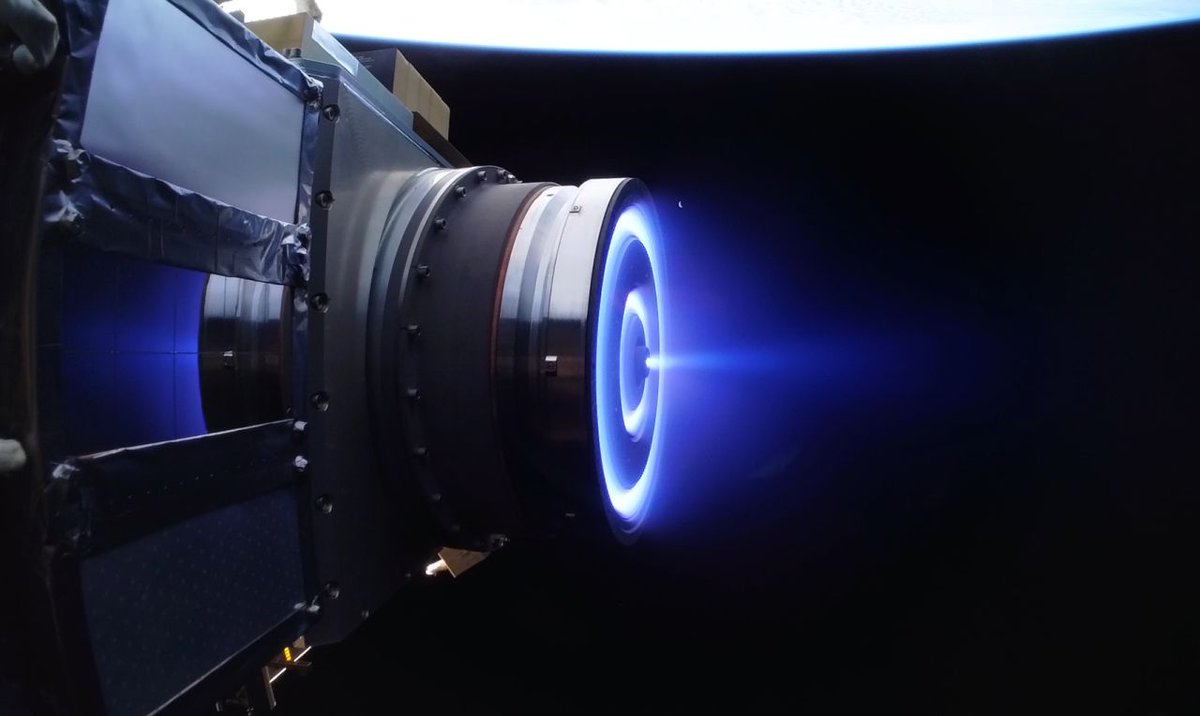
It’s official: K2 Space is operating the most powerful Hall thrusters currently flying in space. Just a few weeks after the launch of our first test mission, Gravitas, we’ve successfully fired both of our 20kW Hall thruster systems to achieve a new level of electric propulsion power never before seen on orbit for this type of system. We plan to continue raising and lowering our orbit as we gather more data on the thruster performance while continuing our mission in LEO.
This milestone is yet another validation of K2’s approach to building bigger, as more powerful thrusters will enable the MEO, GEO, and deep space missions of the future.
.@NationalDefence Canada outlines 'profound shift in space posture' coming w/ $18.8B multi-year budget. Autonomy/sovereignty is North Star -- 'from joining a carpool to owning a car.' @spacecanada@NATO@Telesat@MDA_space. https://t.co/s3VeSkRE7A
Vantor collected new imagery showing the aftermath of the Ukrainian drone attacks on an oil terminal in St. Petersburg, Russia as well as the damaged Steregushchy-class corvette Boikiy in a naval dry dock at Kronstadt, Russia.
In Kronstadt, you can see fire crews working to control the fires onboard the ship with high-pressure water cannons.
📸@vantortech
This is a spent Chinese Long March 3B rocket body, imaged by a Vantor WorldView Legion satellite from 88 km away.
The image quality is not simply about range. It reflects the strength of Vantor’s advanced WorldView constellation and high-performance imaging hardware, which enable detailed observation of objects in orbit.
It’s a powerful example of Vantor’s NEI tasking through our WorldView Space product line: using high-resolution satellites to look out into space and capture detailed imagery of objects in orbit.
Why does that matter? Most tracking systems can show where an object is. WorldView Space NEI helps show what it is, its structure, orientation, condition, and potential risk. It can also support Movement Analysis, helping operators understand whether an object is intact, tumbling, spinning, or otherwise changing behavior over time.
That level of detail is especially important for large rocket bodies like this one. They are big, long-lived debris objects that share orbits with critical infrastructure, including communications, Earth observation, weather, science, and national security satellites. A single collision involving an intact rocket stage can create thousands of new fragments, increasing risk across already crowded orbital regions.
As launch activity accelerates, we need to understand not just where objects are in space, but what they are, how they are moving, and how they may behave over time.
Nimbus-B launched atop a Thor-Agena rocket in 1968, but it deviated and was blown up by the range safety officer.
Aboard was an RTG with ~1kg of Pu-238. It fell into the ocean...without leaking, allowing it to be recovered, reused and flown on Nimbus-3!
https://t.co/Eu7QR42pNt
Look at this gorgeous piece of aerospace history! This dense, exposed wedge of circuitry is the Gemini Guidance Computer, built by IBM in the 1960s.
To be a little more specific, it was the onboard brain used for Project Gemini and flown on Gemini 8 on March 16, 1966. The mission was piloted by Neil Armstrong and Dave Scott.
Fun fact: the Gemini computer had just 4,096 words of ferrite core memory. By the Gemini 8 era, the software had been split into program modules that could be loaded from the Auxiliary Tape Memory during different mission phases, because the full flight program had outgrown the computer’s limited memory.
I will always have the deepest appreciation for these early hardware pioneers!
https://t.co/rXnkLiV7k0
https://t.co/W0eluEC0Tn
https://t.co/YJ43FJolYe
#RetroTech #SpaceHistory #VintageComputing
Some LC-36 updates. Now that we’ve had access to the pad and integration facility we can share a bit of good news. The propellant farm, oxygen, liquid hydrogen and LNG tanks are all in good shape. This is good luck because these are very long lead items. The water tower is also good. The big support tower is damaged, but it can be repaired in place rather than torn down and replaced. The booster “Never Tell Me The Odds” and the three GS-2s that were onsite in the integration facility also look good.
I’ve seen some speculation that we might move directly to the 9x4 configuration, but we won’t do that. Rate manufacturing of 7x2 is going well, and we’re going to continue that at pace as planned and store the stages for use. In addition, we had already been working for some time on eliminating our transporter-erector in favor of an alternative vertical conop, and we’ll now go directly to that; so we don’t need a new transporter-erector.
We will fly again before the end of this year. Gradatim Ferociter.
French Earth observation solution provider Kayrros being acquired by two companies is an interesting case study in the business of EO.
Why was one EO company bought by two separate buyers in different sectors?
Context: Safran, the French defense firm acquired the geospatial intelligence part of Kayrros and Energy Aspects, one of the leading market analytics providers, bought the EO-based energy analytics business.
The reason? I think it might be because Kayrros built one geospatial capability properly: to monitor assets and activities around them with satellite data.
That single foundation extended across markets from oil tanks and methane plumes for the energy sector to targets and strike impacts for the defence sector - in other words, the same tech stack served both sectors.
In general, breadth could be considered a dilution of focus in scaling EO businesses. But in this case, the breadth across markets derived from the same foundational EO capability became the reason for the outcome.
So much so that two major players in completely different sectors each wanted a piece of the same underlying technology. For me, that is an important market signal, regardless of what either of them paid.