@KordingLab It is unfortunate that the authors state that we shuffled the data in our Neural Language Taskonomy paper. In fact, we used cross-validation and did not shuffle the data. Since data shuffling is not reported in the paper, this appears to be a misunderstanding.
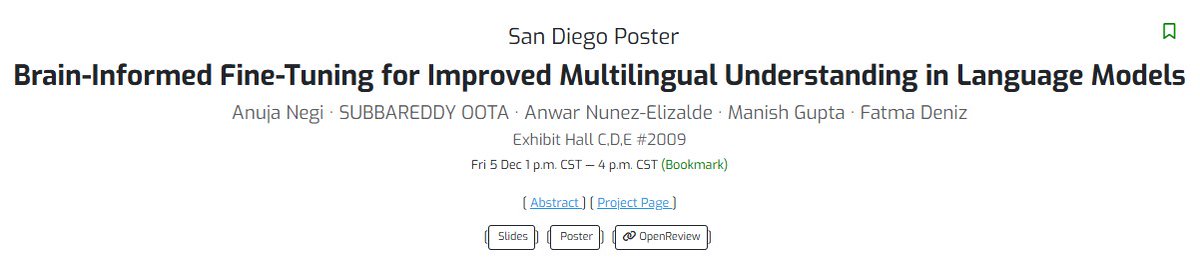
@anujanegi_1 and I will be at #NeurIPS2025 from Dec 2-8@Sandiego!
Excited to present our work: Brain-Informed Fine-Tuning for Improved Multilingual Understanding in Language Models
Visit our poster during in-person poster session on Friday, Dec 5th, from 11:00 AM to 02:00 PM PST
Excited to present our work on bilingual brain-informed fine-tuning at #NeurIPS2025 🎉
https://t.co/07J88JFwDf
We fine-tune monolingual and multilingual language models using fMRI data from bilingual participants as they read naturalistic stories in English and Chinese.
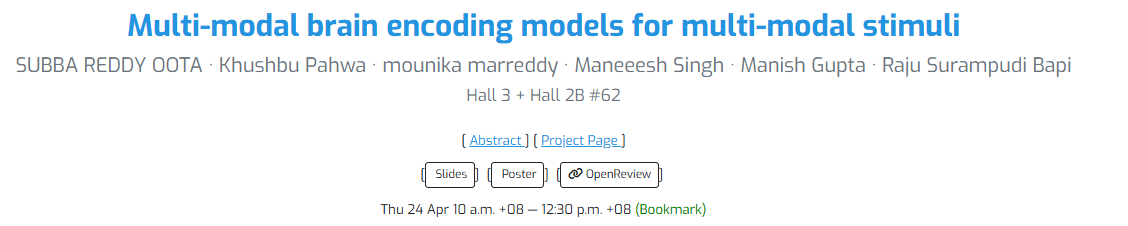
@khushbu_pahwa and I will be at #ICLR2025 from April 24-28 @Singapore!
Feel free to reach out if you want to chat about Insights from Multi-Modal and Instruction-Tuned MLLMs and Brain Alignment!
Visit our poster1, #62, at Hall 3 + Hall 2B on Thursday, April 24th, from 10.00 AM to 12:30 PM SST
🚀 Check out our recently accepted work at #TMLR Transactions on Machine Learning Research 🧠🤖
Deep Neural Networks and Brain Alignment: Brain Encoding and Decoding (Survey)
📄 Read it here: https://t.co/m4LQiWwTKU
Work done jointly with @ZijiaoC, @blitzprecision, @fredalexandre33 and @neuronalX 🎉
We thank Stefan Frank and @mtoneva1 for providing valuable feedback on several versions of this work. 🙏✨
#NeuroAI #DeepLearning #BrainAlignment
Thread below!
7/n
Conclude with key challenges such as issues in processing neural recordings, selection of appropriate evaluation metric, & ethical considerations in neuro-AI.
🚨 Thrilled to announce that our paper "Language models and brains align due to more than next-word prediction and word-level information" has been accepted at #EMNLP2024! 🧠🤖
Work done in collaboration with @mtoneva1.
Curious about why brain and GPT-2 models align?
Read on👇
I will be at #ACL2024NLP from Aug 11-16 @Bangkok!
Excited to present our work: Speech language models lack important brain-relevant semantics
@emincelik, Fatma Deniz, @mtoneva1
Visit our poster during in-person poster session 4 on Tuesday, Aug 13th, from 10:30 AM to 12:00 PM ICT (GMT+7)
8/n
3 main conclusions:
- Speech models useful for modeling early listening: investigate speech models to learn more about AC
- Text models useful for modeling late language in both listening and reading
- But, more work to do for a complete end-to-end model of reading and listening in 🧠
Check out our recently accepted work at #ACL2024
Speech language models lack important brain-relevant semantics
https://t.co/UyUabiWolZ
Work done jointly with @emincelik, Fatma Deniz, and @mtoneva1
Thread below!
7/n
For speech language models, we find that:
- Some of the very high alignment with early AC (~75% of estimated noise ceiling) due to low-level speech features, but much residual alignment remains
- Alignment in late language regions entirely due to low-level stimulus features